
The false narrative with regard to the shooting created by the press and opportunistic political leaders served to reinforce perhaps the greatest false narrative of our day, that the American public is polarized. There is little to no evidence that the general public is polarized - at least any more polarized now than at any point in the last 30 years. Rather we live in a two party system and the parties have become ever more polarized and controlled by partisan fringes. Polarized parties create the illusion of a polarized public.
As if on cue, Paul Krugman furthers the myth of a divided America today writing "One side saw health reform, with its subsidized extension of coverage to the uninsured, as fulfilling a moral imperative: wealthy nations, it believed, have an obligation to provide all their citizens with essential care. The other side saw the same reform as a moral outrage, an assault on the right of Americans to spend their money as they choose." Says Krugman, "There’s no middle ground between these views."
There of course is a middle ground between those views and it's the ground upon which a plurality, perhaps a majority, of Americans reside. What Mr. Krugman means to write is that for the political class, such as himself and Glenn Beck and Sarah Palin, there is no middle ground. But the political class is quite polarized and in that respect a poor representation of America.
Scholars like Alan Abramowitz have made a cottage industry of trying to prove that the electorate is indeed becoming more polarized. They cite as evidence the stark differences between self identified Republicans and self identified Democrats on issues such as abortion, health insurance, aid to minorities, presidential approval and voting, and self identification as Liberal or Conservative.
When defined in that way, there is in fact evidence that Democrats and Republicans have drifted farther apart over the last 20 years - but as odd as it sounds, it does not demonstrate polarization. To paraphrase an old country song, folks are looking for polarization in all the wrong places. Morris Fiorina has explored polarization from the perspective of changes in popular opinion, separate from party labels and has found no increase in polarization.
When Americans are asked to express support or opposition for the supposedly polarizing policy areas cited by Abramowitz and Paul Krugman - health insurance, aid to minorities, government spending and services, defense spending, and abortion - Fiorina finds that there has been no increase in polarization on these issues in the past 20 years. In fact, Fiorina finds that the public has shifted slightly to the left on the issues government support for health coverage and the provision of services and slightly to the right on the issues of national defense and aid to minorities. There has been no change with regard to abortion. In other words, we're shifting together on some issues, not at all on others.
So what's going on, what are folks like Abramowitz really measuring? Simple, it's called party sorting. As the agendas of the political parties became ever more divergent Americans began to "sort" more neatly into one party or the other - and more Americans began to identify as either pure Independents or only loosely associated with a party.
As the agenda of the Democratic Party became more liberal and the Republican Party more conservative, liberal Republicans left the party and became Democrats or Independents and conservative Democrats became Republicans or Independents.
Krugman writes "Commentators who pine for the days of civility and bipartisanship are, whether they realize it or not, pining for the days when the Republican Party accepted the legitimacy of the welfare state, and was even willing to contemplate expanding it." What Krugman has conveniently ignored is the fact that the Democratic Party once included many folks who rejected the legitimacy of the welfare state as well.
The following graph charts Congressional polarization from the 89th Congress through the 110 Congress, notice the considerable overlap in the middle that existed in the 1960s and through the 1970s. There was a time when Conservative Democrats and Liberal Republicans were not anomalies. This helps to explain why legislation that today would divide the parties, the Civil Rights Act, the Creation of Medicare and Medicaid, even passage of President Reagan's first budget in 1981 were, in fact, bi-partisan affairs.
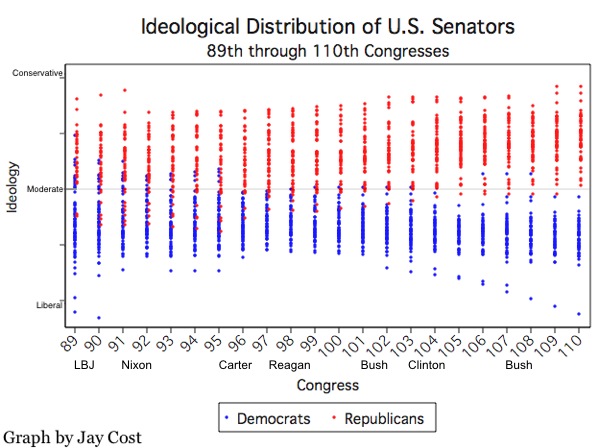
Today, however, there is no home in the Democratic Party for conservatives and no real home in the Republican Party for moderates - this is why Jim Jeffords bolted the GOP in 2001 and Joe Lieberman felt so ill at ease with Democrats back in 2006.
The parties polarized, the public did not. As Fiorina notes, there has been precious little change in the last 30 years with regard to the share of Americans who identify as Conservative, Moderate, or Liberal. Rather conservatives no longer feel comfortable in the Democratic Party and Liberals are no longer comfortable in the Republican Party - Moderates appear to be less comfortable with both parties. The electorate is no more polarized now than in 1970, 1980, or 1990 - but the parties are. So of course 90% of Republicans vote Republican and 90% of Democrats vote Democrat. Of course Presidential approval correlates to party affiliation, it's the natural byproduct of party sorting, but party sorting is not the same as polarization.
The reasons for party polarization are many - the breakdown of mass-based political parties that operated as bottom-up entities driven often by local issues has played a role. Parties are now top-down entities controlled by a relative and ideologically similar few.
The increase in political competition has played a role as well. The Democrats lost their hold on the South, the Republicans lost their hold on the North East. According to data from State Politics and Policy Quarterly only 7 states had divided government in 1954, in 2007 that number stood at 23 states. With few exceptions, either party has fair shot at winning statewide elections in most states (remember, we vote for offices other than President). A recent study by political scientist Daniel Coffey determined that there is a direct and positive correlation between party competition and party ideology. As a state becomes more competitive between Republicans and Democrats the respective parties become ever more conservative and liberal.
V.O. Key hinted at this in 1956 when he argued that competition would force parties to offer more distinct policies to voters in an effort to influence their choice. Additionally, as competition increases the parties come to rely more heavily, not on the mean, median, or moderate voter, but rather on the more committed and active voter. For Democrats this means liberal activists and for Republicans conservative activists. This has the effect of pushing the parties ever farther to the extreme. This is, of course, what has happened.
Where is there evidence of polarization? Among the most engaged and active third of the electorate - what we call base voters, as they form the foundation of support for each party. Sadly this third has a tremendous impact on the direction and agenda of the two major parties. This third votes regularly and is more likely to contribute to and be active in politics. Parties and politicians seek to motivate these voters by painting every election as a choice between political life and death. Recall the closing days of the 2000 election when Al Gore suggested that "strict constructionists" like George W. Bush are little different from those who once deemed a black man to be but three-fifths of a person. Or the waning days of the 2008 campaign when Sarah Palin accused Barack Obama of "palling around with terrorists."
The goal for the left and the right is the same, scare the hell out your base to motivate them. So the left reduces the right to a caricature of bigoted, racist, violent, homophobic fascists and the right reduces the left to a caricature of immoral, anti-American, authoritarian socialists. The hope is that the scare tactics will motivate the base and win over wavering voters in the middle - remember, Democrats won Independent voters by 19 points in 2006 only to see Republicans win them by 19 points in 2010.
So America is not a deeply polarized nation on the brink of civil war. Rather, the American electorate is being poorly represented by a very polarized political class. A political class that sees the world in measures of black and white where there is "no middle ground." It is a pernicious myth that is doing great harm to America - and as we just witnessed in Arizona it all too often causes the political class to focus on imagined problems at the expense of real problems.


