Showing posts with label obama. Show all posts

Thursday, November 20, 2014

Obama's Executive Action on Immigration Offers More Evidence of A Weakened Presidency

As Obama is set to take unilateral action on immigration reform, I am reminded of an op-ed I wrote on the eve of his 2nd inaugural. Sadly, Obama's decision to "go it alone" is a common feature of contemporary presidents and by far a greater sign of presidential weakness than of gridlock.

Steve Schier and I cover the presidential power trap in great detail in our book, American Government and Popular Discontent.

Excerpt:

"Faced with obstacles to successful leadership, recent presidents have come to rely more on their formal powers. The number of important executive orders has increased significantly since the 1960s, as have the issuance of presidential signing statements. Both are used by presidents in an attempt to shape and direct policy on their terms. Presidents have had to rely more on recess appointments as well, appointing individuals to important positions during a congressional recess (even a weekend recess) to avoid delays and obstruction often encountered in the Senate. Such power assertions typically elicit close media scrutiny and often further erode political capital.

Faced with the likelihood of legislative defeat in Congress, the president must rely on claims of unilateral power. But such claims are not without limit or cost and will likely further erode his political capital."

Full Op-Ed:

January 21, 2013|By Todd Eberly
As Barack Obama prepares to be sworn in for the second time as president of the United States, he faces the stark reality that little of what he hopes to accomplish in a second term will likely come to pass. Mr. Obama occupies an office that many assume to be all powerful, but like so many of his recent predecessors, the president knows better. He faces a political capital problem and a power trap.
In the post-1960s American political system, presidents have found the exercise of effective leadership a difficult task. To lead well, a president needs support — or at least permission — from federal courts and Congress; steady allegiance from public opinion and fellow partisans in the electorate; backing from powerful, entrenched interest groups; and accordance with contemporary public opinion about the proper size and scope of government. This is a long list of requirements. If presidents fail to satisfy these requirements, they face the prospect of inadequate political support or political capital to back their power assertions.
What was so crucial about the 1960s? We can trace so much of what defines contemporary politics to trends that emerged then. Americans' confidence in government began a precipitous decline as the tumult and tragedies of the 1960s gave way to the scandals and economic uncertainties of the 1970s. Long-standing party coalitions began to fray as the New Deal coalition, which had elected Franklin Roosevelt to four terms and made Democrats the indisputable majority party, faded into history. The election of Richard Nixon in 1968 marked the beginning of an unprecedented era of divided government. Finally, the two parties began ideologically divergent journeys that resulted in intense polarization in Congress, diminishing the possibility of bipartisan compromise. These changes, combined with the growing influence of money and interest groups and the steady "thickening" of the federal bureaucracy, introduced significant challenges to presidential leadership.
Political capital can best be understood as a combination of the president's party support in Congress, public approval of his job performance, and the president's electoral victory margin. The components of political capital are central to the fate of presidencies. It is difficult to claim warrants for leadership in an era when job approval, congressional support and partisan affiliation provide less backing for a president than in times past. In recent years, presidents' political capital has shrunk while their power assertions have grown, making the president a volatile player in the national political system.
Jimmy Carter and George H.W. Bush joined the small ranks of incumbents defeated while seeking a second term. Ronald Reagan was elected in two landslides, yet his most successful year for domestic policy was his first year in office. Bill Clinton was twice elected by a comfortable margin, but with less than majority support, and despite a strong economy during his second term, his greatest legislative successes came during his first year with the passage of a controversial but crucial budget bill, the Family and Medical Leave Act, and the North American Free Trade Agreement. George W. Bush won election in 2000 having lost the popular vote, and though his impact on national security policy after the Sept. 11 attacks was far reaching, his greatest domestic policy successes came during 2001. Ambitious plans for Social Security reform, following his narrow re-election in 2004, went nowhere.
Faced with obstacles to successful leadership, recent presidents have come to rely more on their formal powers. The number of important executive orders has increased significantly since the 1960s, as have the issuance of presidential signing statements. Both are used by presidents in an attempt to shape and direct policy on their terms. Presidents have had to rely more on recess appointments as well, appointing individuals to important positions during a congressional recess (even a weekend recess) to avoid delays and obstruction often encountered in the Senate. Such power assertions typically elicit close media scrutiny and often further erode political capital.
By mid-2011, Mr. Obama's job approval had slipped well below its initial levels, and Congress was proving increasingly intransigent. In the face of declining public support and rising congressional opposition, Mr. Obama, like his predecessors, looked to the energetic use of executive power. In 2012, the president relied on executive discretion and legal ambiguity to allow homeowners to more easily refinance federally backed mortgages, to help veterans find employment and to make it easier for college graduates to consolidate federal student loan debt. He issued several executive orders effecting change in the nation's enforcement of existing immigration laws. He used an executive order to authorize the Department of Education to grant states waivers from the requirements of the No Child Left Behind Act — though the enacting legislation makes no accommodation for such waivers. Contrary to the outcry from partisan opponents, Mr. Obama's actions were hardly unprecedented or imperial. Rather, they represented a rather typical power assertion from a contemporary president.
Many looked to the 2012 election as a means to break present trends. But Barack Obama's narrow re-election victory, coupled with the re-election of a somewhat-diminished Republican majority House and Democratic majority Senate, hardly signals a grand resurgence of his political capital. The president's recent issuance of multiple executive orders to deal with the issue of gun violence is further evidence of his power trap. Faced with the likelihood of legislative defeat in Congress, the president must rely on claims of unilateral power. But such claims are not without limit or cost and will likely further erode his political capital.
Only by solving the problem of political capital is a president likely to avoid a power trap. Presidents in recent years have been unable to prevent their political capital from eroding. When it did, their power assertions often got them into further political trouble. Through leveraging public support, presidents have at times been able to overcome contemporary leadership challenges by adopting as their own issues that the public already supports. Bill Clinton's centrist "triangulation" and George W. Bush's careful issue selection early in his presidency allowed them to secure important policy changes — in Mr. Clinton's case, welfare reform and budget balance, in Mr. Bush's tax cuts and education reform — that at the time received popular approval.
However, short-term legislative strategies may win policy success for a president but do not serve as an antidote to declining political capital over time, as the difficult final years of both the Bill Clinton and George W. Bush presidencies demonstrate. None of Barack Obama's recent predecessors solved the political capital problem or avoided the power trap. It is the central political challenge confronted by modern presidents and one that will likely weigh heavily on the current president's mind today as he takes his second oath of office.

Friday, November 22, 2013

Why Are So Many Saying Obama Has Had A "Katrina Moment"? Because He Has.

I've been amused of late by the hyperbolic reaction of Obama supporters to the myriad commentaries arguing the Obama has had his "Katrina moment." Most of the folks making such statements are referring to the failure of the Affordable Care Act rollout. I'm actually proud to have been among the first to have written of an Obama "Katrina moment." In an piece for the Baltimore Sun this Summer, I argued that Obama had lost control of the narrative and that the 1, 2, 3 hits of the Benghazi attack, the IRS scandal, and then the first major leak regarding the monitoring of reporters' phones threatened to undermine his second term. Of Obama I wrote, "Mr. Obama was ...the reliable and competent manager who understood there was a positive role for government in improving people's lives. If Mr. Obama is not careful, that image will collapse in spectacular fashion." And collapse it did, then he found himself in the midst of the failed roll-out with no political capital to draw on.

The main point of contention offered up by the rose colored glasses crowd is that there is no literal comparison between hurricane Katrina and the roll out of the Affordable Care Act, or the IRS scandal, etc... To their argument I say, "well duh." Of course there's no literal comparison. The "Katrina moment" is what those of us who took high school English refer to as an analogy  -  an assertion of similarity, on some point of comparison, between things that are otherwise unrelated. No one is making a literal comparison to Katrina, rather we're making a figurative comparison. 

Let me provide an example of an analogy in action. In late 2010 we learned that US students were trailing students from Shanghai in reading, math, and science - according to the Program for International Student Assessment standardized test. In reaction to the news, President Obama said, "Fifty years later, our generation’s Sputnik moment is back...” People in India and China are now “plugged into the world economy,” and nations with the most educated workers will prevail. “As it stands right now, America is in danger of falling behind.”

Now understand, there is no literal comparison to be made between the US government falling behind the Soviet Union in the space race and our high school students falling behind other nations in math, science, and reading. No literal comparison, but an assertion that, on some point of comparison, our students' poor performance on the tests was the same as the otherwise unrelated Sputnik launch. What was the point of comparison? The US was falling behind.

So why are some now saying Obama has had a Katrina moment? Simple, back in 2005, President Bush's approval rating was already in decline when hurricane Katrina hit Louisiana and FEMA botched the response. But Bush's favorability rating had remained strong. In other words, people didn't like the job he was doing, but they still liked him and still considered him to be trustworthy and competent. All of that changed after Katrina and Bush never recovered. Therein lies that point of comparison essential to any good analogy. Heading into the Summer of 2013, Obama's approval rating was in decline, but his favorability rating was very strong. Folks weren't thrilled with his job performance, but they still liked and trusted him. The cumulative effect of the IRS scandal, the ongoing leaks from Edward Snowden, and now the roll-out of the Affordable Care Act and the clearly false assertion that people could keep their existing health insurance has been a collapse in Obama's approval rating AND his favorability rating. People lost faith in his competence and his trustworthiness. I maintain that the Katrina moment came this past Summer, most others say it was health reform. Either way, the analogy is appropriate.

Even after Katrina, Bush maintained the support of a dedicated 35-40% of the public. No matter what, there was a delusional minority convinced that all was well. The folks who are now refusing to accept the relevance of the Katrina analogy are just the members of the Obama minority - the core group who will never be able to accept that Obama is not the transformational deliverer of hope and change that they believed they were voting for. Instead, he is and was a rather conventional politician with no special governing talents. Now, he's a rather conventional politician with no political capital and the very real possibility that he will spend the next three years as a lame duck.  No calm down, he's not literally a lame duck, it's just another one of those analogies.

And no, I do not derive any pleasure from making the analogy or from seeing Obama's popular support collapse. With the exception of the changes to the individual market, I support the affordable care act and want it to succeed. I want comprehensive immigration reform with a path to citizenship. I want No Child Left Behind to be reauthorized, but with an incentive structure and not a penalty structure. I support the Common Core as a replacement for the perverse incentives created by Adequate Yearly Progress and 100% proficiency requirements. All of these issues are on Obama's second term agenda. None of them will happen so long as Obama has a 40% approval rating and an upside down favorability rating. And once a president loses the confidence of the people, it's nearly impossible to earn it back.

Saturday, November 10, 2012

Obviously I was Wrong about Romney

There have been multiple postmortems on the Romney campaign and all reveal significant flaws. The campaign had virtually no get out the vote machine, they became over confident about their position in key swing states and they spent a lot of precious time in PA instead of VA, FL, OH or CO. It was a lower turnout election with Romney receiving fewer votes than McCain in 2008 and the President winning far fewer votes than he did in 2008. And then there was Hurricane Sandy.


If you look to the Real Clear Politics polling data for the two/three weeks prior to the hurricane Romney had established a consistent lead. But more important than the Romney lead, the President had a poll ceiling of 47% and most polls had him at 45, 46 or 47% - this is deadly for an incumbent. Then Sandy hit and the numbers shifted quite clearly in the President's favor. His 46 and 47% poll numbers jumped to 49 and 50%. His approval rating increased as well. It certainly gave him a boost on election day.  Of course any discussion of the hurricane impacting the race is immediately dismissed by the Left as they try to magnify the significance of what was a rather poor 50%-48% re-election margin for the President. And the Right is trying to avoid facing the facts that they are losing racial and ethnic minority voters and are too reliant on the votes of a shrinking white electorate. I don't much care what the Left or the Right have to say - but to deny that Sandy had a positive impact on Obama's bid and a negative impact on Romney is to deny common sense. Much as would any attempt to deny the Romney campaign's serious failings.

A review of pollster accuracy by Nate Silver reveals something pretty amazing - nearly every pollster overstated GOP strength. This is an historic anomaly, polls tend to understate GOP strength. The systemic bias in favor of the GOP suggests just how impressive the Obama campaign's turn-out machine was. Turn-out overall was done by several million voters, but based on exit polls youth, African-American, and Hispanic voters turned-out at the same numbers as they did in 2008 (the Hispanic numbers were actually up a bit), but they accounted for a greater share of the electorate because so many white voters simply failed to show up. The GOP needs white voters to win and when millions stay home, the GOP loses (Of course, if the GOP had not succeeded in turning away Hispanic voters in recent years then all of those white voters would not have mattered. Had Romney won the same share of Hispanics as McCain in 2008 he would have likely eked out a win. Had he received the same share as Bush in 2004 he would have won comfortably.).


On election day the Obama folks found and turned-out their voters and the GOP did not. There have been reports the Romney campaign's turn-out program - code named Orca - was based on a proprietary software program designed to identify likely GOP voters who not yet voted. The program was top secret and in an effort to keep it that way the Romney folks barely tested it and did minimal training. Worse, it crashed on election day. So field workers, ready to turn-out voters, were left twisting in the wind as their voters stayed home. It was a colossal failure. In a lower turn-out election, the team with the better ground game will win, and in this case they did.

As with any election, winners win and losers lose for a multitude of reasons. Blaming any one reasons is pretty much folly. The losers will look to find any excuses so as to avoid a painful period of self-reflection. The winners will look to ignore any factors that serve to diminish the significance of their victory. As New Republic's Timothy Noah recently wrote there appears to be no clear reason for Obama's win or Romney's loss. Exit polls reveal no clear endorsement of Obama's agenda or a rejection of Romney's. Rather the election results point to a status quo election in which the voters sent to no clear message to anyone. Regardless of the voters' lack of a message, the loss makes quite clear which side is better able to win when no national wave is carrying either party to the finish.

Perhaps ABC's Political Director Amy Walter wrote it best: "In 2006, 2008 and 2010 voters punished the party it saw as too consumed with its own agenda and unfocused on the concerns of average Americans. But each "wave election" only served to convince the winning party that they had a mandate for their ideological agenda. Ironically, it took a "status quo" election to finally convince the two sides to hear what voters have been telling them along: stop the posturing and work together to get something done to fix the many problems this country is facing."

We can only hope she is correct.

Monday, October 29, 2012

Get Ready for a Crazy 7 Days, and Perhaps Beyond!

I keep saying that 2012 looks like 2004 and that advantages Romney, but there is an important caveat. In 2004 Bush narrowly won OH and narrowly lost many states such as WI and PA. This time around we are seeing similar trends with Romney and Obama close in otherwise Democratic states such as WI, MN, MI and PA. The few polls that have come from solid Democratic states like NJ and CA show Obama with much smaller leads than in 2008 while Romney is well ahead in truly red states.

This does set the stage for that rare event - a split between the electoral college and the popular vote. Though I have no faith in Nate Silvers so-called "election models" I agree with him in one area - Obama has a better chance of winning the electoral college than he does of winning the popular vote (and the electoral college is all that matters - I say that because it's obvious and because I support the electoral college). So it's possible Romney will win the popular vote by 1 or 2% and lose the election by losing OH. In that light, it is possible to see the closing week actions by the president in a different light.

Obama may be expending campaign resources in states like PA and MN because he wants to boost his popular vote numbers, but also because he fears that he may win OH and then lose the race because a state like PA or MN slips away from him.

Now, am I hedging my bets? No, not really. I predicted a Romney win because I believe the fundamentals point to his win. But even with those fundamentals it is not a certainty. Rather than a 50/50 chance Romney wins I see a 55/45 chance. That's hardly overwhelming and I am fully prepared to be wrong - but in the end I've made a prediction based on campaign activity, choices regarding ad buys and campaign stops, on polling numbers among key voting blocs (women and independents), and actual early voting data (not polling data). I do not believe that an election can be predicted the way one might predict a batting average.

Much evidence will come in the next 7 days - that Romney is planning an even in MN and that Biden is going to PA are telling and suggest a race breaking toward Romney. GOP early voting numbers are up in nearly every battleground state and Republican enthusiasm remains higher. But if there is a late break for Obama or for Romney there should be some clear indication by Friday... I know I'll be obsessed with every twist and turn between now and next Tuesday.

Tuesday, October 23, 2012

All Signs Point to a Romney Win

Update: Obviously I was wrong.

The election is a mere two weeks away and I've decided to step away from the twitterverse and provide a more detailed write-up on the state if the race between Barack Obama and Mitt Romney. Anyone who has read my tweets on the campaign will not be surprised when I say that I believe that Romney currently has the momentum and I consider him to be the favorite to win on Election Day. I argue the current electoral college map, national polls, support levels among women and Independents, and the results of the debates all point to a Romney win. I'll consider each in turn.

The Electoral College
There can be no question but that Romney has made significant gain in the battle for 270 electoral votes in the past 3 weeks. Romney has a solid hold on every state John McCain won in 2008 and has reclaimed two Obama states - Indiana and North Carolina. But that tells only part of the story. Florida and Virginia have also moved significantly toward Romney and if you look at the top ten advertising market ad buys Virgina is nowhere to be found and Florida is at the bottom of the list. Democratic operative and CNN contributor Paul Begala told CNN just yesterday that Florida has been lost to Romney. That Virginia is not even in the top ten speaks to the reality of race in that state. Add to that the fact that the scuttlebutt is that Obama for America has ceased polling in Virginia and team Obama may have pulled upwards of half of their staff out of the state to be used elsewhere.

With Florida and Virginia in the Romney column I see a current electoral map with 237 electoral votes for Obama and 248 for Romney. Six states remain as toss-ups - Nevada, Colorado, Iowa, Wisconsin, Ohio, and New Hampshire.

Among those six states, Colorado has been trending to Romney and Nevada has been trending to Obama - that would create 243 votes for Obama and 257 for Romney. There has been much talk of everything coming down to Ohio, but that is now only true for Obama. In the map I'm seeing, Obama must win Ohio to win, but he'd only have 267 electoral votes and would need New Hampshire, Iowa, or Wisconsin to cross the victory line.  Romney can hit 270+ by winning Wisconsin and New Hampshire or Wisconsin an Iowa. Romney doesn't need Ohio, but if he does win it, he wins it all. And the trend in Ohio is toward Romney. Since the first debate Obama's average lead in OH has fallen from 5% to below 2% and multiple polls show Obama receiving 47% support or below - that's a dangerously low level of support for an incumbent. If one looks to the last 5 presidential elections, in 4 of the 5, late deciders broke strongly for the challenger. In Ohio specifically, late deciders broke for John Kerry by a 22 point margin in 2004. Kerry still lost, but a key difference between George W. Bush and Barack Obama is the fact that Bush was closer to the 50% mark already and there were fewer undecided voters in 2004.

But the electoral story goes deeper. Recent polling data and campaign actions suggest that once safe Obama states may now be in play - Pennsylvania and Minnesota. Paul Ryan attended a rally in Pittsburgh last weekend and in Minnesota the Obama campaign has made an ad buy. Worse, I'm hearing rumblings today that one of two campaigns is conducting polls in Oregon. Obama won all three states by comfortable margins in 2008. Romney is unlikely to win any of the three, but the simple fact that they are in play demonstrate how Obama's fortunes have changed. I see an end result that puts Romney at 285 electoral votes as a minimum.

The National Polls
The national polls provide the best evidence of Romney's momentum. Prior to the first debate on October 3rd, Obama held a clear advantage.


The table above, from Realclearpolitics.com makes clear the strength of Obama's position just before the first debate. Obama was ahead by an average of 3 to 4 points and more important he was regularly hitting 49% and 50% in the polls.

Then came the debate....


Obama's advantage was gone and worse his 49% and 50% marks were now accompanied by 45% and 46% levels of support - deadly for any incumbent.  Some on the American Left have tried to argue that Romney gained temporary momentum after the first debate and that momentum stalled after the 2nd debate - that is clearly wishful thinking.


Romney is in a better position today than after the first debate. Romney is hitting the 49%, 50% and 51% mark and appears to be establishing a lead. The one poll that offered Obama hope was the IBD/TIPP tracking poll that had Obama with a 6 point lead on Sunday, but within two days the lead fell to 2% suggesting the lead was just the result of a bad day of polling. Obama is regularly receiving support in the 45%-47% range and it's hard to see how he climbs back to 50.1%. 

Support Among Key Voting Blocs
When you take a glance deeper inside the polls you see greater trouble signs for Obama. Obama is counting on a large gender gap to win him a second term - namely he hopes to win women by a large margin. That was the basis for the "war against women" meme and the constant talk of contraception access. But the approach isn't working. The Monmouth/SurveyUSA survey shows what has been a common element most national polls - Obama is not winning women by a margin sufficient to win. Romney has a double digit lead among men, but Obama has only a mid single digit lead among women. Team Obama has failed to recognize that women are more concerned with the economy than any other issue. The focus on "gender issues" came at the expense of presenting a plan for improving the economy in his second term.

Independent voters are the other key group. Obama won Independents by 7-8 percentage points in 2008, yet in most national polls and in most swing states - including Ohio - Romney has a clear advantage among Independent voters - usually in the 5-7% range. Absent the gender gap and the support of Independent voters, Obama would need Democratic turn-out to match or exceed 2008 levels. But 2008 was an election marked by tremendous enthusiasm among Democrats and the party's 7 percentage point turn-out advantage likely was a high water mark that will not be repeated. If the party's turn-out advantage winds up at the 4% range (the average of 2004 and 2008) Obama will fall short of victory.

The Debates
The prior paragraphs make clear the gains Romney made from the first debate, but his gains continued through the 2nd and 3rd - debates he "lost." After the 2nd debate, a CNN poll of viewers found Obama scored a narrow victory, but on the most important question - who would be the better leader on the economy - Romney won 58%-40%. After the final debate on foreign policy, many of Obama's supporters were convinced of the president's clear victory. But CNN again found viewers gave the president a narrow win and on the only question that mattered - is the candidate ready to be commander-in-chief - Obama and Romney tied. A different poll of  viewers by PPP (a Democratic firm) asked if the debate made viewers more or less likely to support a candidate. Among Independent voters, 32% said they were more likely to vote for the President and 48% answered less likely. For Romney, the numbers were reversed, 47% more likely and 35% less likely. 

The debates also allowed Romney to undo the negative effects of $100 million in swing state advertising by the Obama campaign to define him as an unacceptable candidate. Going into the fall Obama enjoyed a tremendous favorability advantage over Romney. Romney was considered to be one of the least liked candidates ever. As of today, Romney enjoys a 6% advantage over Obama on favorability! It marks a stunning turnaround.

Summary
For all of the reasons discussed above, and many more, I see a race that has shifted dramatically in Romney's favor and at present I consider him the most likely victor. Obama's Intrade advantage has collapsed and one of his biggest supporters, Nate Silver of the 538blog, has begun to hedge his bets and discuss the limits of his probability models (which are actually variants of the rather commonplace Monte Carlo method). If you follow Silver religiously you should really move on, because he's not doing anything special and the modifications he's made to the Monte Carlo model all favor Obama - for instance he tends to add greater weight to polls favorable to the President and will even weigh such polls more heavily when they are older and clearly contradicted by newer surveys. Those who follow the futures markets have seen in the past 24 hours how quickly they can change.

All indications are that the results of the election will be close, and it may well come down to a single state that makes the difference, but right now Romney is the candidate with the momentum and the likely victor. I will add, however, that there is the possibility - if national polls are truly capturing the dynamics of the race - that Romney will win by a more comfortable margin.

I may well be wrong, but a week before the the 2010 midterms when most political science models and analysts (including Nate Silver) were predicting GOP House gains in the 50 seat and below range - with many models predicting the GOP would fail to even capture the majority in the House - I predicted a 65 seat gain (the actual was 63) and I correctly called all of the Senate races (also something Silver failed to do) - so I'm just sayin'...

Wednesday, September 26, 2012

The Case Against Re-electing Obama

The conventions are over. The GOP and the Democrats have had their parties and spent six days preaching to their respective choirs. Ratings and surveys show us that few people watched the conventions and those that did had already made up their minds.

Unfortunately for me the conventions offered little to clarify my choice. You see, I'm an undecided voter. And contrary to the claims of many a pundit, I'm not undecided because I know too little about the candidates or issues. I'm undecided because I know too much.

I do not want to vote for President Obama because he has not earned a second term. I had serious reservations about Senator Obama in 2008. He lacked much experience and ran a campaign premised on vague promises designed to let voters hear what they wanted to hear. There was nothing in his time as either a state or US Senator that suggested he was prepared to be President. In fact, his qualifications appeared to be his ability to give great speeches.

As I consider his record during the last 3.5 years I believe that my reservations regarding his preparedness were largely validated. After promising to be a post-partisan President, Obama repeatedly deferred to then Speaker of the House Nancy Pelosi to craft his legislative agenda. Pelosi is proud partisan who actively sought to exclude House Republicans from any meaningful discussions of legislation.

Obama's first substantial legislation was the American Recovery and Reinvestment Act of 2009 (stimulus bill). More than a simple stimulus bill it was actually a Christmas Tree bill adorned with projects House and Senate Democrats had been unable to enact during the prior 8 years of Republican control. Worse, the bill cynically offered financial assistance to states for cash starved Medicaid and Unemployment programs, but in order to receive the temporary funds states were required to make programmatic changes that would increase costs long after the stimulus dollars were gone. Though the President promised much of the stimulus funds would be directed to "shovel ready jobs," only $111 billion of the $800 billion stimulus went to infrastructure. Estimates are the stimulus created or saved 3 million jobs - but at $800 billion that's about $266,000 per job. This is because most of the funds were not directed to job creation. It was a missed opportunity.

Obama again deferred to Congressional leadership for what would become the Patient Protection and Affordable Care Act. In the House, Pelosi shut Republicans out of the process entirely. In the Senate, only Finance Committee chair Max Baucus actively sought a bipartisan bill. In the end his committee produced a bill that did receive the vote of Republican Senator Olympia Snowe. But when it came time to introduce the bill Senate Majority Leader Harry Reid introduced a version that excluded the bipartisan efforts of Baucus. Throughout the process President Obama consistently refused to engage in the debate. He offered little leadership and frequently confused the process as he seemed to waffle on issues such as whether there should be a public option.

When Democrats lost their filibuster proof majority after the stunning election of Republican Scott Brown in early 2010 - an election that served as an early indicator of public opposition to the health care law that was taking shape - the President held a hastily arranged "bipartisan" summit to discuss ways in which Republicans could be part of the reform process. They talked, he listened, and then he ignored their suggestions. In the end, the White House and Congressional Democrats chose to rely on a procedural trick - the use of budget reconciliation - to pass the reform law. Reconciliation allowed the measure to avoid an expected GOP filibuster.

Though I support universal health care, the manner in which the bill was enacted was unacceptable. Additionally there are two major problems at the heart of the bill. The first is the individual mandate - a requirement that every American purchase health insurance. Senator Obama had rejected such a mandate when running for President, but then embraced it after the election. My real objection the mandate was the claim that the Constitution's "Commerce Clause" empowered Congress to compel a citizen to purchase a private good - health insurance. Contrary to the claims of many a partisan pundit, such a claim of power was unprecedented. Ultimately the Supreme Court rejected the commerce clause argument, but upheld the mandate as little more than a tax under a different name.

The second problem with the legislation is its reliance on expanding Medicaid. The law expects to add 17 million people to the rolls of a program that is already breaking most state budgets and suffers from severe physician shortages. In many ways the Medicaid expansion is a cruel joke. It offers the promise of coverage, but many enrollees will still be unable to receive care.

Though I support many of the President's policy goals, I am repeatedly disturbed by the manner in which he achieves them. In November 2010, voters elected a majority Republican House of Representatives. In response to this voter-imposed obstacle to his agenda the President has shown a blatant disregard for constitutional limits on his power and the separation of powers.

He has made recess appointments while Congress was not recessed. He used executive orders to initiate substantive policy changes to the No Child Left Behind Act and the 1996 welfare reform law - even though the originating legislation makes no provision for such executive discretion. He unilaterally decided that he would not enforce elements of US immigration law in order to end deportation of folks who were illegally brought to America as children. Again, I support the goal - allowing folks to remain in the only country they've ever known rather than deport them for laws broken by their parents - but such a decision should be made legislatively and not unilaterally.

But all of these issues pale in comparison to President Obama's national security abuses. The President has established a "secret kill list" and has authorized the execution of suspected terrorists - including American citizens. How this can be defended or justified is beyond explanation. He authorized military action in Libya in direct violation of the constitution and the War Powers Act. And, the President has taken drone warfare to new limits in North Waziristan where he is responsible for the deaths of not just terrorists, but hundreds of innocent men, women, and children - including a 16 year old American citizen in Yemen.

To borrow a phrase from The Atlantic's Connor Friedersdorf, these many transgressions are simply deal-breakers.

I have problems with Mitt Romney and view votes cast for Gary Johnson or Jill Stein as wasted votes. But for all the things I find objectionable about Mitt Romney, he has never killed a 16 year old American citizen. And that sort of makes the whole "47%" comment seem pretty silly.

Wednesday, February 22, 2012

Democrats Need Moderates

In a piece in today's Washington Post, Ruth Marcus outlines a report I wrote for Third Way - a centrist Democratic organization. The report, Family Feud: Democratic Activists v. Democratic Voters - The Ideological Gulf that Thwarts a Sustained Majority, seeks to unravel a defining mystery of the modern political era. Since 1972, Democrats have held a lead in the number of Americans who identify with the party, but that hasn’t translated into sustained Congressional and White House dominance. In “Family Feud: Democratic Activists v. Democratic Voters,” I explain this quandary and its serious electoral consequences for Democrats. Essentially, the Democratic coalition is more divided between activists and rank and file members than are the Republicans. Most Democrats are moderates and this has not change in 40 years. Party activists are liberals. Republicans of all stripes are conservative, but many moderate Democrats find themselves situated between the extremes of the two parties and can "go either way." I conclude odds favor a re-emergent Democratic majority, but only if liberal party activists will cede control of the agenda and allow the party to move in the direction of its moderate non-activist voters.

Of course many in the political world argue there are no moderates and that the only strategy that matters is a base strategy - appeal to and turn-out your core voters. I think a base strategy can work - so long as 40% of the electorate stay home on election day. But a base strategy is the right choice only if your only concern is the current election cycle. The present base strategy approach being used by both parties is part of the reason we see such dramatic shifts in control of government. There are two parties with roughly matched bases. Each election comes to out motivating the other side. I argue the key to sustained party control is to move beyond the base strategy and bring moderate voters into the fold in a permanent way. The data I show in the report suggests Democrats have a real opportunity to do that - Republicans don't.

I have already heard from several members of the Democrats' activist base accusing me of trying to turn Democrats into "Republican-lite." This is simply not the case. My report shows the Republican party - activists and rank and file alike - have moved right since the 1970s and have reached a point where there is little divide between activists and non-activists. The Republican party is a uniformly conservative party. But there remains a divide between Democratic activists and non-activists. Non-activists are a very moderate bunch and include quite a few conservatives. Furthermore, non-activists make-up the vast majority of the party and those moderates are ideologically situated right between the liberal and conservative "peaks" of each party's activist base. Republicans have a smaller voting coalition, but can win by winning those moderate and conservative Democrats - the GOP is sunk without them. If Democrats can bring them securely into the fold they are unbeatable.

We see some of this playing out on the national scene right now. When President Obama essentially vetoed the Keystone XL Pipeline or issued the initial ruling on religious affiliated organizations providing contraception as part of their health care plans, he was following a path paved by party activists. If the U.S. does not partner with Canada on the pipeline another country will work with them. The tar sands will be tapped, the oil extracted. Blocking the pipeline was a symbolic measure with no actual effect other than to eliminate even modest job opportunities and contribute to more expensive fuel prices when the U.S. imports the extracted oil. The Obama administration realized its mistakes - the contraception order was hastily changed and the white House is now trying to backtrack on the Keystone decision by arguing that the White House had no choice in the matter. The initial actions created the impression of a party too far left.

On the GOP side we see a party that is moving too right, too fast to win over Democratic party moderates. The clash between Romney, Santorum, and Gingrich has resulted in an effort by each candidate to "out-conservative" the other. Add to that the fact that Republicans horribly overplayed their hand on the contraception issue. Witness Santorum's seeming attacking on the moral ills of contraception and the legislative efforts to limit coverage of contraception - this has created a clear picture of a party too far right.

President Obama is enjoying a resurgence in the polls - but this resurgence has little to do with anything the White House has done. Rather it's being driven by two things 1) signs of life in the economy and 2) and GOP veering right and making the President appear more moderate in comparison.  This can work for the President but only if both factors remain. The rising price of oil may well derail the present boost of optimism and if the GOP does settle on a nominee and that nominee is Mitt Romney the intra-party battle that has resulted in the rightward shift will end. Romney will have time to reposition and focus will shift equally to the President.

The President must remain committed to keeping moderate Democrats in the fold. And there is reason to believe that he'll have difficulty doing that. A poll in December found that Americans see themselves as centrists - on a 5 point ideological scale voters rate themselves as a 3.3 - right or center. The rated Obama a 2.3 and most of the GOP candidates as around 3.5. In a new poll just out, 51% of voters described Obama as too liberal. Obama has a problem - his base is angry because they think he has been too moderate. Most voters, however, think he has been too liberal. Obama's advisor's are going to tell him to fire up that base - this is just bad advice. Think Rick Santorum is unelectable? Think again. 2012 will be a referendum on Obama. He needs to secure the support of the vital center.

The question for Democratic activists is clear, do you want to engage in a ping-pong battle for control and as a result have no coherent long term policy agenda or do you want to establish a sustained hold on power? With a sustained grasp on the mechanisms of government Democrats could begin to rebuild voters' trust in government, first through moderate and incremental changes - changes especially geared toward working class voters - and then, after trust has been restored, consider what larger reforms may be possible. At present, the American people fundamentally lack trust in their government. That lack of trust alone will derail the emergence of a truly progressive majority any time soon. As the anti-statist party, that lack of trust aids Republicans.

Democrats need to re-establish a permanent link with their moderate membership and then slowly work to build faith in a progressive agenda. There is a pervasive myth in America that at crucial times in our history strong leaders have emerged and through force of will these great leaders took the country in a new direction. This is myth. In presidential studies we refer to this as directors of change v. facilitators of change. Directors are revolutionaries, they change the system and take the people where they did not want to go. Facilitators are tacticians,the work the system to take the people where they already wanted to go. Directors of change are rare if the exist at all. Franklin Roosevelt came to power at a time when the people were ready for social change. His ideas weren't revolutionary, rather they were an extension of state-based reforms. And when Roosevelt tried to direct change through packing the Supreme Court or intervening in Democratic congressional primaries the public rose up and swatted him down. Ronald Reagan did not direct a conservative revolution, rather he channeled and gave voice to a growing public dissatisfaction with government. Reagan got his tax and regulatory reform. He got his defense budget. But he never unraveled he New Deal safety net. He never brought the force of the American people into his battle against communism in central America. He was not a director.

If Democrats on the left want a progressive revolution in America they need to understand that it will not happen from the top down - that's not how it works here. What they need to do is find the areas where activists and non-activists overlap. They need to facilitate the change that the vast and vital center is seeking. If they can accomplish that, then perhaps the vital center will become ever more open to a more progressive government. Then, when the people are ready, Democrats can help facilitate the change. Right now, however, Democrats need to focus on how they can win and win consistently - that requires engaging the party's centrists. Democrats can embrace the middle and win. If Republicans push too hard to embrace the middle they will lose too many of their activists and non-activists. The key to victory for Democrats is to force Republicans to fight for the middle.

Monday, February 13, 2012

Romney and Inevitability by Any Other Name

A Guest Column by Mark Snyder:

After his decisive victory in Florida Mitt Romney looked all but assured to sail through the rest of the
contests and to the nomination, mostly due to Rick Santorum’s persisting inability to raise money
and organize volunteers and Newt Gingrich’s rapidly declining favorability numbers. He had shaken off the rebuke of South Carolina voters in Florida and ended up winning almost every major demographic group, winning the primary 46% of the vote and leading his next closest competitor, Gingrich, by 14 points.

Romney then went on the win Nevada with a full 50% of the vote, leaving Gingrich 29 points behind him. Even though Nevada was a state Romney was all but assured to win, the inevitability narrative seemed to be building. The month of February was not going to be a kind one to Gingrich, and Santorum still was not making enough money or building enough of a ground game to be taken seriously.

With Santorums sweep of Colorado, Minnesota, and the beauty contest in Missouri the inevitability narrative once again comes into some doubt.

Nate Silver opined after Romney’s win in Florida (and it looked even more true after his Nevada win) that there were a number of ways forward, but can be boiled down to four: the contest ends early and Romney
wins, the battle stretches on but Romney pulls it off, Santorum emerges as the anti-Romney that the media has been saying the Republican base is looking for, or the contest stretches on all the way to a brokered convention.

The first two looked like the likely scenarios, but now with Romney’s upset earlier this week are the latter too looking like better bets?

The answer, in my mind, is no. For several reasons.

First, Romney still holds a huge money lead. According to the latest FEC filing Romney has raised over $57 million, more than the rest of his competitors combined. Not only does this mean Romney will be able to control the airwaves if his campaign so chooses, but he will be able to go to the convention with just the money he has on hand at the moment, which differentiates him from his competitors. The super PAC
supporting Romney, Restore our Future, is also sitting high above the water financially, and showed its willingness to get involved aggressively on behalf of Romney in Iowa. The super PAC has also recently made a media buy in Ohio, a state seen as key for all of the contenders.

Second, though Romney’s favorability ratings have recently taken a hit he is not alone, as mentioned before Gingrich’s has as well, and now increased scrutiny of Santorum’s record and personal statements are
starting to have a negative effect on his ratings. Romney, though not seen as a good candidate by those who consider themselves very conservative, has maintained strong support from moderate Republicans and Independents in exit polls in the first four contests.

Finally the anyone but Romney contingent, Gingrich, Santorum, and Paul, face serious questions about how electable they actually are; all three trail Pres. Obama in Gallup surveys, while Romney is running even with him nationally, and beating him in many swing states. In Iowa, New Hampshire, and Florida voters who thought that the ability to defeat Obama is the most important characteristic in a candidate overwhelmingly supported Romney. The exception was in South Carolina, where they support Gingrich 51%/37%, which can be attributed to the mini-implosion of the Romney campaign, marked by their handling of attack on Romney’s time at Bain Capital, his refusal to release his tax records, and his subjugation by Gingrich during the debates.

Looking forward Romney should be able to prove his inevitability with wins in Michigan and Arizona, but look for Gingrich and Santorum to stay long past those primaries. Due to the way the RNC fashioned
the primary season it is impossible for any one candidate to win enough delegates to become the nominee this early, however if Romney can cement his front runner status and make it stick this time, look for him to suck all of the oxygen out of the room, leaving Santorum and Gingrich languishing with dwindling funds and even dimmer prospects.

Romney’s relatively weak finish in Maine, along with the incredible low turnout, only bolsters the importance of the Michigan and Arizona primaries in the coming weeks. The current polling number suggest an interesting scenario: Romney could win Arizona by a large margin (50% to Gingrich’s 26% and Santorum’s 14%) and lose Michigan to Santorum (40% to Romney’s 27%, and Gingrich with 18%) With polling numbers in those states few and far between the current numbers should be taken with a grain of salt.

The Michigan and Arizona primaries are February 28th.

Mark Snyder is a Senior Political Science major at St. Mary's College.

Friday, January 14, 2011

The Arizona Tragedy and the False Narrative of a Polarized America

There is a great write-up in the New Republic on just how bad the press covered the tragedy in Arizona and how it ignored a real problem (treating mental illness, seeing warning signs) while focusing on an imagined one (heated rhetoric).

The false narrative with regard to the shooting created by the press and opportunistic political leaders served to reinforce perhaps the greatest false narrative of our day, that the American public is polarized. There is little to no evidence that the general public is polarized - at least any more polarized now than at any point in the last 30 years. Rather we live in a two party system and the parties have become ever more polarized and controlled by partisan fringes. Polarized parties create the illusion of a polarized public.

As if on cue, Paul Krugman furthers the myth of a divided America today writing "One side saw health reform, with its subsidized extension of coverage to the uninsured, as fulfilling a moral imperative: wealthy nations, it believed, have an obligation to provide all their citizens with essential care. The other side saw the same reform as a moral outrage, an assault on the right of Americans to spend their money as they choose." Says Krugman, "There’s no middle ground between these views."

There of course is a middle ground between those views and it's the ground upon which a plurality, perhaps a majority, of Americans reside. What Mr. Krugman means to write is that for the political class, such as himself and Glenn Beck and Sarah Palin, there is no middle ground. But the political class is quite polarized and in that respect a poor representation of America.

Scholars like Alan Abramowitz have made a cottage industry of trying to prove that the electorate is indeed becoming more polarized. They cite as evidence the stark differences between self identified Republicans and self identified  Democrats on issues such as abortion, health insurance, aid to minorities, presidential approval and voting, and self identification as Liberal or Conservative.

When defined in that way, there is in fact evidence that Democrats and Republicans have drifted farther apart over the last 20 years - but as odd as it sounds, it does not demonstrate polarization. To paraphrase an old country song, folks are looking for polarization in all the wrong places. Morris Fiorina has explored polarization from the perspective of changes in popular opinion, separate from party labels and has found no increase in polarization.

When Americans are asked to express support or opposition for the supposedly polarizing policy areas cited by Abramowitz and Paul Krugman - health insurance, aid to minorities, government spending and services, defense spending, and abortion - Fiorina finds that there has been no increase in polarization on these issues in the past 20 years. In fact, Fiorina finds that the public has shifted slightly to the left on the issues government support for health coverage and the provision of services and slightly to the right on the issues of national defense and aid to minorities. There has been no change with regard to abortion. In other words, we're shifting together on some issues, not at all on others.

So what's going on, what are folks like Abramowitz really measuring? Simple, it's called party sorting. As the agendas of the political parties became ever more divergent Americans began to "sort" more neatly into one party or the other - and more Americans began to identify as either pure Independents or only loosely associated with a party.

As the agenda of the Democratic Party became more liberal and the Republican Party more conservative, liberal Republicans left the party and became Democrats or Independents and conservative Democrats became Republicans or Independents.

Krugman writes "Commentators who pine for the days of civility and bipartisanship are, whether they realize it or not, pining for the days when the Republican Party accepted the legitimacy of the welfare state, and was even willing to contemplate expanding it."  What Krugman has conveniently ignored is the fact that the Democratic Party once included many folks who rejected the legitimacy of the welfare state as well.

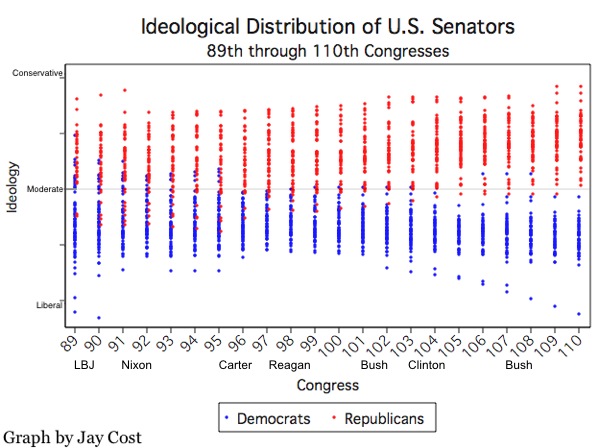
The following graph charts Congressional polarization from the 89th Congress through the 110 Congress, notice the considerable overlap in the middle that existed in the 1960s and through the 1970s.  There was a time when Conservative Democrats and Liberal Republicans were not anomalies. This helps to explain why legislation that today would divide the parties, the Civil Rights Act, the Creation of Medicare and Medicaid, even passage of President Reagan's first budget in 1981 were, in fact, bi-partisan affairs.


Today, however, there is no home in the Democratic Party for conservatives and no real home in the Republican Party for moderates - this is why Jim Jeffords bolted the GOP in 2001 and Joe Lieberman felt so ill at ease with Democrats back in 2006.

The parties polarized, the public did not. As Fiorina notes, there has been precious little change in the last 30 years with regard to the share of Americans who identify as Conservative, Moderate, or Liberal. Rather conservatives no longer feel comfortable in the Democratic Party and Liberals are no longer comfortable in the Republican Party - Moderates appear to be less comfortable with both parties.  The electorate is no more polarized now than in 1970, 1980, or 1990 - but the parties are. So of course 90% of Republicans vote Republican and 90% of Democrats vote Democrat. Of course Presidential approval correlates to party affiliation, it's the natural byproduct of party sorting, but party sorting is not the same as polarization.

The reasons for party polarization are many - the breakdown of mass-based political parties that operated as bottom-up entities driven often by local issues has played a role. Parties are now top-down entities controlled by a relative and ideologically similar few.

The increase in political competition has played a role as well. The Democrats lost their hold on the South, the Republicans lost their hold on the North East. According to data from State Politics and Policy Quarterly only 7 states had divided government in 1954, in 2007 that number stood at 23 states. With few exceptions, either party has fair shot at winning statewide elections in most states (remember, we vote for offices other than President). A recent study by political scientist Daniel Coffey determined that there is a direct and positive correlation between party competition and party ideology. As a state becomes more competitive between Republicans and Democrats the respective parties become ever more conservative and liberal.

V.O. Key hinted at this in 1956 when he argued that competition would force parties to offer more distinct policies to voters in an effort to influence their choice. Additionally, as competition increases the parties come to rely more heavily, not on the mean, median, or moderate voter, but rather on the more committed and active voter. For Democrats this means liberal activists and for Republicans conservative activists. This has the effect of pushing the parties ever farther to the extreme. This is, of course, what has happened.

Where is there evidence of polarization? Among the most engaged and active third of the electorate - what we call base voters, as they form the foundation of support for each party. Sadly this third has a tremendous impact on the direction and agenda of the two major parties. This third votes regularly and is more likely to contribute to and be active in politics. Parties and politicians seek to motivate these voters by painting every election as a choice between political life and death. Recall the closing days of the 2000 election when Al Gore suggested that "strict constructionists" like George W. Bush are little different from those who once deemed a black man to be but three-fifths of a person. Or the waning days of the 2008 campaign when Sarah Palin accused Barack Obama of "palling around with terrorists."


The goal for the left and the right is the same, scare the hell out your base to motivate them. So the left reduces the right to a caricature of bigoted, racist, violent, homophobic fascists and the right reduces the left to a caricature of immoral, anti-American, authoritarian socialists. The hope is that the scare tactics will motivate the base and win over wavering voters in the middle - remember, Democrats won Independent voters by 19 points in 2006 only to see Republicans win them by 19 points in 2010.

So America is not a deeply polarized nation on the brink of civil war. Rather, the American electorate is being poorly represented by a very polarized political class. A political class that sees the world in measures of black and white where there is "no middle ground." It is a pernicious myth that is doing great harm to America - and as we just witnessed in Arizona it all too often causes the political class to focus on imagined problems at the expense of real problems.

Friday, December 17, 2010

Compromise in the Era of the True Believers

The recent handwringing on the Left and on the Right over the tax deal struck between President Barack Obama and Senate Republicans has provided a nice opportunity for Americans to see that there is in fact little difference between the far Left and the far Right in America - to be sure, they differ with regard to their stance on issues - but when it comes to the their arrogant, self-righteous, intransigence they are cut from the same cloth.

Political scientist E. E. Schattschneider once wrote,
Democracy is based on a profound insight into human nature, the realization that all men are sinful, all are imperfect, all are prejudiced, and none knows that whole truth…. Even when we disagree with other people we like to think that they speak from good motives and while we realize that all men are limited, we do not let ourselves imagine that any man is bad. Democracy is a political system for people who are not sure that they are right.
In other words, the very foundation of the democratic social contract is the understanding that no one philosophy or ideology is to be privileged above others. In contemporary American politics this is simply no longer the case. As political elites, be they Liberal or Conservative, have grown ever more polarized they have lost sight of the reality that "none knows that whole truth" and that at its heart "Democracy is a political system for people who are not sure that they are right."

Instead we live in an age when the Left and the Right have drifted so far apart that neither is able to see any good in the opposition. Last year, William Galston presciently warned,
"polarized partisanship creates a climate in which each party is likely to deny any truth or virtue to the other. But because no party has a monopoly on truth or virtue, this mindset all but rules out legislation that draws from the best ideas of both... partisan polarization tends to create a self-fulfilling prophecy. If Democrats feel sure that Republicans will only obstruct their legislative agenda, why allow them to participate in drafting it?"
In the midst of an ever more partisan and bitter era in American politics, and following a devastating electoral defeat for Democrats, President Obama and Republican Senate Leader Mitch McConnell achieved the impossible - compromise. As the clock ticked down on tax rates enacted under George W. Bush and a Republican Congress many Democrats, still stinging from the midterm elections, demanded that only the tax rates for those earning less than $250,000 per year be extended. Republicans sought to maintain all tax rates at current levels. During his presidential campaign, Obama had promised to allow the upper income tax rates to expire. During the same time that Congress and the White House was discussing the issue of the tax rates, Congress was also considering an extension of federal unemployment benefits - but Republicans in the Senate were blocking the effort.

The deal struck between McConnell and the White House allowed for a temporary two-year extension of the Bush era tax rates, a temporary 2 percentage point reduction in the payroll tax, and a 13 month extension of unemployment benefits. The legislation passed the Senate by an impressive 81-19 margin and after considerable moaning by Democrats it passed the House with a bipartisan majority of 277-148.

Yet this tremendous victory has caused many on the Left to view President Obama as a traitor who betrayed his base. Some have even called for a primary challenge to Obama in 2012. It's enough to give a casual political observer whiplash. During the height of the health care debate the American Left defended Obama against attacks from the Right. Obama critics were derided as racists, radicals, birthers - all seeking to bring down the President. Now Obama has to deal with flak from his Left - his great treasonous crime? Compromise.

In his book "The True Believer" Eric Hoffer wrote
"It is the true believer's ability to "shut his eyes and stop his ears" to facts that do not deserve to be either seen or heard which is the source of his unequalled fortitude and constancy. The fanatic cannot, can not be weaned away from his cause by an appeal to his reason or moral sense. He fears compromise and cannot be persuaded to qualify the certitude and righteousness of his holy cause.  Though they seem to be at opposite poles, fanatics of all kinds are actually crowded together at one end. It is the fanatic and the moderate who are poles apart and never meet. The fanatics of various hues eye each other with suspicion and are ready to fly at each other's throat. But they are neighbors and almost of one family. They hate each other with the hatred of brothers."
Those "true believers" on the Left who now decry President Obama as a traitor to the faith are little more than the dizygotic siblings of those on the Right who angrily dismiss the President as a socialist out to destroy America or who believe McConnell sold out. Left or Right, they are fanatics. Democrats lost 63 seats in the House of Representatives in the November midterm, they lost 6 Senate seats, and over 700 state legislative seats in the worst electoral rout in 70 years. Somehow, many Democrats have convinced themselves that the correct response is to entrench, to defend ever more vigorously progressive policies - seemingly oblivious to the fact that the 2010 losses were driven by the massive defection of Independent voters who felt that Democrats were already pursuing an agenda that was too far left. Meanwhile, conservatives and Tea Party folks in Congress have mistaken the voters repudiation if Obama and the Democrats. The greatest threat to the GOP in 2012 isn't Obama it's the possibility of Tea Party intransigence.

President Obama got the message of the 2010 midterms, the tax deal is evidence of that and probably the first significant mile marker in his road to reelection. Mitch McConnell got the message as well and provided a significant boost to Congressional Republicans. Congressional Democrats seem clueless.

What has been too often lost in the discussion of the tax compromise are the effects that it is having on other legislation. Now that the tax deal is out of the way it is very likely that the Senate will join the House and vote to repeal of Don't Ask, Don't Tell, and the Senate is likely to ratify the START treaty - it's event possible that the Dream Act will pass the Senate - none of this would have been possible without the compromise on taxes.

The far Left thinks that President Obama sacrificed too much, the far Right suspects the same of Senate Republicans. All I can say is, if the fanatics are angry, it must have been a damn good compromise. It's not the bill I would have preferred, but I welcome the precedent that it may set for future relations between the White House and Congressional Republicans.