Tuesday, March 30, 2010

Ehrlich's in, but can he win?

The biggest question being asked in Maryland politics has been answered - ending months (or years) of speculation, former Republican Governor Bob Ehrlich has announced that he wants his old job back

So now we know that he's back in, the new question is 'can he win?'

Much has changed in Maryland since 2002 when Ehrlich became the state’s first Republican governor since Spiro Agnew in 1966, defeating then Lieutenant Governor Kathleen Kennedy Townsend by a margin of 51.6% to 47.7%. Some of that change was already taking shape in 2006 when Ehrlich lost his bid for re-election to O’Malley by 52.2% to 46.2%. No doubt Ehrlich and his most trusted advisers have been surveying the Maryland political landscape and though he may not be looking for advice or insight from the halls of academia, I offer it nonetheless. He is free to accept or ignore it. In my examination of his chances, Ehrlich can find cause for concern and for encouragement. Overall, I conclude that Ehrlich’s road back to Annapolis would be steep, but not insurmountable. The success of his journey would likely rely as much on national political trends as it would on issues specific to Maryland.

The Bad News
The first thing Ehrlich must contend with is the overwhelming partisan advantage enjoyed by Democrats in the Free State. As of October 2009 the State Board of Elections reports that 56.8% of registered voters are Democrats, while only 26.6% are Republicans. Approximately 14% are unaffiliated and the rest belong to a scattering of minor parties. That two-to-one party advantage should give any potential GOP candidate pause and the trend in partisan advantage should be cause for nightmares. Since Ehrlich’s victory in 2002, Maryland Democrats have added just over 384,000 new voters to their ranks. During that same time, the Republican ranks grew by only 73,000. Since 2006 Democrats have added 204,000 voters to the party rolls while Republican ranks shrank by 3,000. In 2002, Republicans accounted for 30% of all registered voters and the Democrats 56%. So in the 7 years since Maryland last elected a Republican Democrats have padded there partisan advantage by about 0.8% while Republicans have seen their party position eroded by 3.4%. These numbers should matter to Ehrlich given that he defeated Townsend by only 67,000 votes and lost to O’Malley by nearly 117,000. Any strategist would look to the margin of loss in 2006 and question how it could be overcome when the Democrats’ ranks have been growing at a rate five times that of the Republicans’.

The Good News
Well that’s the bad news for Ehrlich – the Democratic Party has been growing its advantage among registered voters as the GOP has seen its share decline. So what’s the good news? It can be seen in the seemingly daunting statistics that I have already shared. In 2002, Democrats enjoyed a 56% to 30% advantage among Maryland’s registered voters – yet Ehrlich won nearly 52% of the vote. By 2006, Republicans had fallen to 28.9% of registered voters and Ehrlich still managed 46%. Clearly the Democrats’ registration advantage and the GOP’s disadvantage do not directly correlate to final vote totals. In fact, a review of the last four gubernatorial elections in Maryland (1994, 1998, 2002, and 2006) shows that the Democratic candidate typically and significantly under-perform in final vote totals relative to their party registration advantage and the Republican candidate typically and significantly over-performs. It is in that level of over and under performance that Ehrlich can find a path back to Annapolis.

As shown in Table One, in all but one of the last four gubernatorial elections the Democratic candidate received a total statewide vote that was less than their party’s partisan registration advantage among those who voted. In 1994 879,842 Democrats cast ballots, but the Democratic candidate received only 708,094 total votes – the Democrat under-performed relative to partisan advantage receiving a total statewide vote equaling only 80.5% of the total Democrats voting. On the Republican side, GOP candidate always over-perform. Looking again to 1994 only 451,256 Republicans cast votes, but the Republican candidate received 702,101 votes. The Republican candidate over-performed by 155.6%. In all but one election, 1998, the Democratic candidate underperformed and in every election the Republican candidate over-performed. This means that in most of the recent gubernatorial elections many registered Democrats voted Republican as did many of the unaffiliated and third party voters. There is no other way to explain the under and over performance by the parties.

Table One tells us more than just levels of party performance. The grey boxes indicate the winning candidate in each election. As shown, the Democratic Candidate won in 1994, 1998, and 2006. The Republican candidate won in 2002 – the election in which Ehrlich defeated Townsend. So Democrats won 3 of the last 4 gubernatorial elections, but look closely at 1994- the margin of victory is very small. In 1994 Democratic candidate Parris Glenndening defeated Republican Candidate Ellen Sauerbrey by a scant 5,993 votes. In 1998 and 2006 the Democrat victory margins were more significant. The 1994 and 2002 results show that Republicans can win in Maryland so long as the GOP candidate significantly over performs and the Democratic candidate underperforms. In 1994 and 2002 the Democrat under-performed by 80.5% and 83% respectively and GOP candidate over-performed by 155.6% and 156.5%. Conversely, Democrats won decisively in 1998 and 2006 when their candidate performed on par with their partisan share of the electorate and the GOP candidate’s level of over-performance declined.

This is important because of the two election cycles when the Republicans performed best and the Democrats worst – 1994 and 2002. 1994 was the year of the Republican revolution that resulted in the GOP recapturing the House of Representatives and the Senate for the first time in more than a generation. 1994 was the first mid-term election after Bill Clinton’s 1993 election and the election was largely viewed as a referendum on his very uneven first 18 months in office. Likewise, 2002 was a very strong year for Republicans. Since Reconstruction, only three presidents have enjoyed mid-term electoral victories in Congress: FDR in 1934, Bill Clinton in 1998, and George W. Bush in 2002. So the 1994 and 2002 mid-terms were very good for Republicans nationally and the strong Republican showing in the Maryland gubernatorial elections were a reflection of that national trend.

In contrast, 1998 and 2006 were good years for Democrats. In 1998 a rebounding and re-elected Bill Clinton saw his party gain seats in the House of Representatives as an impeachment wary public expressed disapproval of Congressional Republicans. Much as in 2006 when a war weary nation stripped Republicans of there majorities in the House and Senate and delivered control to the Democrats. So 1998 and 2006 were good years for Democrats nationally and that translated into the strong showing by Democrats in the Maryland gubernatorial elections.

Implications for Ehrlich
So what does all of this mean for Ehrlich and 2010? It means that Ehrlich has to decide whether he thinks that the 2010 mid-term election will be like 1994 and 2002 – in which case he has a decent chance at reclaiming his old job – or will 2010 be closer to 1998 and 2006 – in which case he should let the Maryland GOP designate some other sacrificial lamb. Once that decision has been made, he must consider whether the Democratic Party’s current registration advantage, or rather the Republican Party’s disadvantage, can be overcome.

Will 2010 be a GOP Year?
If current indicators are to be trusted then the 2010 election is shaping up to be a mid-term in the 1994/2002 mold. Consider the evidence:
  • According to most polls, registered voters would prefer a Republican over a Democratic candidate in November. Gallup reports that Republicans have rarely held an advantage on the generic ballot dating back to 1950. Two exceptions occurred in 1994 and 2002.
  • Independent and moderate voters are expressing a clear preference for the Republican candidate.
  • In 1994, the Republican wave that swept the Democrats out of power in the House and Senate was presaged by Republican gubernatorial victories in Virginia and New Jersey in 1993. Republicans scored clear victories in both states in 2009, largely a result strong support from Independents.
  • The surprise victory by Republican Scott Brown in Massachusetts is also a bad omen for Democrats and offers some hints to how Ehrlich could win in Maryland.
  • Add to this the latest edition of the Cook Political Report which has identified 50 competitive House seats heading into 2010. Of the 50, 39 (or 78%) are held by Democrats.
Overcoming the Party Advantage
Even if 2010 mimics 1994 and 2002, Ehrlich must decide whether or not a strong GOP wave would be sufficient to overcome the tremendous registration advantage enjoyed by the Democrats. To try and answer I examined statewide registration and turnout data to estimate how a 1994 or 2002 election would translate with 2009 registration numbers.

Table Two shows Democratic and Republican Party turnout in each of the four elections discussed. Republican turn-out is consistently higher than Democratic, but Republican turnout was highest in the years that Republicans did well and Democratic Turn-out in 1994 and 2002 and was similar to the strong Democratic year in 1998. Democratic turnout was high the years when the party underperformed (Table One), suggesting that higher Democratic turnout may have represented registered Democrats voting Republican.


Using current voter registration data (October 2009) it is possible to model the potential outcome of an Ehrlich/O’Malley rematch based on prior turnout and over/underperformance levels for the Democratic and Republican parties. As of October 2009 there were 1,940,634 registered Democrats and 906,679 registered Republicans in Maryland, a 56.8% to 26.6% advantage.

As shown in Table Three, if the 2010 gubernatorial election follows the turnout and party performance patterns of 1994 or 2002 then Martin O’Malley would still be narrowly re-elected governor. These results reflect not only the increased registration advantaged enjoyed by the Democrats, but also the declining registration among Republicans. Even in a strong Republican year – like those in 1994 and 2002 – Ehrlich would face an uphill struggle against the Maryland Democratic Party’s registration advantage.


Could Ehrlich Win?
Despite the rather dire numbers presented in Table Three, Ehrlich would still have a fighting chance in a re-match with O’Malley. If Ehrlich could match the level of over-performance that he mustered in 2002 he would stand to receive 957,162 votes, and if Democratic underperformance were to fall to 1994 levels O’Malley would receive 952,336 votes. Ehrlich would win, though barely. In the end, Ehrlich’s best hopes lie within data than cannot be incorporated into the turnout models in Table Three. When Ehrlich and O’Malley faced off in 2006 Ehrlich was the Republican incumbent in a year that was bad for Republicans. In 2010, O’Malley will be running as a Democratic incumbent in a year that is likely to be bad for Democrats and incumbents. O’Malley will be running on his record and potentially against a strong anti-incumbent tide.

The latest poll in the Maryland governor's race shows incumbent Martin O'Malley with a 6 point lead over potential rival, and former governor, Bob Ehrlich - the race stands at 49% to 43%. The survey, by Rasmussen Reports, shows that O'Malley simply cannot crack 50% and polling below 50% is a bad sign for any incumbent. A Clarus poll taken late last year showed further danger for O’Malley as it found that only 39% of Maryland voters wanted to see O’Malley re-elected.  When asked to rate O'Malley’s performance on 11 key state issues (taxes, budget, jobs) he only received majority approval on one issue – "living up to high standards of ethics."

There is no question but that Bob Ehrlich would face a steep climb back to Annapolis, he would likely need to ride a national wave similar those in 1994 and 2002. In addition, he would need to overcome the significant registration disadvantage among Republicans statewide, or work to reverse the trend over the next 7 months. He could also hope that many of the newly registered Democrats were motivated by the drama of the 2008 Democratic primary battle and subsequent presidential election and that the Democratic Party’s registration advantage is somewhat overstated. Democratic Party registration swelled in Virginia and New Jersey in 2008 as well, but this did not translate into any appreciable party advantage in the 2009 gubernatorial elections. Democratic Party registration in Maryland grew at a rate of about 2.5% between 1994 and 1998, then by 5% between 1998 and 2002, before swelling to 11% prior to the 2006 gubernatorial and 2008 presidential elections. That excess growth may overstate the Democrats’ true advantage in the state by as many as 200,000 voters. If one were to factor that into the models presented in Table Three then Ehrlich would win under either a 1994 or 2002 scenario by a margin similar to his 2002 victory over Townsend.

Even with the challenges he’ll face, 2010 will likely present his best chance at reclaiming his old job. If Ehrlich waited until 2014 he'd risk that it would be a less hospitable year than 2010. If a Republican is elected president in 2012 then history tells us that 2014 would be a bad year for Republicans. If Obama or another Democrat is elected in 2012, then 2014 may well be a good year for the GOP, but in Maryland Ehrlich would have been out of public office for 8 years and could no longer assume the position of presumptive frontrunner for the nomination. Ehrlich would face much the same challenge if he were to decide to pursue one of Maryland’s Senate seats. Democratic Senator Barbara Mikulski is up for re-election in 2010, but nothing less than a GOP tsunami would defeat her. Ehrlich’s next chance would be 2012 when the seat held by Democratic Senator Ben Cardin would be on the ballot – but president Obama would be on the ballot as well in a state that he carried by a margin of 62% to 37%. Anything approaching that margin would likely have some down-ballot coattails and sink any challenge to Cardin or another Democrat.
In the end, for all the challenges and difficulties that he'll face, 2010 presents Ehrlich with his best chance for reclaiming the governorship. For Ehrlich, it's now or never. And he has decided that it's now.

More on the Ehrlich/O'Malley race can be found here and the impact of Enrlich's run on Republican efforts to gain 5 seats and reach 19 (the number needed sustain a filibuster) in the Maryland Assembly can be found here.

Thursday, March 25, 2010

O'Malley v Ehrlich - Round Two

WJLA-TV in Washington is reporting that former Gov. Bob Ehrlich (R) will formally announce his bid to reclaim his old job on Wednesday, April 7, in Rockville, followed by an event at his childhood home in Arbutus. If true, this would end months of "will he, or won't" speculation in Maryland. Although 2010 is shaping up to be a bad year for Democrats and incumbents, Ehrlich would face an uphill battle in a race against current governor Martin O'Malley. Democrats enjoy a 2 to 1 voter registration advantage in the state, and the largest jurisdictions, Prince Georges and Montgomery counties and Baltimore City, provide any Democratic statewide candidate with a solid base of support. The “Big Three” are home to 1.4 million of the state’s 3.4 million registered voters and more than half of the state’s registered Democrats. These jurisdictions are crucial for any Democratic candidate. In 1994, Democratic candidate Parris Glendening lost every county in Maryland, save for the Big Three and still managed a narrow victory over Republican Ellen Sauerbrey.


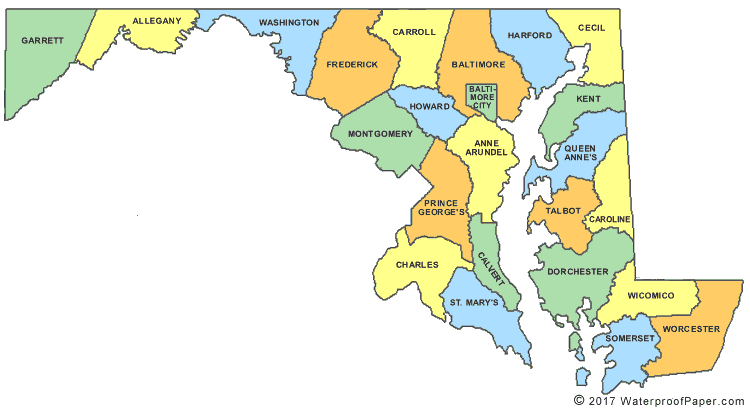
Move beyond the "Big Three" Democratic jurisdictions and the rest of the state is far more competitive. The “Big Three” advantage enjoyed by Democrats can be offset by a Republican by focusing on the “Big Five” counties in central Maryland – Baltimore (county, not city), Carroll, Harford, Howard, and Anne Arundel. These counties are home to 1.2 million voters, but less than half are Democrats.

The rest of Maryland can be divided into the “Western Four” counties of Alleghany, Frederick, Garret, and Washington home to 277,000 registered voters and Republicans outnumber Democrats in each county. Next we can move to the “Southern Three” counties of Calvert, Charles, and St. Mary’s. This region represents the fastest growing area in the state, though it is currently home to just over 200,000 voters. Although Democrats outnumber Republicans in each of the three counties, the Southern Three had been a reliable Republican voting bloc in gubernatorial elections – until 2006 when the largest of three, Charles County, went Democrat. Finally, there is the “Eastern Shore Nine” of Caroline, Cecil, Dorchester, Kent, Queen Anne’s, Somerset, Talbot, Wicomico, and Worchester – home to 266,000 voters. Democrats enjoy a slight voter registration advantage on the Eastern Shore, but the nine counties have been a reliable source of Republican gubernatorial votes.

The key for Ehrlich, or any statewide Republican candidate, is to run strong in the Big Five, while maintaining the party’s traditional advantage in the Western Four, the Southern Three, and the Eastern Shore Nine. When Ehrlich defeated Kathleen Kennedy-Townsend in 2002 he won every county in Maryland except the Big Three. When Ehrlich faced O’Malley in 2006 the story was different. O’Malley enjoyed a tremendous advantage in the Big Three, but also made inroads in the Big Five. In 2002, Ehrlich won Howard County by nearly 10,000 votes; in 2006 O’Malley flipped that to a 1,000 vote victory. Ehrlich won Baltimore County by 64,000 votes in 2002; O’Malley reduced that margin to 8,000. Among the Southern Three, O’Malley was able to flip Charles County.

If Ehrlich intends to reclaim his old job and return to Annapolis he'll need to repeat his success in 2002 and reverse the gains made by O’Malley in 2006. This will be no easy task. Maryland Democrats have added more than 384,000 new voters to their ranks since 2002, while the Republican ranks grew by only 73,000. Regardless of whether Ehrlich wins, he is the only Republican candidate with a viable chance and his presence at the top of the ticket may well help Republican candidates in the rest of the state - especially candidates for the Maryland Senate where Republicans are only five seats shy of breaking the Democrat's filibuster-proof majority. Ehrlich will need a well financed campaign, a compelling message, and a strong anti-incumbent or pro-Republican wave to help push him over the finish line.

Please see my prior posts exploring Ehrlich's chances in a rematch - here, here, and here.

Explaining the Health Reform Bill

The Kaiser Foundation has produced a great summary of health coverage provisions in the new health reform law signed by the president.

The legislation passed by the House of Representatives will do the following:

  • Most individuals will be required to have health insurance beginning in 2014.
  • Individuals who do not have access to affordable employer coverage will be able to purchase coverage through a health Insurance Exchange with premium and cost-sharing credits available to some people to make coverage more affordable. Small businesses will be able to purchase coverage through a separate Exchange.
  • Employers will be required to pay penalties for employees who receive tax credits for health insurance through the Exchange, with exceptions for small employers.
  • New regulations will be imposed on all health plans that will prevent health insurers from denying coverage to people for any reason, including health status, and from charging higher premiums based on health status and gender.
  • Medicaid will be expanded to 133% of the federal poverty level ($14,404 for an individual and $29,327 for a family of four in 2009) for all individuals under age 65. 
A detailed summary can be found here.

Friday, March 19, 2010

Health Care Reform will Add to Medicaid's Importance; Help Maryland

Medicaid, the little health program that could, has already grown to be the single largest provider of health coverage in the nation. Over 60 million Americans, mostly children, receive their health coverage through Medicaid. Though it covers more people, Medicaid is often overshadowed by the more well known and more popular Medicare. Part of that lack of recognition stems from the fact that Medicaid is a state/federal partnership. The federal government establishes program regulations and provides at least half of the funding, but states are required to administer the program and have a certain degree of freedom to tailor it to their needs. In that regard Medicaid is actually 50 different programs.


If health reform is enacted (including Senate passage of the reconciliation bill), Medicaid will likely eclipse Medicare in name recognition. The legislation pending in Congress seeks to insure an additional 32 million Americans - and half of them would receive coverage via Medicaid. As currently structured, federal regulations limit the program's availability to childless adults - no matter how poor. But health reform would expand Medicaid to every American with income at or below 133% of the federal poverty line. This change will bring millions of new people into the program. Many states were concerned that the influx of new recipients would overwhelm already strapped budgets – remember, states share in the funding.

The legislation that would reconcile House and Senate differences addresses that concern. According to the proposed bill federal Medicaid matching payments for the costs of services to newly eligible individuals will be provided at the following rates: 100% in 2014, 2015, and 2016; 95% in 2017; 94% in 2018; 93% in 2019; and 90% thereafter. So states only absorb 10% of the cost. Some states have chosen to cover these adults, largely at state expense, and the bill will help them as well by reducing the state share of the costs by 50% in 2014, 60% in 2015, 70% in 2016, 80% in 2017, 90% in 2018. In 2019 and thereafter, these states would bear the same state share of the costs of all other states.

This could help reduce current Medicaid costs for states like Maryland and Massachusetts. In 2007, Maryland expanded coverage to childless adults with incomes up to 116% of poverty. An analysis conducted by the state's Department of Legislative Services (DLS) in January estimated the Medicaid expansion and enhanced funding in the Senate version of health reform would save Maryland roughly $135 million per year between 2014 and 2016 (due to the extra federal money). State costs would then begin to rise to around $200 million per year between 2017 and 2019 - owing to increased enrollment. Based on DLS estimates the expansion would impact 133,000 Marylanders - $200 million in costs would mean the state would be covering these folks for the bargain price of $1,500 each. The state would incur additional savings as well, the state maintains an uncompensated care fund for hospitals to offset the cost of covering the uninsured. Those costs topped $1 billion in fiscal 2009. The increased coverage would reduce those costs.  The state also manages a high-risk pools called the Maryland Health Insurance Plan (MHIP) - MHIP cost $111 million. MHIP would no longer be needed and those funds would be freed.

It is no secret that Medicaid saves money by paying providers less money than they would receive from Medicare or private insurance. In many states providers may earn as little as 35-45% of the usual rate for Medicaid patients. In the past year, 38 states (Maryland included) cut provider payments to try and squeeze savings out of Medicaid. This caused many to worry that the expansion of Medicaid would accomplish little as the newly insured would not be able to find participating doctors.

The reconciliation language requires that Medicaid payment rates to primary care physicians be no less than 100% of Medicare payment rates in 2013 and 2014 (an presumably thereafter). Given that many states could not afford such an increase, the federal government would provide 100% federal funding for the costs to States of meeting the requirement.

In short, the proposed health reform holds the potential of transforming Medicaid into a true national health insurance model. The expansion of the program to new, higher income individuals, and the provision of dramatically improved federal funding, holds the promise that Medicaid may soon become a federal responsibility – freeing states form the tremendous cost burden and freeing Americans from a situation where their access to health care depends on their state of residence.

Full text of the bill is here - Part C. Sections 1201 and 1202 directly address Medicaid.

Thursday, March 18, 2010

The House has Posted the Health Reform Reconciliation Bill

The 153-page bill would make several changes to the Senate bill, including:
  • Increase the tax credits for middle-income families who buy insurance.
  • Reduce the penalty for not buying insurance from $750 to $695. But the bill also requires some people to pay a share of their income as a penalty and that number was raised from 2 percent to 2.5 percent.
  • Close the gap in Medicare prescription drug coverage by 2011 and give seniors who fall into the gap this year a $250 rebate.
  • Eliminate the Cornhusker Kickback (the special Medicaid deal for Nebraska) and covers 100 percent of the increased Medicaid costs of all states until 2016 and decreases each year thereafter.
    • Though it appears to stop at a 10% state share, this is a significant development that should help already burdened states.
    • It will also provide an enhanced federal match for states that have already expanded coverage to childless adults. This could mean millions of dollars for states like Massachusetts and potentially extra money for Maryland.
  • Require that doctors that care for Medicaid patients be reimbursed at the full rate.
    • This is also significant and should bring new doctors into Medicaid. The Feds will cover 100% of cost to bring physician pay in line with Medicare.
  • Delay the tax on high-end insurance plans in keeping with the deal Democrats struck with the labor unions. However, it does lower the index at which plans will be taxed, making it likely that more plans will be affected over time.
    • This change directly impacts Social Security revenue and may well be rejected by the Senate parlimentarian during the reconciliation process - if so, unions will scream.
  • Impose a Medicare tax on unearned income for families making more than $250,000.
 More detail via Politico (the source for this posting).

Tuesday, March 16, 2010

Why Process Matters

Update: Realizing that it was undermining the credibility of the vote, Democratic leaders in the House have announced that they will not use the "deeming" procedure to pass health reform. This means that no one can question the process by which the Senate bill becomes law (if it is passed). Though the changes being made via reconciliation still represent a violation of process, the decision to abandon deeming goes a long way toward respecting the process of lawmaking.

With all of the talk about "deeming," "self-executing rules," and reconciliation proponents of health care reform have dismissed everyone who engages in a discussion of "process" as being opposed to reform and trying to avoid a real discussion of "the issues." As a proud advocate of health reform I reject such accusations and further contend that my obsession with "process" is a direct result of my support for health reform. In short, health reform is too important to passed in any manner other than one which embraces a clean, open, and honest debate. That means no parlimentary tricks, no rule making sleight of hand - no action which could ultimately undermine reform.

As a professor of public policy my students are introduced early to what is called the Policy Process Model - a six stage description of the process through which policy is created: problems are defined, policies considered, implemented, evaluated, and changed (if need be).  The third step in the process is one that is all too often overlooked - Policy Legitimation. According to public policy scholars Michael Kraft and Scott Furlong:
"Legitimation as a step in the policy process is at once both simple and complex. It is simple when it merely means that a recognized authority considered and approved a policy proposal. A bill becomes a law at the national level if both houses of Congress approve it and the president signs it, but does that process necessarily imply that the measure was legitimated?"
That's the simple, School House Rock, process of legitimation - but the authors continue:
"The complex view is that legitimation requires more than a majority vote... Policy legitimacy... flows from several conditions..." such as "demonstrable public support... and a full and open airing of the issues and controversies."
Kraft and Furlong conclude that without a sense of legitimacy:
"Policies... face serious hurdles. They may well fail to command public support, affected interest groups may... challenge them in court, and their implementation could be adversely affected."
I dwell quite a bit on the issue of legitimation in my classes and cite the examples of the Nuclear Waste Policy Act of 1982 and the Medicare Catastrophic Coverage Act of 1988 to illustrate why the simple process of legitimation is insufficient. If the public doubts the legitimacy of a legislative act, if there is any reason to question the decision-making process, a legally enacted bill (even two very good pieces of legislation) can ultimately fail.

Health care reform is one of the most important issues of our time. Health care spending is bankrupting our nation, our citizens, and 45 million Americans lack even basic coverage. The legislation pending before the House of Representatives marks the most substantial social reform since the creation of Medicare and Medicaid in 1965 and is equally as import. But if Democrats opt to use parlimentary trickery to pass health reform they risk everything they hope to accomplish. Relying on reconciliation to bypass the Senate's filibuster rules and now talk of "deeming" the Senate bill to have passed in the House without a true up or down vote only serve to further undermine already abysmal public support for the legislation. Members of the public may rightly ask 'If this legislation is so good, why are all of the normal rules of process being cast aside?'.

Aside from the public's reaction the "deeming" process would put the entire legislation in question as it would certainly face a court challenge. As reported by Politico, Alan Morrison, a professor at the George Washington University Law School who has litigated similar issues before the Supreme Court warned “If I were advising somebody," on whether deem and pass would run into constitutional trouble, "I would say to them, ‘Don’t do it.’” Michael McConnell, a former federal judge on the U.S. Court of Appeals, argues that the use of deeming to pass the Senate bill and simultaneously pass the reconciliation bii likely violates Article 1, Section 7 of the Constitution. Said McConnell:
"Most of the time a self-executing rule is used to incorporate amendments into a pending bill without actual votes on the amendments, where the bill is then subject to a final vote by the House and Senate. That usage may be a dodge around House rules, but it does not violate the Constitution. I am not aware of any instance where a self-executing rule has been used to send one bill to the president for signature and another to the Senate for consideration by means of a single vote. Self-executing rules have also been used to increase the debt ceiling by virtue of adopting a budget resolution. That procedure is questionable, but because budget resolutions are not laws, this usage does not have the feature of using one vote to send a bill to the president and at the same time to send a different bill to the Senate."
So contrary to the claims that deeming and self-executing rules are common, or that they have been sanctioned by the courts, the simple fact is that they have not. So the use in this instance, a bill so substantial, represents poor judgement and certainly will raise questions of legitimacy.

House Majority Leader Steny Hoyer defended the use of the "deeming" approach by dismissing any need to worry about the rules of process. Said Hoyer, "We talk a lot about process in this town... 'So what?’ says the American public. What they’re interested in [is] ‘What result? What did you do for me and my family..." Congressman Hoyer is right and wrong - in most cases Americans do not care about process. In the past, the House of Representatives has used the deeming procedure on matters pertaining to House rules, it has been used to consider amendments to bills, there is a standing rule in the House to use deeming to raise the debt ceiling - but deeming has rarely been used to effect final passage of legislation. It has never been used to pass something as significant, and controversial, as comprehensive health reform. Americans do care about process - when they believe that it is being abused.

And the deeming approach is simply one more example of such abuse - it began with the decision to use reconciliation. The Constitution makes clear that the House and Senate must each approve a bill before it goes to the President. When they pass different versions of a bill they must reconcile those differences and if changes are made the new bill must be passed again by both chambers. The House and Senate passed different health reform bills last year, House and Senate negotiators were working on compromise legislation when Democrats lost their 60 seat filibuster-proof majority in the Senate following the special election to fill the late Ted Kennedy's seat in Massachusetts. Faced with the threat of a GOP filibuster in the Senate and a House that was unwilling to accept the legislation passed in the Senate, Democratic leaders decided that rather than abide by the rules of process they would instead have the House approve the Senate bill, but then use the budget reconciliation process to resolve key differences between the House and Senate bills. They essentialy decided to use reconciliation - a Senate budget process with limited debate that cannot be filibustered - to do an end run around the House/Senate conference process.

When party leaders discovered that many in the House were still unwilling to accept the Senate version they decided to explore the deeming process whereby House members would be asked only to vote on the House/Senate reconciliation fixes and if those fixes passed, the original Senate bill would be "deemed" to have passed.

If health reform passes as a result of the one-two punch of deeming in the House and reconciliation in the Senate there is little hope that it will ever be accepted as legitimate. It will face years of legal challenges and likely deeply entrenched public opposition. Worse, the manner in which the bill is being pushed may allow for errors or inconsistencies in the law that could weaken or undermine it in unanticipated ways. The normal process may cause delays and be fraught with obstacles, but it exists to protect the public and to promote sound legislation. In the end, Democrats will have turned the most important domestic policy issue of our time into a bill more toxic than the Nuclear Waste Act - and they will have only themselves to blame.

Thursday, March 11, 2010

A Reconstructive President? Not in this Political Time.

A recent editorial from the McClatchy new service opined that Barack Obama was on the verge of missing his chance to be the next FDR or Ronald Reagan… in truth, Obama never had such an opportunity. Presidential scholar Stephen Skowronek argues that American political history is marked by the rise and fall of regimes. The strengths of these regimes ebb and flow, but all will ultimately fray and collapse. Every president comes to office either affiliated with, or opposed to, a given regime. Weak or strong, affiliated or opposed – each combination affords a unique set of opportunities or limitations to a president. With the exception of the reconstuctive opportunity, each places significant limitations on what a president can accomplish. Table One presents Skowronek's opportunity structure typology.

Table One: Skowronek's Opportunity Structure Typology


President’s Political Identity

Previously Established
Commitments


Opposed


Affiliated


Vulnerable


“Politics of Reconstruction”


“Politics of Disjunction"

Resilient


“Politics of Preemption”


“Politics of Articulation”

Reconstructive presidents come to power opposed an existing coalition at a time when its regime is weakened and its legitimacy questioned. Such leaders face a fortuitous opportunity structure and the rare chance to create a new political order. Disjunctive presidents come to office affiliated with an existing regime at a time when its legitimacy has come into questions. These presidents may in fact have only the most tenuous connection with their regime as originally constructed. This “regime drift” is a natural result on ongoing decay of a long established coalition and the actions of the disjunctive president will likely serve to further fragment the regimes existing coalition – thus setting the stage for a reconstructive opportunity. Articulation presidents represent the vast majority of American presidents; they enter office affiliated with a still resilient regime. To them falls the often challenging task of maintaining a political order established by the president that constructed the present political order. Preemptive presidents enter office in what Skowronek refers to as the “most curious of all leadership situations.” Such presidents are opposed to an existing, but still resilient, regime but they seek to manipulate and aggravate existing “cleavages and factional discontent” within a regime.

I cannot do justice to Skowronek's theory here, but in short, Barack Obama came to office facing one of two possible opportunity structures - Reconstruction or Preemption - as he was opposed to the electoral regime created by Ronald Reagan, the most recent Reconstructive president. For Obama to have inherited a reconstructive opportunity structure, like Reagan, FDR, Lincoln, or Andrew Jackson, one must accept that the Reagan regime met its demise under George W. Bush. If this is true, then history tells us that there should have been some indication of electoral upheaval in the 2008 election - as every reconstructive president has entered office during such episodes of upheaval. No such upheaval occurred in 2008.

Indeed, an examination of state by state election results shows that 2008 election was highly correlated with the election of 2004, 2000, 1996, 1992, and 1988 - as odd as it may sound, the election that sent Barack Obama to the White House in 2008 was little different from the elections that twice sent George W. Bush there (I will present the statistical analyses that verify my assessment at the Midwest Political Science Association's annual meeting in Chicago on April 22nd). This suggests that the Reagan regime is still strong, but that enough of a cleavage existed for an opposed president to be elected - much as Bill Clinton was elected in 1992, or Eisenhower in 1952 during the FDR regime. So Obama joins the ranks of the preemptive presidents. Men whose tenure in office served to galvanize the existing regime; presidents who while personally popular had little lasting impact on American politics.

If Skowronek’s theory is solid and if my assessment that Obama has inherited a preemptive structure is also correct, then his tenure in office will serve to re-galvanize the Reagan regime. Obama may, and if history is a guide likely will, serve two terms as the elements of the Reagan coalition seek a new leader to articulate the movement's vision, but Obama's impact on national politics will be limited, his legacy not too far reaching. He will be a Cleveland, an Eisenhower, a Clinton – but not a Jackson, an FDR, or a Reagan. This is the reality of President Obama's place in political time and he would do well to heed the lessons of Eisenhower and Clinton - presidents who came to embrace their place in the political order and enjoyed reasonable success in office. If, however, Obama believes that he can effect transformative change he is likely to be very disappointed.

Democrats' March of Folley

Pat Caddell and Douglas Schoen offer a very frank warning to the current leadership of their party in the Washington Post:

"As pollsters to the past two Democratic presidents, Jimmy Carter and Bill Clinton, respectively, we feel compelled to challenge the myths that seem to be prevailing in the political discourse and to once again urge a change in course before it is too late. At stake is the kind of mainstream, common-sense Democratic Party that we believe is crucial to the success of the American enterprise.

Comprehensive health care has been lost. If it fails, as appears possible, Democrats will face the brunt of the electorate's reaction. If it passes, however, Democrats will face a far greater calamitous reaction at the polls. Wishing, praying or pretending will not change these outcomes.

Health care is no longer a debate about the merits of specific initiatives. Since the spectacle of Christmas dealmaking to ensure passage of the Senate bill, the issue, in voters' minds, has become less about health care than about the government and a political majority that will neither hear nor heed the will of the people.

Voters are hardly enthralled with the GOP, but the Democrats are pursuing policies that are out of step with the way ordinary Americans think and feel about politics and government. Barring some change of approach, they will be punished severely at the polls."

Only time will tell if President Obama, Speaker Pelosi, and Majority Leader Reid can break out of the Washington bubble long enough to see just how badly the have misjudged the meaning of the 2008 election. Voters wanted change - in that they wanted an end to the Bush administration - beyond that simple fact it is increasingly clear that there was no larger mandate.

Tuesday, March 2, 2010

For Maryland Republicans 19 is the New 41, but is it Attainable?

Maryland Republicans have set their sights on the magic number 19 – the number of Senators they would need in the Maryland General Assembly to successfully mount a filibuster and therefore become relevant players in Annapolis. Currently, there are 14 Republicans in the Senate so the GOP need only pickup 5 seats – or more precisely – pick off 5 of the 33 Senate Democrats in 2010.

Unfortunately for the Maryland GOP, five seats may simply be too tall of an order.  A review of district by district election results from 2002 and 2006 shows that there are very few truly competitive districts for the GOP to target (Table One). In 2006 there was only one district where a Democrat won by less than a 10 point margin – district 30 in Anne Arundel County. The next 6 most competitive races were all decided by decisive margins. The election in 2006 represented a high water mark for Democrats nationally and in the state, so I looked to 2002 as well. In 2002 Republicans did very well nationally and Bob Ehrlich won the governor’s race. Even in 2002, however, there were only 3 races decided by a margin of less than 10 points – District 13 in Howard County, District 42 in Baltimore County, and District 15 in Montgomery County. None of those districts were close to being competitive in 2006. If the GOP truly hopes to pick up 5 seats they will have a very hard time identifying good targets. They may have to rely on unexpected retirements, primary challenges, or the sudden arrival on the agenda of a politically divisive issue to weaken Democratic incumbents. In addition, Republicans scored only narrow victories in District 3 in Frederick County and District 31 in Anne Arundel in 2006  - so they would need to pick up 5 Democratic seats AND defend all of their own.


When Scott Brown was running to succeed Ted Kennedy to the U.S. Senate in Massachusetts he campaigned on the pledge to be “number 41.” Meaning that he would be the crucial 41st vote to deny Senate Democrats their filibuster-proof majority. All indications are that the tactic worked. Maryland Republicans may want to emulate the Brown approach, but it’s a harder case to make when candidates would need to proclaim “I’m number 15, and I’m number 16, and I’m number 17…” Reaching 19 votes would likely revitalize the Maryland GOP and bring some much needed checks and balances to the state's one party rule, but the bar may be too high. Although any number closer to 19 would mean one less Democrat that the GOP would need to convince to join a filibuster effort. In the end, if Maryland Republicans are to have any hope of reaching the magic number of 19 they’ll need a strong candidate at the top of the ticket (and there is only one candidate who fits that description) and a GOP wave nationally to carry them over the line.

Sunday, February 28, 2010

Reconciliation is Not an Acceptable Approach for Passing Comprehensive Health Reform

According to multiple news reports President Obama and Congresional Democrats will seek to pass health reform via the reconciliation process - bypassing the possibility of a filibuster and thereby needing only 51 votes in the Senate. Many reform advocates have been urging the use of the reconciliation process and several experts on Congress have come forward to argue that reconciliation is an appropriate process for the creation of comprehensive new programs. According to the Center for Budget and Policy Priorities “Congress has employed reconciliation many times to make major policy shifts.”

These shifts in policy included the passage of the Personal Responsibility and Work Opportunity Act of 1996 (welfare reform), the Economic Growth and Tax Relief Act of 2001 (tax cuts), the Jobs and Growth Tax Relief Reconciliation Act of 2003 (more tax cuts), and the creation of several health programs such as the health portability changes contained in the Consolidated Omnibus Budget Reconciliation Act of 1985 (COBRA), and the creation of the State Children’s Health Insurance Program passed as part of the Balanced Budget Act of 1997. Indeed, each of those measures were enacted via the budget reconciliation process, but contrary to what the Center for Budget and Policy Priorities as well as Thomas Mann and Molly Reynolds of the Brookings Institution and Norman Ornstein of the American Enterprise Institute have explained, using reconciliation to enact health reform would NOT be consistent with past congressional practice.

I have argued many times in favor of enacting comprehensive health reform, including the need for a single payer system - but I cannot endorse the use of the reconciliation process and will explore prior uses of the procedure to argue that they do not, in fact, support the use of the process to enact comprehensive reform.

  • The Consolidated Omnibus Budget Reconciliation Act of 1985 amended existing tax law to deny employers the ability to deduct health insurance costs unless it allowed employees and their immediate family members to maintain their coverage if for up to 18 months if they were to lose coverage. COBRA initially passed in the Senate in November on 1985 by a 93-6 margin. A subsequent vote on the conference report reconciling differences between the House and Senate passed with 78 votes, additional changes were then made to appease the House and the final bills was passed in the Senate with no recorded vote – meaning there was no serious opposition. So COBRA passed the Senate with a filibuster proof majority, reconcilation was a procedural not a strategic choice.
  • The Personal Responsibility and Work Opportunity Act of 1996 amended the Social Security Act to end the entitlement to Aid to Families with Dependent Children and replace it with the non-entitlement program Temporary Assistance for Needy Families. PRWORA passed the Senate 74-24 and a subsequent conference report passed 78-21. So like COBRA, PRWORA passed via reconciliation, but not in an effort to bypass negotiation and compromise.
  • The Balanced Budget Act of 1997 and the creation of the State Children’s Health Insurance Program (SCHIP) represented the culmination of true bipartisan negotiations in the Senate. SCHIP, a program to provide grants to states to provide health care to children with family incomes too high to qualify for Medicaid was the work product of Democratic Senator Ted Kennedy and Republican Senator Orrin Hatch. After several early roadblocks over funding mechanisms and worries about the creation of a new social program broad agreement was eventually reach on SCHIP and it was attached to the Balanced Budget Act of 1997. Although the Balance Budget Act was passed via reconciliation it initially passed the Senate with Unanimous Consent and a subsequent Conference Report passed by an 85-15 margin. So SCHIP was technically created via reconciliation, but only after negotiations garnered broad support for the program, and it was merely attached to a budget bill as “last train leaving the station” means by which to enact an already bipartisan piece of legislation. Reconciliation was not used to bypass negotiations.
  • The Economic Growth and Tax Relief Act of 2001 (EGTRA) amended existing tax law to utilize projected surpluses to provide broad tax reductions. Consistent with the reconciliation process the law included an expiration date of 10 years post enactment and it passed the Senate by a vote of 62-38. The subsequent Conference Report was passed by a vote of 58-33. Two Republicans, that supported the measure, were not present to cast votes – Mike Enzi (R-WY) and Pete Domenici (R-NM). So the bill enjoyed a filibuster proof majority.
  • The Jobs and Growth Tax Relief Reconciliation Act of 2003 amended existing tax law – namely the Economic Growth and Tax Relief Act of 2001 – to accelerate tax reductions. This is the one example that could be pointed to as an effort by the Republican majority to circumvent the process – because they did. The GOP violated the letter and spirit of reconciliation to accelerate the bipartisan tax cuts approved in 2001 – they did not, however, create any new programs.
Although 19 bills have passed via reconciliation since the creation of the process, the five that I just cited are the ones most frequently mentioned as evidence that the reconciliation process has been used to create new programs – including new health programs - and would therefor be appropriate for enacting health care reform. The fact of the mater is that these bills show quite the opposite. The most extensive health reform, SCHIP, represented the culmination of intense bipartisan negotiations and though it was attached to the budget bill passed via the reconciliation process reconciliation was not “used” to create a new program. The President and Congressional Democrats are seeking to use reconciliation so as to avoid compromise and negotiation - this is not what has been done in the past.

The use of reconciliation to enact comprehensive health care reform would be a violation of the process. The only reason that reconciliation is being considered is because health reform, as currently written, cannot overcome a filibuster threat. In other words, reconciliation is being proposed solely for the purpose of bypassing normal rules of procedure in the Senate. This represents a clear abuse of process and one that should be rejected by all responsible. James Madison warned that men are not governed by angels nor are they angels themselves – as such we rely on auxiliary precautions to prevent the abuse of power. The division of the legislature into a House and Senate, each with a distinct connection to the electorate, and each with divergent interests and motivations, was done to prevent majoritarian tyranny – in other words, it was never expected that in America 51 votes would be enough for a majority to do whatever they wished.

O'Malley Leads Ehrlich by 6, But Cannot Break 50%

The latest poll in the Maryland governor's race shows incumbent Martin O'Malley with a 6 point lead over potential rival, and former governor, Bob Ehrlich - the race stands at 49% to 43%. The new survey, by Rasmussen Reports, shows a closer race than a poll conducted last month, and a near halving of O'Malley's lead since a poll conducted last September. Like every poll on the race it shows that O'Malley simply cannot crack 50% and polling below 50% is a bad sign for any incumbent, but the Maryland race is a bit unusual as it pits two governors against one another. Ehrlich may not be the incumbent, but he cannot seem to make it into the mid 40s. Maryland is a tough nut for any Republican candidate to crack with a 56% to 27% voter registration advantage among Democrats. Ehrlich carried the day in 2002, but came up well short in 2006. He'll need a strong GOP electoral wind come November to help carry him over the top.

Ehrlich may hold out hope that a Democratic primary challenge from George Owings weakens O'Malley as he enters the final months of the race - the 1970 race for the Senate in Maryland offers some interesting parallels. State Attorney General Doug Gansler's recent decision on same-sex marriage may also play a role in the 2010 race. The Washington Post offers a great analysis of the potential political fallout of the decision in Maryland - a state that often prefers its Democrats to be more Blue Dog and a bit less True Blue.

Friday, February 19, 2010

Proposed Cuts to Maryland Medicaid Threaten Access to Health Care

The following is an editoral comment from Professor Todd Eberly.

As Gov. Martin O’Malley proposes cutting $123 million from Medicaid for the 2011 budget in addition to the $179 million cut from fiscal 2010, a recently published study that I co-authored found that Medicaid has improved access to medical care and reduced racial and ethnic disparities among children and adolescents in Maryland.

Medicaid has proven to be crucial to the health and well being of our children. It provides health insurance for 23 million children every month in the U.S. and nearly 400,000 in Maryland. Unfortunately many states, including Maryland, have had to make cuts to the program in recent years to balance their budgets. According to the Center for Budget and Policy Priorities at least 29 states have made cuts to their public health programs. Given that public health programs like Medicaid and the State Children's Health Insurance Program (SCHIP) account for approximately 25% of a given state's budget (in Maryland it's 27%) it's understandable why they have become the targets of cuts. President Obama's budget proposal holds the promise of additional Medicaid funds for states, but that would be only a one time fix, and in these tight budgetary times there is no guarantee that the funds will be approved by Congress.

In Maryland, the need to close the state's $2 billion budget gap must be balanced with the simple fact that Medicaid has improved the lives of thousands of children.  At a time when access to affordable health care is falling, it would be a shame to see the state forced to make even more cuts to a program so essential to the health of our young people.

Due to federal rules that govern the Medicaid program, the state cannot cut benefits or deny eligibility, doing so would mean the loss of federal money - in Maryland we receive about $0.62 in federal funds for $0.38 in state funds that we spend on Medicaid and our SCHIP (called MCHP). So what Maryland and other states are doing instead is cut reimbursements to providers. In other words, those who provide care for Medicaid patients will be paid less. The net effect of the lower reimbursement will be decreased access to care for folks on Medicaid - including 400,000 Maryland children. Facing the prospect of reduced payments providers will react by seeking to avoid providing care. Though the Maryland cuts target hospitals many physicians may well decide to stop seeing Medicaid patients out of fear that their already low reimbursements will be cut at a future date.

My study also showed that black and Hispanic children in Maryland are more likely to live in areas with fewer providers participating in the program. The continued reductions in reimbursement to hospitals and the potential that this will discourage physicians from seeing Medicaid patients may serve to exacerbate an existing problem. This could undermine the success that Medicaid has experienced with regard to reducing disparities in health care access among children in the state.
 
The most frustrating part of all of this is that fact that cuts are not needed. There are alternative means by which the state could fill the budget shortfall. One proposal would add an additional $0.10 to the excise tax on alcholic beverages generating $200 million per year. Given the upcoming 2010 election, many members of the General Assembly have said that tax increases of any sort are off the table for the current legislative session - but the proposed cuts to hospital reimbursement rates will be paid for by Maryland taxpayers. According to a report at CenterMaryland the proposal from the state "will allow hospitals to raise the rates they can charge patients with private insurance... to generate revenue to offset the decrease in Medicaid payments." In other words, the Medicaid cuts will be offsett via higher prices charged to the privately insured. Make no mistake, this is a tax, but it's a tax implemented with no political price as no legislator will be forced to vote for it. This approach will not prevent providers from refusing to treat Medicaid patients; rather it sets the stage for the very real possibility that Medicaid patients will suffer reduced access AND the privately insured will pay higher prices for care.
 
This approach to budget savings amounts to little more than a stunning act of political cowardice that will result in reduced services to those least able to protest while shifting the potential cost to taxpayers in a way that seeks to avoid any political accountability. Marylanders deserve better from their elected leaders.

The paper, entitled “Managing the Gap: Evaluating the Impact of Medicaid Managed Care on Preventive Care Receipt by Child and Adolescent Minority Populations” examined the impact of Maryland's Medicaid program on 260,000 children as the program was expanded during the past decade. The study was published in the Black History Month edition of the Journal of Health Care for the Poor and Underserved.

Monday, February 15, 2010

FreeStater Midterm 2010 Outlook

With the stunning news that Indiana Democrat Evan Bayh will not seek re-election in 2010 today seems like a good day to post the first in a monthly series of Midterm updates at the FreeStater Blog.  These assessments will be based on reviews of polling data as well and district or state trends as well as national dynamics. Democrats currently hold a 255 to 178 majority in the House and a 57 to 41 seat majority in the Senate (with two independents who caucus with Democrats). Republicans need 40 House seats and 10 Senate seats to reclaim control of each chamber.

Here's how things stand today -

In the House
I estimate that if the election were held today Republicans would pickup 36 seats in the following districts:
AL-2, AZ-5, AZ-8, CO-3, CO-4, FL-8, FL-24, MO-4, ID-1, IN-9, KS-3, MD-1, MI-7, MS-1, NV-3, NH-1, NH-2, NM-2, NY-13, NY-29, ND-AL, OH-1, OH-15, OH-16, OH-18, PA-7, PA-10, PA-12, SC-5, TN-8, TX-17, VA-2, VA-5, VA-9, WA-3, and WV-1

Democrats will pickup 2 seats:
IL-10 and LA-2

That would be a net gain of 34 seats for Republicans, 6 shy of the number needed to reclaim control of the chamber and the GOP may make inroads in New England in 2010. Keep an eye on CT-4 and CT-5 as well as MA-10.

In the Senate
If the election were held today the Republicans would pickup 7 seats:
AR, CO, DE, IN, NV, ND, and PA

Democrats would not win any Republican seats.

That would be a net gain of 7 Senate seats for Republicans, giving them 48 seats - 3 shy of a majority. That makes contests in CA, IL, NY, WI, and WA must wins for Democrats - if Republicans pickup 2 of the 5 they would reach 50 seats and Joe Lieberman (I-CT) could become a kingmaker.
 
So, with 8 months until the 2010 midterms Republicans would reach 212 seats in the House and 48 seats in the Senate - if the election were held today. Democrats would retain the majority, but those numbers should send shivers of fear through the party's leadership. Based on current trends, Republicans have a better than even chance of reclaiming the House. The Senate is still a long shot, but another surprise announcement like Bayh's could shift that dynamic sugnificantly. Stay tuned for the next update.

Note: This midterm update reflects the opinion of Professor Todd Eberly.

Saturday, February 13, 2010

Eliminating the Filibuster is a Cure Worse than the Disease

Update: Word comes today that Illinois Senator Dick Durbin has now joined the effort to essentially eliminate the filibuster. So what has changed since May 23, 2005 when Durbin said “Those who would attack and destroy the institution of the filibuster are attacking the very force within the Senate that creates compromise and bipartisanship.”? All that has changed is that Democrats had only 45 seats in the Senate when Durbin defended the filibuster... today they have 59. Those who would abandon the filibuster for short term political gain need to sit down, take a deep breath, and truly consider what they are proposing.

Original Post: Two Senate Democrats have formally launched an effort to kill the filibuster. Sens. Tom Harkin (D-Iowa) and Jeanne Shaheen (D-N.H.) introduced a bill that would set a gradually lowering threshold to shut off debate on legislation, starting at 60 votes and lowering to 51 over six days.

So let’s just imagine the future – a future where the filibuster is no longer an option and only 51 votes are needed in the Senate to pass, or repeal, legislation.

In the near term, Democrats will pass Cap and Trade, Comprehensive Health Reform, and a truly progressive tax code. Then, by 2012 Republicans reclaim the House, the Senate, and the White House – a very plausible scenario, especially if the public reacts negatively to Democrats passing their agenda by changing the rules to circumnavigate debate and public scrutiny.

The new Republican majority, needing only 51 votes in the Senate to accomplish anything, shuts out the minority Democrats and repeals Cap and Trade, repeals Health Reform, passes a flat tax – and with their new freedom they privatize Social Security, next they decide to turn Medicaid into a block grant giving states the freedom to cover whomever they wish –or no one at all. Vacancies on the U.S. Court of Appeals? No problem, no debate. Vacancies on the Supreme Court? No problem, no debate. Drilling in ANWAR? No problem, no debate. Offshore drilling? No problem, no debate.

Are you thinking “well if they did all of that then the people would vote the Republicans out of office.” Indeed they would, and Democrats would then spend their time repealing what the Republicans had done… and then proceed to pass their partisan legislation and approve their partisan nominees… and the process would repeat.

Make no mistake, if Democrats repeal the filibuster it will set the stage for a complete breakdown of the legislative process – and yes, I reject the claims that the process is already broken. The best fix for our federal woes must take place at the state level where congressional districts are drawn. Partisan gerrymandering has created a polarized House making compromise with the Senate difficult and has served to polarize the Senate by discouraging turn-out among moderate and indepedent voters.

In Federalist 63 James Madison wrote of the Senate “that such an institution may be sometimes necessary as a defense to the people against their own temporary errors and delusions. As the cool and deliberate sense of the community ought… ultimately prevail over the views of its rulers… how salutary will be the interference of some temperate and respectable body of citizens, in order to check the misguided career, and to suspend the blow meditated by the people against themselves…”

The Senate was intended to be the place where everything slowed down, where the passions of the people, as expressed in the House, received a more discerning look. Where “the cool and deliberate sense of the community” prevailed. The filibuster does not represent what is wrong with our system of government, rather it represent what is best. The filibuster served our nation when it forced more intense scrutiny of George W. Bush’s judicial nominees and his proposal for Social Security reform and it serves us now as we debate fundamental policy changes.

Indeed, in 2005 when Senate Republicans were threatening to strip the ability of Democrats to filibuster judicial nominees it was current Senate Majority Leader Harry Reid who defended the filibuster saying that "stripping away these important checks and balances is about the arrogance of those in power who want to rewrite the rules so that they can get their way... This isn't about some arcane procedures of the Senate. It is about protecting liberty and our limited government... It would mean that one political party — be it Republicans today or Democrats tomorrow — gets to have all the say." Reid's words were true in 2005 and are true today.

In Federalist 73, Alexander Hamilton bragged openly about the difficult nature of policymaking in America “It may perhaps be said that the power of preventing bad laws includes that of preventing good ones; and may be used to the one purpose as well as to the other. But this objection will have little weight with those who can properly estimate the mischiefs of that inconstancy and mutability in the laws, which form the greatest blemish in the character and genius of our governments… The injury which may possibly be done by defeating a few good laws, will be amply compensated by the advantage of preventing a number of bad ones.”

If Democrats cannot muster 60 votes in the Senate, the answer is not to change the rules so that they only need 51 – the answer is to craft legislation that can attract a coalition of 60 Senators – whether that is 59 Democrats and 1 Republican, or 40 Democrats and 20 Republicans, or 35 Republicans and 25 Democrats. Anyone who dismisses that approach should take the time to read Robert Caro’s Master of the Senate and read how Lyndon Johnson negotiated the Civil Rights Act of 1957 – a bill that liberals viewed as toothless and hollow. But Johnson knew that he needed a bill that could pass, so he caved to Southern Democrats and accepted a weak bill – he didn’t win their vote, but he overcame their filibuster. That legislation then served as the foundation for the Civil Rights Act of 1960, and then 1964, and most importantly the Voting Rights Act of 1965 - perhaps none of which would have been possible without that crucial, and toothless, first bill.

Coalition and compromise that’s the Senate and it forces us to recognize that the true test of any bill is not how effective or comprehensive it may be – the true test is whether it can pass. If it can’t, move on, start over, make changes. Only those measures that can successfully navigate the obstacle course that is the American legislative process are worthy of becoming policy – and that’s how it was always meant to be. In Federalist 10, Madison argued that the only way to eliminate the threat of faction was to eliminate liberty. Today we face the question of how we might eliminate obstacles to legislating, the supposed solution is the elimination of the filibuster.  I'll respond in the same manner as Madison - such an option would be a "cure worse than the disease."

David Brooks Offers a Brutally Honest Assessment of Obama – Year One

New York Times columnist David Brooks, frequent critic of all that is wrong with the Republican Party, offers a brutally honest assessment of what has gone wrong in President Obama’s first year.
“There were actually two elements to the Obama campaign. First, he promised a less partisan government. Second, he promised a more activist government… It was clear voters wanted the first element, but it was never clear how many wanted the second.”

“The stimulus package, the cap-and-trade legislation and the health care bill were all blends of expert planning and political power-broking. This project would have permanently changed government’s role in national life... It was not to be… Unlike 1932 and 1965, Americans do not trust Washington to take them on a leap of faith, especially if it means more spending.”

The country has reacted harshly… Independent voters have swung against the administration… A president can’t lead a social transformation without a visceral bond with the center of the electorate and without being in step with the rhythm of the times. Obama is lacking these things. As a result, the original Obama project, the third Democratic wave, is dead.”

Brooks goes on to offer the President advice on how to restore his Presidency, but with a new agenda. Only time will tell if the President takes the advice.

Wednesday, February 10, 2010

As Democrats Founder, Republicans Rise

The first paragraph of the story on the new Washington Post/ABC News poll paints the picture "Republicans have significantly narrowed the gap with Democrats on who is trusted to deal with the country's problems and have sharply reduced several of President Obama's main political advantages..."

According to the poll, on issue after issue, Republicans have wiped away the Democrats once sizeable advantage, a "year ago, Democrats held a 26-point advantage on dealing with the big issues; that lead is now six points. At the one-month mark, Obama's lead over the Republicans on dealing with the economy was 35 points; it's now five points."

The poll does offer some very telling bits "The GOP's image has improved since last year, but a majority of poll respondents still see the party in an unfavorable light (52 percent unfavorable, 44 percent favorable)."

The Republican party has gained on Obama and the Democrats, they are tied with the Democrats on the generic ballot - yet 52% of Americans view them unfavorably. What that tells me is that Americans have simply soured on the Democrats, that after one year with sizeable majorities in the House and Senate and control of the White House Americans are once again asking - can Democrats govern? It's the same question that was asked under Jimmy Carter and answered in 1980 and asked under Bill Clinton and answered in 1994. A question that is likely to be similarly answered in 2010 in a dramatic electoral repudiation.

Pundits like Jacob Weisberg at Salon may think that this is all the fault of the "childishness, ignorance, and growing incoherence of the public at large" but it is becoming increasing clear that the true fault may well rest with the stunning incompetence of the Democratic party leadership. Likewise, Norm Ornstein, co-author of one of the best books ever written about Congress, has tried to argue that the Democratic Congress has been "very productive" and he cites the stimulus bill passed in February of 2009 as evidence as well as passage of a "credit card holders' bill of rights" - I'm certain we'll be teaching our children about that one... He then adds to the list a host of bills that have been passed by the House of Representatives - Cap and Trade, Health Reform, Financial Regulatory Reform - but this is not the Nebraska state legilslature. We still have two houses of Congress and passing a bill in one house that has no hope of emerging from the other house is not a sign of productivity - rather it is evidence of gross incongruity.

Be clear, Republicans aren't winning based on their new and exciting ideas, they're winning because the Democrats seem so totally incapable of governing - and it's a story that is becoming all too familiar. The Democrats have been engaged in a 40 year search for their collective soul since a party civil war forced Lyndon Johnson from the ticket in 1968 (as well as national security liberals and eventually southern states from the party). Since that time the party has seen its share of registered voters fall from a lofty high of 51% to its present level of roughly 35%. Generational loyalties, residual socialization effects from the New Deal coalition, and the public backlash against Watergate and the resignation of Richard Nixon provided the party with a advantage that helped them maintain control of the House of Representatives until 1995. Between 1965 and 1973 Democrats suffered a net loss of 53 House seats, before winning 49 in the aftermath of the Nixon resignation. In the Senate they lost 12 seats between 1965 and 1973, before reclaiming 4 post-Watergate. The election of Jimmy Carter in 1976 presented the party with its first chance at unified government in 8 years. By the end of Carter’s only term the party had lost 15 seats in the Senate and control of the chamber and 50 seats in the House.

Democrats were out of the White House until the election of Bill Clinton in 1992, and within 2 years of unified government Democrats lost 54 seats in the House, 8 seats in the Senate, and control of both chambers. They would not reclaim control until 2007. With the election of Barack Obama Democrats achieved unified government again in 2009 – Democrats hold 255 House seats and 57 Senate seats (plus two Independents) – this is nearly identical to the majorities that they held when Bill Clinton assumed office in 1993. At the moment, Democrats appear headed for a 2010 very much like 1994. Charlie Cook rates 60 House races as competitive and 50 of the 60 are Democratic seats (Republicans need a net gain of 40 seats to reclaim the House) and analysts are increasingly seeing the Senate as being in play – current estimates are the Republicans would gain 7 Senate seats if the election were held now. Can losses by Democrats be attributed simply to normal party losses during midterms? Not really, historically the party in the White House experiences the worse losses during their sixth year, not the second year. In 1982 Republicans did lose seats in the House, but their Senate majority was untouched and they rallied back in the House in 1984 reclaiming more than half of the seats lost in 1982. In 2002 Republicans gained seats in the House and Senate, a feat repeated in 2004. Though Republicans have had fewer years of unified government, they have proven more adept at maintaining it. Since 1968 every instance of unified Democratic government has been met with either the loss of Congress or the loss of the White House within 4 years. Democrats need to figure out why they cannot convince the public to trust them with the reins - it may be that so long as the Democratic party remains unclear as to just what it stands for, the public will be uncertain as well and that does not inspire confidence.

In his re-nomination acceptance speech in 2004 George W. Bush said "You may not agree with me, but you know where I stand." Much the same can be said of the Republican Party - they may be the party of No, but at least they are consistent. Such a statement could not be uttered by Barack Obama, nor could it be ascribed to the Democratic Party. A public option? Maybe/ Maybe not. A discretionary spending freeze? Maybe/Maybe not. Cap and Trade? Maybe/Maybe not. Wall Street Bonuses? Maybe/Maybe not. Tax Cuts for Business? Maybe/Maybe not. Agree or disagree, voters like to know where their elected leaders stand - Democrats have about 6 months to try and figure that out for themselves... after 40 years of searching.

Tuesday, February 9, 2010

George Owings III, O'Malley Challenger, Speaks to Students at St. Mary's College

The following story is posted courtesy of the Point News, the St. Mary's College of Maryland newspaper.

On Wednesday, Feb. 3, George Owings III, a candidate for the upcoming gubernatorial Democratic primary, visited the College. After a lunch with a small number of professors and students, Owings spoke to students in the 300-level political science course Maryland State and Community Politics, fielding questions about Maryland politics and the Maryland budget.

Owings previously served for 17 years in the Maryland House of Delegates representing Southern Maryland, eventually becoming the majority Whip, and he later served under Governors Robert Ehrlich (R) and Martin O’Malley (D) as Secretary of Veterans’ Affairs from 2004-2007. Before his work in state government, he served in the Marine Corps from 1964-1968, and fought in Vietnam from 1965-1968, receiving multiple awards for valor. He was also a mortgage banker, and is currently a member of the Calvert County Democratic Club.

Owings began his talk by pressing the importance of the right to vote.

“I take that right very seriously,” he said, and came prepared with voter registration forms for any student in the class not yet registered to vote.

Owings spoke about the power that the Maryland governor has over the state budget. The Maryland budget is often called the “gubernatorial budget” because the only way in which the legislature can influence the budget is to cut the funds that the governor has allotted. Owings called the power to decide the budget “the single most powerful thing” that a governor could do, excepting redistricting and reapportionment of districts.

After a quick budget overview, Owings then took questions from the class. When asked about why he wanted to become governor, Owings said that while he liked Governor O’Malley on a personal level, he was worried about some of the policies that O’Malley had enacted. Owings was especially worried about Maryland jobs, and criticized O’Malley for looking to bring in workers from outside the state. He also proposed the consolidation of government agencies and criticized the governor for taking “already inflated salaries…and increas[ing] them by some $6,000.” He positioned himself as a more conservative option within the Democratic party, and his Web site advocates fiscal responsibility and a return to center-right positions.

Still, Owings said, “I am a Democrat.”

“The Democratic tent is so big, all are welcome underneath,” he said. He distinguished himself from Republicans by adding, “The Republican party was always for big business. I still represent the working people.”

Owings also provided his positions on a variety of issues when asked by the students.

For example, Owings said that he is a supporter of oyster restoration in the Chesapeake Bay, but he disliked the way in which the restoration would be implemented under the current administration. He said, “Before you do it, shouldn’t you let the watermen know?…They read it in the paper.”

When it came to Owings’ economic solutions for the state of Maryland, he said that raising taxes and cutting spending were not either-or propositions.

“You cannot just cut a budget and make things work,” Owings said. “You have to have a combination of both…You have to raise taxes.” Maryland law requires that the state balance its budget every year; Owings said that as a lawmaker, “you might not like it, but if [the budget]’s balanced, you vote for it.”

Owings also said that he has “always been a supporter of slots,” and saw firsthand the revenue that they could generate when he lived in North Beach in Calvert County. He also said that while he supported slots, common sense had to be used in their placement. Slots in the inner harbor in Baltimore would be a “terrible idea,” but in areas like Laurel, and Pimlico with its racetrack, slots could bring in revenue and also help the horse-racing industry.

When asked about social issues, Owings expressed conservative points of view. Regarding same-sex marriage, he said, “A marriage is between a man and a woman. That is the law in this state,” however, he is a supporter of domestic partnerships, both for people like his brother, who needs medical help that domestic partnerships can allow a healthy partner to provide, but also for loving same-sex couples looking for the closest alternative to marriage.

On abortion, Owings said that he has “come down on the pro-life side” on budget issues regarding abortion funding. Although he supports Roe v. Wade as law, he said, “Personally, I’m a pro-life believer.”

On education, Owings said that “you are entitled in this state and in this country to a free education,” referring to levels K-12, and pointed to the “historic levels” of K-12 funding by the state of Maryland under Governors Glendening and Ehrlich. He said that he “supported charter schools under Glendening, under Ehrlich.” He also supports community colleges, having attended Prince George Community College. In addition, he believes that the No Child Left Behind Act has failed, saying that “When you teach to a test, you’re not teaching basics.”

Political science professor and Director of Public Policy Studies Todd Eberly, who teaches the Maryland State and Community Politics Class, was pleased with the way the talk went.

“He was enthusiastic and engaged and willing to take any question,” Eberly said. “And he was willing to express his opinions, not gloss over them like many who seek public office.”

Eberly added that the fact that Owings is a “Blue Dog Democrat” added to the experience for students.

“Conservative Democrats were crucial to the Democratic party becoming the majority party during the New Deal up through the Johnson administration,” Eberly said. “If the Democratic party wants to maintain its control of Congress, the White House, and the majority of our State Houses, it needs to find a way to balance the demands of liberal, moderate, and even conservative voices within its coalition.”

Eberly added that Governor Martin O’Malley was also invited to speak at the College, but his office declined the invitation but will be sending Maryland Secretary of State John McDonough in O’Malley’s place later in the semester.

Chris Rodkey, a senior in the class, described Owings as “a fiery candidate who definitely has the potential to stir things up in the Democratic primary.”

“He energized me to follow the upcoming campaign and make an informed decision when I vote,” he added.

The Maryland Democratic gubernatorial primary will be held on Tuesday, Sept. 14, 2010. More information about George Owings III can be found on his Web site, http://www.owingsforgovernor.org/index.php .

By Lara Southgate

Thursday, February 4, 2010

Larry Sabato Predicts that Ehrlich would Defeat O'Malley in Maryland... and Other 2010 News

The latest crystal ball prediction from Larry Sabato at the University of Virginia's Center for Politics contains some fear inducing predictions for Democrats.  "...if the election were held today... Republicans would pick up nine governorships currently held by Democrats, but lose three they currently occupy. Therefore, the GOP would have a net gain of six governorships, plus opportunities to play offense in three more toss-up races in states where Democrats now reign." Sabato further predicts the GOP will gain 7 Senate seats and 27 House seats.

In Maryland, Sabato predicts that Robert Ehrlich would defeat Governor Martin O'Malley and he rates the race as a likely GOP win.

I have argued for weeks here, here, and here that Governor O'Malley faced a serious threat from Ehrlich - it's nice to see Sabato following my lead, and I'm willing to back up my analysis with data.

I feel obliged to mention as well that I've been discussing the potential for significant Republican gains in the House and Senate for several weeks.  I think that Sabato is underestimating Republican gains in the House and Senate. Independent voters are becoming an ever more important factor on Election Day, and this introduces significant unpredictability into our elections. From one election to the next roughly 90% of Democrats and 90% of Republicans cast a vote loyal to their party, but fully 1/3 of Independents shift their support between the two parties. When Independents represented a smaller slice of the electorate this was not such a issue. Independents now comprise fully 1/3 of the American electorate - rivaling Republicans and Democrats in voter share. A shift of 1/3 of 1/3 of the electorate - or roughly 11% - can have a significant impact on election outcomes.  Independents broke heavily for Democrats in 2006 and 2008 - delivering them the Congress and White House. But in VA, NJ, Massachusetts and nationally Independents have turned on the Democrats. Evidence of this shifting support can be seen in the Republicans current 3 point lead in the generic Congressional ballot - this is significant given that in the two most recent election cycles when Republicans gained seats in the House and Senate - 1994 and 2002 - the generic ballot in November of each election year had Republicans and Democrats either tied (at 46% in 1994) or Republicans trailing the Democrats (by 5% in 2002) - yet Republican performed better come election day. The simple reason being that Republican voters are more likely to turn-out. So Democrats need a significant lead to offset turn-out. If Republicans enter November with a lead in the Generic ballot then Democrats can say goodbye to their House majority and expect no better than a 1 seat majority in the Senate.

And 2010 matters because states will engage in redistricting after the 2010 census - gaining the governorships in states like Maryland, Illinois, Ohio, Iowa, Wisconsin, and Michigan would give Republicans an advantage in redrawing Congressional districts that could then protect a potential GOP majority for a decade.

Tuesday, February 2, 2010

George Owings III to Speak to Students at St. Mary's College on Feburary 3rd

George Owings III the Secretary of Veterans Affairs under Robert Ehrlich and current challenger to Martin O'Malley for the Democratic nomination for governor will speak to students at St. Mary's College of Maryland on Wednesday February 3rd. Secretary Owings will speak to students studying State and Local Politics in Maryland. The class meets at 2:40 PM in Kent Hall and will be open to the press.

Secretary Owings was a member of the Maryland House of Delegates from 1988 to 2004 and held the position of Majority Whip from 1994-2004 after serving as Deputy Majority Whip from 1992-94.

Owings announced in early January that he would challenge O'Malley for the Democratic nomination. 

Contact Professor Todd Eberly with questions - teeberly@smcm.edu or 240-895-4391.

Monday, February 1, 2010

President Obama's Budget Would Provide Millions for Maryland

President Obama is receiving heated criticism over his proposed $3.83 trillion budget for fiscal year 2011. Critics have seized on the fact that the budget would add $5.08 trillion in deficits over the next five years an amount that is $1.32 trillion, or 35%, more than the White House predicted just 12 months ago. Lost in the discussion of the budget proposal, however, is the inclusion of some much needed relief for states and an especially important bit of help for Maryland. The President’s budget includes nearly $25 billion in supplemental Medicaid funding for states via a temporary boost to the share of program costs paid by the federal government. The so-called Federal Medical Assistance Percentages, or FMAPs, determine the share of Medicaid costs paid by Washington and all states receive at least a 50% match on dollars spent. Although Medicaid is jointly funded by states and the federal government it is an expensive program and in many states represents the largest slice of the budget pie – averaging about 22% of a typical state’s budget. Medicaid participation is very responsive to changes in the economy and the recent economic downturn has caused state Medicaid enrollment to swell. A study by the Kaiser Commission on Medicaid determined that each 1 percentage point increase in the national unemployment rate translates into one million additional Medicaid participants and state revenue declines of 3 to 4%. It was estimated that nearly 5 million Americans had enrolled in Medicaid since the start of the recession.

To help states defray the cost of this increased demand for Medicaid, Congress included a 6.2% increase in the FMAP as part of the American Recovery and Reinvestment Act past early last year. But that assistance expires on 12/31/2010. Few states expect to experience an economic recovery sufficient to offset the loss of those supplemental funds by then. The House of Representatives had included supplemental Medicaid funding in its version of health reform and more recently included the 6.2% increase in the FMAP in a jobs bill passed in December. The House version of health reform is considered to be dead in light of the special election in Massachusetts that ended the Democrat’s supermajority in the Senate, and the Senate is yet to move on the jobs bill. Many states, Maryland included, were already counting on the receipt of the additional Medicaid funds to avoid making painful cuts in their fiscal 2011 budgets. In an effort to close a nearky $2 billion hole, Maryland Governor Martin O’Malley assumed the receipt of nearly $400 million in supplemental Medicaid funds in the budget that he submitted to the General Assembly on January 20th. The Massachusetts election seemed to put those funds in doubt and state Republican leaders criticized the inclusion of the funds in the governor's budget. But the Presidents budget proposal appears to vindicate O’Malley’s choice to count on the funds. If approved, the 6.2% increase would mean several hundred million additional Medicaid dollars for Maryland in fiscal 2011.