Tuesday, July 22, 2014

Is the Affordable Care Act on Life Support? Maybe.

Here's my quick take on this and why I think the Supreme Court will agree with DC Circuit Court of Appeals and strike a lethal blow to the Affordable Care Act. 

In short, section 1411 of the Affordable Care Act specifies that premium assistance can only be given to exchanges established by a State under section 1311. An exchange established by the Federal Secretary of Health and Human Services under section 1321 does not qualify according to the letter of the law. But when the IRS issued implementing regulations the agency interpreted "established by the State" to mean any exchange operating in the State.

That's the point of contention. Today, the DC court said the IRS overstepped its authority and violated the clear letter of the law. The 4th Circuit disagreed and said section 1401 is "ambiguous" and as such the IRS was free to interpret the true meaning and the courts should defer.

I really don't think that the 4th Circuit's "ambiguous" argument will pass muster in the Supreme Court. A 5 vote majority would likely decide that section 1411 was not ambiguous and not even in error as the wording is repeated in the Definitions section of the Affordable Care Act. So twice, Congress stipulated that subsidies were only available to those who enrolled in an exchange established by the State under section 1311.

If this is upheld by the Supreme Court then much of the Affordable Care Act and the attempt to reach near-universal coverage will essentially die. There are over two dozen states that never established exchanges and millions in those states would lose their subsidies and then their insurance. And there would be no bare bones, low cost alternatives available because of the minimum benefit standards established by the law.

It would be a nightmare, but a nightmare of Congress' making. All of the normal procedures for legislating were pushed aside in the push to enact the law after losing the filibuster-proof majority in the Senate. No amendments were allowed, no conference committee appointed, no opportunity to look for problematic language. I warned of this back in March of 2010 in a post titled "Why Process Matters" in which I wrote of the Affordable Care Act "It will face years of legal challenges and likely deeply entrenched public opposition. Worse, the manner in which the bill is being pushed may allow for errors or inconsistencies in the law that could weaken or undermine it in unanticipated ways. The normal process may cause delays and be fraught with obstacles, but it exists to protect the public and to promote sound legislation.

Suddenly the 2014 midterms take on a new meaning. If the Supreme Court does strike down the subsidies Obama may have to go to a GOP House and Senate to seek a legislative solution. I expect they extract a heavy price.


Below are key excerpts from the law with certain crucial sections highlighted.

The key comes down to the use of the word "State" in SEC. 1401. REFUNDABLE TAX CREDIT PROVIDING PREMIUM ASSISTANCE FOR COVERAGE UNDER A QUALIFIED HEALTH PLAN. Which explains, "Premium assistance amount.--The premium assistance amount determined under this subsection with respect to any coverage month is the amount equal to the lesser of-- `(A) the monthly premiums for such month for 1 or
                more qualified health plans offered in the individual
                market within a State which cover the taxpayer, the
                taxpayer's spouse, or any dependent (as defined in
                section 152) of the taxpayer and which were enrolled in
                through an EXCHANGE ESTABLISHED BY THE STATE under 1311

                of the Patient Protection and Affordable Care Act."

Section 1311 specifies all the ways in which a State can establish an exchange. At no point in Section 1311 is the Federal Exchange ever mentioned.

The Federal Exchange is first mentioned several sections later in SEC. 1321. STATE FLEXIBILITY IN OPERATION AND ENFORCEMENT OF EXCHANGES AND RELATED REQUIREMENTS.

Which reads:

Failure To Establish Exchange or Implement Requirements.--
            (1) In general.--If--
                    (A) a State is not an electing State under
                subsection (b); or
                    (B) the Secretary
                determines, on or before January 1, 2013, that an
                electing State--
                          (i) will not have any required Exchange
                      operational by January 1, 2014; or
                          (ii) has not taken the actions the Secretary
                      determines necessary to implement--
                                    (I) the other requirements set forth
                                in the standards under subsection (a);
                                or
                                    (II) the requirements set forth in
                                subtitles A and C and the amendments
                                made by such subtitles;
       THE SECRETARY SHALL (directly or through agreement with a not-
        for-profit entity) ESTABLISH and operate such Exchange within
        the State
and the Secretary shall take such actions as are
        necessary to implement such other requirement."

So there you have it. The law clearly says that subsidies are available to those enrolled in exchanges established by the State as the language regarding the federal exchange comes several sections later and refers to the Secretary establishing it...

The court is being presented with a case of the letter of the law v. the intent of the law. If a court thinks the letter is clear it will trump the intent.

Thursday, July 3, 2014

The Real Force Behind the Hobby Lobby Decison is the Religious Freedom Restoration Act - Not Five Justices

I've been reading the majority opinion in the Hobby Lobby case and it's just fascinating. But the press coverage and talking head rhetoric is so hyperbolic, discussion of the majority's reasoning are all but absent. I wanted to understand it. What I've learned is that many folks have no idea what the case was really about or what the court was being asked to decide. Folks clearly have no knowledge of the Religious Freedom Restoration Act which is the legislation at the heart of all of this.

I will not engage in any discussion of the impact of the ruling. And I'm certainly not saying it was a good decision or a bad decision. Please do not read anything into what I've written. As I said, I'm just exploring the logic behind the ruling.

First and foremost, a critical thing to understand at the outset is that sole proprietorships and general partnerships were already recognized as individuals and as individuals they could seek an exemption from contraceptive mandate under the Religious Freedom Restoration Act (RFRA) of 1993.  Non-profit religious organization were also able to request exemptions. I've heard a lot of people say variations of "employers shouldn't be making health care decisions for employees." But that was already happening and was specifically allowed. It is estimated that approximately 30% of employees work for employers exempted from the contraceptive mandate. In fact, a lower court Judge argued that so many employers have been exempted from the mandate that the Obama Administration could not claim there was a compelling state interest in imposing the mandate.

Many talking heads are saying that in the Hobby Lobby case the court "again" decided that corporations were people with rights. But that's incorrect. In the Hobby Lobby case the majority didn't grant the contraceptive exemption based on corporations being "persons" with religious freedom under the RFRA. In the Hobby Lobby case, the Supreme Court acknowledged that corporations are fictitious persons. But in a closely held corporation where 5 or fewer people own the majority of the company the court majority ruled that when government compels the corporation to do something it is really compelling those 5 people to do something - there is no diffuse ownership. In that case, the RFRA protections apply. So the Hobby Lobby decision basically said that in closely held corporations the fictitious person gives way to actual persons. Remember, it's already established and accepted that individuals, sole proprietorships, and general partnerships can seek exemptions based on religious beliefs under the Religious Freedom Restoration Act. It just wasn't settled whether for-profit corporations could. Alito essentially bypassed that issue by saying that we're really dealing with individuals.

From the ruling: "A corporation, being a fictitious construct with no real existence in the context of a closely-held corporation, is too slight and gossamer a thing to put any weight upon as far as distinguishing burdens placed on it and burdens placed on its owners."

In other words, if individuals, sole proprietors, or general partnerships can seek an exemption then the owners of a closely held corporation could as well as they are little different from general partnerships.  In a general partnership and a closely held corporation - you are essentially dealing with individuals.

Justice Alito wrote in his opinion that he can't imagine there are any large corporations (many people owning the majority of stock) that would be able demonstrate eligibility for a religious exemption. Ownership of large corporations is so widely diffused that there is really no way to demonstrate that the "owners" are being asked to violate their beliefs. Alito also said that this was a narrow ruling and it would not open the door for corporations to seek exemptions from other services like immunizations or blood transfusions.

Justice Ginsburg argued in her dissent that the ruling was actually quite broad and it opened the door to all sorts of religious exemption claims. She also argued that for-profit corporations cannot claim religious exemptions because they are first and foremost organized for competition  and customers in the commercial market place and not for the primary purpose of serving their religious beliefs or serving fellow adherents to their religion. Interestingly, Justices Breyer and Kagan did not sign on to Justice Ginsburg's dissent, specifically the part where Ginsburg addressed the corporation question.

So that's pretty much it. This case was never really about the right to access to contraceptives, that wasn't the issue before the court. The case revolved around the Religious Freedom Restoration Act and whether its protections applied to corporations like the Hobby Lobby. As Paul Horowitz wrote in today's New York Times,
"The decision in Hobby Lobby was no shock to anyone familiar with the heavy weight that the Religious Freedom Restoration Act places on religious accommodation. The fate of the case was sealed 21 years ago — not by a slim majority of the court, but by virtually every member of Congress. "

The RFRA already established that folks could claim a religious exemption. And roughly 30% of all employees in the US were already exempt from the mandate. The majority of the court determined that that the owners of closely held corporations have the same protections as similar non-incorporated employers.

The real issue here is not the ruling of 5 Justices, the real issue is a very broad piece of legislation enacted in 1993 - the Religious Freedom and Restoration Act.  In my book, American Government and Popular Discontent, I write that Congress has increasingly come to rely on broadly written legislation. They do so because specificity creates openings for dissent and division. As a result of broad and ambiguous laws it often falls on the courts to determine what the law actually means.

Many of the folks who voted for the Religious Freedom Restoration Act are still in Congress (There is even an e-mail in which Elena Kagan, while working for President Clinton 1999, celebrated the act). Some are now saying they never intended it to be so broadly applied. Sorry, but that just doesn't fly. When you vote for an ambiguous law, when you opt to skip specificity just to ensure passage and avoid controversy, you must accept some responsibility when a court is called upon to provide that specificity.

Friday, June 13, 2014

Despite Headline, Pew Poll Does Not Show a Polarized America

In my first book with Steven Schier, American Government and Popular Discontent, I wrote extensively about the ongoing claims that the American public is deeply polarized. I disputed arguments offered by political scientists like Alan Abramowitz, author of The Disappearing Center, and found support for the claims of mass moderation overshadowed by elite polarization offered by Morris Fiorina in Disconnect.
 
I am currently writing a new book on the impact of ideology and polarization on American politics and have been picking through a new survey from Pew. According to Pew the study finds "Republicans and Democrats are more divided along ideological lines – and partisan antipathy is deeper and more extensive – than at any point in the last two decades. These trends manifest themselves in myriad ways, both in politics and in everyday life."
 
But, despite the headlines, the study doesn't really show that America is polarized. Rather it shows that a decidedly small group of ideological activists on the left and right are incredibly polarized and have each laid claim to one of the two major parties.
 
Here are some quick reactions which I think undermine the premise of polarization. In reality, the Pew poll confirms that WE ARE NOT a deeply polarized nation coming apart at the seams. Rather a small group of committed ideologues are working hard to pull us apart.

1.) True ideologues have increased by 11 percentage points in 20 years from 10% in 1994 to their present level of 21% - that’s hardly earth shattering. The scary headline being that they've doubled in size but the calm down and breath take away is that they are but 1/5 of the electorate.

Growing Minority Holds Consistent Ideological Views

2). And it is among the most ideological voters that Pew finds people unhappy with family members marrying outside of the party and having few friends in the other party.
 
But among most of the rest (the majority), we don’t care who our family members marry, we don’t care about our friends’ partisanship, and we like compromise.

Guess Who’s Coming? Ideological Differences in Views of  Family Member Marrying Different Race, Gun Owner
 
3) It’s among the most ideological that compromise is dismissed as selling out. The rest of us like compromise.

Compromise in the Eye of the Beholder

4) On the issue of geographic polarization or Red State v Blue State, the study found that liberals like communities where everything is close together while conservative live wide open spaces - that puts a new spin on the big sort. Dear God! We're coming apart at the seams! 
 
So, are we moving so we can be around like minded people or is it really that liberals and conservatives like different physical environments?
 
5) Do we want to live near people with similar views? With the exception of the small subset of "True Conservatives," the vast majority of everyone else doesn't care.
Ideological “Silos”

6) With regard to the amenities provided by a community, liberals and conservatives largely agreed that they want to live near family, with good schools, and access to the great outdoors.
 
Where do they differ? Liberals care more about having access to museums... Can we as a nation ever get past this divide?
 
Liberals, Conservatives Agree on Importance of Living Near Family, Good Schools and the Outdoors
7) The study does confirm that the most ideological are the most likely to vote and the most like to contribute money - so a minority of ideologues dominates American politics.
 
Voting, Donations Linked to Negative Views of the Other Party
 
8) Those in the middle outnumber those on the wings. But they do not participate and do not make use of their numerical advantage. American politics is polarized not because the people are polarized, but because the vast and vital center has ceded all control to the small and malignant wings.

Wednesday, May 7, 2014

Very Quick Thoughts on MD Dem Gubernatorial Debate

And the winner is…. Doug Gansler.

Doug Gansler was the clear winner in the first televised Democratic gubernatorial debate - though that was not so evident during the opening minutes. Gansler’s opening statement seemed to be little more that boilerplate sloganeering and then he got off to a slow start on the first question concerning MD’s failed health exchange. Gansler needs to walk a fine line on the exchange - he can’t be seen as criticizing the Affordable Care Act, but he needs to criticize its failed implementation in MD. He found that fine line tonight. The 2014 midterms are shaping up to be bad news for Democrats nationally owing to ongoing unpopularity of health reform, Gansler essentially accused Brown of handing the GOP a path to victory by botching the implementation. On the second question, concerning marijuana legalization, Mizeur offered the best direct response, but it was Brown’s misstep that stood out. Brown’s pivot away from marijuana decriminalization and attempt to paint Gansler as hostile to the rights of racial minorities owing to his support of the death penalty came across as simultaneously low and an overreach. On the question of taxes, Brown promised a Blue Ribbon Panel and attacked Gansler’s support of a corporate tax rate cut. Gansler swung right back, reminding voters that the O’Malley/Brown team have presided over numerous tax increases and that leading Democrats in the state - including Steny Hoyer - support lowering the corporate tax rate.

Heather Mizeur started out strong, but them seemed to fade into the background - almost entirely because the moderator, David Gregory, did such a bad job moderating. Gregory turned the debate into the Gansler/Brown point/counterpoint show. I think being constantly excluded from exchanges threw Mizeur off of her game. Her strongest moment was the discussion of qualifications and her work to pass bipartisan family planning legislation. She helped her campaign, but the impact of the debate will be muted because of Gregory’s failure as a moderator. Mizeur very effectively reminded voters of the gender wage gap in America. Gregory seemed to think that since women earn on average 15% less than men that Mizeur should receive 15% less debate time than either Gansler or Brown. Let's close that gap next time.

Brown stumbled right out of the gate. He started with a very strong bit about his family biography that never really led into a policy discussion or governing philosophy. Most of the evening he seemed more interested in getting in clearly rehearsed attacks on Gansler (the death penalty, the beach party, the reprimand) than in discussing his plans for the state. In his closing statement he promised, “I have a plan,” and all I could think was, then why didn’t you discuss it? I think the worst moment of the debate was Brown's very clumsy pivot to the death penalty and racial bias in response to the marijuana legalization question. Was he really trying to insinuate that Gansler was hostile to issues of racial bias in the justice system? It was a bad moment in a bad night for Brown. But there were no lethal blows either received or self-inflicted.

In all, I see no game changing moment, though Gansler certainly helped his cause Brown's weak performance wasn't deadly and Mizeur was denied the breakout moment that she needs. Brown needs to do much better at the second debate. Mizeur needs to make sure no other moderator shuts her out the way Gregory did. Gansler needs to be ready for a much better prepared Brown.

Thursday, April 24, 2014

For Gansler and Brown it's All About Being Disliked Less

There is a great graphic included with the released of the new St. Mary's College Maryland Poll. It tracks candidate support from the first statewide poll taken in October of 2013 up though the college's just released poll.


Anthony Brown is the sitting, two-term LT. Governor. He has been running for this nomination for the past year. He has raked in the endorsement of every high profile Democrat in Maryland, multiple special interest groups, and Bill Clinton. And yet, his level of support has fallen by nearly 14 percentage points since October.

Doug Gansler is the sitting, two-term Attorney General. He scared away any competition in 2010 and was reelected with better than 90% of the vote. He's been running for the nomination since his first election as Attorney General (he often joked AG actually meant aspiring governor). He officially declared his candidacy back in September. Since then, his support has fallen by over 10 percentage points.

Heather Mizeur was a little known and very progressive delegate from Montgomery County when she announced that she was going to join the race as well. Few in the press took her seriously at the time, but she has run a clean and rather uplifting campaign. Her level of support has increased by 2.5 percentage points. Though she's still in the single digits, Mizeur is the only candidate gaining ground. She still has a lot of ground to make up, but it's a lot easier to gain on an opponent when that opponent is falling.

Meanwhile, "No Preference" has become a voter favorite. Mr. Preference was trailing LT. Gov. Brown by nearly 8 points in October, but has since surged 21 points to become the unmistakable leader in the race.

This is a sad state of affairs folks. We have two rather well known and established candidates in Brown and Gansler - and yet, the more they campaign and the more people learn about them the less people seem to like them.

Gansler has been hounding Brown on the failure of the MD health exchange, continually questioning his leadership skills and qualifications to office. Though the leadership in the Maryland General Assembly effectively whitewashed any meaningful investigation, it's clear the matter has harmed Brown. Brown often responds to Gansler's criticisms by dismissing the Attorney General as reckless and unprepared. Gansler has been dogged by early scandals concerning his treatment of state troopers assigned to drive him and owing to his presence at a graduation party where underage drinking was taking place. Many believe that at least one of those "scandals" was fed to the press by the Brown campaign and it's clear that they have harmed Gansler.

In recent days, Brown and Gansler have accelerated the war of words. The graphic above explains why. It's clear that voters don't like either man - so now, each is simply trying to become the one that voters dislike less. How inspiring. It's a sad state of affairs.

But Gansler and Brown had better watch out. They're each doing such an effective job convincing the public to reject the other that by Primary Day on June 24th they may just discover that they were so busy tearing each other down they didn't notice how effectively they were building Mizeur up.

* I would've offered a similar assessment of the GOP race, but there was no October poll of GOP voters.

Wednesday, April 23, 2014

New Poll Confirms No One Cares About the MD Gubernatorial Race


The inaugural Maryland Poll from St. Mary's College of Maryland surveyed the political landscape heading into the 2014 primary election and found that most Marylanders have absolutely no preference when it comes to the candidates for governor.

The poll is in line with prior polls for Gonzales Research, The Baltimore Sun, and The Washington Post. Much like those polls, the Maryland Poll finds a very unsettled race for the GOP nomination and a Democratic race where the favorite, the sitting two term lieutenant governor, is being beaten by "No Preference" by a 2 to 1 margin.

The 2014 primary is two months away and yet most voters appear to have no firm commitments to the candidates.

No firm commitments

Specifically, the poll finds Anthony Brown with 27% support, followed by Douglas Gansler at 11% and Heather Mizeur at 8%. But fully 54% expressed no preference.

In a three-way race, Brown is close to the 34% that would be sufficient to win a closely matched election. But much like the other candidates, he has been unable to expand his base of support even after a year of campaigning and advertising.

Gansler has been hammering away at Brown on the issue of Maryland's failed health exchange, but with 11% support the issue does not appear to be helping him.

Mizeur has been generating a lot of coverage and interest of late owing to her unapologetically progressive campaign. She has embraced a living wage, physician-assisted suicide, a moratorium on fracking, legalization of marijuana, and host of other progressive wish list items. Yet she's made no noticeable progress in winning over potential voters.

Brown's to lose 

The Democratic primary remains Brown's to lose and it's likely that the upcoming debates will present the final opportunities for either Gansler or Mizeur to change that reality.

Interestingly, Gansler seems to have shifted his strategy. Early on, he presented himself as a centrist, pro-business Democrat. Recently, he has de-emphasized those qualities and instead focused on more progressive policy issues. This was a mistake.

In a three way race with two candidates already chasing the progressive vote, the smart move is to target the voters that the other two are ignoring. Gansler needs to pivot back to the center. His only path to victory requires Brown and Mizeur to split the progressive vote while Gansler goes for the moderate and conservative Democrats still in the party.

GOP's disastrous situation 

On the Republican side the poll finds a disastrous situation for the state's permanent minority party.

More than two-thirds of Maryland Republican voters have no preference. Larry Hogan claims the support of 16%, followed by David Craig at 7.8%. Neither Ron George nor Charles Lollar were able to crack 4%.

Maryland is a very tough nut for Republicans to crack. Democrats enjoy a 2 to 1 voter registration advantage and Republicans are rarely ever able to overcome the Democrats' advantages in the state's population centers.

For a Republican to win, the nominee would need several things to break his or her way.

·       The Democratic party must be divided after the primary. That could certainly happen this year.

·       The Democratic electorate must lack passion for the party's nominee. That could certainly happen this year.

·       It must be a good year for Republicans nationally (like in 1994, 2002, or 2010). That could certainly happen this year.

Beyond those three ingredients, a Republican candidate also needs a unified and passionate Republican party and an electorate frustrated with the direction of the state. Neither of those two ingredients are present.

Not enough dissatisfaction

With regard to the direction of the state: Though the poll found a plurality of 46% agreeing that the state is going in the wrong direction, another 41% said it was going in the right direction. That margin is not sufficient for a Republican to overcome the Democrats' built in advantages.

Keep in mind, Bob Ehrlich had an approval rating above 50% when he lost the 2006 election by 6 percentage points.

A clear majority of poll respondents supported increasing the minimum wage and reported that the Affordable Care Act either helped their families or had no effect on them, a slim majority supported decriminalizing small amounts of marijuana, and pluralities supported affirmative action, the fracking moratorium and gun control.

In a particularly interesting finding, the survey asked respondents how they were registered and then later asked what party they consider themselves to be a member of. The voter registration numbers essentially match state records - 53% Democrat, 28% Republican, and 18.5% Independent or other.

When asked how they see themselves, the breakdown was 44% Democrat, 25% Republican, and 31% Independent or other. The breakdown shows that there is an opportunity for the GOP in the state, but only if the party can broaden its appeal and only if party activists accept that the party cannot win without attracting Independent voters.

No frontrunners in GOP

Several months ago, as I was arguing that David Craig represented the GOP's best chance at reclaiming the governor's mansion, many Republican activists challenged my assertion. Both privately and via social media these activists suggested a much stronger candidate existed and would soon enter the race and energize the party. They were referring to Larry Hogan.

Well, Hogan's in the race and he is the "frontrunner." But in a race where 64% of potential primary voters have no preference, there are no frontrunners. Hogan has not lit the fire that many were expecting.

Likewise, Craig has not run the experienced, well managed campaign that I was expecting. Craig sought to shore up the GOP base by taking a distinct right turn (thereby harming his ability to win in November) and Hogan has adopted a play it safe strategy by skipping forum after forum (thereby harming his credibility).

And no GOP candidate has any real success raising money. All four candidates combined could barely reach $1 million - meanwhile, Gansler and Brown are each sitting on multiple millions.

As things stand today, it's hard to see the GOP reclaiming the keys to Government House. 


*Though I am an Associate Professor at St. Mary's College, I had no involvement in the development, execution, or analysis of the poll results.

Saturday, March 8, 2014

In District Maryland's 29B, Voters Need to Re-Elect John Bohanan

I have never formally endorsed a candidate in any election - until now. I have decided to weigh in on the race for District 29B in St. Mary's county - my county. In recent editions of the Enterprise and the County Times (our local papers) several members of my community have written letters urging voters to “kick Del. John Bohanan to the curb” in November - a distinct possibility given the changing political composition of the county. The letter writers typically cherry pick one or two votes, out of the thousands that Bohanan has cast, and present them as proof that he does not represent the views of St. Mary’s county voters. The most commonly cited examples are his votes to legalize same sex marriage and his vote to approve the recent increase in the gas tax.
 
Del. Bohanan was narrowly reelected in 2010 and Republicans now outnumber Democrats in St. Mary’s county, but I believe that voters would be sorry if Bohanan were defeated. The simple truth is that Bohanan is the only member of the St. Mary’s delegation who has any real influence in Annapolis. He is the chair of the powerful Spending and Affordability committee and sits on the Appropriations committee. His seniority and committee assignments allow him to “deliver the goods” to St. Mary’s county. Were he to be defeated, he would be replaced by a freshman Republican. I don’t particularly care if I’m represented by a Republican or a Democrat, I just want a representative with integrity and the power to be a forceful representative of my community. Were a Republican, such as candidate Deb Rey, to replace Bohanan she would go to Annapolis as a member of a minority party that is outnumbered by a 2-to-1 margin in the Assembly. A party with virtually no influence in the General Assembly. She would have no seniority, no prime committee assignments, and no chance of ever chairing a committee - in other words she would have no leverage and little to no ability to ensure that St. Mary’s county had a voice that was heard in Annapolis. St. Mary’s county is one of the fastest growing counties in the state and we cannot afford to be voiceless.

Clearly, Del. Bohanan is not the only representative of St. Mary's County in Annapolis and this endorsement is not intended as a slight to Sen. Roy Dyson, Del. Johnny Wood (29A) or Del. Tony O'Donnell (29C). Rather I am making an endorsement based on the best interest of St. Mary's county. District 29 encompasses both St. Mary's and Calvert counties. To many, the counties may seem indistinguishable, but the reality is the two counties are different and may well have differing agendas. Sen. Dyson and Del. O'Donnell represent both counties, as such they must always balance the needs of the two counties. In an era of limited funds and competition for resources I see that as an important distinction. As to Del. Wood, he is retiring. His seat will be filled by a freshman member with little to no influence. This makes the reelection of John Bohanan that much more important. Were Bohanan to be defeated, then both of St. Mary's dedicated districts - 29A and 29B - would be represented by relatively weak members of the Assembly. To me, that's not acceptable.
 
Am I making this endorsement based solely on Del. Bohanan's power and influence? Of course not. Neither would matter if I didn't respect him and his judgment. Have I agreed with every vote that Del. Bohanan has cast? Of course not. And when I have disagreed, he has heard from me. But that’s the nature of our system of government, a system where we elect a person to speak on behalf of a community. It is not the job of those we elect to simply serve as a megaphone or as a mirror reflecting the views of the voters - if that were the case our founders would have simply opted for a direct democracy. Instead, they chose a system in which we elect representatives and they are expected to use their best judgment and to make decisions they believe represent what is best for a community - even when a majority of voters may disagree. Though I have disagreed with some of his votes, I have never doubted that Del. Bohanan was motivated by what he believed to be in the best interest of St. Mary’s county.
 
I supported his votes in favor of same sex marriage and increasing the gas tax - though both were unpopular in St. Mary's county. In the case of same sex marriage, Maryland overwhelmingly endorsed the law in a referendum in 2012 and voters, as well as state and federal courts, have been tearing down the discriminatory barriers faced by same sex couples in other states. As to the gas tax, typically I oppose most excise taxes as they tend to be regressive and have a disproportionate impact on poor and working class people. But Maryland is in desperate need of infrastructure improvements, and as a fast growing county, St. Mary's is in particular need. Those improvements will benefit everyone, but cannot happen without sufficient funds. Perhaps of greater import, in the months before MD increased the gas tax, the Virginia legislature approved a plan to spend $3.1 billion dollars upgrading the state's infrastructure in an effort to attract businesses and residents. Though VA eliminated the gas tax, they actually increased everyone's taxes by hiking the sales tax to pay for the plan. Maryland could not afford to stand idly by in the face of such state competition. In both of these cases, Bohanan knew two things, 1) that his votes would be opposed by a majority of his constituents, and 2) that even in the face of that opposition, they were the right votes to cast. That's political courage.
 
I vehemently opposed some of Bohanan's votes - his decision to support Governor O'Malley's gerrymandered monstrosity masquerading as a redistricting map was one. His recent vote to increase the state minimum wage - an increase that I believe will harm youth and unskilled workers, especially in Baltimore City, Western MD, and the counties on the lower Eastern Shore - is another. I could name more, but such disagreements do not negate all of the good he has done for St. Mary's county. And after all, his job is not to simply reflect the policy wishes of me or any other single voter, rather his job is to represent what he believes to be in the best interest of my community. Something he does quite effectively.
 
Voters will have a choice to make in 2014, they can vote to deprive St. Mary’s of any meaningful and dedicated voice in the General Assembly, or, they can reelect John Bohanan and ensure that the needs of our county are heard loud and clear. To me, that’s an easy choice to make.

Saturday, February 15, 2014

Though the Minimum Wage Needs a Boost, it is not a Living Wage

In prior posts, I've argued against proposals in Maryland to raise the minimum wage to $10.10 per hour on the grounds that it will do significant damage to the employment prospects of young and unskilled workers - and not provide much actual help to the working poor.

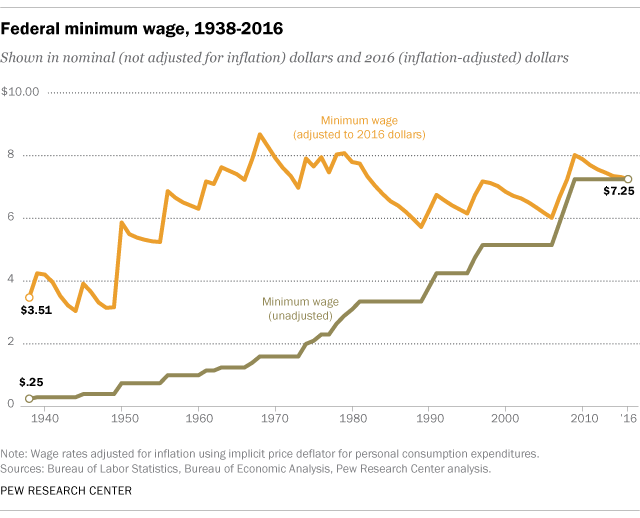
What I've not made clear is that I do not oppose raising the minimum wage. In fact, I think a review of the history of the wage suggests that it should be raised to approximately $8.40 an hour and then indexed to inflation thereafter. But the proposal to make the MD minimum $10.10 by 2016 simply goes too far and would likely have significant negative effects on youth and unskilled employment levels. Those advocating the $10.10 an hour wage like to claim that had the minimum wage in the late 1960s simply kept pace with inflation the wage today would be well be roughly$10.50 per hour. Unfortunately, those folks are being intentionally misleading.

In fact, a new Congressional Budget Office report puts the lie to most of the claims made in support of the $10.10 minimum wage. According to the report, such a wage hike would result in the loss of 500,000 jobs. Though the wage hike would theoretically inject $31 billion dollars into the economy, only 19% of that would benefit families living in poverty while 29% would benefit families earning three times the poverty level or more - this is because most of those earning the minimum wage are not in poor working families. But the $31 billion figure is actually meaningless. The CBO estimates that 93% of the $31 billion would be negated by lost income to businesses, lost income from the resultant job loss, and lost income due to higher prices caused by the wage hike. In Maryland, Martin O’Malley has argued that a $10.10 minimum wage would pump $456 million into the Maryland economy, but if the CBO estimates are accurate, that $456 million would actually be less than $30 million owing to job loss, higher prices and lost business income. As an alternative, the CBO considered a $9 minimum wage as well and noted far fewer negative effects.

Are Minimum Wage Earners Young and Childless or Working Parents?
The other justification for the $10.10 per hour proposal is that it would raise the income of a family of four, with a single parent working full time, to the poverty level.  But this a dubious goal. The average family size in American is 2.6, not 4. At a recent town hall meeting in southern Maryland Senator Ben Cardin offered some less than helpful statistics regarding those earning minimum wage. He said that roughly 2/3 are women and the average age of an earner is 35. His intent was clearly to create the impression that most minimum wage earners are single Moms. This is not the case. Roughly 1/3 of low income families are in house holds with a single adult.

As to the average age, the statistics shows why social scientists have three measures of central tendency, 1) the mean or simple average, 2) the median or value at which half the observations are above and half are below, and 3) the mode or the most frequently observed value.  Though most people are familiar with concept of an average, the measure can present a skewed picture. Imagine 10 people, 9 of them have $10 and one of them has $1,000. Calculating the average cash on hand is easy - $1,090/10=$109. Clearly that is not an accurate accounting of the group. The median and modal values would be $10 - more accurate.  So, back to minimum wage earners - consider the average age of 35 and a working life of 16-65 years of age. There are 19 measurable years between 16 and 35, but there are 30 measurable years between 35 and 65. Because our working life excludes our first 15 years of life, the simple average age of a minimum wage worker would skew "old." Consider how difficult it is to reconcile the average age with this fact: one-third of those earning the federal minimum wage are teens, and just over half of minimum wage earners are under the age of 25. If just over half are 25 of younger it suggests the median age is approximately 24 years old. And one final point, the vast majority of minimum wage earners are not the sole source of income for a family. So suddenly the image of minimum wage earners as single Moms disappears. It is true that about 1/4 of minimum wage earners fall into the category of parents with children - but it's inefficient and poor targeting to implement a 40% wage hike for the 75% of wage earners who are no parents supporting a family just to provide an income boost to 25% - and a recent piece in the Baltimore Sun demonstrated that as a result of the wage hike, many of those in that 25% would lose eligibility for social supports and wind up with less net income.

Would the Inflation Adjusted Wage Really Be over $10 per hour?
The following graph, courtesy of the unbiased folks at Pew, shows that the period from the late 1960s through at least 1981 were an unusually "generous" period for the minimum wage. But the period was far from the norm. If one were to select the late 1940s or the late 1950s as the basis for today's wage in would be far below $10.50, below $10.10, and below the current level of $7.25  - so claims of an inflation adjusted $10 minimum wage are simply disingenuous.  In the end, none of the main arguments for a $10 wage hold up to serious scrutiny.


Should the Wage Be Higher?
There is a case to be made that the inflation-adjusted average wage for the "generous" period should serve as a baseline for the wage moving forward. Without question, a concerted effort was made to increase the purchasing power of the minimum wage throughout the 1960s and 70s before a long slide began in the 1980s through until 2009. Boosting the wage to the 1960s and 70s level would yield a minimum wage for 2015 of approximately $8.40 per hour. If it were then indexed to inflation and automatically adjusted every year thereafter it would no longer go through long periods of decline followed by sudden increases. As result, it would provided some degree of predictability in the value of the wage to workers and the cost of labor to employers.

In a prior post I cited a New York study that estimated a 20% jump in job loss among the young and the unskilled as a result of a 30% hike in the state's minimum wage. Applying those findings to Baltimore City, where unemployment among those aged 16-24 is a devastating 31%, could lead to an unimaginable 37.5% unemployment rate. Beyond Baltimore City youth, the overall unemployment rates in Baltimore City, Washington county in western Maryland, and the counties of the lower Eastern Shore show that significant portions of the state simply could not absorb the job shock likely to be caused by a 40% wage hike.

The Governor and the folks at Raise the Wage estimate that over 500,000 workers would get a raise if the minimum were set at $10.10. With just under 3 million employed workers in the state that amounts to nearly 17%! That represents a significant new cost imposed upon businesses. How can anyone seriously think that employers will not respond by trimming hours, cutting positions, and refusing to hire the young and the less skilled?  How can anyone believe that the state's high unemployment counties will be made better off?

Senate President Mike Miller has been less than receptive to the idea of a $10.10 statewide minimum. He has raised the possibility of allowing counties to set their own wages. Though that is certainly preferable to a statewide minimum of $10.10 per hour, I think a wage of $8.40 per hour, adjusted for inflation thereafter, is the best option for the state (and the country). 

Wednesday, February 5, 2014

The Minimum Wage is a Poor Way to Support Working Families in Maryland

In a prior post, I argued against minimum and living wage schemes on the basis that they harm unskilled laborers and are far less effective than tax schemes like the Earned Income Tax Credit when it comes to targeting the working poor.  As Maryland lawmakers continue to consider a substantial hike in MD's minimum wage, I have been encouraged by the number of folks speaking against the perceived wisdom of such an increase.  Let me be clear, I do not oppose raising the minimum wage. In fact, I think a review of the history of the wage suggests that it should be raised to approximately $8.40 an hour and then indexed to inflation thereafter. But the proposal to make the MD minimum $10.10 by 2016 simply goes too far and would likely have significant negative effects on youth and unskilled employment levels.

In recent commentary, Barry Rascovar discussed the problems with a one-size-fits-all wage approach in a state with very different cost of living standards. Much like myself, Rascovar pointed to the better policy approach f increasing the Earned Income Tax Credit (a negative income tax that supplements the earnings of the working poor - especially those with children). Today, Howard Leathers, an associate professor in the Department of Agricultural and Resource Economics at the University of Maryland, published a piece in the Baltimore Sun in which he outlines the seemingly paradoxical reality that a substantial increase in the minimum wage would reduce net income for a working parent. In the example provided by Leathers, a 59% increase in the minimum wage would actually result in a 3% decline in net income for a working parent. How can that be? The answer is simple, with the higher wages, the low income working parent would pay higher taxes and lose eligibility for crucial social supports such as Food Stamps, subsidies for child care, and housing assistance.

Many may consider it a good thing for people to be more self reliant. In fact, decreased eligibility for social programs would result in less government spending for those programs - in theory. But consider the costs. The decreased government spending would be offset by higher spending by employers as a result of the higher hourly wage. Many of the businesses that pay minimum wage are small businesses with precious little profit margin. Faced with higher wage costs, those businesses would likely increase prices (if the market will allow) and customers would pay more for goods and services. Those businesses are likely as well to reduce their labor costs by reducing their workforce - meaning more unemployed individuals suddenly eligible for social support services. So we'd be left with some workers receiving a higher wage, but many being worse off due to lost benefits. And we'd have more people unemployed and drawing on the social services that the higher wages were supposedly replacing. It's a perverse form of income transfer as the low income workers who lose their jobs transfer their lost income to those who keep their jobs. Then, those who keep their jobs transfer their social service benefits to the newly unemployed.

And make no mistake, a minimum wage hike like that being proposed in Maryland will have a  negative impact on employment. Consider just two recent studies - in the first, professors from Texas A&M University determined "that the minimum wage reduces net job growth, primarily through its effect on job creation by expanding establishments. These effects are most pronounced for younger workers and in industries with a higher proportion of low-wage workers." In other words, businesses respond to higher wages by either not expanding or by hiring fewer employees when then do expand. The second study is the most compelling. Most studies of the employment effects of the minimum wage consider the impact of marginal increases in the wage - increases in the range of 10% or so. Maryland is considering a 40% increase in its minimum wage. Such dramatic increases are rare, and even more rarely studied. New York state implemented a 30% wage increase about 10 years ago and a recently published paper examined the impact of that increase. According to the authors - all college professors with expertise in the matter -  "the NYS minimum wage increase is associated with a 20.2% to 21.8% reduction in the employment of less-skilled, less-educated workers, with the largest effects on those aged 16 to 24."  Their results provide substantial evidence that state minimum wage increases can have significant adverse labor demand effects for low-skilled individuals.

To put the New York study into perspective, consider this - the unemployment rate in Baltimore City for those aged 16-24 is a devastating 31%. That is more than twice the statewide youth rate of 13.4% and nearly double the national rate of 16.1%. Imagine a 21% increase in youth unemployment in Baltimore City. Instead of a devastating 31% we'd see a catastrophic 37.5% rate. That is simply unacceptable - but the empirical data, and Governor O'Malley always claims to be driven by data and not ideology, suggests that a $10 minimum wage would only exacerbate an already out of control unemployment problem in Baltimore. Good luck finding anyone who would argue that a 40% increase in the minimum wage would improve the employment situation in Baltimore City.  The Governor and the folks at Raise the Wage estimate that over 500,000 workers would get a raise if the minimum were set at $10.10. With just under 3 million employed workers in the state that amounts to nearly 20%! That represents a significant cost imposed upon businesses - how can anyone seriously think that employers will not respond by trimming hours, cutting positions, and refusing to hire the young and the less skilled?

I'd like to address as well the issue of income inequality and effective means of targeting the needs of the working poor. Minimum wage laws are indiscriminate and incredibly inefficient policy tools. Is it really a problem if an 17 year old middle class kid living at home earns $7.25 an hour while working at a fast food restaurant? The obvious answer is "no." That kid is not supporting a family and is not trying to "live" on minimum wage. At present, one-third of those earning the federal minimum wage are teens, and just over half of minimum wage earners are under the age of 25. The vast majority of minimum wage earners are not the sole source of income for a family. But employers are not permitted to offer different wages to different employees doing the same job simply based on need (keep in mind, it was once common for employers to pay men more than women for doing the same job based on the notion that men had families to support - today we call such practices discriminatory). Using the minimum wage to target the needs of working families would require employers to pay substantially higher wages to all workers. So in order to provide a $10.10 wage to a working parent with two kids an employer would need to provide that same wage to an upper middle class kid working part time to earn pizza money. That is not sound policy.

I may not care if that middle class kid earns $7.25 an hour, but do I care if a mother or father working one full time or several part time jobs is unable to meet the basic needs of their family. As a policy person, and as someone who believes in "to each according to their need," the question must be - how can we best support that family? The answer is not some misguided one size fits all minimum wage that treats the 17 year old and the single parent as if they are the same. The answer is not a minimum wage hike that effectively lowers the net income of working parents while simultaneously increasing unemployment.

Social support programs such as Food Stamps, child care subsidies, and the earned income tax credit allow society to effectively target need without creating the negative effects of artificially inflated wages. And perhaps of even greater import, these social programs are more effective at addressing inequality. A higher minimum wage simply transfers income between low income workers - those that keep their jobs and those that lose their jobs. But social programs like those listed here effectively transfer income from the well-off who pay income taxes to the less well off who earn too little to pay income taxes.

Those advocating the $10.10 an hour wage like to claim that had the minimum wage in the late 1960ssimply kept pace with inflation the wage today would be well be roughly$10.50 per hour. Unfortunately, those folks are being intentionally misleading.

The following graph, courtesy of the unbiased folks at PEW, shows that the period from the late 1960s through at least 1981 were an unusually "generous" period for the minimum wage. But the period was far from the norm. If one were to select the late 1940s or the late 1950s as the basis for today's wage in would be far below $10.50, below $10.10, and below the current level of $7.25  - so claims of an inflation adjusted $10 minimum wage are simply disingenuous.  That said, there is a case to be made that the inflation-adjusted average wage for the "generous" period should serve as a baseline for the wage moving forward. Without question, a concerted effort was made to increase the purchasing power of the minimum wage throughout the 1960s and 70s before a long slide began in the 1980s through until 2009. Boosting the wage to the 1960s and 70s level would yield a minimum wage for 2015 of approximately $8.40 per hour. If it were then indexed to inflation and automatically adjusted every year it would no longer go throw long periods of decline followed by sudden increases - it would provided some degree of predictability in the value of the wage to workers and the cost to consumers.


The real choice facing lawmakers in Annapolis is not whether or not they should support working families, rather it is how best they can support those working families. I think a wage of $8.40 per hour, adjusted for inflation, is the best option for the state and the country. 

Thursday, January 30, 2014

The Difference Between Polarization and Party Sorting...

Discussions of contemporary American politics tend to center around the issue of polarization and the notion that Americans are deeply divided over a host of issues. This deep division is driving our elected officials to eschew cooperation and compromise. There is a robust debate among political scientist regarding the true nature of polarization in American.  An ongoing series by the Monkey Cage blog is exploring the issue of polarization and providing an avenue for very diverse and often contradictory perspectives.

One of the areas of disagreement concerns the depth of polarization in America. On one side of the argument, political scientists such as Alan Abramowitz contend that the mass electorate is deeply polarized and the deep polarization evident in Congress and many state legislatures is reflective of voter preferences. On the other side of the argument, political scientists like Morris Fiorina argue polarization is largely an elite-driven phenomenon. Fiorina contends the American public is no more polarized today than it was four decades ago. Rather, political elites - those most active in politics - have redefined the priorities of the two political parties such that they now endorse diametrically opposed agendas on a host of policy questions. Given the stark contrast between the two parties, Americans have sorted more neatly among the opposing camps. The Democratic party was once home to many conservative voters and the Republican party included more moderate and liberal voters among its coalition. As political activists took the Democratic party to the left and the Republican party to the right, liberal, moderate, and conservative voters reacted by sorting into the party that most closely matched their preferences.

So how is this not polarization? First, consider the arguments offered by Abramowitz. He argues that the distance between Democrats and Republicans on key policy questions are evidence of a polarized public.  I'll use the example of attitudes regarding abortion to illustrate his argument. The following graph compares the attitudes of self identified Democrats and Republicans regarding the legality of abortion in 1980 and in 2008. The blue bar represents a liberal attitude (legal in all cases), the green bar a conservative attitude (illegal in all cases), and the red bar is a moderate position (legal in some cases).The data for 1980 reveal something interesting - 34 years ago, there was precious little difference between Democrats and Republicans regarding abortion. Roughly equal portions of each party opposed or supported abortion rights.

Figure One

But by 2008, we see a more familiar distribution of opinions. Democrats are now clearly the party of abortion rights and Republicans the party of abortion restriction. Members of the two parties are polarized on the issue of abortion - so clearly we would expect our elected officials to mirror this mass polarization and refuse to compromise on abortion.

But does the abortion question actually reveal a polarized electorate? Does it truly demonstrate polarization at the mass level rather than the elite level? Consider Figure Two. In Figure Two I am presenting the same data presented in Figure One, except for a single difference, instead of dividing the public into Democrats and Republicans I considered them collectively. What a difference that choice makes - and the difference is the difference between polarization and party sorting. The data in Figure Two make one thing very clear, the electorate is no more polarized today on the issue of abortion than it was in 1980.

Figure Two

So how do we explain the polarization between identified Democrats and Republicans, given little has changed among the two groups when considered collectively? We explain it by looking to the actions taken by political elites.

In 1972, abortion rights advocates pushed to have a plank added to the Democratic Party Platform defending the legality of abortion. The push failed. In 1976, party activists were able to insert the first supportive abortion language into the platform, but it was a mild statement: "We fully recognize the religious and ethical nature of the concerns which many Americans have on the subject of abortion. We feel, however, that it is undesirable to attempt to amend the U.S. Constitution to overturn the Supreme Court decision in this area."  In 1980, activists were able to expand the statement of support a bit more: "We fully recognize the religious and ethical concerns which many Americans have about abortion. We also recognize the belief of many Americans that a woman has a right to choose whether and when to have a child. The Democratic Party supports the 1973 Supreme Court decision on abortion rights as the law of the land and opposes any constitutional amendment to restrict or overturn that decision." Again, hardly a polarizing stance. Over time, the language became more bold, 1988: that the fundamental right of reproductive choice should be guaranteed regardless of ability to pay... 2008: The Democratic Party strongly and unequivocally supports Roe v. Wade and a woman's right to choose a safe and legal abortion, regardless of ability to pay, and we oppose any and all efforts to weaken or undermine that right.

Changes were taken place in the Republican platform as well. The party's 1976 platform barely mentioned abortion other than endorsing "a position on abortion that values human life." In 1980, Republican activist make a more clear statement, while also recognizing differences of opinion: "While we recognize differing views on this question among Americans in general—and in our own Party—we affirm our support of a constitutional amendment to restore protection of the right to life for unborn children. We also support the Congressional efforts to restrict the use of taxpayers' dollars for abortion." By 2008, there could be no doubt regarding the Republican party's position on abortion: "We oppose using public revenues to promote or perform abortion and will not fund organizations which advocate it... We support the appointment of judges who respect traditional family values and the sanctity and dignity of innocent human life. We have made progress. The Supreme Court has upheld prohibitions against the barbaric practice of partial-birth abortion. States are now permitted to extend health-care coverage to children before birth. And the Born Alive Infants Protection Act has become law; this law ensures that infants who are born alive during an abortion receive all treatment and care that is provided to all newborn infants and are not neglected and left to die. We must protect girls from exploitation and statutory rape through a parental notification requirement. We all have a moral obligation to assist, not to penalize, women struggling with the challenges of an unplanned pregnancy. At its core, abortion is a fundamental assault on the sanctity of innocent human life. Women deserve better than abortion. Every effort should be made to work with women considering abortion to enable and empower them to choose life."

Over the course of three decades, party activist worked to define a Democratic and Republican party position regarding abortion that suited their preferences. These activists represent a decidedly small segment of the population, but exert tremendous influence over the direction of each party. As the differences between the two parties regarding abortion became ever more clear, voters responded by more neatly sorting into the two camps. The electorate is no more divided on the issue of abortion today than it was 30 years ago - but the two political parties are much more divided and that division defines contemporary politics and discourse.

Over the past several decades, liberal and conservative activists have worked to redefine the political parties in their ideological images. On a host of issue ranging from health care, taxation, welfare spending, abortion, and same sex marriage the parties are increasingly defined by their stark contrasts with one another. But this stark contrast is an elite and activist driven process, one that the electorate must then adapt to and contend with.

Without question, the resultant party sorting contributes to the polarization process by reinforcing the Us v. Them nature of contemporary party politics. But if elites and activists were to stop promoting division, if they were to stop creating a zero sum political game, then the electorate would no longer be compelled to choose a side. There's a reason why the party coalitions of 2008 represented in Figure One are no longer able to forge the compromises that their counterparts did in 1980 - and the reason is elite driven.
 

Wednesday, January 15, 2014

Should an 88 Year Old Man Lose His Home Over a $720 Sewer Bill? I Say No (and with your help, so might the General Assembly).

Update: Members of the St. Mary's County delegation to the General Assembly will be meeting to discuss legislative changes to MetCom's tax lien authority.  Please keep making calls and sending emails!

Original Post
For those of you unfamiliar with the story, an 88 year old man in St. Mary's County, named Combs Toney, was faced with the possible loss of the home he had lived in since the age of 5. Mr. Toney's home was never connected to our public water and sewer operated by a quasi-governmental utility - MetCom. Even though Mr. Toney was never connected to the public water/sewer and had his own well and an inspected and properly functioning septic tank, but because of his proximity to the public lines he was required to pay for monthly service. Mr. Toney paid his "bill" for many years. But his retirement income became tight after his wife became ill and required in-home dialysis (which she still receives). Something had to give, so Mr. Toney decided that he would no longer pay MetCom for a service he didn't receive. But MetCom has a power that few other utilities have - MetCom has the power to impose a tax lien on someones home for lack of payment. As Mr. Toney's bills accrued, MetCom imposed the tax lien and was taking his house to public auction. The sum total of his overdue bills? $719. MetCom refused to consider Mr. Toney's circumstances and argued they were required by law to impose the lien. He was 88 and facing the loss of his home, a home where his wife was receiving dialysis. Mr. Toney's bill has since been paid, but only through January 31st. At which time his bills will once again accrue and a tax sale threat could return.

I am asking people to take action and prevent this from happening to others. I need people to contact the Democratic members of the General Assembly from St. Mary's County and urge them to introduce legislation that would restrict or eliminate MetCom's power to impose tax liens. They should rely on the same bill collection practices of other utilities such as electric or phone.  If you are so inclined, would you consider contacting Del. John Bohanan, 1-800-492-7122, ext. 3227, john.bohanan@house.state.md.us,  or Johnny Wood, 1-800-492-7122, ext. 3170, john.wood@house.state.md.us, or Senator Roy Dyson, 1-800-492-7122, ext. 3673, roy.dyson@senate.state.md.us, and ask them to introduce a bill that would restrict or eliminate MetCom’s power to impose tax liens? Otherwise this will happen again, either to Mr. Toney or to someone else.

Monday, January 13, 2014

Maryland Needs to Embrace the Natural Gas Economy

Those who think we are on the cusp of a green energy revolution should read the latest issue of Scientific American. Professor Vaclav Smir, in an article titled "The Slow Rise of Solar and Wind, notes that all global energy transitions have taken 50-60 years, with the pace slowing, not increasing over time. He estimates we are 50-75 years away from renewable sources achieving a meaningful market share of energy production - especially in a world with roughly $20 trillion invested in infrastructure to support the fossil fuel system. He found that since 1980, the best return on federal investment has come not from renewables but from work on horizontal drilling and fracking shale deposits.

We cannot spend the next 3 generations burning ever more coal, it is a dirty and dangerous fuel source and a major contributor to global CO2 increases. People need to see natural gas for the crucial and beneficial stopgap that it is. Our nation's steady transition to natural gas in recent years resulted in U.S. CO2 emissions falling to their lowest levels in 20 years

The more we replace coal with gas, the better off we are. In MD, the Western part of the state sits atop one of the largest known shale gas deposits - the Marcellus Shale. But while other states are busy extracting gas from the shale beneath their states, Maryland dithers. Many want to ban hydraulic fracking in the state - convinced that a green energy revolution is right around the corner. What they're really doing is perpetuating the use of coal. We need to stop playing politics with the Western MD shale deposits and start extracting the natural gas.

And then we need to allow a new liquefied natural gas export facility in Sourthern MD at Cove Point (quite literally my back yard) so that we can export our natural gas to nations that might otherwise be burning coal. In the last decade, China has invested $500 million in New coal fired power plants to produce 300 gigawatts of new energy. According to Smil, that's more than the combined fossil fuel generating capacity of France, Germany, Italy, Spain, and the UK! There can be no question but that natural gas is the better and the greener alternative. But for a country to rely on gas instead of coal, gas must be available and the supply reliable. We can make that happen. So why is Maryland standing in the way?

Tuesday, December 10, 2013

Why I Oppose Making the Minimum Wage a Living Wage

I get flack for opposing living wage schemes and minimum wage hikes... but I'm proud to oppose both. And I oppose them because I believe in a simple philosophy, "from each according to ability, and to each according to need." Neither the living wage nor a higher minimum wage live up to that belief - in fact, they undermine it. A column today from David Neumark perfectly captures my beliefs on the matter - so I quote from it heavily in the paragraphs below.

"Proponents of raising the minimum wage often point out that the real minimum wage is lower now than it was decades ago.  But the federal policy aimed at low-wage work and low-income families has shifted — wisely — away from reliance on the minimum wage and toward a generous earned-income tax credit, which is better focused on poor families.  There is nothing wrong with reducing our reliance on a less effective policy when we have adopted a more effective one.  In fact, we should hope that research on public policy leads to exactly this kind of outcome."

Minimum wages and living wages are indiscriminate and incredibly inefficient policy tools. I don't care if an 17 year old living at home earns $7.50 an hour to put a basket of frozen fries into a vat of oil. I would care if that kid suddenly made $15 for doing the same skilless task. However, I do care if a mother or father is working a full time or even several part time jobs and is still unable to meet the basic needs of their family. As a policy person, and as someone who believes in "to each according to need," the question must be - "how can we best support that family?" The answer is not some misguided one size fits all minimum wage that treats the 17 year old and the parent as if they are the same.

The Earned Income Tax Credit allows us, as a society, to support working families by targeting income to those who need it most. "So suggesting that federal policy addressing low-wage work and low-income families has somehow failed because the minimum wage has not kept pace with inflation ignores the fact that we have moved away from a focus on the minimum wage — a policy with many flaws — and toward the earned-income tax credit."

"Nonetheless, there are important differences between the earned-income tax credit and the minimum wage. The fundamental difference is that the earned-income tax credit aims benefits at low-income families with children, rather than simply low-wage workers. This is in large part its virtue, and it makes a lot more sense than the minimum wage’s focus on low-wage workers."

The earned income tax credit is targeted to working families, it enjoys bipartisan support, it's indexed to inflation, and it does not negatively impact the employment of teens and unskilled workers. It is in every way superior to a living wage or a higher minimum wage. And people and policymakers who want to help working families really need to shift their focus away from those inefficient and inappropriate policy options.

Friday, November 22, 2013

Why Are So Many Saying Obama Has Had A "Katrina Moment"? Because He Has.

I've been amused of late by the hyperbolic reaction of Obama supporters to the myriad commentaries arguing the Obama has had his "Katrina moment." Most of the folks making such statements are referring to the failure of the Affordable Care Act rollout. I'm actually proud to have been among the first to have written of an Obama "Katrina moment." In an piece for the Baltimore Sun this Summer, I argued that Obama had lost control of the narrative and that the 1, 2, 3 hits of the Benghazi attack, the IRS scandal, and then the first major leak regarding the monitoring of reporters' phones threatened to undermine his second term. Of Obama I wrote, "Mr. Obama was ...the reliable and competent manager who understood there was a positive role for government in improving people's lives. If Mr. Obama is not careful, that image will collapse in spectacular fashion." And collapse it did, then he found himself in the midst of the failed roll-out with no political capital to draw on.

The main point of contention offered up by the rose colored glasses crowd is that there is no literal comparison between hurricane Katrina and the roll out of the Affordable Care Act, or the IRS scandal, etc... To their argument I say, "well duh." Of course there's no literal comparison. The "Katrina moment" is what those of us who took high school English refer to as an analogy  -  an assertion of similarity, on some point of comparison, between things that are otherwise unrelated. No one is making a literal comparison to Katrina, rather we're making a figurative comparison. 

Let me provide an example of an analogy in action. In late 2010 we learned that US students were trailing students from Shanghai in reading, math, and science - according to the Program for International Student Assessment standardized test. In reaction to the news, President Obama said, "Fifty years later, our generation’s Sputnik moment is back...” People in India and China are now “plugged into the world economy,” and nations with the most educated workers will prevail. “As it stands right now, America is in danger of falling behind.”

Now understand, there is no literal comparison to be made between the US government falling behind the Soviet Union in the space race and our high school students falling behind other nations in math, science, and reading. No literal comparison, but an assertion that, on some point of comparison, our students' poor performance on the tests was the same as the otherwise unrelated Sputnik launch. What was the point of comparison? The US was falling behind.

So why are some now saying Obama has had a Katrina moment? Simple, back in 2005, President Bush's approval rating was already in decline when hurricane Katrina hit Louisiana and FEMA botched the response. But Bush's favorability rating had remained strong. In other words, people didn't like the job he was doing, but they still liked him and still considered him to be trustworthy and competent. All of that changed after Katrina and Bush never recovered. Therein lies that point of comparison essential to any good analogy. Heading into the Summer of 2013, Obama's approval rating was in decline, but his favorability rating was very strong. Folks weren't thrilled with his job performance, but they still liked and trusted him. The cumulative effect of the IRS scandal, the ongoing leaks from Edward Snowden, and now the roll-out of the Affordable Care Act and the clearly false assertion that people could keep their existing health insurance has been a collapse in Obama's approval rating AND his favorability rating. People lost faith in his competence and his trustworthiness. I maintain that the Katrina moment came this past Summer, most others say it was health reform. Either way, the analogy is appropriate.

Even after Katrina, Bush maintained the support of a dedicated 35-40% of the public. No matter what, there was a delusional minority convinced that all was well. The folks who are now refusing to accept the relevance of the Katrina analogy are just the members of the Obama minority - the core group who will never be able to accept that Obama is not the transformational deliverer of hope and change that they believed they were voting for. Instead, he is and was a rather conventional politician with no special governing talents. Now, he's a rather conventional politician with no political capital and the very real possibility that he will spend the next three years as a lame duck.  No calm down, he's not literally a lame duck, it's just another one of those analogies.

And no, I do not derive any pleasure from making the analogy or from seeing Obama's popular support collapse. With the exception of the changes to the individual market, I support the affordable care act and want it to succeed. I want comprehensive immigration reform with a path to citizenship. I want No Child Left Behind to be reauthorized, but with an incentive structure and not a penalty structure. I support the Common Core as a replacement for the perverse incentives created by Adequate Yearly Progress and 100% proficiency requirements. All of these issues are on Obama's second term agenda. None of them will happen so long as Obama has a 40% approval rating and an upside down favorability rating. And once a president loses the confidence of the people, it's nearly impossible to earn it back.

Tuesday, November 5, 2013

In Maryland Speech, Obama Promised No Changes for Individual Market Plans

Let me preface this post by stating something that some new readers may not know, I supported the Affordable Care Act when it was passed in 2010. I continue to support substantial portions of it, especially the use of tax credits and insurance exchanges to extend coverage to the uninsured. That said, I consider the substantial disruption of the Individual Health Insurance Market to be an unacceptable outcome. As pointed out I my last post, the original legislation grandfathered most existing plans, but when the Department of Health and Human Services published implementing regulations they made the grandfather restrictions so severe that their own estimate was the decimation of the Individual Market. It serves no purpose, it is not essential for the law's success, it is paternalistic and cruel. I am also outraged by the fact that the President continued to promise people they could keep their existing plans long after who knew it wasn't true. On a recent trip to Maryland, the President once again made his all to familiar pledge.

As the news on millions of cancellation notices continues to grab headlines, the White House and sympathetic supporters have been trying to pretend that President Obama never actually promised that Americans could keep their existing health plans. The President himself has suddenly claimed that he always told people there would be exceptions to his promise... too bad that he never actually told people there would be exceptions. And the President kept making that promise even after his own Department of Health and Human Services published predictions in the Federal Register acknowledging that upwards of 10 million Americans will see their existing coverage cancelled.

President Obama brought his promise to Maryland on Sept. 26 in a speech meant to tout the soon to launch healthcare.gov website. In his speech, he repeated the claim that people could keep their existing insurance. What makes this speech different is that he made specific reference to the individual market.
"Now, let’s start with the fact that even before the Affordable Care Act fully takes effect, about 85 percent of Americans already have health insurance -– either through their job, or through Medicare, or through the individual market.  So if you’re one of these folks, it’s reasonable that you might worry whether health care reform is going to create changes that are a problem for you -- especially when you’re bombarded with all sorts of fear-mongering.
So the first thing you need to know is this:  If you already have health care, you don’t have to do anything.  In fact, for the past few years, since I signed the Affordable Care Act, a lot of you have been enjoying new benefits and protections that you didn’t before even if you didn’t know they were coming from Obamacare."

The Maryland speech marks one of the few times the President made a specific reference to folks in the Individual Market and he clearly implied promised "If you already have health care, you don’t have to do anything." No caveats. No reference to plan changes. Just a promise. A completely untrue promise that he knew to be untrue at the time he made it. It's hard to explain how a President could tell folks that they "don't have to do anything" when his own folks tolk him that roughly 10 million of those people on the individual market would have to find new coverage.

*** I've actually received emails from folks arguing that nothing in the excerpted paragraphs could possibly be interpreted as a promise that folks could keep their existing coverage. Seriously. Sorry, folks, the reality is there's simply no other way to read those paragraphs other than as just such a promise.