Showing posts with label polarization. Show all posts

Wednesday, April 25, 2018

Polarization in America Is Not Ideological

Across two books and multiple blog posts I have argued that Americans ARE NOT ideologically polarized nor are they more partisan. Rather we're less attached to party and most Americans lack a cohesive ideology. Ideological polarization and entrenched partisanship are instead reserved for political elites.
A new study by Eric Groenendyke makes the case far more eloquently: In short, he finds no evidence to support claims of mass polarization along ideological lines. In fact, their is widespread policy agreement among Americans on all be a few issues. Additionally, there is no evidence of Americans becoming more attached to their parties. Instead, he finds few people love, or even like, their own party or think it represents their interests well. Nevertheless, voters increasingly hate the other party, and this is enough to keep them in their respective parties. The more frustrated folks become with their own party, the more they denounce and demonize the other party. Demonizing the other party makes voters feel better about sticking with a party that doesn't do a good job representing them. And the more a party acts out of fear and loathing toward the other party there is less cooperation and compromise and more reasons for voters to dislike their party and more reasons for the other party to demonize their party.
Think of it this way, many folks who voted for Trump didn't care what policies he proposed or his character flaws. They cared that he wasn't a Democrat. Much as many voted against him not because of who he was or love of Clinton but because he was a Republican. That means as well that should he run for re-election, many voters will be motivated to vote AGAINST the Democrat with little care for what Trump has done or not done.
This type of polarization and partisanship is especially unhealthy. Because folks are voting against the other party instead of for their own party the winning party receives no mandate to govern. Rather once the "other" party loses voters tend to focus on the reasons why they dislike their own party. If Groenendyke is correct then the more dissatisfied voters become with their own party the more they will look to demonize the other party.
This suggests that Trump's frequent tirades against Republicans and well as Democrats may be a very effective way to keep his base.

Thursday, January 30, 2014

The Difference Between Polarization and Party Sorting...

Discussions of contemporary American politics tend to center around the issue of polarization and the notion that Americans are deeply divided over a host of issues. This deep division is driving our elected officials to eschew cooperation and compromise. There is a robust debate among political scientist regarding the true nature of polarization in American.  An ongoing series by the Monkey Cage blog is exploring the issue of polarization and providing an avenue for very diverse and often contradictory perspectives.

One of the areas of disagreement concerns the depth of polarization in America. On one side of the argument, political scientists such as Alan Abramowitz contend that the mass electorate is deeply polarized and the deep polarization evident in Congress and many state legislatures is reflective of voter preferences. On the other side of the argument, political scientists like Morris Fiorina argue polarization is largely an elite-driven phenomenon. Fiorina contends the American public is no more polarized today than it was four decades ago. Rather, political elites - those most active in politics - have redefined the priorities of the two political parties such that they now endorse diametrically opposed agendas on a host of policy questions. Given the stark contrast between the two parties, Americans have sorted more neatly among the opposing camps. The Democratic party was once home to many conservative voters and the Republican party included more moderate and liberal voters among its coalition. As political activists took the Democratic party to the left and the Republican party to the right, liberal, moderate, and conservative voters reacted by sorting into the party that most closely matched their preferences.

So how is this not polarization? First, consider the arguments offered by Abramowitz. He argues that the distance between Democrats and Republicans on key policy questions are evidence of a polarized public.  I'll use the example of attitudes regarding abortion to illustrate his argument. The following graph compares the attitudes of self identified Democrats and Republicans regarding the legality of abortion in 1980 and in 2008. The blue bar represents a liberal attitude (legal in all cases), the green bar a conservative attitude (illegal in all cases), and the red bar is a moderate position (legal in some cases).The data for 1980 reveal something interesting - 34 years ago, there was precious little difference between Democrats and Republicans regarding abortion. Roughly equal portions of each party opposed or supported abortion rights.

Figure One

But by 2008, we see a more familiar distribution of opinions. Democrats are now clearly the party of abortion rights and Republicans the party of abortion restriction. Members of the two parties are polarized on the issue of abortion - so clearly we would expect our elected officials to mirror this mass polarization and refuse to compromise on abortion.

But does the abortion question actually reveal a polarized electorate? Does it truly demonstrate polarization at the mass level rather than the elite level? Consider Figure Two. In Figure Two I am presenting the same data presented in Figure One, except for a single difference, instead of dividing the public into Democrats and Republicans I considered them collectively. What a difference that choice makes - and the difference is the difference between polarization and party sorting. The data in Figure Two make one thing very clear, the electorate is no more polarized today on the issue of abortion than it was in 1980.

Figure Two

So how do we explain the polarization between identified Democrats and Republicans, given little has changed among the two groups when considered collectively? We explain it by looking to the actions taken by political elites.

In 1972, abortion rights advocates pushed to have a plank added to the Democratic Party Platform defending the legality of abortion. The push failed. In 1976, party activists were able to insert the first supportive abortion language into the platform, but it was a mild statement: "We fully recognize the religious and ethical nature of the concerns which many Americans have on the subject of abortion. We feel, however, that it is undesirable to attempt to amend the U.S. Constitution to overturn the Supreme Court decision in this area."  In 1980, activists were able to expand the statement of support a bit more: "We fully recognize the religious and ethical concerns which many Americans have about abortion. We also recognize the belief of many Americans that a woman has a right to choose whether and when to have a child. The Democratic Party supports the 1973 Supreme Court decision on abortion rights as the law of the land and opposes any constitutional amendment to restrict or overturn that decision." Again, hardly a polarizing stance. Over time, the language became more bold, 1988: that the fundamental right of reproductive choice should be guaranteed regardless of ability to pay... 2008: The Democratic Party strongly and unequivocally supports Roe v. Wade and a woman's right to choose a safe and legal abortion, regardless of ability to pay, and we oppose any and all efforts to weaken or undermine that right.

Changes were taken place in the Republican platform as well. The party's 1976 platform barely mentioned abortion other than endorsing "a position on abortion that values human life." In 1980, Republican activist make a more clear statement, while also recognizing differences of opinion: "While we recognize differing views on this question among Americans in general—and in our own Party—we affirm our support of a constitutional amendment to restore protection of the right to life for unborn children. We also support the Congressional efforts to restrict the use of taxpayers' dollars for abortion." By 2008, there could be no doubt regarding the Republican party's position on abortion: "We oppose using public revenues to promote or perform abortion and will not fund organizations which advocate it... We support the appointment of judges who respect traditional family values and the sanctity and dignity of innocent human life. We have made progress. The Supreme Court has upheld prohibitions against the barbaric practice of partial-birth abortion. States are now permitted to extend health-care coverage to children before birth. And the Born Alive Infants Protection Act has become law; this law ensures that infants who are born alive during an abortion receive all treatment and care that is provided to all newborn infants and are not neglected and left to die. We must protect girls from exploitation and statutory rape through a parental notification requirement. We all have a moral obligation to assist, not to penalize, women struggling with the challenges of an unplanned pregnancy. At its core, abortion is a fundamental assault on the sanctity of innocent human life. Women deserve better than abortion. Every effort should be made to work with women considering abortion to enable and empower them to choose life."

Over the course of three decades, party activist worked to define a Democratic and Republican party position regarding abortion that suited their preferences. These activists represent a decidedly small segment of the population, but exert tremendous influence over the direction of each party. As the differences between the two parties regarding abortion became ever more clear, voters responded by more neatly sorting into the two camps. The electorate is no more divided on the issue of abortion today than it was 30 years ago - but the two political parties are much more divided and that division defines contemporary politics and discourse.

Over the past several decades, liberal and conservative activists have worked to redefine the political parties in their ideological images. On a host of issue ranging from health care, taxation, welfare spending, abortion, and same sex marriage the parties are increasingly defined by their stark contrasts with one another. But this stark contrast is an elite and activist driven process, one that the electorate must then adapt to and contend with.

Without question, the resultant party sorting contributes to the polarization process by reinforcing the Us v. Them nature of contemporary party politics. But if elites and activists were to stop promoting division, if they were to stop creating a zero sum political game, then the electorate would no longer be compelled to choose a side. There's a reason why the party coalitions of 2008 represented in Figure One are no longer able to forge the compromises that their counterparts did in 1980 - and the reason is elite driven.
 

Wednesday, September 11, 2013

Intra-State Secessionist Movements a Symptom of a More Serious Disease

A small group of Western Marylanders are pursuing a quixotic secessionist movement that would see the state's 4 western counties break away and form a new state. Led by Scott Strzelczyk, the secessionists argue Maryland is controlled by a single party and by folks elected from 3 jurisdictions - Baltimore, Montgomery County, and Prince Georges County. Everyone else, they say, is being ignored.

Given that western Maryland is overwhelmingly white and rural, some have been quick to dismiss the secessionist movement as a race-based action motivated by white voters fearful of growing diversity in the state. Though such arguments may hold a kernel of truth, they obscure the more fundamental cause for these movements in Maryland and elsewhere. These intra-state movements are driven by a complex mix of issues that go to the very heart of a representative Democracy.

It's important to understand that what's happening in Western MD is not unique to the region or to MD.  For decades there has been a secessionist movement on the Eastern Shore. The movement's strength ebbs and flows much like the tides that surround the region. Proposals for a new state date back to the 1830s. In 1998, legislation was introduced that would have put the question of Eastern Shore secession on the ballot. Eastern Shore secessionists argue the region is not well represented in Annapolis, that tax dollars generated by tourists are not appropriately reinvested in the area, and that transportation monies are consistently directed elsewhere.

In Colorado multiple rural counties have pursued secession in an effort to create one or more new states. Movement organizers, including elected officials from the secessionist counties, argue their interests are not being represented in a state legislature dominated by officials from more suburban and urban counties. Recent gun control legislation as well as new renewable energy standards placed on electric cooperatives (common in rural areas) have bolstered the movement.

Lest you think the secession movements are all the result of disgruntled conservative, understand that disgruntled liberals are looking to secession as well. As recently as 2008 and again in 2012 Democratic officials in southern Florida sought to separate from the Republican rest of the state. And liberals in southern Arizona, frustrated by Republican dominance in the state capital, have pursued secession as well.

And these are just a selection of the intra-state secession movements active in the U.S. today. It's important to understand that intra-state secession movements are quite different from the secession movements seeking to separate from the United States altogether. Intra-state secessionist are not disillusioned with the United States, rather they are frustrated by a political system that they believe to be ignoring them - and the reality is, they probably are being ignored.

Given the deep divide between elected Democrats and Republicans, being a political minority in a state or legislative district likely means being marginalized. In truly competitive states and legislative districts, elected officials cannot afford to alienate voters not in their party. In such states and districts, fellow partisans lack sufficient numbers to ensure victory. As the parties have polarized and Democrats have become more consistently liberal and Republicans more consistently conservative some states that were once competitive no longer are. Maryland is a good example. Though Maryland has been dominated by Democrats since Reconstruction, Republicans were once more successful in the state. Ronald Reagan and George H.W. Bush carried MD in 1984 and 1988. Mac Mathias represented the state in the U.S. Senate for 18 years until 1987. But the parties were not as polarized then. There were plenty of moderate Democrats and Republicans and substantial bipartisan cooperation. In such an environment, conservative leaning voters are more comfortable voting for Democrats and liberal leaning voters are more comfortable voting for Republicans. In such an environment, competitive states and districts are more likely.

In the present era, however, voting Republican only makes sense if you have a preference for conservatism over liberalism - even if it's a slight preference. Voting Democrat only makes sense if you have a preference for liberalism over conservatism - even if it's slight. As a result, once competitive states have become less competitive. The number of landslide states has grown (states where one party typically wins the presidential vote by at least 10 points). It's important to understand this can happen even if the voters themselves have not become more liberal or conservatives - more polarized. It's not that voters polarized, it's that the parties and therefor candidates polarized. In an election between two polarized candidates, a non-polarized electorate can make polarized choices.

In Congressional and state legislative districts a similar dynamic has been playing out, but it has been assisted by power hungry partisans and frustrated people voting with their feet. As recently as 1992, there were about 103 truly competitive swing districts in Congress and about 123 landslide districts. Today, there are roughly 35 swing districts and 242 landslide districts. Some of this reflects the reality of voters choosing between two polarized candidates, but it also reflects substantial advances in the gerrymandering of congressional districts - drawing districts to either advantage or disadvantage a particular political party. The same thing has been going on with state legislative districts. In states dominated by Republicans, districts have been drawn to marginalize Democratic representation and Democrats have returned the favor in the states they dominate.

We see this in Maryland. Though Democrats do enjoy a 2-to-1 voter registration advantage in the state (57% to 27%) actual election results reveal a different balance. Republicans routinely receive 40% of the vote in the state and win in the counties and areas outside of the Baltimore/Washington corridor. That 40% largely precludes Republicans from winning statewide, but should ensure reasonable representation in the state legislature and some presence in the states Congressional delegate- especially given the significant swaths of Maryland where Republicans routinely outpoll Democrats . Yet the GOP claims only 1 of the state's 8 U.S. House seats (12.5%), only 12 of the 47 state senators (25%), and only 43 of the 141 delegates (30%). This under-representation is driven largely by the gerrymandering of MD's congressional and state legislative districts. Republicans are either packed into the 1st congressional district on the Eastern shore and northern MD or they are cracked and divided among the remaining 7 districts.


In the legislature, state senate districts defy county and city boundaries and divide neighborhoods and school districts all in the name of maximizing the number of Democratic seats. In the MD House most districts elect three delegates at large with the top three candidates winning a seat. As originally intended some districts were to be divided into subdistricts - either into three one-delegate subdistricts or into one two-delegate subdistrict and one one-delegate subdistrict. Democrats have used the subdistrict allowance to carve out Democratic subdistricts in otherwise Republican areas (see map below).

 
Almost without fail, the presence of subdistricts in MD redound to the benefit of Democrats.
 
Which brings me back to the secessionists... if you are a Republican in Maryland, or even an independent who leans a bit more to the right than to the left, then forget being represented in Annapolis. The deck has been stacked against you. And because the districts have been so meticulously drawn the majority party has no reason to care what minority Republicans or unaffiliated voters want. Simply stated, being a Republican in Maryland is like being a Democrat in Texas - you're invisible. It's this feeling of invisibility and irrelevance that's motivating folks in Florida, Colorado, Arizona, Maryland and elsewhere.
 
A recent study by Professor Philip Jones at the University of Delaware determined that political competition boosts accountability of elected officials, increases participation, and motivates voters to be more informed. We increasingly live in a system that has less and less competition, which means less accountability and less participation.
 
Intra-state secessionists are frustrated by a polarized and heavily manipulated political system that seeks to marginalize minority party voters in states. Nationally, the two parties may be well balanced, but it's a balance brought about by the representative imbalance in individual states.
 
Our system of government was not designed to ensure representation of two extreme and polarized factions. It was designed to force extremes to compromise, cooperate, and moderate. In the absence of such compromise and cooperation, the folks who are marginalized will seek alternatives ways to be heard. Alternatives that may or may not succeed, but that nevertheless point to significant problems at the heart of our representative form of government. We would do well to listen to what these marginalized voters are saying and ask whether the system is simply failing them or failing us all.
 
Though I understand the motivations for these secessionist movements, they are a cure worse than the disease. Were we to allow regions of states to breakaway and create politically homogenous new states we would make worse our existing problems. We already see some evidence of frustrated voters deciding to vote with their feet and move to states or districts that better represent their preferences. Such actions only make matters worse. By removing themselves from one area they contribute to the majority party's strength there and by relocating to an area where they are part of the majority they help further marginalize the minority in their new area. The solution is not ever more homogenous states and districts, the solution is to remove the impediments to true competition and representation.

Friday, July 20, 2012

Congressional Dysfunction, Part 2 - The Rise of Progressive Democrats: 1958-1974

Democrats emerged from the midterm elections of 1930 as the majority party in American politics for the next four decades. Since the end of Reconstruction, much of the south was home to a single party – the Democrats. As a result, the safest seats and the most senior members of the party hailed from the states of the old Confederacy. During this era, coalition building and negotiations with the White House were a joint endeavor. Party leadership needed the consent and cooperation of committee chairs. It was a productive system, but it achieved efficiency and expediency at the expense of deliberation and the full participation of junior, mostly northern liberal, members. Conservative southern Democrats exercised their power as committee chairs to block or significantly amend progressive Democratic legislation. Junior members lacked institutional support and meaningful committee assignments. Progressive Democrats lacked the power of numbers needed to overcome their conservative Southern counterparts.

Though Democrats as well as Republicans in Congress occupied a middle ground for several decades, Democrats began a trek away from the political center near the end of the 1950s. Indeed, the election of 1958 brought with it an influx of new Democratic members in the House (48) and Senate (15), mostly northern liberals. In the election of 1964, President Lyndon Johnson crushed Republican Senator Barry Goldwater. The tidal wave of Johnson’s victory brought 48 freshman Democrats to the House of Representatives and the defeat by Republicans of several southern Democrats. As shown in Figure 4.1, Panel A, the ideological make-up of the Democratic Party was beginning to move left. The balance of power was shifting within the party as well, prompting greater pressure for internal reforms to empower individual members of Congress. The post-Watergate midterm election of 1974 sealed the fate of the Southern Democrats and the era of the textbook Congress referenced by Mayhew. In the election of 1974 Democrats netted 49 seats in Congress, but elected 75 freshman members. The vestiges of the textbook Congress were disappearing, as approximately 85 percent of the members in Congress in 1975 had not been in Congress prior to 1958.

Pressure from Within

The freshman class of Democrats elected in 1958 still lacked power, but they began the pursuit of institutional reforms that would distribute more evenly the powers in Congress. They formed the Democratic Study Group (DSG), a caucus of progressive members dedicated to advancing liberal causes in the House. The efforts of these members and of the DSG met with significant resistance.

Though many issues during the late 1950s and early 1960s contributed to the frustrations of progressive Democrats, few were as crucial as the push for civil rights protections. In 1959, a civil rights bill was reported out of the House Judiciary Committee (chaired by a liberal Democrat from New York), but was then held captive by the Rules Committee when its chair Howard Smith (D-VA), a conservative civil rights opponent, refused to hold hearings. In the Senate, the measure was referred to a Judiciary Committee chaired by a Mississippi Democrat. In the end, civil right opponents viewed the legislation that ultimately emerged in 1960 as a toothless measure watered down to ensure passage. However, the battles of 1959 and 1960 did result in important changes in Congress. The Senate changed its rules to ensure that every member received one major committee assignment, resulting in greater committee participation by junior members. In the House, following the election of John Kennedy in 1960, progressive Democrats convinced the Speaker to increase the size of the Rules Committee to avoid the embarrassment of having the president’s agenda blocked.  This change proved crucial as the House considered the bill that would become the Civil Rights Act of 1964. Though Smith tried to block the legislation, he was compelled to send it to the floor by a majority of his committee members.

The election of Republican President Richard Nixon and the arrival of divided government made the seniority situation intolerable for progressive Democrats. Congress became the repository of the progressive Democratic agenda and the push for internal reforms accelerated after the loss of the White House. The Democratic caucus adopted a rule in 1969 requiring monthly party meetings rather than a single meeting at the start of each Congress. Another new rule provided for party ratification of committee members.   As these were changes to party rules, and not House or Senate rules, they enhanced the power of the party caucus and precluded Southern Democrats from colluding with Republicans to thwart reform efforts on the floor.  A “subcommittee bill of rights” received passage in 1973 granting subcommittees and their chairs independence from their parent committee chairs and subcommittees gained budgets and support through staff. Between 1971 and 1975 series of party rules changes subjected committee chairs to the secret ballot approval of the Democratic caucus. In 1975, as the new Congress was organizing, the Democratic caucus ousted three prominent committee chairs, among them two Southern Democrats.  The seniority system that had been the source of power for the now minority Southern Democrats and a hallmark of the textbook Congress was gone.

Under the Legislative Reorganization Act of 1970 closed door committee meetings were discouraged, committees were required to have formal written rules, committee roll-call votes were to be made public, the rights of minority members were protected, and committee hearings were opened to radio and television coverage. The act provided for the recording of roll call votes on the floor. Until then, the only way to know how a member of Congress had voted was to stand in the viewing gallery and watch the vote.

In this new era, the number of subcommittees grew rapidly, reaching 139 by 1976 – twice the number as in the House just 20 years prior. The growth in number and power of subcommittees, coupled with an influx of new Democratic House members and an increasingly liberal Democratic caucus, saw power distributed among 139 subcommittees and the party’s 291 members. The era following the reforms of the early 1970s received the labels of the era of the subcommittee and the era of the individual member. Regardless of the label, it was a period of decentralization and diffuse power.

Individual members long enjoyed the ability to influence the legislative process in the Senate. In a chamber where most business requires the unanimous consent of members, it was the unwritten rules of the chamber, the behavioral norms, which prevented obstruction.  Among the “acceptable” behavior for Senators of the time was an expected period of apprenticeship and deference to senior Senators, courtesy and reciprocity toward fellow Senators, and a commitment to the institution over all else. This often meant exercising restraint in the use of formal powers.

The Legislative Reorganization Act of 1970 signaled a move away from powerful committees and toward more power for subcommittees and individual members in the Senate. Committee members gained the ability to call for hearings, minority members received the ability to call witnesses, and individual members gained additional staff and resources. The Senate changed its rules in 1975 to reduce the power of the filibuster as a means of minority obstruction. The two-thirds (67 vote) majority required to invoke cloture – to end debate – was reduced to a three-fifth majority (60 votes).

The cumulative effect of these changes was a significant decentralization of power within Congress. Members in the House and Senate gained access to staff and resources, member offices received computers, and additional funds for their district offices. The Congressional Research Service – which provides policy and legal analysis to committees and members – grew in size and resources. Members of Congress professionalized. Professionalism grew in the legislative branch in the 1960s and 1970s with the lengthening of congressional careers.  The number of professional staff grew to help lawmakers become electorally secure by solving constituent problems with “casework” and delivering federal funds for constituency projects – “porkbarreling.” 

In 1960, the total individual staff for Representatives was 2,444. By 1974 that had grown to 5,109 and individual member payroll for staff had increased nearly tenfold.  Comparable increases occurred in staffs for individual Senators, chamber staffs and committee staff.  Committee staff in the House number 394 in 1960, swelled to 1843 by 1981 and remained well above 1960’s total at 1241 in 2005.  In the Senate, committee staff stood at 433 in 1960 before jumping to 1022 in 1981 and remained at 883 in 2005. The total congressional workforce grew dramatically during the period between the late 1960s and 1980. We explore the implications of that growth in chapter six.

Pressure from Without

The constituencies of the parties were changing considerably and adding to the newly emerging distance between Democrats and Republicans in Congress. The passage of the Civil Rights Act of 1964 and the Voting Rights Act of 1965 increased voter registration by African-Americans, especially in the south, and brought African-Americans into the Democratic Party fold.  African-American voter registration rates jumped from 6.7 percent before passage of the acts to 59.8 percent by 1967 in Mississippi alone. Their increased participation in Democratic party politics contributed to the primary defeats of conservative southern Democrats in states such as Louisiana and Virginia (where House Rules Committee chair Howard Smith (D-VA) lost the nomination to a liberal challenger) at the hands of partisans more in line with the party’s emerging progressive majority. This provided an opportunity for Republican candidates in the south, as they were better able to defeat liberal Democratic nominees. Steadily, either southern Democrats lost elections or they began to tow the party line more frequently.

The south was not the only region to experience change. In a series of court rulings during the 1960s the manner in which states created congressional districts was greatly altered. In 1964 in Wesberry v. Sanders, the U.S. Supreme Court ruled that congressional districts must contain approximately the same number of people. Many states had not engaged in reapportionment or the redrawing of congressional districts to reflect population change for decades. Over the course of the next decade states engaged in a dramatic overhaul of congressional districts. Once dominant rural areas saw power and representation shift to newly emerging suburbs and urban areas achieved equitable representation. Reapportionment made Democrats more attentive to the demands of black voters in the north just as the Civil Rights Act and Voting Rights Act had in the south.

Sprawling suburban development resulted in more heterogeneous district populations and presented new challenges for representatives in the House. It was more difficult to campaign and to reach out to voters in these new suburban districts as they lacked either the community centers of urban areas or the shared history of rural areas. The varied interests, needs, and demands of these new districts required elected representatives to diversify their legislative portfolios and to reach beyond the committee specific specialization of the textbook Congress. Candidates and incumbents needed a new method for securing victory. The rise of interest groups offered one such method as these advocacy organizations provided candidates and members of Congress with a means for connecting with constituencies.

Concomitant with the rise in the number of associations in the 1960s was a rise in the number congressional staff. Newly empowered members of Congress fought to expand subcommittee jurisdictions to engage emerging policy issues. The dramatic increase in the number of bills subject to multiple committee referrals offers evidence of this expansion. Multiple referrals were once quite rare in Congress, but have become quite commonplace since the late 1960s. Jurisdictional expansion and multiple referrals in turn attracted the attention of interest groups seeking to influence policy. Members derived electoral support from these groups. In return for electoral support, the groups attained access to the policy process. A self-reinforcing mechanism resulted, encouraging both more lobbying by associations and additional efforts by members to expand their sphere of policy influence. The number of congressional personnel grew at a pace similar to the rise in the number of associations between 1964 and 1980.

Though Democrats dominated national politics and Congress for much of the time since 1932, electoral changes were breaking that hold on power.  As African-Americans moved toward the Democrats, white southerners and white working class voters began to move away. Republicans reclaimed the White House in 1968 and retained it in 1972. Although Republicans in Congress suffered a tremendous setback in the aftermath of Watergate, the election of 1980 delivered the White House and Republicans claimed just over 190 members in the House for only the third time since 1956. The party captured a six-seat majority in the U.S. Senate – their first majority since 1952. Of greater import, Republicans were now mirroring the Democrats’ trek left and growing partisan homogeneity. Increased competition, the advent of divided government, and the growth of conservative homogeneity among Republicans in Congress set the stage for the next step in the evolution of the contemporary Congress – a return to centralized party control.

Next: Part III - The Rise of Conservative Republicans: 1976-1994

Monday, July 16, 2012

Congressional Dysfunction - Part 1: Congress Today

In a recent post, Ezra Klein profiled 14 reasons why the current Congress is the worst Congress ever. I find little to argue with in Klein's myriad criticisms of Congress, other than to suggest that the present dysfunction has been a long time coming and is the result of many moving parts slowing coming into sync. In the next few months, a book that I co-authored with Steven Schier - The Dysfunction of American Politics - will begin to hit book shelves. In advance of that publication I have decided to excerpt my chapter on Congress over the course of the next week or so. What I hope to create is a more complete picture of Congressional dysfunction. Perhaps of greater importance, the picture I'll present portrays a dysfunction that is deeply bipartisan. Contrary to the recent claims by noted Congressional scholars Thomas Mann and Norm Ornstein the dysfunction is not simply the fault of an insurgent and radicalized GOP. The problem goes much deeper than that and as a result will be much more difficult to repair.

Part 1: Congress Today

Writing in 2006 in their aptly titled "The Broken Branch" Congressional scholars Thomas Mann and Norm Ornstein described the contemporary Congress as “a supine, reactive body more eager to submit to presidential directives than to assert its own prerogatives." According to the authors, many characteristics that define the contemporary Congress took shape during the period of the late 1960s. Among the changes was a shift away from the “textbook” Congress of the New Deal era characterized by a decentralized power structure, powerful committee chairs, and weak parties.

Though I agree with much of what Mann and Ornstein presented in The Broken Branch, I believe the seeds of Congressional dysfunction where planted a bit earlier. A combination of internal and external pressures dating to the late 1950s set in motion the creation of the contemporary Congress. A series of elections spanning nearly two decades (from the the 1950s-1970s) changed the ideological make-up of the Democratic party. A combination of court decisions and federal legislation (in the 1960s) changed the nature of congressional constituencies. A series of internal reforms enacted from the late 1960s through the mid-1970s empowered individual members of Congress. Concomitant with these changes was a dramatic rise in interest groups, a marked rise in two-party competition, and the frequent presence of divided partisan control of the legislative and executive branches. Collectively, these changes raised the stakes in the pitched battle over lawmaking.  Highly professionalized members, intense partisan polarization, centralized control among party leaders, and an increased reliance on “unorthodox” procedures to secure passage of legislation mark the Congress that emerged.
Over the course of the next few weeks, I will discuss in detail what I merely summarize now.

Two deeply polarized political parties engaged in a close-fought and bitter struggle for electoral victory and legislative control mark the contemporary Congress. Though the even level of electoral competition has been especially evident in recent years, it first emerged in the late 1970s when Republicans gained a congressional foothold in the south. Increased electoral competition coupled with the advent of divided government gave rise to reforms in the Congress that first empowered individual members to become highly professional representatives but then gave way into further changes that effectively centralized control around the organizing principle of party. In the House and Senate, members realized that the best way to ensure success of the party agenda and to obstruct the minority party was through greater centralization of power in party leadership. This was more readily achieved in the House, but even in the Senate changes in the minority/majority approach to floor activity and amendments show that centralization around party – if not necessarily party leadership – has occurred.

In today’s Congress, lawmakers pursue initiatives important to their constituents, to key interest groups, and to their party in a professional environment of ideologically uniform parties with sharp agenda differences. Washington’s professional and partisan legislature often supports a president in the same party as a congressional majority and obstructs an opposition party president. As measured by the number of pages in the Federal Register, the contemporary Congress appears capable of legislating, though not when addressing issues of major concern.  Why?  The congressional parties diverge sharply on major issues, leading to attempts at legislative domination by partisan majorities and obstruction by partisan minorities.

There are now so many voices at play in policy-making, described fully in chapters two and six, that it has become more difficult to legislate and easier to obstruct. Multiple congressional committees and subcommittees enjoy some degree of jurisdiction over major issues. These committees in turn have established mutually beneficial relationships with interest groups. Multiple committee referrals are quite common as a result. Party leadership uses restrictive rules and post-committee adjustment to ensure buy-in by the multitude of interested voices. Such buy-in requires difficult and finely crafted compromises. In a closely divided and polarized environment, every incentive exists for a minority party to derail or prevent such compromises. The result is often congressional inaction and policy stasis.

The great challenges of the present era will often require congressional action. By acting, Congress frequently defines the scope and powers of the executive bureaucracy – Washington’s “permanent government” -- and the scope and jurisdiction of the judiciary. Since the 1960s and 1970s, Congress has become increasingly divided by party and unable to perform its duties with decorum and dispatch.  Dysfunction within Congress reverberates throughout the entirety of the American political system.

Next - Part 2: The Rise of Progresive Democrats - 1958-1974

Saturday, January 7, 2012

The Unholy Trinity: Redistricting, Closed Primaries, and the Money Chase

America's Dysfuntional Politics
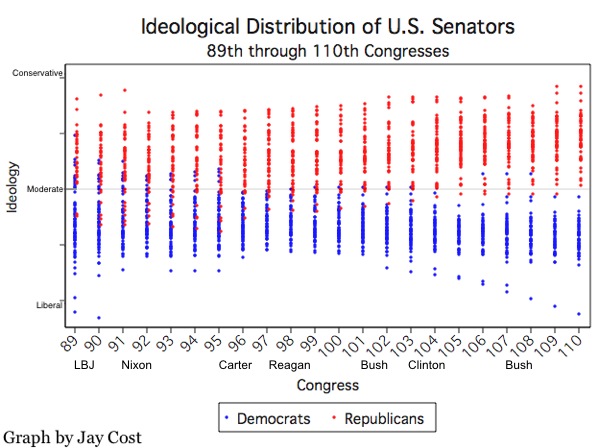
In a report released last Winter, National Journal determined "the overall level of congressional polarization last year (2010) was the highest... recorded... every Senate Democrat compiled a voting record more liberal than every Senate Republican—and every Senate Republican compiled a voting record more conservative than every Senate Democrat." In the House "five House Republicans in 2010 generated vote ratings more liberal than the most conservative House Democrat" and "four Democrats produced ratings more conservative than the most liberal Republican... Every other House Republican produced a more conservative vote rating than every other House Democrat... Of the nine members who were outliers last year, only one... is still in Congress."

How have times changed? "In 1982... fully 344 House members received... vote ratings between the most liberal Republican and the most conservative Democrat." As for the Senate, " In... 1982... 36 Senate Democrats compiled records at least as conservative as the most liberal Republican... 24 Senate Republicans compiled voting records at least as liberal as the most conservative Democrat."

Put simply - Congress has no political center. This absence of a center makes compromise a near impossibility. That would not be a problem if one party clearly dominated in an era of unified government, but the present era is marked by a high level of party competition, tenuous holds on power, and divided government. The result? Gridlock.

Noted Congressional scholar Norm Ornstein summarized it like this "close partisan margins, which gave rise to high-stakes legislative politics and sharply reduced incentives for lawmakers to work across party lines to solve problems."

So what has caused the polarization? This is actually a point of much contention. Scholars like Alan Abramowitz argue the polarization in Congress is reflective of an increasingly polarized public. Others, like Morris Fiorina contend the polarization is elite-driven. As argued in prior posts, I clearly agree with the Fiorina camp.

So if not reflective of a polarized public, what is driving the polarization. There is likely no one explanation, but rather a combination of factors. I put my money of the unholy trinity of partisan redistricting, closed nominating primaries, and the cost of campaigns.

Partisan Redistricting
Gerrymandering is not new (the terms dates to the early 1800s), but technological advances and high levels of political competition have elevated it to new levels. Some scholars argue gerrymandering cannot explain the polarization in House, because the Senate is polarized as well and polarization is evident in state legislatures and county councils. These scholars often fail to consider the prior elective experience of U.S. Senators. In the current Congress (and it's not an outlier) roughly two-thirds of the Senate held prior elective office in a seat subject to partisan redistricting - ranging from a U.S. House seat to a state legislative seat. And state legislative districts are often more gerrymandered than Congressional districts - one need look no farther than Maryland's state legislative districts.

In a study by Nolan McCarty, Keith Poole, and Howard Rosenthal the authors concede that it is nearly impossible for a moderate to win in the nation's currently manipulated Congressional districts, but they see little evidence to support gerrymandering as the cause.  They contend it's difficult to gerrymander many states due to size and population and many have few districts, but this also ignores the impact of gerrymandered state legislative districts and the prior elective experience of U.S. House members. McCarty et al. determined as well that within the same district Democratic and Republican representatives compile distinctly divergent records. This of course can only be studied in districts that are competitive and where candidates from either party can win. Most districts in the U.S. are safe and the out-party has no hope of winning.

The authors note "Republicans are more likely to represent conservative districts, and Democrats are more likely to represent liberal ones" and concede "such an effect is consistent with the gerrymandering hypothesis,
but it is also consistent with a general geographic polarization of voters along ideological and partisan lines." Finally, they determined ideological sorting of candidates began in the 1980s, but this was before the upswing of polarization and before the decline in electoral competition in the House. There are problems with these conclusions as well.

As will be discussed later, the rise in the use of primary elections to select nominees began in the early 1970s and had become the norm by the 1980s. Most primary elections are cosed - meaning only Democrats can vote in Democratic primaries and only Republicans in a Republican primary. I dispute as well the contention that 1980s were not an era of increased competition in the House. In the election of 1980, Republicans won 34 seats and completely recovered from the electoral devastation of Watergate. At 192 seats, the GOP saw a path back to a majority. With a high number of conservative southern Democrats at times the GOP seemed to have a working control of the agenda in the early years of the Reagan presidency. Republicans suffered a setback in 1982, but the era of Democratic dominance was clearly over.

Closed Primaries
Following a series of party reforms in the late 1960s primary elections became the typical approach to selecting candidates for general election contests by the end of the 1970s. In an open primary voters are allowed to vote outside of their declared political party. This allows independents and moderates to have more of a say in government and in their elected officials. However, most states have closed primaries, where only partisans can participate. The result being a system where very few people determine the candidates on the general election ballot and those candidates reflect the preference of dedicated partisan - this means liberal Democrats and conservative Republicans. As such, even in a competitive district the eventual winner is likely to be a liberal Democrat or a conservative Republican (explaining one the findings by McCarty, Poole, and Rosenthal).

Karen Kaufmann, James Gimpel, and Adam Hoffman studied the issue of open primaries and determined they attract more demographically representative voters; attract more centrist voters; and produce more moderate nominees than closed primaries.

As noted earlier, most Congressional districts are not competitive - somewhere in the neighborhood of 360 seats. In these seats, a Representative faces little threat from the opposing party in a general election. The greater threat comes from within the party in a primary election. This means Representatives must work to ensure support among their party's base voters (again liberal Democrats or conservative Republicans). As the chart below Demonstrates, partisan loyalty increases and increased significantly the safer the Congressional district. If primaries were open to all voters, regardless of party, the pressure would be quite different. Even if the Congressional districts were safe, base voters would not be selecting the candidates and the candidates would need to appeal to a broader swath of the electorate to secure a nomination. Of course the power of incumbency and safe seats make it quite difficult to challenge a sitting Representative - challenging and expensive.


Relationship between Partisan Loyalty and District Safety
(Source: National Journal - Pulling Apart)

The Money Game
According to OpenSecrets.org, the average House incumbent raised $1.5 million for their reelection campaign in 2010. The average challenger raised $265,000. The tremendous expense of House elections puts pressure on incumbents to raise money - just over $2,000 each day they are in office. Those voters with deeply held beliefs are the ones most likely to donate money. As demonstrated in a prior post, few folks make political contribution and those that do are far more ideologically polarized than those who do not.

Joseph Bafumi and Michael Herron have shown that members of Congress are not only more partisan than the median voter in their respective states, they are more partisan than their fellow partisan voters. Democrats in Congress are to the left of the median Democratic voter and Republicans to the right of the median Republican voter. The exception being campaign donors - elected officials are quite ideologically aligned with the folks who write the checks.

In “The Price of Leadership: Campaign Money and the Polarization of Congressional Parties,” Eric Heberlig, Marc Hetherington, and Bruce Larson determine the parties are driven by the need for money and support is given to candidates or incumbents who can raise it. The authors conclude, "a plausible new route into party leadership is by demonstrating fundraising capacity for the benefit of the party” and this has “changed the ideological composition of leadership." Once, parties sought to nominate candidates capable of building a coalition or managing legislation, but today fundraising has become the critical deciding factor.

The Unholy Trinity
Taken collectively, the unholy trinity of partisan redistricting, closed primaries, and the money chase offer a plausible explanation for our present levels polarization and dysfunction. Reforms aimed at fixing any one of the three would likely have little effect - rather all must be addressed. Legislation is pending in Congress that would require all states to adopt non-partisan redistricting reform, but such legislation has been introduced before and has been ignored. Seven states have adopted non-partisan, or bipartisan redistricting reforms - but these states hold only 88 of 435 seats. In most states, the parties are simply unwilling to surrender the power to gerrymander.

Roughly 28 states have closed or semi-closed primaries or closed caucuses. The structure and rules for primary elections are left up to the states and are often determined by the parties as independent entities. In states where citizens have pushed for open primaries, the parties have fought to maintain control over the candidate nomination process.

Public financing of presidential elections has been in place since the 1970s, but no such system exists for Congress. Though the Supreme Court has ruled you cannot place limits on private campaign spending, it is lawful to put limits on spending if an individual accepts public funding. Proposals for public funding of Congressional elections have been introduced in nearly every Congress since the early 1970s - but to no avail. Public financing would immediately remove a tremendous advantage enjoyed by incumbents and they do not appear eager to let that advantage go. Kenneth R. Mayer, Timothy Werner, and Amanda Williams studied state legislative elections in five states that offer public financing and determined competition generally increased after public financing was enacted, both in terms of the number of incumbents facing challengers, and the number of “competitive” races.

Competitive races, open primaries, and competition for the median voter instead of the partisan campaign donor. Congressional districts where voters pick their representative instead of incumbent representatives picking their voters.  Collectively these changes offer the hope of decreased polarization in Congress and the return to a functioning government. But the folks who would need to change the rules of the game are the same folks who know how to play the game as it is currently structured.  There is little indication that they are willing to rewrite those rules and invite a new group of players. So for now, let the dysfunction resume.

Shelby Perkins, a Political Science and Spanish major at St. Mary's College of Maryland contributed significantly to this post.

Monday, August 22, 2011

Why Democrats Lose (or Why Republicans Win)

*** Updated with a word of warning for Republicans who think this post holds good news for the GOP (see the end).


No matter how you measure party preference, Democrats have enjoyed a consistent lead for over 60 years. According to data from the American National Election Studies that lead has fluctuated, but remains significant.

Source: ANES

In 2008, Democrats led Republicans by 14 percentage points (when voters who lean toward one party or the other were included in the calculation). Even in years when Republicans won the presidency, including the Reagan landslide of 1984, Democrats enjoyed a voter preference advantage. Though not shown in the above chart, Democrats enjoyed similar advantages during midterm elections when they lost control of Congress or failed to retake control.

So why can't Democrats translate their clear advantage in voter preference into party victory? Aren't we a polarized nation where 90% or Democrats vote for Democrats and 90% of Republicans vote for Republicans? In short, no we're not. Though America's two political parties, and the party activists who set agendas are quite polarized, there is little evidence of polarization within the broader electorate (see my prior post on this).

As shown in Panel A of the following figure, in 1972 the ideological distribution of Democrats and Republicans was actually quite similar. Both parties were dominated by self-identified moderates – the Democratic distribution skewed slightly left and the Republican right.

On the 7-point ideology identification scale (with 1 representing extremely liberal and 7 extremely conservative, a score of 4 represented moderate) the mean score for non-activist Democrats was 3.88 compared to 4.59 for Republicans – a statistically significant difference.  By 1996, the Republican electorate had shifted significantly to the right (mean value of 5.13) and Democrats had shifted slightly, though significantly to the left (mean value of 3.69). The distribution observed in 2008 is very much similar to that of 1996 for both parties. By 1996 a clear divergence between the two party coalitions is evident, but it is driven almost entirely by the Republican party’s move to the right.
Source: ANES. Party activists were defined as those who attended a campaign meeting or rally AND contributed money to a candidate or campaign.

So there is element one of the polarization story - party polarization among the broader, non-activist electorate, has been driven by Republican rank and file voters shifting right while Democratic rank and file members essentially stood still.

But there's more the story and it's told in Panel B of the figure. In 1972, Democratic and Republican party activists differed significantly from non-activists, yet moderates were a sizable component of each group's activist base.

Interestingly, there was no statistically significant difference between the mean value of the Republican distribution for activists and non-activists in 1972. Among Democrats, however, the mean value of 2.89 for party activists was significantly to the left of non-activists. This pattern held through 2008.

Though the Republican party’s activist base has become more conservative, so has the party’s non-activist membership. In 2008 the mean score on the ideological scale for Republican activists was 5.50 – not significantly different from the 5.16 value for non-activists. Among Democrats, activists sported a mean value of 2.85 as compared to 3.64 for non-activist – a significant difference.

Since 1972, Republican party members – activists and non-activists alike – have become more conservative. Suggesting little disconnect between rank and file members of the party and its most committed members. Among Democrats, however, the shift to the left observed among party activists has resulted in a divide between more liberal activist members and more moderate rank and file members.

So there's element two of the polarization story. Republican activists and rank and file members moved right together. Democratic activists are moving left without their rank and file members.

These changes in the party’s coalitions offer further explanation for the Democratic party’s electoral difficulties.
 
As shown in a prior post, the American electorate is not polarized along ideological lines. Though there has been some evidence of a slight rightward shift since 1972. Party activists, however, are very polarized, with Democratic activists well to the left of center and Republican activists well to the right. At first glance, this suggests party activists out of step with their party’s respective coalitions. But this is clearly truer for Democrats than for Republicans. The Democratic party’s coalition has shifted only slightly to the left, but remains well anchored around a core group of moderates. Party activists, however, are decidedly left of center.

So there's element three of the polarization story - the American public has shifted somewhat to the right, so by staying put, the Democratic coalition has in effect moved to the left.

A substantial share of the Democratic party’s coalition finds itself ideologically situated between the extremes of partisan activists on the left and the right. Simply stated, a Democratic party agenda tailored to liberal party activists is more likely to alienate a much broader segment of the Democratic coalition than would a Republican party agenda tailored to conservatives.

There is a greater disconnect between activists and voters in the Democratic party. Democrats have more to lose, with regard to potential voters, by following activists to the left than do Republicans by following a lead to the right. Given this ideological disconnect, one would expect less partisan attachment or party loyalty among Democratic voters – a weakening of partisanship.

In a separate posting later this week I will show that Democratic partisans are in fact less loyal to the party over time and more likely to disagree with the party on key issues of party faith.

In short, Democrats lose because the folks who set the agenda for the party are more out of step with rank and file membership than are the folks who set the agenda for the Republican party. For Republicans, there is strength and ideological cohesion on the right. Republicans win because there is little difference between party activists and rank and file members. Among Democrats, however, strength comes not from the left but from the center - that's where the parties core group of rank and file voters are and when the party strays left many of those voters defect.

Update: But Republicans should not look to this post as good news for the GOP. At present, Republicans are able to win because so many Democrats occupy that middle ground between the extremes of the two activist elements - but the GOP has been moving right faster than the overall electorate and in the opposite direction of the non-activist Democrats. If the GOP continues to trek to the right they will reach a point where moderate Democrats no longer view the GOP as an acceptable alternative.

Those moderate Democrats may decide to support their own party or just stay home - either way the GOP would be left with it's smaller coalition of voters.

Perhaps more dangerous for the GOP, the Democratic party could moderate it's agenda and actively seek to close the gap between activists and non-activists. If Democrats can unify their coalition and consistently attract the broad middle of America's electorate the GOP is sunk and will return to the near minor party status they occupied between 1932 and 1964.

The data on party coalition ideology suggests that Democrats can move to the center and win, if Republicans move to the center they risk alienating a substantial portion of their electoral coalition.  So long as America remains a moderate nation, odds favor a re-emergent Democratic majority - but only if Democrats actively work to make it happen. The real question for Democrats is whether liberal party activists will cede control of the agenda and allow the party to move in the direction of it's moderate, non-activist voters. Current anger at President Obama, coming from the American left, suggest those activists are not quite ready.

Friday, August 12, 2011

We're Still Not Polarized...

In a New York Times story yesterday, reporter Jennifer Steinhauer told readers that in townhall meetings across the country members of Congress are not being told to compromise or find common ground, but rather to dig in, fight harder, and not compromise. Steinhauer was right to tell readers that these townhall meetings tend to be magnets for activists and the "most partisan and intransigent factions of both parties."

She's right and it's important to understand that these very vocal folks represent a distinct minority. According to data collected by the American National Election Studies, the most comprehensive database of Americans' political activities and beliefs, only 10% of the electorate attended a political meeting or rally in 2004 or 2008 - and these were presidential campaign years, so the that is probably the high watermark for attendance.

So 90% of the electorate does not attend these meetings and their voices are not heard by members of Congress. That would not matter if the 10% was representative of the absent 90% - but they are not. The American electorate is generally quite moderate, with a plurality (about 34%) describing themselves as pure moderates. Add in the folks who identify as only slightly liberal or conservative and you have 60% of Americans walking that middle road.


The folks who attend meetings and rallies are decidedly more ideological. In fact, the ideological distribution among those who attend meetings is nearly the inverse of those who do not. Fully 56% of meeting attendees come from the left and right wings of the ideological distribution - in recent election years they have tended to be more liberal than conservative, but with a Democratic President that has likely shifted somewhat.

Members of Congress are on recess and talking with constituents. Unfortunately, they are hearing a distorted message from party activists who despise compromise and celebrate partisan warfare. Meanwhile, the opinions of the vast majority of the electorate, a moderate electorate, are not being heard.

Want to stop the nonsense? Make sure you contact your member of Congress.Make your voice heard. In a recent post, I highlighted the fact that campaign volunteers and contributors tend to be far more partisan and ideological. So the folks who go to meetings, write checks, and knock on doors represent a very small, but very vocal, and ideologically committed slice of the electorate. Their level of commitment magnifies the influence of their small numbers.These folks are contributing to the poisonous nature of contemporary politics.

In a Democracy, even when it's a representative republic, larger numbers can defeat louder voices.

Tuesday, July 26, 2011

America Needs a Declaration of Independents...

There is so much to love in Jeffrey Sachs all out attack on the colossal failings of America's two major political parties.

Every part of the budget debate in the U.S. is built on a tissue of willful deceit. Consider the Republican Party's double-mantra that the deficit results from "runaway spending" and that more tax cuts are the key to economic growth. Republicans claim that the budget deficit, around 10 percent of GDP, has been caused only by a rise in outlays. This is blatantly untrue. The deficit results roughly equally from a fall of tax revenues as a share of GDP and a rise of spending as a share of GDP... The Democrats of the White House and much of Congress have been less crude, but no less insidious, in their duplicity... at every crucial opportunity, Obama has failed to stand up for the poor and middle class. He refused to tax the banks and hedge funds properly on their outlandish profits; he refused to limit in a serious way the bankers' mega-bonuses even when the bonuses were financed by taxpayer bailouts; and he even refused to stand up against extending the Bush tax cuts for the rich last December, though 60 percent of the electorate repeatedly and consistently demanded that the Bush tax cuts at the top should be ended. It's not hard to understand why. Obama and Democratic Party politicians rely on Wall Street and the super-rich for campaign contributions the same way that the Republicans rely on oil and coal. In America today, only the rich have political power.
Sachs concludes "America needs a third-party movement to break the hammerlock of the financial elites. Until that happens, the political class and the media conglomerates will continue to spew lies, American militarism will continue to destabilize a growing swath of the world, and the country will continue its economic decline."

I do not disagree with Sachs' assessment. I for one am tired of hearing partisans defend their party while proclaiming that "the other side" is the unreasonable party. A review of recent columns by leading opinion leaders on the Left and the Right reveals little more than an exercise in finger pointing and self righteous indignation. From the Left you'll hear that the Republicans are "hostage takers" willing to risk fiscal ruin to protect America's wealthy. On the Right you'll hear that President Obama and Congressional Democrats refuse to accept significant spending cuts because to do so would be to admit that the modern progressive era is over, and failed.

The truth is America is being ill-served by both parties as they seek to appeal to ever more partisan and polarized bases.

Some, argue that the American electorate is polarized as the two parties simply reflect that polarization. But there is little to no evidence that the general public is polarized - at least any more polarized now than at any point in the last 30 years. Rather we live in a two party system and the parties have become ever more polarized and controlled by partisan fringes. Polarized parties create the illusion of a polarized public. Problem is, a winner-take-all, plurality rule, two-party system is supposed to promote the creation of two moderate parties.


In his seminal work, Economic Theory of Democracy, Anthony Downs wrote when the electorate is polarized "regardless of which party is in office, half the electorate always feels that the other half is imposing policies upon it that are strongly repugnant to it... In this situation, if one party keeps getting reelected, the disgruntled supporters of the other party will probably revolt; whereas if he two parties alternate in office, social chaos occurs, because government policy keeps changing from one extreme to the other."

One could look to that passage as prophetic, but what if Downs had it backward? What if polarized parties led to the polarized electorate? Extensive research by Fiorina shows us that the mass public has not become more polarized even as the members of the two parties have - especially the most engaged members.

A recent study by Daniel Coffey (in PS: Political Science and Politics) determined that there is a direct and positive correlation between party competition and party ideology. As a state becomes more competitive between Republicans and Democrats the respective parties become ever more conservative and liberal.

So as politics became more competitive through the 1960s, 70s, 80s, and 90s the parties responded by becoming ever more ideological. V. O. Key argued that competition would force parties to offer more distinct policies to voters in an effort to influence their choice.

As competition increased the parties came to rely more heavily not on the median voter in a unimodal distribution, but rather on the more committed and active voters on the left and right of the distribution.

As the agendas of the political parties became ever more divergent Americans began to "sort" more neatly into one party or the other - and more Americans began to identify as either pure Independents or only loosely associated with a party. As the agenda of the Democratic Party became more liberal and the Republican Party more conservative, liberal Republicans left the party and became Democrats or Independents and conservative Democrats became Republicans or Independents.

The parties polarized, the public did not. There has been precious little change in the last 30 years with regard to the share of Americans who identify as Conservative, Moderate, or Liberal. Rather conservatives no longer feel comfortable in the Democratic Party and Liberals are no longer comfortable in the Republican Party - Moderates appear to be less comfortable with both parties.

The electorate is no more polarized now than in 1970, 1980, or 1990 - but the parties are. So of course 90% of Republicans vote Republican and 90% of Democrats vote Democrat. Of course Presidential approval correlates to party affiliation, it's the natural byproduct of party sorting, but party sorting is not the same as polarization. Moderate voters tend to split their support and vote at lower levels.

So what we have is a modification to Downs. The distribution of the American electorate (in the broadest sense) is unimodal which should promote more moderate parties, but the distribution of the most engaged and activist elements of the electorate is bimodal which has resulted in two polarized parties.

Steven Hill (author of Fixing Elections: The Failure of Winner Take All Elections) writes "one of the defining characteristics of a winner-take-all system is that it promotes adversarial politics so that on a whole host of issues it is painfully obvious that the overriding agenda for both major parties is... to stake out positions vis-a-vis the other side."

In the 1960s Republicans exploited several emerging schisms in the ranks of the Democratic Party's coalition in order to become competitive - schisms revolving around national security, welfare spending, and policies with regard to race relations. The party defined itself by being what the Democratic Party was not. Over time the parties increasingly defined themselves by being the antithesis of the other party.

This led to party sorting, internal partisan homogeneity, and the bimodal distribution of the engaged voters and the system now feeds off of that bimodal distribution even as the broader mass electorate's distribution remains unimodal.

And such a system can be maintained so long as the respective bases maintain intensity and the strategies used to motivate base voters do not alienate more moderate voters who are often needed to swing an election given the near parity of each party's base.

But what happens when the strategies, rhetoric, and policies required to maintain base allegiance begin to alienate more moderate voters? If those voters simply stop voting it may not matter, but if they continue to vote it could be very disruptive as they seek an electoral outlet.

It would be reasonable for one party to moderate and absorb those moderate voters, but doing so risks losing their base. So instead both parties engage in what Jacobs and Shapiro (Politicians Dont' Pander) describe as "crafted talk" in which they use words that suggest moderation even as they pursue very partisan policies. But the pursuit of those policies will push the moderate voters away - and they only have one other choice, the opposition party.
It's possible, that as the base strategy accelerates one would expect to see more see-saw elections like 2006 and 2010. Such oscillations in partisan control of government contributes to the present era's dysfunction, but so long as the parties remain committed to a polarized, partisan base strategy it will remain a feature of the present era.

And that brings us back to Sachs. America does not need a third party; rather America needs two new parties. In recent years we have seen an increase in the number of voter instigated ballot initiatives, rising levels of voter discontent, see-saw election results like the 2006 and 2010 midterms.

The evidence suggest that the broader electorate is beginning to resist and push back against the current political system. Perhaps disaffected voters in the broader electorate are nearing a critical mass and may soon be able to break the hold on the system by the two parties.

Only time will tell, but the current political system which emerged from the turmoil and tumult of the 1960s, has not lasted longer than any recognized political era in American history. Of course, our two major parties control campaign fundraising laws, ballot access, voter registration laws, the drawing of Congressional districts, the manner in which electoral votes are awarded, and access to the public airways. It's a duopoly more damaging than any monopoly in American history.

The only way to break their hold is to mobilize the growing number of folks who feel alienated from both parties, the 40% of folks who don't vote and in presidential elections, and the 60% who don't vote in Congressional elections. It's time for a revolution... not like 1776, but rather the electoral revolutions of 1800, or 1828, or 1860, or 1932.... we need systemic transformation from below and we need it soon.

America needs a Declaration of Independents... a declaration that we will no longer allow America's future and prosperity to be held hostage to the narrow ideological pursuits of the Democratic and Republican parties and the ideologues who fund them.

Friday, January 14, 2011

The Arizona Tragedy and the False Narrative of a Polarized America

There is a great write-up in the New Republic on just how bad the press covered the tragedy in Arizona and how it ignored a real problem (treating mental illness, seeing warning signs) while focusing on an imagined one (heated rhetoric).

The false narrative with regard to the shooting created by the press and opportunistic political leaders served to reinforce perhaps the greatest false narrative of our day, that the American public is polarized. There is little to no evidence that the general public is polarized - at least any more polarized now than at any point in the last 30 years. Rather we live in a two party system and the parties have become ever more polarized and controlled by partisan fringes. Polarized parties create the illusion of a polarized public.

As if on cue, Paul Krugman furthers the myth of a divided America today writing "One side saw health reform, with its subsidized extension of coverage to the uninsured, as fulfilling a moral imperative: wealthy nations, it believed, have an obligation to provide all their citizens with essential care. The other side saw the same reform as a moral outrage, an assault on the right of Americans to spend their money as they choose." Says Krugman, "There’s no middle ground between these views."

There of course is a middle ground between those views and it's the ground upon which a plurality, perhaps a majority, of Americans reside. What Mr. Krugman means to write is that for the political class, such as himself and Glenn Beck and Sarah Palin, there is no middle ground. But the political class is quite polarized and in that respect a poor representation of America.

Scholars like Alan Abramowitz have made a cottage industry of trying to prove that the electorate is indeed becoming more polarized. They cite as evidence the stark differences between self identified Republicans and self identified  Democrats on issues such as abortion, health insurance, aid to minorities, presidential approval and voting, and self identification as Liberal or Conservative.

When defined in that way, there is in fact evidence that Democrats and Republicans have drifted farther apart over the last 20 years - but as odd as it sounds, it does not demonstrate polarization. To paraphrase an old country song, folks are looking for polarization in all the wrong places. Morris Fiorina has explored polarization from the perspective of changes in popular opinion, separate from party labels and has found no increase in polarization.

When Americans are asked to express support or opposition for the supposedly polarizing policy areas cited by Abramowitz and Paul Krugman - health insurance, aid to minorities, government spending and services, defense spending, and abortion - Fiorina finds that there has been no increase in polarization on these issues in the past 20 years. In fact, Fiorina finds that the public has shifted slightly to the left on the issues government support for health coverage and the provision of services and slightly to the right on the issues of national defense and aid to minorities. There has been no change with regard to abortion. In other words, we're shifting together on some issues, not at all on others.

So what's going on, what are folks like Abramowitz really measuring? Simple, it's called party sorting. As the agendas of the political parties became ever more divergent Americans began to "sort" more neatly into one party or the other - and more Americans began to identify as either pure Independents or only loosely associated with a party.

As the agenda of the Democratic Party became more liberal and the Republican Party more conservative, liberal Republicans left the party and became Democrats or Independents and conservative Democrats became Republicans or Independents.

Krugman writes "Commentators who pine for the days of civility and bipartisanship are, whether they realize it or not, pining for the days when the Republican Party accepted the legitimacy of the welfare state, and was even willing to contemplate expanding it."  What Krugman has conveniently ignored is the fact that the Democratic Party once included many folks who rejected the legitimacy of the welfare state as well.

The following graph charts Congressional polarization from the 89th Congress through the 110 Congress, notice the considerable overlap in the middle that existed in the 1960s and through the 1970s.  There was a time when Conservative Democrats and Liberal Republicans were not anomalies. This helps to explain why legislation that today would divide the parties, the Civil Rights Act, the Creation of Medicare and Medicaid, even passage of President Reagan's first budget in 1981 were, in fact, bi-partisan affairs.


Today, however, there is no home in the Democratic Party for conservatives and no real home in the Republican Party for moderates - this is why Jim Jeffords bolted the GOP in 2001 and Joe Lieberman felt so ill at ease with Democrats back in 2006.

The parties polarized, the public did not. As Fiorina notes, there has been precious little change in the last 30 years with regard to the share of Americans who identify as Conservative, Moderate, or Liberal. Rather conservatives no longer feel comfortable in the Democratic Party and Liberals are no longer comfortable in the Republican Party - Moderates appear to be less comfortable with both parties.  The electorate is no more polarized now than in 1970, 1980, or 1990 - but the parties are. So of course 90% of Republicans vote Republican and 90% of Democrats vote Democrat. Of course Presidential approval correlates to party affiliation, it's the natural byproduct of party sorting, but party sorting is not the same as polarization.

The reasons for party polarization are many - the breakdown of mass-based political parties that operated as bottom-up entities driven often by local issues has played a role. Parties are now top-down entities controlled by a relative and ideologically similar few.

The increase in political competition has played a role as well. The Democrats lost their hold on the South, the Republicans lost their hold on the North East. According to data from State Politics and Policy Quarterly only 7 states had divided government in 1954, in 2007 that number stood at 23 states. With few exceptions, either party has fair shot at winning statewide elections in most states (remember, we vote for offices other than President). A recent study by political scientist Daniel Coffey determined that there is a direct and positive correlation between party competition and party ideology. As a state becomes more competitive between Republicans and Democrats the respective parties become ever more conservative and liberal.

V.O. Key hinted at this in 1956 when he argued that competition would force parties to offer more distinct policies to voters in an effort to influence their choice. Additionally, as competition increases the parties come to rely more heavily, not on the mean, median, or moderate voter, but rather on the more committed and active voter. For Democrats this means liberal activists and for Republicans conservative activists. This has the effect of pushing the parties ever farther to the extreme. This is, of course, what has happened.

Where is there evidence of polarization? Among the most engaged and active third of the electorate - what we call base voters, as they form the foundation of support for each party. Sadly this third has a tremendous impact on the direction and agenda of the two major parties. This third votes regularly and is more likely to contribute to and be active in politics. Parties and politicians seek to motivate these voters by painting every election as a choice between political life and death. Recall the closing days of the 2000 election when Al Gore suggested that "strict constructionists" like George W. Bush are little different from those who once deemed a black man to be but three-fifths of a person. Or the waning days of the 2008 campaign when Sarah Palin accused Barack Obama of "palling around with terrorists."


The goal for the left and the right is the same, scare the hell out your base to motivate them. So the left reduces the right to a caricature of bigoted, racist, violent, homophobic fascists and the right reduces the left to a caricature of immoral, anti-American, authoritarian socialists. The hope is that the scare tactics will motivate the base and win over wavering voters in the middle - remember, Democrats won Independent voters by 19 points in 2006 only to see Republicans win them by 19 points in 2010.

So America is not a deeply polarized nation on the brink of civil war. Rather, the American electorate is being poorly represented by a very polarized political class. A political class that sees the world in measures of black and white where there is "no middle ground." It is a pernicious myth that is doing great harm to America - and as we just witnessed in Arizona it all too often causes the political class to focus on imagined problems at the expense of real problems.