
Showing posts with label senate. Show all posts
Showing posts with label senate. Show all posts
Tuesday, September 14, 2010
For Republicans, has the Senate Moved out of Reach?
The unexpected loss by moderate Republican Mike Castle in Delaware to the conservative newcomer Christine O'Donnell has just made it less likely that Republicans can retake the Senate in 2010. Heading into November the GOP holds 41 seats and none appear to be at risk. The GOP is expected to pickup AR, ND, and IN as well as CO and PA for 5 new seats. Delaware was expected to be number 6 with the GOP reaching 57 seats and need only 4 more - IL, CA, NV, WA, and WI are all possibilities with CT and WV as long shots. The GOP would have needed 4 of those 7 a tall but possible order. Now, the GOP needs to win 5 of the 7. I can still happen, but it will tougher after tonight.


Tuesday, August 3, 2010
Midterm Update - The GOP Wave Has Not Crested
Last week, some pundits wondered aloud if Democrats were staging a mini rally against Republicans. The Gallup tracking poll reported a Democratic lead in the so-called generic ballot question for two consecutive weeks. Charlie Cook wrote "One interpretation of recent results is that the momentum in this critical midterm election has shifted and the Republican wave has subsided. Another interpretation is that it's too soon to tell whether much has changed at all."
The latest Gallup poll shows that Republicans have reclaimed a 5 point lead. A review of the generic ballot question from several polls available at Realclearpolitics.com shows that Republicans currently lead in every national poll.

The Republicans enjoy an average lead of 6% - and nearly every poll is limited to registered voters and not likely voters. This is significant as Republicans appear far more motivated to vote in the 2010 midterm, so the average "likely voter" is probably much more Republican than the typical "registered voter." A recent survey by Pew found that "Fully 56% of Republican voters say they are more enthusiastic about voting this year than in previous elections – the highest percentage of GOP voters expressing increased enthusiasm about voting in midterms dating back to 1994."Among Democrats, only 42% reported such enthusiasm. To add a bit oh historical perspective "The Republican Party now holds about the same advantage in enthusiasm among its party’s voters that the Democratic Party held in June 2006 and the GOP had late in the 1994 campaign." Pew is actually understating the historical significance as this is the first time that any party has recorded an enthusiasm rating above 50% in the last 16 years.
What impact will this enthusiasm have come election day? Cook notes in his column that a 5 point lead among registered voters for Democrats typically translates into a tie with Republicans among actual voters - because registered voter numbers historically underestimate actual Republican turn-out. In October 1994 Gallup reported that Democrats enjoyed a 46% to 44% lead over Republicans in the generic ballot - on Election Day Republicans won the national popular vote 52% to 45%. So a 2 point Democratic lead among registered voters translated into a 7 point Republican lead among actual voters and a gain of just over 50 House seats.
The current 6 point lead held by Republicans would likely translate into a pick-up of at least 40 - if not 50 - seats in the House. If the actual lead come election day is closer to 10 points it would not be unrealistic to see Republicans pick-up roughly 70 seats in the House - and likely come within a single vote of retaking the Senate.
Events can still change, Democrats can still reclaim an advantage - though one must wonder how. A look at the generic ballot trend going back to President Obama's inauguration shows that voters began to turn on the Democrats just as the health reform battle was heating up last summer and despite a slight tightening in lat spring 2010 the trend has been favoring the GOP for over a year. As Republicans learned in 2006, once started it's hard to alter that trend.

The latest House race assessment from the Rothenberg Report finds that 88 House seats are "in play." Of the 88, only 12 are held by Republicans, and the Rothenberg report excludes some Democratic seats that now seem to be in danger including Illinois’s 17th congressional and North Carolina's 11th. In the Senate, Rothenberg predicts GOP gains of 5 to 8 seats and even sees the once safe seats in CA, WA, and WI as moving toward the GOP. All of this, coupled with President Obama's newly reached low of 41% approval in the USA Today Gallup poll, point to significant GOP gains in November. The coming wave has not crested.
The latest Gallup poll shows that Republicans have reclaimed a 5 point lead. A review of the generic ballot question from several polls available at Realclearpolitics.com shows that Republicans currently lead in every national poll.

The Republicans enjoy an average lead of 6% - and nearly every poll is limited to registered voters and not likely voters. This is significant as Republicans appear far more motivated to vote in the 2010 midterm, so the average "likely voter" is probably much more Republican than the typical "registered voter." A recent survey by Pew found that "Fully 56% of Republican voters say they are more enthusiastic about voting this year than in previous elections – the highest percentage of GOP voters expressing increased enthusiasm about voting in midterms dating back to 1994."Among Democrats, only 42% reported such enthusiasm. To add a bit oh historical perspective "The Republican Party now holds about the same advantage in enthusiasm among its party’s voters that the Democratic Party held in June 2006 and the GOP had late in the 1994 campaign." Pew is actually understating the historical significance as this is the first time that any party has recorded an enthusiasm rating above 50% in the last 16 years.
What impact will this enthusiasm have come election day? Cook notes in his column that a 5 point lead among registered voters for Democrats typically translates into a tie with Republicans among actual voters - because registered voter numbers historically underestimate actual Republican turn-out. In October 1994 Gallup reported that Democrats enjoyed a 46% to 44% lead over Republicans in the generic ballot - on Election Day Republicans won the national popular vote 52% to 45%. So a 2 point Democratic lead among registered voters translated into a 7 point Republican lead among actual voters and a gain of just over 50 House seats.
The current 6 point lead held by Republicans would likely translate into a pick-up of at least 40 - if not 50 - seats in the House. If the actual lead come election day is closer to 10 points it would not be unrealistic to see Republicans pick-up roughly 70 seats in the House - and likely come within a single vote of retaking the Senate.
Events can still change, Democrats can still reclaim an advantage - though one must wonder how. A look at the generic ballot trend going back to President Obama's inauguration shows that voters began to turn on the Democrats just as the health reform battle was heating up last summer and despite a slight tightening in lat spring 2010 the trend has been favoring the GOP for over a year. As Republicans learned in 2006, once started it's hard to alter that trend.

The latest House race assessment from the Rothenberg Report finds that 88 House seats are "in play." Of the 88, only 12 are held by Republicans, and the Rothenberg report excludes some Democratic seats that now seem to be in danger including Illinois’s 17th congressional and North Carolina's 11th. In the Senate, Rothenberg predicts GOP gains of 5 to 8 seats and even sees the once safe seats in CA, WA, and WI as moving toward the GOP. All of this, coupled with President Obama's newly reached low of 41% approval in the USA Today Gallup poll, point to significant GOP gains in November. The coming wave has not crested.
Wednesday, April 7, 2010
A Senate Majority for Republicans? It's Not Out Of The Question.
The latest Gallup poll finds a record-low 28% of American voters say most members of Congress deserve to be re-elected. The previous low was 29% in October 1992. According to Gallup, "The same poll finds 49% of voters, a near-record low, saying their own member of Congress deserves to be re-elected. This marks only the second time since Gallup began asking this question in 1992 that the figure has dipped below 50%, and the first on the doorstep of a midterm election."
 The latest round-up of 2010 Senate races at RealClearPolitics.Com finds that Republicans would gain 7 seats in the Senate if the election were held today - bringing the balance of power to 52 Democrats and 48 Republicans. These projections are based on poll averages in contested states. A close examination of that polling data reveals that a 51 seat majority for Republicans is not out of reach. At present, California, Wisconsin, and Illinois are projected to remain in democratic hands - but the most recent polls in Wisconsin and Illinois show Republicans in the lead and the race is tied in California.
Last year at this time pundits were predicting that Democrats would likely add to their margin in the US Senate, about 7 months ago they began to estimate losses of maybe 2 seats, now the estimate is roughly 7 seats - but the trend is clear and a Republican Senate is no longer out of the question come January 2011. Democrats need to find some way to change the dynamic of the 2010 midterms, but with the latest CBS News poll showing that the public is opposed to the recently passed health reform law by a margin of 53% to 32% it is unclear to me how they will accomplish that goal.
 The latest round-up of 2010 Senate races at RealClearPolitics.Com finds that Republicans would gain 7 seats in the Senate if the election were held today - bringing the balance of power to 52 Democrats and 48 Republicans. These projections are based on poll averages in contested states. A close examination of that polling data reveals that a 51 seat majority for Republicans is not out of reach. At present, California, Wisconsin, and Illinois are projected to remain in democratic hands - but the most recent polls in Wisconsin and Illinois show Republicans in the lead and the race is tied in California.
Last year at this time pundits were predicting that Democrats would likely add to their margin in the US Senate, about 7 months ago they began to estimate losses of maybe 2 seats, now the estimate is roughly 7 seats - but the trend is clear and a Republican Senate is no longer out of the question come January 2011. Democrats need to find some way to change the dynamic of the 2010 midterms, but with the latest CBS News poll showing that the public is opposed to the recently passed health reform law by a margin of 53% to 32% it is unclear to me how they will accomplish that goal.
Tuesday, March 2, 2010
For Maryland Republicans 19 is the New 41, but is it Attainable?
Maryland Republicans have set their sights on the magic number 19 – the number of Senators they would need in the Maryland General Assembly to successfully mount a filibuster and therefore become relevant players in Annapolis. Currently, there are 14 Republicans in the Senate so the GOP need only pickup 5 seats – or more precisely – pick off 5 of the 33 Senate Democrats in 2010.
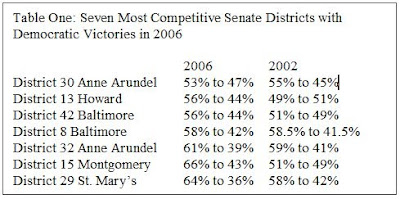
Unfortunately for the Maryland GOP, five seats may simply be too tall of an order. A review of district by district election results from 2002 and 2006 shows that there are very few truly competitive districts for the GOP to target (Table One). In 2006 there was only one district where a Democrat won by less than a 10 point margin – district 30 in Anne Arundel County. The next 6 most competitive races were all decided by decisive margins. The election in 2006 represented a high water mark for Democrats nationally and in the state, so I looked to 2002 as well. In 2002 Republicans did very well nationally and Bob Ehrlich won the governor’s race. Even in 2002, however, there were only 3 races decided by a margin of less than 10 points – District 13 in Howard County, District 42 in Baltimore County, and District 15 in Montgomery County. None of those districts were close to being competitive in 2006. If the GOP truly hopes to pick up 5 seats they will have a very hard time identifying good targets. They may have to rely on unexpected retirements, primary challenges, or the sudden arrival on the agenda of a politically divisive issue to weaken Democratic incumbents. In addition, Republicans scored only narrow victories in District 3 in Frederick County and District 31 in Anne Arundel in 2006 - so they would need to pick up 5 Democratic seats AND defend all of their own.

When Scott Brown was running to succeed Ted Kennedy to the U.S. Senate in Massachusetts he campaigned on the pledge to be “number 41.” Meaning that he would be the crucial 41st vote to deny Senate Democrats their filibuster-proof majority. All indications are that the tactic worked. Maryland Republicans may want to emulate the Brown approach, but it’s a harder case to make when candidates would need to proclaim “I’m number 15, and I’m number 16, and I’m number 17…” Reaching 19 votes would likely revitalize the Maryland GOP and bring some much needed checks and balances to the state's one party rule, but the bar may be too high. Although any number closer to 19 would mean one less Democrat that the GOP would need to convince to join a filibuster effort. In the end, if Maryland Republicans are to have any hope of reaching the magic number of 19 they’ll need a strong candidate at the top of the ticket (and there is only one candidate who fits that description) and a GOP wave nationally to carry them over the line.
Unfortunately for the Maryland GOP, five seats may simply be too tall of an order. A review of district by district election results from 2002 and 2006 shows that there are very few truly competitive districts for the GOP to target (Table One). In 2006 there was only one district where a Democrat won by less than a 10 point margin – district 30 in Anne Arundel County. The next 6 most competitive races were all decided by decisive margins. The election in 2006 represented a high water mark for Democrats nationally and in the state, so I looked to 2002 as well. In 2002 Republicans did very well nationally and Bob Ehrlich won the governor’s race. Even in 2002, however, there were only 3 races decided by a margin of less than 10 points – District 13 in Howard County, District 42 in Baltimore County, and District 15 in Montgomery County. None of those districts were close to being competitive in 2006. If the GOP truly hopes to pick up 5 seats they will have a very hard time identifying good targets. They may have to rely on unexpected retirements, primary challenges, or the sudden arrival on the agenda of a politically divisive issue to weaken Democratic incumbents. In addition, Republicans scored only narrow victories in District 3 in Frederick County and District 31 in Anne Arundel in 2006 - so they would need to pick up 5 Democratic seats AND defend all of their own.

When Scott Brown was running to succeed Ted Kennedy to the U.S. Senate in Massachusetts he campaigned on the pledge to be “number 41.” Meaning that he would be the crucial 41st vote to deny Senate Democrats their filibuster-proof majority. All indications are that the tactic worked. Maryland Republicans may want to emulate the Brown approach, but it’s a harder case to make when candidates would need to proclaim “I’m number 15, and I’m number 16, and I’m number 17…” Reaching 19 votes would likely revitalize the Maryland GOP and bring some much needed checks and balances to the state's one party rule, but the bar may be too high. Although any number closer to 19 would mean one less Democrat that the GOP would need to convince to join a filibuster effort. In the end, if Maryland Republicans are to have any hope of reaching the magic number of 19 they’ll need a strong candidate at the top of the ticket (and there is only one candidate who fits that description) and a GOP wave nationally to carry them over the line.
Monday, February 15, 2010
FreeStater Midterm 2010 Outlook
With the stunning news that Indiana Democrat Evan Bayh will not seek re-election in 2010 today seems like a good day to post the first in a monthly series of Midterm updates at the FreeStater Blog. These assessments will be based on reviews of polling data as well and district or state trends as well as national dynamics. Democrats currently hold a 255 to 178 majority in the House and a 57 to 41 seat majority in the Senate (with two independents who caucus with Democrats). Republicans need 40 House seats and 10 Senate seats to reclaim control of each chamber.
Here's how things stand today -
In the House
 I estimate that if the election were held today Republicans would pickup 36 seats in the following districts:
AL-2, AZ-5, AZ-8, CO-3, CO-4, FL-8, FL-24, MO-4, ID-1, IN-9, KS-3, MD-1, MI-7, MS-1, NV-3, NH-1, NH-2, NM-2, NY-13, NY-29, ND-AL, OH-1, OH-15, OH-16, OH-18, PA-7, PA-10, PA-12, SC-5, TN-8, TX-17, VA-2, VA-5, VA-9, WA-3, and WV-1
Democrats will pickup 2 seats:
IL-10 and LA-2
That would be a net gain of 34 seats for Republicans, 6 shy of the number needed to reclaim control of the chamber and the GOP may make inroads in New England in 2010. Keep an eye on CT-4 and CT-5 as well as MA-10.
In the Senate
If the election were held today the Republicans would pickup 7 seats:
AR, CO, DE, IN, NV, ND, and PA
Democrats would not win any Republican seats.
That would be a net gain of 7 Senate seats for Republicans, giving them 48 seats - 3 shy of a majority. That makes contests in CA, IL, NY, WI, and WA must wins for Democrats - if Republicans pickup 2 of the 5 they would reach 50 seats and Joe Lieberman (I-CT) could become a kingmaker.
So, with 8 months until the 2010 midterms Republicans would reach 212 seats in the House and 48 seats in the Senate - if the election were held today. Democrats would retain the majority, but those numbers should send shivers of fear through the party's leadership. Based on current trends, Republicans have a better than even chance of reclaiming the House. The Senate is still a long shot, but another surprise announcement like Bayh's could shift that dynamic sugnificantly. Stay tuned for the next update.
Note: This midterm update reflects the opinion of Professor Todd Eberly.
Here's how things stand today -
In the House
AL-2, AZ-5, AZ-8, CO-3, CO-4, FL-8, FL-24, MO-4, ID-1, IN-9, KS-3, MD-1, MI-7, MS-1, NV-3, NH-1, NH-2, NM-2, NY-13, NY-29, ND-AL, OH-1, OH-15, OH-16, OH-18, PA-7, PA-10, PA-12, SC-5, TN-8, TX-17, VA-2, VA-5, VA-9, WA-3, and WV-1
Democrats will pickup 2 seats:
IL-10 and LA-2
That would be a net gain of 34 seats for Republicans, 6 shy of the number needed to reclaim control of the chamber and the GOP may make inroads in New England in 2010. Keep an eye on CT-4 and CT-5 as well as MA-10.
In the Senate
If the election were held today the Republicans would pickup 7 seats:
AR, CO, DE, IN, NV, ND, and PA
Democrats would not win any Republican seats.
That would be a net gain of 7 Senate seats for Republicans, giving them 48 seats - 3 shy of a majority. That makes contests in CA, IL, NY, WI, and WA must wins for Democrats - if Republicans pickup 2 of the 5 they would reach 50 seats and Joe Lieberman (I-CT) could become a kingmaker.
So, with 8 months until the 2010 midterms Republicans would reach 212 seats in the House and 48 seats in the Senate - if the election were held today. Democrats would retain the majority, but those numbers should send shivers of fear through the party's leadership. Based on current trends, Republicans have a better than even chance of reclaiming the House. The Senate is still a long shot, but another surprise announcement like Bayh's could shift that dynamic sugnificantly. Stay tuned for the next update.
Note: This midterm update reflects the opinion of Professor Todd Eberly.
Saturday, February 13, 2010
Eliminating the Filibuster is a Cure Worse than the Disease
Update: Word comes today that Illinois Senator Dick Durbin has now joined the effort to essentially eliminate the filibuster. So what has changed since May 23, 2005 when Durbin said “Those who would attack and destroy the institution of the filibuster are attacking the very force within the Senate that creates compromise and bipartisanship.”? All that has changed is that Democrats had only 45 seats in the Senate when Durbin defended the filibuster... today they have 59. Those who would abandon the filibuster for short term political gain need to sit down, take a deep breath, and truly consider what they are proposing.
Original Post: Two Senate Democrats have formally launched an effort to kill the filibuster. Sens. Tom Harkin (D-Iowa) and Jeanne Shaheen (D-N.H.) introduced a bill that would set a gradually lowering threshold to shut off debate on legislation, starting at 60 votes and lowering to 51 over six days.
So let’s just imagine the future – a future where the filibuster is no longer an option and only 51 votes are needed in the Senate to pass, or repeal, legislation.
In the near term, Democrats will pass Cap and Trade, Comprehensive Health Reform, and a truly progressive tax code. Then, by 2012 Republicans reclaim the House, the Senate, and the White House – a very plausible scenario, especially if the public reacts negatively to Democrats passing their agenda by changing the rules to circumnavigate debate and public scrutiny.
The new Republican majority, needing only 51 votes in the Senate to accomplish anything, shuts out the minority Democrats and repeals Cap and Trade, repeals Health Reform, passes a flat tax – and with their new freedom they privatize Social Security, next they decide to turn Medicaid into a block grant giving states the freedom to cover whomever they wish –or no one at all. Vacancies on the U.S. Court of Appeals? No problem, no debate. Vacancies on the Supreme Court? No problem, no debate. Drilling in ANWAR? No problem, no debate. Offshore drilling? No problem, no debate.
Are you thinking “well if they did all of that then the people would vote the Republicans out of office.” Indeed they would, and Democrats would then spend their time repealing what the Republicans had done… and then proceed to pass their partisan legislation and approve their partisan nominees… and the process would repeat.
Make no mistake, if Democrats repeal the filibuster it will set the stage for a complete breakdown of the legislative process – and yes, I reject the claims that the process is already broken. The best fix for our federal woes must take place at the state level where congressional districts are drawn. Partisan gerrymandering has created a polarized House making compromise with the Senate difficult and has served to polarize the Senate by discouraging turn-out among moderate and indepedent voters.
In Federalist 63 James Madison wrote of the Senate “that such an institution may be sometimes necessary as a defense to the people against their own temporary errors and delusions. As the cool and deliberate sense of the community ought… ultimately prevail over the views of its rulers… how salutary will be the interference of some temperate and respectable body of citizens, in order to check the misguided career, and to suspend the blow meditated by the people against themselves…”
The Senate was intended to be the place where everything slowed down, where the passions of the people, as expressed in the House, received a more discerning look. Where “the cool and deliberate sense of the community” prevailed. The filibuster does not represent what is wrong with our system of government, rather it represent what is best. The filibuster served our nation when it forced more intense scrutiny of George W. Bush’s judicial nominees and his proposal for Social Security reform and it serves us now as we debate fundamental policy changes.
Indeed, in 2005 when Senate Republicans were threatening to strip the ability of Democrats to filibuster judicial nominees it was current Senate Majority Leader Harry Reid who defended the filibuster saying that "stripping away these important checks and balances is about the arrogance of those in power who want to rewrite the rules so that they can get their way... This isn't about some arcane procedures of the Senate. It is about protecting liberty and our limited government... It would mean that one political party — be it Republicans today or Democrats tomorrow — gets to have all the say." Reid's words were true in 2005 and are true today.
In Federalist 73, Alexander Hamilton bragged openly about the difficult nature of policymaking in America “It may perhaps be said that the power of preventing bad laws includes that of preventing good ones; and may be used to the one purpose as well as to the other. But this objection will have little weight with those who can properly estimate the mischiefs of that inconstancy and mutability in the laws, which form the greatest blemish in the character and genius of our governments… The injury which may possibly be done by defeating a few good laws, will be amply compensated by the advantage of preventing a number of bad ones.”
If Democrats cannot muster 60 votes in the Senate, the answer is not to change the rules so that they only need 51 – the answer is to craft legislation that can attract a coalition of 60 Senators – whether that is 59 Democrats and 1 Republican, or 40 Democrats and 20 Republicans, or 35 Republicans and 25 Democrats. Anyone who dismisses that approach should take the time to read Robert Caro’s Master of the Senate and read how Lyndon Johnson negotiated the Civil Rights Act of 1957 – a bill that liberals viewed as toothless and hollow. But Johnson knew that he needed a bill that could pass, so he caved to Southern Democrats and accepted a weak bill – he didn’t win their vote, but he overcame their filibuster. That legislation then served as the foundation for the Civil Rights Act of 1960, and then 1964, and most importantly the Voting Rights Act of 1965 - perhaps none of which would have been possible without that crucial, and toothless, first bill.
Coalition and compromise that’s the Senate and it forces us to recognize that the true test of any bill is not how effective or comprehensive it may be – the true test is whether it can pass. If it can’t, move on, start over, make changes. Only those measures that can successfully navigate the obstacle course that is the American legislative process are worthy of becoming policy – and that’s how it was always meant to be. In Federalist 10, Madison argued that the only way to eliminate the threat of faction was to eliminate liberty. Today we face the question of how we might eliminate obstacles to legislating, the supposed solution is the elimination of the filibuster. I'll respond in the same manner as Madison - such an option would be a "cure worse than the disease."
Original Post: Two Senate Democrats have formally launched an effort to kill the filibuster. Sens. Tom Harkin (D-Iowa) and Jeanne Shaheen (D-N.H.) introduced a bill that would set a gradually lowering threshold to shut off debate on legislation, starting at 60 votes and lowering to 51 over six days.
So let’s just imagine the future – a future where the filibuster is no longer an option and only 51 votes are needed in the Senate to pass, or repeal, legislation.
In the near term, Democrats will pass Cap and Trade, Comprehensive Health Reform, and a truly progressive tax code. Then, by 2012 Republicans reclaim the House, the Senate, and the White House – a very plausible scenario, especially if the public reacts negatively to Democrats passing their agenda by changing the rules to circumnavigate debate and public scrutiny.
The new Republican majority, needing only 51 votes in the Senate to accomplish anything, shuts out the minority Democrats and repeals Cap and Trade, repeals Health Reform, passes a flat tax – and with their new freedom they privatize Social Security, next they decide to turn Medicaid into a block grant giving states the freedom to cover whomever they wish –or no one at all. Vacancies on the U.S. Court of Appeals? No problem, no debate. Vacancies on the Supreme Court? No problem, no debate. Drilling in ANWAR? No problem, no debate. Offshore drilling? No problem, no debate.
Are you thinking “well if they did all of that then the people would vote the Republicans out of office.” Indeed they would, and Democrats would then spend their time repealing what the Republicans had done… and then proceed to pass their partisan legislation and approve their partisan nominees… and the process would repeat.
Make no mistake, if Democrats repeal the filibuster it will set the stage for a complete breakdown of the legislative process – and yes, I reject the claims that the process is already broken. The best fix for our federal woes must take place at the state level where congressional districts are drawn. Partisan gerrymandering has created a polarized House making compromise with the Senate difficult and has served to polarize the Senate by discouraging turn-out among moderate and indepedent voters.
In Federalist 63 James Madison wrote of the Senate “that such an institution may be sometimes necessary as a defense to the people against their own temporary errors and delusions. As the cool and deliberate sense of the community ought… ultimately prevail over the views of its rulers… how salutary will be the interference of some temperate and respectable body of citizens, in order to check the misguided career, and to suspend the blow meditated by the people against themselves…”
The Senate was intended to be the place where everything slowed down, where the passions of the people, as expressed in the House, received a more discerning look. Where “the cool and deliberate sense of the community” prevailed. The filibuster does not represent what is wrong with our system of government, rather it represent what is best. The filibuster served our nation when it forced more intense scrutiny of George W. Bush’s judicial nominees and his proposal for Social Security reform and it serves us now as we debate fundamental policy changes.
Indeed, in 2005 when Senate Republicans were threatening to strip the ability of Democrats to filibuster judicial nominees it was current Senate Majority Leader Harry Reid who defended the filibuster saying that "stripping away these important checks and balances is about the arrogance of those in power who want to rewrite the rules so that they can get their way... This isn't about some arcane procedures of the Senate. It is about protecting liberty and our limited government... It would mean that one political party — be it Republicans today or Democrats tomorrow — gets to have all the say." Reid's words were true in 2005 and are true today.
In Federalist 73, Alexander Hamilton bragged openly about the difficult nature of policymaking in America “It may perhaps be said that the power of preventing bad laws includes that of preventing good ones; and may be used to the one purpose as well as to the other. But this objection will have little weight with those who can properly estimate the mischiefs of that inconstancy and mutability in the laws, which form the greatest blemish in the character and genius of our governments… The injury which may possibly be done by defeating a few good laws, will be amply compensated by the advantage of preventing a number of bad ones.”
If Democrats cannot muster 60 votes in the Senate, the answer is not to change the rules so that they only need 51 – the answer is to craft legislation that can attract a coalition of 60 Senators – whether that is 59 Democrats and 1 Republican, or 40 Democrats and 20 Republicans, or 35 Republicans and 25 Democrats. Anyone who dismisses that approach should take the time to read Robert Caro’s Master of the Senate and read how Lyndon Johnson negotiated the Civil Rights Act of 1957 – a bill that liberals viewed as toothless and hollow. But Johnson knew that he needed a bill that could pass, so he caved to Southern Democrats and accepted a weak bill – he didn’t win their vote, but he overcame their filibuster. That legislation then served as the foundation for the Civil Rights Act of 1960, and then 1964, and most importantly the Voting Rights Act of 1965 - perhaps none of which would have been possible without that crucial, and toothless, first bill.
Coalition and compromise that’s the Senate and it forces us to recognize that the true test of any bill is not how effective or comprehensive it may be – the true test is whether it can pass. If it can’t, move on, start over, make changes. Only those measures that can successfully navigate the obstacle course that is the American legislative process are worthy of becoming policy – and that’s how it was always meant to be. In Federalist 10, Madison argued that the only way to eliminate the threat of faction was to eliminate liberty. Today we face the question of how we might eliminate obstacles to legislating, the supposed solution is the elimination of the filibuster. I'll respond in the same manner as Madison - such an option would be a "cure worse than the disease."
Monday, November 9, 2009
Why Health Reform Will Fail (To Pass) - Part Two
I wanted to provide an update to my prior post in which I explained why I think health reform will ultimately fail to pass. This weekend, in an historic vote, the House passed health care reform by a very narrow 220-215 vote. Never before has any house of Congress passed legislation for universal health care in America. So does this alter my prediction? Hardly - in fact I am more convinced than ever that no bill will reach the President's desk. And the seeds of its destruction were sown in the deals made to reach 220 votes in the House. To win the votes of pro-life Democrats Speaker Pelosi allowed a vote on an amendment offered by Rep. Bart Stupak (D-Mich.) that would prevent the use of federal subsidies to pay for insurance that covers elective abortion. The amendment was adopted with the votes of 64 Democrats. Pro-choice Democrats were angry, but they knew that the bill could not pass without the votes of pro-life Democrats, so they accepted the amendment. Now the bill has moved to the Senate, where moderate Democrats have made it clear that they too will demand a bill that bars any federal funds for abortion. So, the Senate is unlikely to pass a bill if it does not include the Stupak language. Problem is 40 pro-choice Democrats in the House have now signed a letter pledging to vote against any House/Senate compromise bill that includes the Stupak amendment. If the Conference Committee agrees to a bill with the Stupak language it will lose the 40 pro-choice votes in the House and fail. If, on the other hand, the Conference strips the Stupak language then it would lose the votes of pro-life Democrats in the House and the Senate and fail to pass. What must be remembered is that in the Senate, Conference Reports can be filibustered - it's rare, but allowed. So now add abortion to the list of reasons why health reform will fail - and later, expect me to add immigration policy to the growing list.
Original Post
There has been much news this week about the momentum for health reform. House Speaker Nancy Pelosi has just introduced a 1,990 page bill representing the House version of reform, complete with a public option that would allow the government to negotiate payment rates with providers. On the Senate side, Majority Leader Harry Reid made news earlier this week when he announced that the Senate bill would include a public option with an allowance for states to “opt-out” of the program.
Given these developments there is now a sense of inevitability that health reform will pass and be signed into law by President Obama either this year or early next year. I’m not so certain. In fact, I am increasingly convinced that no reform legislation will make it to the president’s desk.
Allow me to explain why…
The Public Option
For too long the press has been obsessed over the question of the public option, as if it were the only point of contention between the House and the Senate. The truth of the matter is that the debate over the public option was as much about disagreements within the House and within the Senate as it was about a disagreement between the two bodies. In the House, Democrats can be divided into three camps 1) those who demanded a public option that paid doctors a fee linked to Medicare reimbursement rates, 2) those who supported a public option but wanted negotiated reimbursement rates (mostly rural state members where Medicare rates are low), and 3) those who simply oppose creation of a public option (mostly Blue Dogs who hail from conservative districts). There are 256 Democrats in the House and it takes 218 votes to pass any legislation – so Democratic leadership had to find a compromise. In the end, Pelosi went with group 2 (negotiated reimbursement) based on the assumption that many in group 1 and perhaps a few from group 3 would come on board. At last count, Pelosi is still short of the 218 votes; so passage in the House is still an open question.
In the Senate, disagreement over the public option and the form it should take is a bit more complicated, but Senators can also be grouped. There are 1) those who support a public option but would allow states to “opt-out”, 2) those who favor the creation of a trigger that would create a public option if other reforms efforts fail, 3) those who support allowing states to create their own public option, and 4) those who oppose the creation of a public option. Harry Reid has decided to go with group 1 and the opt-out provision in hopes that it would represent an acceptable compromise. The problem that Reid faces is that any bill requires 60 votes given the likelihood of a filibuster. There are only 60 Democrats in the Senate and only 1 potential GOP vote – Maine’s Olympia Snowe – so Reid cannot afford to lose anyone. So far Snowe has said that she opposes the opt-out approach and Joe Lieberman (CT) (and Independent who caucuses with the Democrats) has said the he to will seek to block such an approach as well. By most counts Reid is about 5 votes shy of the 60 he needs. Trouble is, if the opt-out provision comes to the floor as part of the bill any effort to strip it out via amendment would also need to overcome the 60 vote hurdle – and there may be 41 Democrats who want to keep it. So Reid finds himself lacking the votes to pass legislation with the public option opt-out and possibly lacking the votes to remove the opt-out from the bill. As such, reform could easily die in the Senate.
But let’s assume that the House and Senate do pass their bills. Then a conference committee will be convened for the purpose of reconciling the differences. With regard to the public option there are key differences between the House and Senate. The House bill would not allow for an opt-out and it is doubtful that House liberals would accept such a provision; likewise, the Senate could not muster enough votes to pass a public option without an opt-out. The greater threat to compromise between the House and Senate would be the elimination of the public option in the Senate version. It is unlikely that Pelosi could wrangle the 218 votes needed for compromise legislation with no public option, even with the provision for a trigger. So the public option could derail passage in the House, in the Senate, and especially in the final stage of compromise between the two bodies.
But the public option is just one point of disagreement. The House and Senate also differ on how to pay for reform and how to achieve universal coverage. The differences are significant and philosophical and raise serious questions about whether compromise can be attained.
Mandates
Employer provided insurance is the principle source of health insurance for Americans under the age of 65 (99% of those over 65 have Medicare). About 60% of the non-elderly population receives health insurance through an employer (or a parent/spouse/guardian’s employer). As health care costs have increased more and more employers are opting to no longer provide insurance. But 83% of the uninsured live in a family headed by at least one employed person. As such, many support requiring employers to provide insurance as a way to expand coverage. To that end, the House legislation requires that employers provide insurance coverage to their employees or face a penalty equal to 8% of total payroll. The Senate legislation does not require employers to provide insurance, but is expected to contain a provision stipulating that if an employer has any uninsured employees who receive a federal subsidy to purchase insurance that employer would face a fine of $750 multiplied by its total workforce. It is an odd provision to be certain, but well short of a mandate. Given that individual insurance costs approximately $5,000 per year, and that most employers pick up the tab for 75% of that cost, a $750 fine per employee may seem like a bargain compared to providing health insurance. It is unlikely that a strict employer mandate could pass in the Senate and equally questionable whether progressive members of the House would accept any compromise that eliminated the employer mandate. The House bill also contains an individual mandate to purchase health insurance, those who fail to do so face a fine equal to 2.5% of their adjusted gross income. In the Senate the individual mandate has been all but eliminated with individuals who fail to purchase insurance facing a maximum fine of $750 per year, and that fine is phased-in slowly over the next 7 years. Given that individual insurance costs about $5,000 per year, the $750 fine may not motivate many to purchase insurance. House Democrats view the mandates as essential to maximizing coverage, many Senate Democrats view mandates as being too burdensome and punitive.
Taxes
Concern over rapidly rising deficits and President Obama’s pledge that he will not sign any bill that exceeds $900 billion over the next ten years or that “added one dime” to the national debt has forced the House and Senate to find ways to pay for health care reform. Not surprisingly each found its own way. The House would fund a substantial portion of its reform via a proposed 5.4% surtax on individuals earning more than $500,000 per year and couples earning more than $1 million. In the Senate income tax increases are a non-starter, instead the Senate has proposed a 40% excise tax on extravagant health plans – so-called Cadillac plans – defined as those that cost more than $8,000 a year for individuals and $21,000 for families. The argument being that this would keep the source of new revenue within the existing health care system and it could discourage such extravagant plans in the future, plans that encourage the overuse of services. The tax on these insurance plans will go nowhere in the House given that many of these Cadillac are in fact the result of years of bargaining on the part of organized labor. Labor is a key constituent of the Democratic Party, labor opposes the Senate tax, and it would never survive the House. The House and Senate taxes are essential to paying for the bills, yet it is hard to see how the House and Senate can come to any compromise on this key funding issue.
In the end, I simply find too many substantive differences between the House and Senate proposal to see how a conference committee could reach consensus that would then be acceptable to each chamber. Months of negotiation, deals, and concessions in each chamber have resulted in legislation that would be acceptable to the barest majority needed to pass a bill in each house of Congress. The conference committee negotiations would necessarily unravel those deals and the fragile coalitions they created within each body. So the House has introduced a bill that currently lacks the 218 votes it needs to pass the bill, the next couple of weeks will be dedicated to finding those votes. In the Senate, Harry Reid is preparing to introduce legislation that is at least 5 votes shy of the 60 votes it needs. The next month (at least) will be spent trying to find those 60 votes. But even if the House and Senate clear the considerable hurdles that remain within their own chambers the far greater, and perhaps insurmountable, challenge will be reconciling the two bills. But the differences between the House and Senate on key provisions – the public option, mandates, and taxes – are considerable and represent deep philosophical and political differences that may prove impossible mediate.
Many expect that once the House and Senate have passed their respective bills President Obama will wade into the negotiations and hammer out a deal – those expectations may not be realistic. Progressive Democrats in the House and the Senate see this as a limited window of opportunity to enact substantive reform and have expressed little willingness to compromise. They know that whatever passes will be policy for years if not decades; after all, it took 15 years just to put health reform back on the agenda after the Clinton failure in 1994. But progressives lack the votes to pass anything without the votes of moderate Democrats, and they are far less willing to embrace substantive change.
(Of course, if I'm wrong I reserve the right to delete this post and pretend that I never wrote it...)
Original Post
There has been much news this week about the momentum for health reform. House Speaker Nancy Pelosi has just introduced a 1,990 page bill representing the House version of reform, complete with a public option that would allow the government to negotiate payment rates with providers. On the Senate side, Majority Leader Harry Reid made news earlier this week when he announced that the Senate bill would include a public option with an allowance for states to “opt-out” of the program.
Given these developments there is now a sense of inevitability that health reform will pass and be signed into law by President Obama either this year or early next year. I’m not so certain. In fact, I am increasingly convinced that no reform legislation will make it to the president’s desk.
Allow me to explain why…
The Public Option
For too long the press has been obsessed over the question of the public option, as if it were the only point of contention between the House and the Senate. The truth of the matter is that the debate over the public option was as much about disagreements within the House and within the Senate as it was about a disagreement between the two bodies. In the House, Democrats can be divided into three camps 1) those who demanded a public option that paid doctors a fee linked to Medicare reimbursement rates, 2) those who supported a public option but wanted negotiated reimbursement rates (mostly rural state members where Medicare rates are low), and 3) those who simply oppose creation of a public option (mostly Blue Dogs who hail from conservative districts). There are 256 Democrats in the House and it takes 218 votes to pass any legislation – so Democratic leadership had to find a compromise. In the end, Pelosi went with group 2 (negotiated reimbursement) based on the assumption that many in group 1 and perhaps a few from group 3 would come on board. At last count, Pelosi is still short of the 218 votes; so passage in the House is still an open question.
In the Senate, disagreement over the public option and the form it should take is a bit more complicated, but Senators can also be grouped. There are 1) those who support a public option but would allow states to “opt-out”, 2) those who favor the creation of a trigger that would create a public option if other reforms efforts fail, 3) those who support allowing states to create their own public option, and 4) those who oppose the creation of a public option. Harry Reid has decided to go with group 1 and the opt-out provision in hopes that it would represent an acceptable compromise. The problem that Reid faces is that any bill requires 60 votes given the likelihood of a filibuster. There are only 60 Democrats in the Senate and only 1 potential GOP vote – Maine’s Olympia Snowe – so Reid cannot afford to lose anyone. So far Snowe has said that she opposes the opt-out approach and Joe Lieberman (CT) (and Independent who caucuses with the Democrats) has said the he to will seek to block such an approach as well. By most counts Reid is about 5 votes shy of the 60 he needs. Trouble is, if the opt-out provision comes to the floor as part of the bill any effort to strip it out via amendment would also need to overcome the 60 vote hurdle – and there may be 41 Democrats who want to keep it. So Reid finds himself lacking the votes to pass legislation with the public option opt-out and possibly lacking the votes to remove the opt-out from the bill. As such, reform could easily die in the Senate.
But let’s assume that the House and Senate do pass their bills. Then a conference committee will be convened for the purpose of reconciling the differences. With regard to the public option there are key differences between the House and Senate. The House bill would not allow for an opt-out and it is doubtful that House liberals would accept such a provision; likewise, the Senate could not muster enough votes to pass a public option without an opt-out. The greater threat to compromise between the House and Senate would be the elimination of the public option in the Senate version. It is unlikely that Pelosi could wrangle the 218 votes needed for compromise legislation with no public option, even with the provision for a trigger. So the public option could derail passage in the House, in the Senate, and especially in the final stage of compromise between the two bodies.
But the public option is just one point of disagreement. The House and Senate also differ on how to pay for reform and how to achieve universal coverage. The differences are significant and philosophical and raise serious questions about whether compromise can be attained.
Mandates
Employer provided insurance is the principle source of health insurance for Americans under the age of 65 (99% of those over 65 have Medicare). About 60% of the non-elderly population receives health insurance through an employer (or a parent/spouse/guardian’s employer). As health care costs have increased more and more employers are opting to no longer provide insurance. But 83% of the uninsured live in a family headed by at least one employed person. As such, many support requiring employers to provide insurance as a way to expand coverage. To that end, the House legislation requires that employers provide insurance coverage to their employees or face a penalty equal to 8% of total payroll. The Senate legislation does not require employers to provide insurance, but is expected to contain a provision stipulating that if an employer has any uninsured employees who receive a federal subsidy to purchase insurance that employer would face a fine of $750 multiplied by its total workforce. It is an odd provision to be certain, but well short of a mandate. Given that individual insurance costs approximately $5,000 per year, and that most employers pick up the tab for 75% of that cost, a $750 fine per employee may seem like a bargain compared to providing health insurance. It is unlikely that a strict employer mandate could pass in the Senate and equally questionable whether progressive members of the House would accept any compromise that eliminated the employer mandate. The House bill also contains an individual mandate to purchase health insurance, those who fail to do so face a fine equal to 2.5% of their adjusted gross income. In the Senate the individual mandate has been all but eliminated with individuals who fail to purchase insurance facing a maximum fine of $750 per year, and that fine is phased-in slowly over the next 7 years. Given that individual insurance costs about $5,000 per year, the $750 fine may not motivate many to purchase insurance. House Democrats view the mandates as essential to maximizing coverage, many Senate Democrats view mandates as being too burdensome and punitive.
Taxes
Concern over rapidly rising deficits and President Obama’s pledge that he will not sign any bill that exceeds $900 billion over the next ten years or that “added one dime” to the national debt has forced the House and Senate to find ways to pay for health care reform. Not surprisingly each found its own way. The House would fund a substantial portion of its reform via a proposed 5.4% surtax on individuals earning more than $500,000 per year and couples earning more than $1 million. In the Senate income tax increases are a non-starter, instead the Senate has proposed a 40% excise tax on extravagant health plans – so-called Cadillac plans – defined as those that cost more than $8,000 a year for individuals and $21,000 for families. The argument being that this would keep the source of new revenue within the existing health care system and it could discourage such extravagant plans in the future, plans that encourage the overuse of services. The tax on these insurance plans will go nowhere in the House given that many of these Cadillac are in fact the result of years of bargaining on the part of organized labor. Labor is a key constituent of the Democratic Party, labor opposes the Senate tax, and it would never survive the House. The House and Senate taxes are essential to paying for the bills, yet it is hard to see how the House and Senate can come to any compromise on this key funding issue.
In the end, I simply find too many substantive differences between the House and Senate proposal to see how a conference committee could reach consensus that would then be acceptable to each chamber. Months of negotiation, deals, and concessions in each chamber have resulted in legislation that would be acceptable to the barest majority needed to pass a bill in each house of Congress. The conference committee negotiations would necessarily unravel those deals and the fragile coalitions they created within each body. So the House has introduced a bill that currently lacks the 218 votes it needs to pass the bill, the next couple of weeks will be dedicated to finding those votes. In the Senate, Harry Reid is preparing to introduce legislation that is at least 5 votes shy of the 60 votes it needs. The next month (at least) will be spent trying to find those 60 votes. But even if the House and Senate clear the considerable hurdles that remain within their own chambers the far greater, and perhaps insurmountable, challenge will be reconciling the two bills. But the differences between the House and Senate on key provisions – the public option, mandates, and taxes – are considerable and represent deep philosophical and political differences that may prove impossible mediate.
Many expect that once the House and Senate have passed their respective bills President Obama will wade into the negotiations and hammer out a deal – those expectations may not be realistic. Progressive Democrats in the House and the Senate see this as a limited window of opportunity to enact substantive reform and have expressed little willingness to compromise. They know that whatever passes will be policy for years if not decades; after all, it took 15 years just to put health reform back on the agenda after the Clinton failure in 1994. But progressives lack the votes to pass anything without the votes of moderate Democrats, and they are far less willing to embrace substantive change.
(Of course, if I'm wrong I reserve the right to delete this post and pretend that I never wrote it...)
Subscribe to:
Posts (Atom)