Showing posts with label gerrymandering. Show all posts

Wednesday, August 19, 2015

Questioning Maryland Democrats and Their New Found Religion on Redistricting Reform

In response to Governor Hogan's call for redistricting reform, Democratic members of Maryland's congressional delegation have argued instead for national reform. Representatives Hoyer and Van Hollen have each argued that Democrats in Maryland should not surrender the redistricting power so long as Republicans hold onto the power in other states. So only bilateral disarmament is acceptable. 
I have advocated national redistricting reform for years. Nothing would please me more or be better for our democracy than national reform. But forgive me for not placing much stock in Md Democrats' new found redistricting faith. Rather I think they are calling for national reform in an effort to provide cover for state Democrats who don't want to give up the power pick and choose their voters. Why am I so dismissive? Let's just say our Democratic delegation sang a different tune when their party controlled Congress AND the White House a few years ago and had the power to enact reform.
In 2008 and 2009, a bipartisan group of Representatives sponsored legislation to enact nation-wide, non-partisan redistricting reform and called on then Speaker Nancy Pelosi to hold hearings - but it went nowhere. Democrat Zoe Lofgren sponsored the Redistricting Reform Act, but it died as well - and no one in the MD delegation co-sponsored it.
2008 offered a perfect storm for reform - under divided government and 2 years prior to a new Census neither party knew who would be in control of drawing new district lines. That uncertainty would have made reform achievable.
If you think that President Bush would have vetoed the measure, the legislation was reintroduced in 2009. At that time Democrats controlled the whole process - the House, the White House, and held a filibuster-proof majority in the Senate. President Obama was on record as opposing gerrymandering having once commented "too often, our representatives are selecting their voters, as opposed to the voters selecting the representatives. That is a situation that I think the American people should not accept."
But these efforts at bilateral disarmament went nowhere. In fact, as sponsors of the bill were advocating nationwide, bilateral disarmament, Nancy Pelosi joined an effort opposing non-partisan redistricting reform in her home state of California.
None of the members of the MD delegation co-sponsored or expressed any support for Lofgren's measure. None.* And all of MD's current Democratic incumbents, except for John Delaney, were in Congress at the time. In fact, Steny Hoyer was Majority Leader at the time. Van Hollen was chairman of the Democratic Congressional Campaign Committee, the fifth-ranking position among House Democrats. Support from either man would've guaranteed passage of the bill - but both were silent. Both knew all too well that it was the gerrymandering efforts of Parris Glendening in 2001 that transformed Maryland's 4 to 4 congressional delegation into a 6 to 2 delegation. Gerrymandering was specifically responsible for Van Hollen's defeat of liberal Republican Connie Morella in 2002. 
Why else did Democrats refuse to reform? Because 2006 and 2008 were great years for Democrats. The party regained control of the House and Senate in 2006 and won the White House in 2008. In both elections, the party made gains in state legislatures and governorships.  In 2009 talk was of a Democratic realignment and a new coalition of voters that would continue to deliver for Democrats. In short, the party gambled on winning big in 2010 and being in control of redistricting in states across the nation. They saw an opportunity to undo Republican gains made after the 2000 Census and secure a Democratic House majority for a decade.
Of course, they lost big on that gamble. In 2010, Republicans made the largest gains in state legislatures by a single party in a century. They used that new power to do what Democrats had planned to do - they gerrymandering the hell out the states they controlled (with especially egregious examples in PA, NC, and TX.  Democrats did the same in the few states they controlled (with their own equally egregious examples in IL and MD).
So when you hear a Democratic member of Congress calling for national reform or condemning Republican gerrymandering, do a quick search to see if he or she supported reform in 2009 when their party faced no obstacles to reform. If they were in Congress at the time, and the answer is "No", then feel free to cast a cynical eye upon them. They had the chance to reform the process, but their commitment to reform lost out to their avarice.
Now let me get to the Republicans (of course there's only one Republican in MD's delegation, but his party controls Congress). There is redistricting reform legislation in Congress right now (and 3 of MD's 6 congressional Democrats are co-sponsors). Republicans control the House and Senate and there remains every reason to believe that President Obama would sign a reform bill. The ball is their court now. If they refuse to reform, they easily could find themselves on the losing end of redistricting after the 2020 Census.
It's a perfect time for reform as neither party can predict who will be in charge after 2020. So call on Speaker Boehner, on Steny Hoyer, on Elijah Cummings, on Dutch Ruppersberger, on John Delaney and on Andy Harris to lend their support to the Redistricting Reform Act of 2015. Let's end this nonsense once and for all.

* Though this article references sponsorship of Zoe Lofgren's Redistricting Reform Act, which has been reintroduced in every Congress for the last decade, John Sarbanes was a co-sponsor of John Tanner's Fairness and Independence in Redistricting Act of 2007. But did not co-sponsor the bill when it was reintroduced in subsequent Congresses. Chris Van Hollen signed on as a co-sponsor of the Fairness and Independence in Redistricting Act of 2009, signing on a year after it was introduced, but did not co-sponsor the bill when it was reintroduced in the following Congress.

Monday, August 10, 2015

Maryland Needs Redistricting Reform Now

During his State of the State address, MD Governor Larry Hogan called for redistricting reform in Maryland. As he condemned the process of partisan Gerrymandering (used by both parties to create artificial party strength by disenfranchising members of the minority party) most Democrats in the General Assembly sat on their hands and refused to embrace his call. Their reluctance is easy to understand once one looks at Maryland's state legislative and congressional district maps (see below).

Democrats outnumber Republicans in Maryland by roughly 2 to 1, but that voter registration advantage overstates the actual electoral strength of Democrats. As I have detailed in prior posts, the effective partisan breakdown in Maryland is closer to 1.5 to 1. It's an advantage sufficient to explain Democrats' dominance in statewide elections, but insufficient to explain their 3 to 1 domination in the General Assembly and their 7 to 1 advantage in the state's Congressional delegation. In order to maintain those tremendous advantages, Democrats have rigged the game. They have manipulated the states legislative and Congressional districts so as to effectively disenfranchise non-Democratic voters.

Maryland's state legislative districts look as though they were created by an over-caffeinated 4 year old with a paint gun. But the haphazard appearance obscures what is actually a carefully crafted map. Jagged and sprawling districts have been created solely to serve a single purpose - maximize the number of Democratic seats. Each of Maryland's legislative districts elect 3 members to the House of Delegates. The districts can either elect all of the members at large or a district can be subdivided into 3 single member or into a 1 single member and 2 two member districts. As originally intended, single member districts were to be reserved for geographically large rural districts. Democrats have used the district structures to carve out Democratic districts in otherwise Republican regions - this is clearly evident in Districts 2, 3, 30 and 37. Democrats have leveraged their effective map making into a nearly 3 to 1 majority in the General Assembly.


But Maryland's legislative districts cannot hold a candle to the state's Congressional districts when it comes to political manipulation. During much of the 1990s, Maryland had a 4-to-4 congressional delegation. But during the 2001/2002 redistricting process then Governor Parris Glendening and state Democrats dedicated themselves to correcting that "flaw." The new map resulted in a 6-to-2 Congressional delegation and elevated Maryland to the proud status as one of the most gerrymandered states in the nation. Casper Taylor (D-Allegany), then Speaker of the Maryland House, said the plan was the best way to elect more Democrats, arguing "We Democrats deserve six [Democrats] and two [Republicans]." 

In 2011, Governor O'Malley had a chance to correct the abuse of process committed in the name of petty partisanship in 2002, but instead he doubled-down and gerrymandered Maryland so drastically that the state now stands side-by-side with the Rorschach test that is the gerrymandered mess created by the GOP in Texas. The O'Malley map created a 7-to-1 Congressional delegation in Maryland. According to data from the 2010 Census, only 174,000 Marylanders actually needed to be placed into new districts in order to create districts with equal populations. The O'Malley plan placed over 1.5 million Marylanders - nearly a third of the state's residents - into new districts.


So brazen were the efforts to gerrymander the map that few bothered to disguise their motives. Maryland's 3rd District is considered to be one of the most gerrymandered districts in the nation. Why does it look like "broken-winged pterodactyl, lying prostrate” across Central Maryland? According to Senate President and map co-author Mike Miller Jr. (D-Calvert) the answer is simple, the map was gerrymandered to meet the needs to the 3rd District's Democratic representative. "Congressman Sarbanes lived in Baltimore County, but wanted to continue to represent the capital city Annapolis." Why do so many districts claim a part of the Baltimore region? Again, according to Miller, because so many of the state's incumbent Democrats live in the Baltimore region. But such accommodations were not afforded to the state's Republican incumbents. Republican Roscoe Bartlett saw his once conservative sixth district fundamentally altered in a successful effort to create a new Democratic district.


Miller attempted to defend the map with a rather peculiar argument. He stated, "Maryland is a small state ... and it doesn’t have many rural, conservative areas that would vote for Republicans that could comprise a district of 700,000 people." This is of course wrong. The reason the map is so gerrymandered is because Maryland is full of regions that would and do vote Republican and these regions surround four counties and Baltimore City that represent the bulk of the Democratic vote. If Democrats were to produce a map containing compact districts that respected existing county lines then there would be 4 or 5 Democratic districts packed along the I-95 corridor and Republicans would carry the rest of the state.

Miller's response to Larry Hogan's call for redistricting reform - "It's not going to happen... this is an issue that needs to be settled nationally." Miller cited Republican gerrymandering in other states and a reason to not reform the process in Maryland. Maryland Democratic Party executive director Pat Murray criticized Hogan's proposal as "dabbling in national politics instead of focusing on issues that impact middle-class families."  Both are just sorry statements. There is perhaps no issue of greater import to state and local politics than the issue of gerrymandering. And there is perhaps no issue more important to middle and working class families than that of fair representation. At it's heart gerrymandering represents the concerted effort by partisans to undermine the fundamental right democratic representation. Gerrymandering creates a system in which those in office choose their voters instead of a system where voters choose those in office. Miller understands this all to well as he took advantage of his position on the redistricting committee to redraw his own district in an effort to boost his electoral fortunes. 

Of course it would be preferable to have national redistricting reform, but those who represent the people of Maryland have first and foremost an obligation to the people of Maryland. As such, any effort to avoid reform of Maryland's redistricting process by calling for national reform is simply an excuse to put the interests of the people of Maryland secondary to the interests of the national party. Maryland needs redistricting reform now.


Wednesday, September 11, 2013

Intra-State Secessionist Movements a Symptom of a More Serious Disease

A small group of Western Marylanders are pursuing a quixotic secessionist movement that would see the state's 4 western counties break away and form a new state. Led by Scott Strzelczyk, the secessionists argue Maryland is controlled by a single party and by folks elected from 3 jurisdictions - Baltimore, Montgomery County, and Prince Georges County. Everyone else, they say, is being ignored.

Given that western Maryland is overwhelmingly white and rural, some have been quick to dismiss the secessionist movement as a race-based action motivated by white voters fearful of growing diversity in the state. Though such arguments may hold a kernel of truth, they obscure the more fundamental cause for these movements in Maryland and elsewhere. These intra-state movements are driven by a complex mix of issues that go to the very heart of a representative Democracy.

It's important to understand that what's happening in Western MD is not unique to the region or to MD.  For decades there has been a secessionist movement on the Eastern Shore. The movement's strength ebbs and flows much like the tides that surround the region. Proposals for a new state date back to the 1830s. In 1998, legislation was introduced that would have put the question of Eastern Shore secession on the ballot. Eastern Shore secessionists argue the region is not well represented in Annapolis, that tax dollars generated by tourists are not appropriately reinvested in the area, and that transportation monies are consistently directed elsewhere.

In Colorado multiple rural counties have pursued secession in an effort to create one or more new states. Movement organizers, including elected officials from the secessionist counties, argue their interests are not being represented in a state legislature dominated by officials from more suburban and urban counties. Recent gun control legislation as well as new renewable energy standards placed on electric cooperatives (common in rural areas) have bolstered the movement.

Lest you think the secession movements are all the result of disgruntled conservative, understand that disgruntled liberals are looking to secession as well. As recently as 2008 and again in 2012 Democratic officials in southern Florida sought to separate from the Republican rest of the state. And liberals in southern Arizona, frustrated by Republican dominance in the state capital, have pursued secession as well.

And these are just a selection of the intra-state secession movements active in the U.S. today. It's important to understand that intra-state secession movements are quite different from the secession movements seeking to separate from the United States altogether. Intra-state secessionist are not disillusioned with the United States, rather they are frustrated by a political system that they believe to be ignoring them - and the reality is, they probably are being ignored.

Given the deep divide between elected Democrats and Republicans, being a political minority in a state or legislative district likely means being marginalized. In truly competitive states and legislative districts, elected officials cannot afford to alienate voters not in their party. In such states and districts, fellow partisans lack sufficient numbers to ensure victory. As the parties have polarized and Democrats have become more consistently liberal and Republicans more consistently conservative some states that were once competitive no longer are. Maryland is a good example. Though Maryland has been dominated by Democrats since Reconstruction, Republicans were once more successful in the state. Ronald Reagan and George H.W. Bush carried MD in 1984 and 1988. Mac Mathias represented the state in the U.S. Senate for 18 years until 1987. But the parties were not as polarized then. There were plenty of moderate Democrats and Republicans and substantial bipartisan cooperation. In such an environment, conservative leaning voters are more comfortable voting for Democrats and liberal leaning voters are more comfortable voting for Republicans. In such an environment, competitive states and districts are more likely.

In the present era, however, voting Republican only makes sense if you have a preference for conservatism over liberalism - even if it's a slight preference. Voting Democrat only makes sense if you have a preference for liberalism over conservatism - even if it's slight. As a result, once competitive states have become less competitive. The number of landslide states has grown (states where one party typically wins the presidential vote by at least 10 points). It's important to understand this can happen even if the voters themselves have not become more liberal or conservatives - more polarized. It's not that voters polarized, it's that the parties and therefor candidates polarized. In an election between two polarized candidates, a non-polarized electorate can make polarized choices.

In Congressional and state legislative districts a similar dynamic has been playing out, but it has been assisted by power hungry partisans and frustrated people voting with their feet. As recently as 1992, there were about 103 truly competitive swing districts in Congress and about 123 landslide districts. Today, there are roughly 35 swing districts and 242 landslide districts. Some of this reflects the reality of voters choosing between two polarized candidates, but it also reflects substantial advances in the gerrymandering of congressional districts - drawing districts to either advantage or disadvantage a particular political party. The same thing has been going on with state legislative districts. In states dominated by Republicans, districts have been drawn to marginalize Democratic representation and Democrats have returned the favor in the states they dominate.

We see this in Maryland. Though Democrats do enjoy a 2-to-1 voter registration advantage in the state (57% to 27%) actual election results reveal a different balance. Republicans routinely receive 40% of the vote in the state and win in the counties and areas outside of the Baltimore/Washington corridor. That 40% largely precludes Republicans from winning statewide, but should ensure reasonable representation in the state legislature and some presence in the states Congressional delegate- especially given the significant swaths of Maryland where Republicans routinely outpoll Democrats . Yet the GOP claims only 1 of the state's 8 U.S. House seats (12.5%), only 12 of the 47 state senators (25%), and only 43 of the 141 delegates (30%). This under-representation is driven largely by the gerrymandering of MD's congressional and state legislative districts. Republicans are either packed into the 1st congressional district on the Eastern shore and northern MD or they are cracked and divided among the remaining 7 districts.


In the legislature, state senate districts defy county and city boundaries and divide neighborhoods and school districts all in the name of maximizing the number of Democratic seats. In the MD House most districts elect three delegates at large with the top three candidates winning a seat. As originally intended some districts were to be divided into subdistricts - either into three one-delegate subdistricts or into one two-delegate subdistrict and one one-delegate subdistrict. Democrats have used the subdistrict allowance to carve out Democratic subdistricts in otherwise Republican areas (see map below).

 
Almost without fail, the presence of subdistricts in MD redound to the benefit of Democrats.
 
Which brings me back to the secessionists... if you are a Republican in Maryland, or even an independent who leans a bit more to the right than to the left, then forget being represented in Annapolis. The deck has been stacked against you. And because the districts have been so meticulously drawn the majority party has no reason to care what minority Republicans or unaffiliated voters want. Simply stated, being a Republican in Maryland is like being a Democrat in Texas - you're invisible. It's this feeling of invisibility and irrelevance that's motivating folks in Florida, Colorado, Arizona, Maryland and elsewhere.
 
A recent study by Professor Philip Jones at the University of Delaware determined that political competition boosts accountability of elected officials, increases participation, and motivates voters to be more informed. We increasingly live in a system that has less and less competition, which means less accountability and less participation.
 
Intra-state secessionists are frustrated by a polarized and heavily manipulated political system that seeks to marginalize minority party voters in states. Nationally, the two parties may be well balanced, but it's a balance brought about by the representative imbalance in individual states.
 
Our system of government was not designed to ensure representation of two extreme and polarized factions. It was designed to force extremes to compromise, cooperate, and moderate. In the absence of such compromise and cooperation, the folks who are marginalized will seek alternatives ways to be heard. Alternatives that may or may not succeed, but that nevertheless point to significant problems at the heart of our representative form of government. We would do well to listen to what these marginalized voters are saying and ask whether the system is simply failing them or failing us all.
 
Though I understand the motivations for these secessionist movements, they are a cure worse than the disease. Were we to allow regions of states to breakaway and create politically homogenous new states we would make worse our existing problems. We already see some evidence of frustrated voters deciding to vote with their feet and move to states or districts that better represent their preferences. Such actions only make matters worse. By removing themselves from one area they contribute to the majority party's strength there and by relocating to an area where they are part of the majority they help further marginalize the minority in their new area. The solution is not ever more homogenous states and districts, the solution is to remove the impediments to true competition and representation.

Wednesday, July 11, 2012

Voters may Reject Maryland's Gerrymandered Mess, but Congress can Stop Redistricting Abuse

Opponents of Maryland's recently adopted Congressional district map appear all but certain of having submitted enough valid signatures to force the map to referendum in November. At last count, they were only 2,200 signatures away from victory with significantly more than 2,500 signatures awaiting validation - an important fact given that only about 10% of all signatures have been rejected thus far. Should the State Board of Election verify enough signatures, the Maryland Democratic party has hinted it will fight the validity of enough accepted signatures to avoid having the map placed before the voters. This is a bad idea. Every non-partisan observer of state politics recognizes the new map for what it is - a partisan power grab intended to net Democrats an additional seat in Congress. To accomplish this, Gov. O'Malley submitted a map to the General Assembly that contains some of the most gerrymandered districts in the nation. Maryland's map is every bit as egregious as the Republican drawn map in Texas. The new Maryland map would likely result in a congressional delegation that is 7 to 1 Democrat over Republican - in a state where Republicans routinely receive at least 40% of the statewide vote. Worse, the map uses minority voters as electoral cannon fodder - slicing and dicing minority communities so that their reliably Democratic votes can dilute Republican votes in the conservative parts of the state that flank the I-95 corridor.

The new Maryland congressional map already mocks the very concept of representative democracy, the state Democratic party really doesn't need to add insult to injury by denying the people their right to petition and judge the map for themselves.


Even if voters do reject the new map, there is nothing to prevent Governor O'Malley from resubmitting the same (or a worse) map to the General Assembly. A rejection of the map by voters would send a powerful message, but more needs to be done.

Legislation has been introduced in the current Congress, by Heath Shuler (D-NC) that would end partisan redistricting. The proposed legislation, requires "redistricting to be conducted through a plan developed by the independent redistricting commission established in the state, or if such plan is not enacted into law, the redistricting plan selected by the state's highest court or developed by a U.S. district court."

Want to make sure that this is the last cycle subject to partisan redistricting? Want to undo the mess created by the GOP in states like PA, TX or NC and by the Democrats in IL and MD? Call your member of Congress and demand action on The John Tanner Fairness and Independence in Redistricting Act (H.R. 453).

Understand, gerrymandering is used by both parties. The simple and unfortunate truth is both parties eagerly engage in this systemic abuse. Maryland's 2nd and 3rd Congressional districts have been highlighted as being among the worst gerrymandered in the nation since appearing a decade ago. Republican drawn districts in Texas (or Pennsylvania) are no worse than Democratic drawn districts in Illinois (or Maryland).

In 2008, a bipartisan group of Representatives sponsored legislation to enact nation-wide, non-partisan redistricting reform (Congress has that power under the Constitution) and called on then Speaker Nancy Pelosi to hold hearings - but it went no where.

2008 offered a perfect storm for reform - under divided government and 2 years prior to a new Census neither party knew who would be in control of drawing new district lines. That uncertainty would have made reform achievable.

If you worry that President Bush would have vetoed the measure, the legislation was reintroduced in 2009. At that time Democrats controlled the whole process - the House, the White House, and held a filibuster-proof majority in the Senate. President Obama was on record opposing gerrymandering having once commented "too often, our representatives are selecting their voters, as opposed to the voters selecting the representatives. That is a situation that I think the American people should not accept."

But these efforts at bilateral disarmament went nowhere. In fact, as these legislators were advocating nationwide, bilateral disarmament, Nancy Pelosi joined an effort opposing non-partisan redistricting reform in her home state of California.

Proposals were ignored under Republican Congresses as well and are now languishing in the GOP-controlled House and Democratic Senate. Speaker John Boehner has shown no interest in redistricting reform. The simple fact is both parties, when presented with opportunities to end this process and put the parties on a level playing field - subject only to the judgement of the voters - have balked.

Partisan redistricting is an issue driven by each party's desire for power and neither party wants to surrender power - even if it is the form of bilateral disarmament.

The John Tanner Fairness and Independence in Redistricting Act (H.R. 453) is currently languishing in the House Judiciary Committee's subcommittee on the Constitution. House leadership seems to have no desire in moving this bill forward, but House leadership can be bypassed.

If a simple majority of House members (regardless of party) sign a Discharge Petition then the supported legislation can move to the floor regardless of leadership opposition or failure of committee action. Call your member of Congress  demand they sign a discharge petition for H.R. 453.

Through the creation of safe seats, gerrymandering creates a reality where the greatest threat to a member of Congress comes from a primary challenge within their party - not from a general election contest. The result being members of Congress more concerned with pleasing the small (but highly motivated and partisan) segment of the electorate who participate in primary elections. For Democrats this means committed liberal activists and committed conservative activists for Republicans - neither group represents the broader electorate.

Help reclaim the House of Representatives for the people and free it from the grip of the parties and ideologically motivated issue activists. Rejecting Maryland's newly created map in November would be a small victory in a much larger war. But it would be an important victory. It may even help spur interest in the John Tanner Fairness and Independence in Redistricting Act or another proposal for national reform. Partisan redistricting undermines the very concept of democratic representation - nothing could be more damaging to American democracy.

When you go to the polls in November put your particular party affiliation aside. Opposing Maryland's gerrymandered mess is not an act of partisanship, but supporting it is. Urban Dictionary defines a Partisan Hack as "Someone who cares more about supporting a particular party or ideology than supporting what is morally right, or factually true." The maps in Maryland and Texas and myriad other states were created by such hacks. Take a stand against the ideologues in November and vote to toss the map.

Saturday, January 7, 2012

The Unholy Trinity: Redistricting, Closed Primaries, and the Money Chase

America's Dysfuntional Politics
In a report released last Winter, National Journal determined "the overall level of congressional polarization last year (2010) was the highest... recorded... every Senate Democrat compiled a voting record more liberal than every Senate Republican—and every Senate Republican compiled a voting record more conservative than every Senate Democrat." In the House "five House Republicans in 2010 generated vote ratings more liberal than the most conservative House Democrat" and "four Democrats produced ratings more conservative than the most liberal Republican... Every other House Republican produced a more conservative vote rating than every other House Democrat... Of the nine members who were outliers last year, only one... is still in Congress."

How have times changed? "In 1982... fully 344 House members received... vote ratings between the most liberal Republican and the most conservative Democrat." As for the Senate, " In... 1982... 36 Senate Democrats compiled records at least as conservative as the most liberal Republican... 24 Senate Republicans compiled voting records at least as liberal as the most conservative Democrat."

Put simply - Congress has no political center. This absence of a center makes compromise a near impossibility. That would not be a problem if one party clearly dominated in an era of unified government, but the present era is marked by a high level of party competition, tenuous holds on power, and divided government. The result? Gridlock.

Noted Congressional scholar Norm Ornstein summarized it like this "close partisan margins, which gave rise to high-stakes legislative politics and sharply reduced incentives for lawmakers to work across party lines to solve problems."

So what has caused the polarization? This is actually a point of much contention. Scholars like Alan Abramowitz argue the polarization in Congress is reflective of an increasingly polarized public. Others, like Morris Fiorina contend the polarization is elite-driven. As argued in prior posts, I clearly agree with the Fiorina camp.

So if not reflective of a polarized public, what is driving the polarization. There is likely no one explanation, but rather a combination of factors. I put my money of the unholy trinity of partisan redistricting, closed nominating primaries, and the cost of campaigns.

Partisan Redistricting
Gerrymandering is not new (the terms dates to the early 1800s), but technological advances and high levels of political competition have elevated it to new levels. Some scholars argue gerrymandering cannot explain the polarization in House, because the Senate is polarized as well and polarization is evident in state legislatures and county councils. These scholars often fail to consider the prior elective experience of U.S. Senators. In the current Congress (and it's not an outlier) roughly two-thirds of the Senate held prior elective office in a seat subject to partisan redistricting - ranging from a U.S. House seat to a state legislative seat. And state legislative districts are often more gerrymandered than Congressional districts - one need look no farther than Maryland's state legislative districts.

In a study by Nolan McCarty, Keith Poole, and Howard Rosenthal the authors concede that it is nearly impossible for a moderate to win in the nation's currently manipulated Congressional districts, but they see little evidence to support gerrymandering as the cause.  They contend it's difficult to gerrymander many states due to size and population and many have few districts, but this also ignores the impact of gerrymandered state legislative districts and the prior elective experience of U.S. House members. McCarty et al. determined as well that within the same district Democratic and Republican representatives compile distinctly divergent records. This of course can only be studied in districts that are competitive and where candidates from either party can win. Most districts in the U.S. are safe and the out-party has no hope of winning.

The authors note "Republicans are more likely to represent conservative districts, and Democrats are more likely to represent liberal ones" and concede "such an effect is consistent with the gerrymandering hypothesis,
but it is also consistent with a general geographic polarization of voters along ideological and partisan lines." Finally, they determined ideological sorting of candidates began in the 1980s, but this was before the upswing of polarization and before the decline in electoral competition in the House. There are problems with these conclusions as well.

As will be discussed later, the rise in the use of primary elections to select nominees began in the early 1970s and had become the norm by the 1980s. Most primary elections are cosed - meaning only Democrats can vote in Democratic primaries and only Republicans in a Republican primary. I dispute as well the contention that 1980s were not an era of increased competition in the House. In the election of 1980, Republicans won 34 seats and completely recovered from the electoral devastation of Watergate. At 192 seats, the GOP saw a path back to a majority. With a high number of conservative southern Democrats at times the GOP seemed to have a working control of the agenda in the early years of the Reagan presidency. Republicans suffered a setback in 1982, but the era of Democratic dominance was clearly over.

Closed Primaries
Following a series of party reforms in the late 1960s primary elections became the typical approach to selecting candidates for general election contests by the end of the 1970s. In an open primary voters are allowed to vote outside of their declared political party. This allows independents and moderates to have more of a say in government and in their elected officials. However, most states have closed primaries, where only partisans can participate. The result being a system where very few people determine the candidates on the general election ballot and those candidates reflect the preference of dedicated partisan - this means liberal Democrats and conservative Republicans. As such, even in a competitive district the eventual winner is likely to be a liberal Democrat or a conservative Republican (explaining one the findings by McCarty, Poole, and Rosenthal).

Karen Kaufmann, James Gimpel, and Adam Hoffman studied the issue of open primaries and determined they attract more demographically representative voters; attract more centrist voters; and produce more moderate nominees than closed primaries.

As noted earlier, most Congressional districts are not competitive - somewhere in the neighborhood of 360 seats. In these seats, a Representative faces little threat from the opposing party in a general election. The greater threat comes from within the party in a primary election. This means Representatives must work to ensure support among their party's base voters (again liberal Democrats or conservative Republicans). As the chart below Demonstrates, partisan loyalty increases and increased significantly the safer the Congressional district. If primaries were open to all voters, regardless of party, the pressure would be quite different. Even if the Congressional districts were safe, base voters would not be selecting the candidates and the candidates would need to appeal to a broader swath of the electorate to secure a nomination. Of course the power of incumbency and safe seats make it quite difficult to challenge a sitting Representative - challenging and expensive.


Relationship between Partisan Loyalty and District Safety
(Source: National Journal - Pulling Apart)

The Money Game
According to OpenSecrets.org, the average House incumbent raised $1.5 million for their reelection campaign in 2010. The average challenger raised $265,000. The tremendous expense of House elections puts pressure on incumbents to raise money - just over $2,000 each day they are in office. Those voters with deeply held beliefs are the ones most likely to donate money. As demonstrated in a prior post, few folks make political contribution and those that do are far more ideologically polarized than those who do not.

Joseph Bafumi and Michael Herron have shown that members of Congress are not only more partisan than the median voter in their respective states, they are more partisan than their fellow partisan voters. Democrats in Congress are to the left of the median Democratic voter and Republicans to the right of the median Republican voter. The exception being campaign donors - elected officials are quite ideologically aligned with the folks who write the checks.

In “The Price of Leadership: Campaign Money and the Polarization of Congressional Parties,” Eric Heberlig, Marc Hetherington, and Bruce Larson determine the parties are driven by the need for money and support is given to candidates or incumbents who can raise it. The authors conclude, "a plausible new route into party leadership is by demonstrating fundraising capacity for the benefit of the party” and this has “changed the ideological composition of leadership." Once, parties sought to nominate candidates capable of building a coalition or managing legislation, but today fundraising has become the critical deciding factor.

The Unholy Trinity
Taken collectively, the unholy trinity of partisan redistricting, closed primaries, and the money chase offer a plausible explanation for our present levels polarization and dysfunction. Reforms aimed at fixing any one of the three would likely have little effect - rather all must be addressed. Legislation is pending in Congress that would require all states to adopt non-partisan redistricting reform, but such legislation has been introduced before and has been ignored. Seven states have adopted non-partisan, or bipartisan redistricting reforms - but these states hold only 88 of 435 seats. In most states, the parties are simply unwilling to surrender the power to gerrymander.

Roughly 28 states have closed or semi-closed primaries or closed caucuses. The structure and rules for primary elections are left up to the states and are often determined by the parties as independent entities. In states where citizens have pushed for open primaries, the parties have fought to maintain control over the candidate nomination process.

Public financing of presidential elections has been in place since the 1970s, but no such system exists for Congress. Though the Supreme Court has ruled you cannot place limits on private campaign spending, it is lawful to put limits on spending if an individual accepts public funding. Proposals for public funding of Congressional elections have been introduced in nearly every Congress since the early 1970s - but to no avail. Public financing would immediately remove a tremendous advantage enjoyed by incumbents and they do not appear eager to let that advantage go. Kenneth R. Mayer, Timothy Werner, and Amanda Williams studied state legislative elections in five states that offer public financing and determined competition generally increased after public financing was enacted, both in terms of the number of incumbents facing challengers, and the number of “competitive” races.

Competitive races, open primaries, and competition for the median voter instead of the partisan campaign donor. Congressional districts where voters pick their representative instead of incumbent representatives picking their voters.  Collectively these changes offer the hope of decreased polarization in Congress and the return to a functioning government. But the folks who would need to change the rules of the game are the same folks who know how to play the game as it is currently structured.  There is little indication that they are willing to rewrite those rules and invite a new group of players. So for now, let the dysfunction resume.

Shelby Perkins, a Political Science and Spanish major at St. Mary's College of Maryland contributed significantly to this post.

Friday, October 14, 2011

O'Malley's Amazing Opportunity

Update:
Martin O'Malley has decided to ask African-American voters to wait at least another decade for fair representation in Maryland... and apparently African-American leaders are ready to give up and say "thank you." At least Donna Edwards had the courage to protest, and hats off to the folks who walked out on the caucus capitulation meeting...

So when asked to choose between creating a third majority-minority district or creating a marginally Democratic district in Western Maryland, O'Malley decided that the mere chance of electing another white Democrat mattered more than boosting minority representation in Congress. So much for people asking Andrew Cuomo who?

Original Post:
Just last night I wrote that I did not envy Martin O'Malley and the choice he needs to make in the state redistricting battle.

Well that was so yesterday... O'Malley has just been presented with a golden opportunity to win and win big. Just as minority groups increased the pressure on presidential aspirant O'Malley to create a third majority-minority district in Maryland and on gubernatorial aspirant Doug Gansler (State Attorney General) to not support the legality of the proposed map (under a Voting Rights challenge) word comes that Marylanders for Marriage Equality will make a push for marriage equality legislation during next week's special session of the General Assembly.

Whether they realize it or not, Marylanders for Marriage Equality may have solved O'Malley's redistricting problem and delivered a big boost to his presidential aspirations. The real test will be whether O'Malley is ready to deal.

Marriage equality legislation died in the House of Delegates last Spring largely due to opposition from African-American community leaders and delegates in the Prince Georges and Montgomery County area - the same folks angry about the proposed redistricting map.

O'Malley needs to make the following deal:

He needs to propose a new map that creates a third majority-minority district in the Montgomery/Prince Georges region. In exchange for the new map, African-American leaders agree not to oppose marriage equality legislation and area senators and delegates agree to support the bill during the special session. This is a good deal for O'Malley and for the African-American community.

O'Malley scores a significant victory in the fight for marriage equality, earning him the respect of national Democratic party leaders and party activists (also known as donors and primary voters). African-American delegates and senators as well as community leaders score a victory as well, by agreeing to support a measure that in no way harms their communities they likely gain a new African-American member of Congress.

So what's the downside?  Creating a third majority-minority district would mean restoring the 6th Congressional district to a Republican district. The 330,000 Montgomery County voters that were to be added to the 6th would be removed and the voters in Frederick and most of Carroll county would be put back. This frees O'Malley to reconfigure the 8th congressional district. Presently, the 8th district is 37% minority, under the current proposal it would fall to 25% minority. O'Malley could restore the minority voters to the 8th, add additional voters from the 5th Congressional district (in exchange for some Anne Arundel voters currently in the 4th), and in pretty short order turn the 8th district into a majority-minority district.

Proposed Redistricting Map

This does mean that O'Malley would fail to deliver a new House seat to the Democratic party, harming their quest to reclaim the majority. But no party leader would hold that against him. No party activist would view this as a bad deal. In fact, O'Malley would likely earn tremendous respect for being willing to cut such a deal to secure marriage equality. What Democrat could possibly be upset over the twofer of marriage equality and increased minority representation?

Additionally, one can imagine a future debate where O'Malley decries the Republican party's petty partisanship and points out that while Republicans were engaging in egregious acts of gerrymandering in Texas, Pennsylvania, Ohio and elsewhere O'Malley rose above the partisan fray and put the interests of the people of his state ahead of all other considerations.

I have been critical of O'Malley for what often seems a lack of bold leadership and risk taking - with this deal all of that past criticism would fall away. If O'Malley can strike this deal he would demonstrate that he is not only ready for prime time, but that he'll be must see TV in the quest for 2016 Democratic presidential nomination.  If he pulls this off, people will start asking Andrew Cuomo who?

(An important side note - the one loser in all of this would be Chris Van Hollen. Van Hollen is a rising star in the Democratic party, but he would likely lose his district. But any effort to create a new majority-minority district would imperil one of the state's incumbent Democrats - this is simply unavoidable. Of course, Van Hollen may want to consider 2016 and the possibility of an open Senate seat.)

Thursday, October 13, 2011

O'Malley's Lament

I do not envy Martin O'Malley. As chair of the Democratic Governor's Association and presidential aspirant O'Malley is under tremendous pressure to deliver at least one new Democratic House seat to bolster his party's chances of reclaiming the House of Representatives in 2012. The map proposed by his Redistricting Commission bowed to that national pressure.

But the only way to create 7 Democratic districts in Maryland (a state where Republicans routinely win 40% of the statewide vote and dominate every region of the state except central Maryland) is to take the substantial African-American vote in Baltimore City, Montgomery County and Prince Georges County and use those voters to dilute the Republican areas of the state. There is clear evidence of this in the recently proposed map.

Baltimore City voters are used to offset Republican votes in Baltimore County, Howard County, Harford County and Anne Arundel County. Montgomery County voters offset western Maryland (and Anne Arundel, and Baltimore County) and Prince Georges voters dilute Southern Maryland (and Anne Arundel).

This is an effective way to gerrymander a state, but the result is reduced minority voting power. Maryland's population is over 40% minority, but only two of the state's eight Congressional districts are majority-minority (the 4th and 7th). Even though the minority population has grown in the past decade, the new map would not create any additional majority-minority districts. Worse, it would weaken minority voting strength in five districts. Minority vote strength in the two majority-minority districts (the 4th and 7th) would decline slightly and in the 8th district minority vote strength would fall dramatically from roughly 37% to around 25% - all a result of the gerrymandering needed to turn Roscoe Bartlett's red 6th district marginally blue.  The 6th district goes from being 10% minority to 22% minority. 

Maryland's 1st district would be 15% minority, the 2nd 37% minority, the 3rd 29% minority, and the 5th 44% minority.

But African-American community leaders in Montgomery and Prince Georges counties are not happy with the manner in which the minority population has been divided and used to create Democratic districts. It's a sad reality of American politics that minority candidates, especially African-American candidates, are rarely elected from non majority-minority districts. So all of those districts with 29%, 37% or 44% minority membership simply rely on minority voters to elect white Democrats.

Given Maryland's population and the geographic concentration of minority voters, the state should be home to at least 3, if not 4, majority-minority districts. In light of that, it's easy to understand why minority community leaders are upset with consolation prize of two districts.

The Voting Rights Act of 1965 prevents redistricting that disadvantages minority voters and weakens their political power - based on that, some community leaders have threatened to file a lawsuit to stop the proposed map. The problem for O'Malley is the simple fact that you cannot create 3 or 4 majority-minority districts in Maryland without creating 2 or 3 Republican districts as a byproduct. You can either have more Democrats, but fewer minority representatives or more minority representatives, but fewer Democrats.

This brings us to the other pressure on O'Malley. O'Malley wants to be President - there can be little doubt about that. But to build a foundation for a presidential run, he needs a record of accomplishment as governor - this has eluded him thus far. O'Malley has been a competent and responsible manager of the state, but he needs a record of legislative accomplishment. O'Malley has chosen to take more risks in the coming legislative session by endorsing high profile issues like marriage equality. Marriage equality died in the prior legislative session when an odd alliance of African-American delegates, conservative Democrats, and Republicans joined to kill the measure.

As a voting bloc, African-American senators and delegates wield tremendous power in the General Assembly, and their opposition to O'Malley's agenda (coupled with Assembly Republicans and conservatives) could make the difference between a failed or successful second term. O'Malley knows this. As such, he cannot afford to ignore the rising tide of opposition to the map proposed by his advisory commission.

O'Malley faces a difficult choice - does he represent the interests of the national Democratic party and deliver them an additional seat in Congress (and risk alienating a key party voting bloc in Maryland) or does he represent the interests of the people of Maryland a present a map that respects the growing minority presence in the state (and risk alienating national party leaders whose support he will need if he runs for president).

In his speech before the 2004 Democratic convention O'Malley said "to govern is to choose." Today, he faces a very difficult choice and his decision will likely tell us much about his ambition and whether his focus remains on Maryland or his future plans. And he must decide soon.

Monday, October 10, 2011

In Maryland, the "Gorrell Map" Deserves Public Consideration

The Congressional Redistricting Plan of 2012 will be scheduled to be heard before the joint hearing of the Maryland General Assembly's Senate Committee on Reapportionment and Redistricting and House Rules and Executive Nominations on Monday, October 17th at 1 pm. The public is welcome to testify. Though I have prepared a rough draft of a map, I have not prepared a precinct specific map that would be available for consideration and adoption.

Rather I am encouraging members of the Assembly and the public to give serious consideration to a map prepared by the only Maryland citizen (other than the commission members) to have attended every meeting of the Governors' Redistricting Advisory Commission. The man is Howard Gorrell. As reported by various news outlets:
Gorrell’s message from first to last was fairly simple: No gerrymandering. No drawing of lines for political gain.

Election districts should be compact, and they should follow geographic and natural boundaries, he maintained. Counties should be kept whole and not cut up. And when parts of other counties must be added to make the population equal, he proposed adding clusters of high schools and their feeder schools.

Under Gorrell’s proposal, the 1st Congressional District would include 10 counties from Worcester north to Harford, and adding the Hereford school district in Baltimore County. The 6th would head east from Garrett to Carroll, with three school clusters added from Montgomery County. The 2nd would include almost all of Baltimore County, and the 3rd would encompass the entire Baltimore City, plus clusters in the county.
Using a Census numbers, precinct-specific data, a calculator, and a magnifying glass Gorrell designed a new district map of Maryland that I believe truly represents the diversity of the state - his decision to rely on school district as the basic unit of "community" represents a true understanding of the building blocks of neighborhoods and common ground.

District-specific details for Gorrell's proposal are available at the following links:

Map:
http://www.mdp.state.md.us/PDF/Redistricting/3rdPartyPlan2010/map092611-CDHGorrel.pdf

Third Party Submission:
http://www.mdp.state.md.us/PDF/Redistricting/3rdPartyPlan2010/doc091911-CDGorrell-ProposalOfficial.pdf

A full-state map was not available, but below is quick snapshot of Gorrell's eight districts.


By now, it should be clear that there is a growing chorus of opposition to the Redistricting Commission's proposed map of Maryland - and the most vocal opposition is not coming from Republicans. As reported by the Washington Post, "Montgomery County Council Democrats find Gov. Martin O’Malley’s proposed gerrymandering of their home turf so outrageous that they are publicly coming out against it." The Post is even running a "Name that District" constest in honor of the ridiculous 3rd Congressional District. And Capital reporter Eric Hartley attempted to drive the 3rd district - only discover that you cannot - "When you design districts for politics, not because you're trying to include major population centers or be geographically consistent, this is what you're left with: a district that includes boarded-up rowhouses in south Baltimore and million-dollar mansions in Howard County."
The Gorrell map deserve to receive public consideration and I hope that it does. It's an impressive proposal and, quite frankly, puts the Redistricting Committee's proposal to shame (then again, spilling a bottle of ink on a map of Maryland is likely to produce a map better than the Commission's).

The Gorrell proposal differs from my own in many ways, but I think that he has captured Maryland just as well - whereas I tried to keep counties together at all costs, Gorrell opted to cross county lines when justified and necessary. His use of school districts was a great way to keep community connections intact even when crossing county lines.

Thursday, October 6, 2011

Race, Redistricting, and a More Reasonable Option?

Update: Please take a moment to tell the Redistricting Commission what you think of their proposal.

Update 2: I tip my hat to the Montgomery County Council for standing up to Governor O'Malley and opposing his gerrymandered mess.
African-American leaders in Maryland are quite justifiably concerned with the recently released Congressional redistricting map prepared by the Governor's Redistricting Commission. As drawn, Maryland will continue to have only two majority-minority districts - the 4th and 7th - and each is likely to have fewer African-American voters.

Though African-Americans compose 30% of the state's population they are heavily concentrated in Baltimore City and county, Montgomery county, and Prince Georges county - combined these four regions are home to 78% of the African-American population (add Charles county and that rises to 82%). With regard to the total population of the state, those four counties are home to only 56% of the state's residents.

The concentrated nature of the African-American population creates a problem for Democrats when redistricting - African-Americans are the most reliable Democratic voting bloc, but the concentration in the central part of the state makes it difficult to offset more conservative voters in western, southern and northern Maryland and on the eastern shore.

The only way to dilute those areas is to create districts that divide the African-American communities and join them with sometimes far-flung conservative areas. In the proposed map (below) one can see that this has been done in the 2nd, 3rd, 4th, 5th, 6th, 7th, and 8th districts. Baltimore City's 620,000 residents are divided among 3 congressional districts - they help to create the majority-minority 7th congressional district, but "surplus" voters are then used to dilute more conservative suburbs in Anne Arundel and Baltimore counties and rural areas of Harford and Baltimore counties. In the last gubernatorial election Democratic incumbent Martin O'Malley won Baltimore city by a margin of 82% to 16% over Republican Bob Ehrlich.  The two split the Baltimore county vote. In Anne Arundel, Ehrlich won 54% to 43% and in Harford he won 65% to 34%.

A single, compact and cohesive majority-minority district could be created by by joining all of Baltimore City with its southwest suburbs in Baltimore county - home to much of the county's African-American population. But the results from 2010 gubernatorial election demonstrate why this was not an acceptable option. Republican voters in the surrounding communities needed to be offset. Baltimore City is divided across 3 districts and divided solely for that purpose.  To further dilute probable Republican voters Baltimore and Anne Arundel county are divided across 4 districts and Harford across 2.

Proposed Congressional District Map from Redistricting Commission

Prince Georges county, home to 840,000 Marylanders, including 560,000 African-American residents is divided among the 4th and 5th districts. The 4th district is a majority-minority district oddly joined with Anne Arundel county. In the most recent gubernatorial election in Maryland, Prince Georges county voted for O'Malley by a margin of 88% to 11% over Ehrlich. Prince Georges county is over 60% larger than Anne Arundel and with the more Republican Anne Arundel county divided among 4 districts Democratic voters, mostly African-American, from Prince Georges county and Baltimore City neutralize the Republican strength there.

Given the size of Prince Georges county and the large surplus of Democratic votes there, it is then used to dominate the 5th district - home to Minority Whip Steny Hoyer (someone I'm proud to have as my representative in Congress). Charles county voted for O'Malley by a 2-to-1 margin over Ehrlich, but Ehrlich won Calvert and St. Mary's (as well as Anne Arundel) handily. Anne Arundel, Calvert, and St. Mary's counties could form a single congressional district positioned on the western shore of the Bay - but it would be a Republican district.

Montgomery county, with 950,000 residents, voted 68% to 31% for O'Malley and is divided across 3 districts. The 6th congressional district currently includes all of western Maryland, Frederick and Carroll counties, and northern Baltimore and Harford counties. Ehrlich won all of those counties in 2010 and carried the district 62% to 33%.

To counter that Republican advantage, the new map drops most of Frederick county as well as all of Carroll and the sections of Baltimore and Harford counties from the district. They are replaced with a sizable chunk of Montgomery county to create a marginally Democratic district. Much of the rest of Montgomery county is then used to offset the addition of Frederick and Carroll county to the 8th district - with a smidge of Montgomery going to the 3rd district as well.

The net effect of all of this being a new congressional map that will yield 7 Democratic members of Congress (including 2 African-American members) and 1 Republican. Not bad for a state where Republicans routinely receive about 40% of the statewide vote.

But it comes at a cost to minority voters. Not only could Baltimore City and its immediate suburbs form a single majority-minority district, the three DC area counties of Montgomery, Prince Georges, and Charles are home to 46% of the state's African-American population. There is nearly equal divide between African-American and white voters among the three counties, but they are also home to 64% of the state's fast growing Hispanic population - providing a distinct advantage to minority candidates. And that advantage matters as it is a sad but true reality in America that African-American candidates are rarely elected from non majority-minority districts.

Montgomery, Prince Georges, and Charles county could occupy 3 congressional districts - possibly creating 2, or perhaps 3, majority-minority districts in the region. Coupled with the Baltimore City/suburbs region Maryland's Congressional delegation would be home to 3, and quite possibly 4, members of the state's minority population - a reasonable number given that Maryland's population is 40% minority.

The 1st congressional district would encompass the eastern shore and Harford county (and the Hereford zone school district in northern Baltimore County). The sixth congressional district would extend to Carroll county and incorporate bordering neighborhoods on western Baltimore county and north western Howard county as needed to achieve equal population sizes. The rest of Baltimore and Howard county would join in a district (with some of southern Howard joining the Montgomery, Prince Georges, Charles grouping).

Such an approach would also undo the gerrymandered mess created in 2002 and made worse under the current proposal and folks need to stop pretending that the proposed map is not gerrymandered - of course it is. Just look at the new 3rd district (below) and read the related story - and then ask, why is the only available map of the 3rd district a map prepared by the press? Why did the committee refuse to include a map of the 3rd district in its presentation? The answer seems clear - because it's a gerrymandered and indefensible nightmare and its inclusion would then draw attention to the very questionable nature of the other districts.
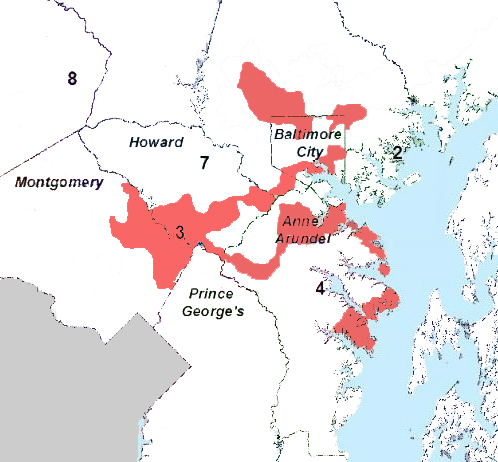

Maryland's New 3rd District
According to Senate President and advisory committee member Thomas V. Mike Miller Jr. (D-Calvert) "Congressman Sarbanes lived in Baltimore County, but wanted to continue to represent the capital city Annapolis." This of course is the root of the problem. In a democracy, the people are supposed to go to the polls and select their representative. Under the process just completed, the Redistricting Commission let the representatives select their constituents. But of course not all representatives were afforded such an accommodation. I doubt Roscoe Bartlett asked to have his district fundamentally reconfigured and I suspect any request to keep Frederick and Carroll counties would have been ignored. Essentially, Miller confessed to partisan gerrymandering.

Miller's peculiar statements continued as he argued "Maryland is a small state ... and it doesn’t have many rural, conservative areas that would vote for Republicans that could comprise a district of 700,000 people." This is of course wrong, especially if you include the suburban areas that Republicans often carry. Has Miller reviewed election returns from Baltimore county? Garrett, Allegheny, Washington, Frederick and Carroll counties? St. Mary's, Calvert, and Anne Arundel county? The entire Eastern shore and Harford county? The reason the proposed map is so gerrymandered is because Maryland is full of regions that would and do vote Republican and these regions surround four counties and Baltimore City that vote Democratic. Democrats are the clear majority party in Maryland - but its hardly a one party state.

Finally, Miller defended the proposed map, arguing "the change is quite modest." It's hard to reconcile that claim with the fact that only 174,000 Marylanders actually needed to be moved in order to create districts with equal populations. The Commission's plan would move over 1.5 million Marylanders - nearly a third of the state's residents.

But, if the Commissioners are open to a moving 1.5 million people to balance out 174,000 why not consider a radical idea - a map that actually represents Maryland.

Below is a very rough depiction of what a more reasonable and representative map might look like (note that the final boundaries would shift a little to balance out district sizes and to maximize minority representation in the 4th, 7th, and 8th districts - but this is essentially a map with 8 roughly equal districts).

Eberly Concept Redistricting Map
 All remnants of past gerrymandering would be gone. I'd also point out that this map intentionally fails to consider whether current incumbents would be redistricted out of their districts - for one simple reason - congressional districts belong to the people and not to a member of Congress.

The map that I've developed and just described would create a Congressional delegation of 4 Democrats (3rd, 4th, 7th and 8th) and 3 Republicans (1st, 5th, and 6th). The 2nd District would be a swing district (O'Malley carried Howard county by 10 points) likely leaning Democratic as the more conservative areas in Howard and Baltimore counties are in the 6th district. Howard and Baltimore are two counties that should be divided over more than one district given there very diverse demographics (a reflection of their central location), but this requires careful slices, not zig-zag slicing and dicing.

As I've demonstrated in the past, Maryland is a 60/40 Democrat/Republican state - a 5/3 Democrat/Republican delegation would be 62.5% Democrat and 37.5% Republican.  The state's geographic, political, and ethnic diversity would be more accurately represented. Minority voters would no longer be denied the opportunity to maximize representation and Maryland would have a map that lets voters pick the best person to represent their communities - as opposed to the current practice in which representatives pick the communities and voters most likely to vote for them.

I of course realize that my proposal or any similar proposal would go no where. The Democratic and Republican parties are engaged in a heated battle to pick up or protect seats anywhere the can. Maryland is one of the few states where redistricting is controlled by the Democrats and there is no way the party would accept a map that would elect more Republicans.

But a redistricting process that is based entirely on maximizing partisan advantage, regardless of the true diversity of a state, undermines the whole concept of representation. It renders the House of Representative nothing more than a tool of the two parties rather than a microcosm of the people. So far, 7 states have abandoned partisan redistricting. In California, the gerrymandering was so bad that in the span of a decade out of 53 congressional seats, across 5 elections (that's 265 distinct elections) there was only one instance (1/265 = 0.38%) when a seat changed parties. That's not democracy. With the state's newly drawn (non-partisan) map, fully 14 of the state's 53 seats are toss-ups - from 0.38% across a decade to possibly 26% in a single election - that's change we can believe in.

In his new book, The Price of Civilization, Jeffrey Sachs rightly describes America not as a democracy but rather as a duopoly controlled by the two parties. It is managed competition in which Democrats have drawn their way to a floor of about 195 seats in the House and Republicans about 185. It is a world where 380 of the House's 435 seats are not competitive. A century ago the progressive movement stood for the end to the corruption of government, it sought to break the hold of party machines and bosses, it sought to return integrity to the political system. The movement needs to rediscover its roots. We need to move beyond the short term obsession over whether a given choice or change helps or hurts Democrats or Republicans and instead focus on the long term objective of doing what is needed to maintain the health and vitality of our democracy. An end to partisan gerrymandering would be a good start (then we can follow that up by ending closed primaries and enacting public financing of campaigns).

Wednesday, August 3, 2011

Talking Redistricting on Kojo Nnamdi on NPR

I was a guest on the Kojo Nnamdi show today discussing redistricting in the state. I'd like to thank Kojo for having me on the show.

Listen here

Maryland's Enters The Fight Over Redistricting in Maryland, Politics

We explore how this round of redistricting is likely to shape the balance of political power in Maryland.

Maryland is about as "blue" as a state can be. But it's about to be consumed by complicated fights over redistricting, even though the Democrats control all the important levers of power. We explore how race is shaping this year's round of redistricting in Maryland, and we hear from Republicans about their strategy going into the process.

Guests:

Andrew A. Green
Opinion Editor, The Baltimore Sun

Alex Mooney
Chairman, Maryland Republican Party

Aisha Braveboy
Member, Maryland House of Delegates (D-Prince George's County); Co-Chair, Maryland Legislative Black Caucus Redistricting Committee

Todd Eberly
Professor, Political Science, St. Mary's College of Maryland; Author, The FreeStater Blog

Friday, July 22, 2011

Just how Democratic is Maryland? Not as Democratic as You Think, but Still Pretty Democratic

As a follow up to my endorsement of the Maryland GOP's proposed redistricting map I wanted to discuss what I referred to as the true political diversity of Maryland. It is often remarked that Democrats enjoy a 2-to-1 voter registration advantage over Republicans in the state. This is quite true, the table below shows party registration numbers as of June.

As the table shows, Democrats hold a 56% to 26.6% registration advantage over Republicans. But the table shows two other important things often overlooked in a discussion of Maryland politics 1) though Democrats outnumber Republicans they still make up only 56% of all voters and 2) Independent or Unaffiliated voters make up a sizable chunk of the state's electorate.

Let's stay for moment with that 56% figure. As the majority party, it makes sense that Democrats would hold all or most (in fact all) statewide offices - Governor, Comptroller, Attorney General, both U.S. Senators. But regional offices should be a bit more competitive - still the Democrats hold 6 of 8 seats in the state's Congressional delegation (75%), 98 of the 141 seats in the House of Delegates (70%), and  35 of the 47 seats in the state Senate (75%). This is a pretty impressive accomplishment for a party that lays claim to only 56% of voters.

There are two possible explanations for this impressive hold on offices within the state 1) Independent and Republican voters actually vote for Democrats or 2) Maryland's 8 Congressional and 47 legislative districts have been gerrymandered such that Democrats are able to outperform their actual voter registration advantage.

So how do those Independent and Unaffiliated voters vote? Below is a table with election results and voter turnout for a selection of Maryland elections dating back to 2004. Included are the 2004 and 2008 presidential election, the 2010 gubernatorial election, and the results form the 2010 election in Maryland's 2nd and 5th Congressional districts. Included are the total votes received by the Republican and Democratic candidate as well as the total votes cast by Democrats, Republicans, and Independent/Unaffiliated voters.


Almost immediately you see that we can throw out explanation 1 (that Independent and Republican voters vote for Democrats). In nearly every election included in the table (and in nearly every election in Maryland) the Democratic candidate receives a vote total either just above, or in some cases just below, the total number of Democrats who voted in the election.

But look at the tallies for Republican candidates, in each election the Republican candidate received substantially more votes than there were Republicans voting. In 2004, George W. Bush received 1.024 million votes, yet only 733,000 Republicans voted. In 2010, Bob Ehrlich received 776,000 votes when only 578,000 Republicans voted. By way of contrast, O'Malley received 1.044 million votes which was 29,000 votes fewer than the total number of Democrats who cast ballots. Even in Congressional districts, Republicans outperform their partisan turnout.

What's going on? Simple, Independent/Unaffiliated voters overwhelmingly vote for Republican candidates, regardless of the office and regardless of turnout. To be fair, in every election some Republicans do vote Democrat and some Democrats do vote Republican (but most studies show that only abut 10% of voters cross party lines when voting). Republicans candidates in Maryland consistently outperform their share of registered voters casting ballots. In the 2004 presidential contest and the 2010 gubernatorial race I estimate that Republicans claimed the support nearly all Independent/Unaffiliated voters (in all likelihood Republicans actually won quite a few Democrats and O'Malley received more than 1.2% of Independents - but it all comes out in the wash). In 2004 68% of Independents turned out, but only 35% turned out in 2010 - yet they still broke for the Republican by similar margins.

2004 and 2010 may be poor examples. Bush was an incumbent president and Ehrlich a former governor. So I included the 2008 presidential election and two Congressional elections from 2010, each with an incumbent Democrat. Turn out by Independents in 2008 was similar to 2004 and turnout in the two Congressional districts was essentially the same as the 2010 statewide turnout. In the three elections covered Democrats outperformed Democratic turnout in 2 of the 3. In the Presidential election and in the 5th Congressional district race I estimate that Democrats carried 22% to 24% of the Independent vote. Republicans picked up between 59% and 70% of the Independent vote.

In Maryland, regardless of the election, Independent voters break heavily toward the GOP. This rather consistent support for GOP candidates suggests that Republicans actually claim a larger share of Maryland's voters than registration number suggest. Averaging the elections highlighted above (and placing a greater weight on higher turnout elections) suggests that Republicans receive about 77% of the Independent vote, Democrats about 6% and the remainder actually goes to third party candidates.

The table below shows an alternate breakdown of each party's effective partisan strength in the state if we were to reallocate Independent voters according actual election results.

Democrats gain very little and remain at 57% of the electorate, Republicans see there share of the electorate jump from 26.6% to 38.6% and true Independent voters dwindle (yes we are a lonely few).

So how do Democrats hold 75% of Congressional seats, 70% of the seats in the House of Delegates, and 75% of the seats in the state Senate?

It's called gerrymandering folks...


Gerrymandering is the process by which a political party draws district lines not to represent the interests of the people, but rather to represent the interests of the party. By drawing the 6th and 1st district such that registered Republican and Republican leaning Independent voters are packed into those districts the remaining districts contain more Democrats. Republicans in Anne Arundel, Baltimore and Harford county are sliced across multiple districts to dilute their influence and excess Democrats in Baltimore City, Prince Georges, and Montgomery county are spread across multiple districts to boost Democratic prospects.

The same process is applied to the state's legislative districts. What's up with 2C, 3A, 37A - easy, they each create Democratic districts in the midst of otherwise Republican areas (and before someone thinks to remind me that the state's legislative districts were "redrawn" by the courts, I would remind you that the changes made by the court were miniscule).

And this process is not unique to Maryland or to Democrats - one look at the map of Legislative and Congressional districts in Texas and it's easy to see why state Democrats fled the state in 2003 to try and stop the proposed map.


After my column supporting the Republican's proposed map was published I was accused of being a partisan out to boost the Republican party - this simply is not the case. I am among the 2.5% of truly Independent voters in Maryland (this was not always the case, I was once a very partisan fellow, but years of studying American politics made me realize the damage that hyperpartisanship has done to our system). I tend to be a pretty moderate person and I really dislike the ideologues that dominate both major parties. Above all, what I care about is a process that respects voters and the true political diversity of a state. When Democrats or Republicans abuse the process to boost their numbers the voters suffer, the concept of representation suffers.

My goal is not more Democrats or more Republicans, my goal is a state where the people are truly represented, not a state where one party can artificially create a partisan advantage simply by drawing lines... Maryland has been a leader in environmental legislation and health care reform, can we now be a leader in moving toward non-partisan redistricting? What a wonderful legacy that would be for Governor O'Malley.