Showing posts with label hogan. Show all posts

Friday, November 2, 2018

Maryland Politics 2018 - Can Larry Hogan Hold Back the Blue Wave


Maryland has not reelected a Republican governor in over 60 years. Despite that daunting history and clear evidence of Democratic enthusiasm as we near Election Day 2018, Maryland Governor Larry Hogan appears set to defy both history and the Blue Wave that is building nationally. 

How has Hogan managed to withstand the strong national headwinds? Will Hogan's popularity help other Republicans on the ballot in Maryland? 

Larry Hogan is the second most popular governor in the country, enjoys a 70% approval rating, and holds an 18-20 point lead over Democratic challenger Ben Jealous - all in a state where Democrats out number Republicans by a margin of 2 to 1. Will the Blue Wave cause so much as a ripple as it hits the Chesapeake Bay? 

These are just a few of the questions explored by Bryan Sears, Maryland Politics Reporter for The Daily Record, Mileah Kromer, Director of the Goucher Poll at Goucher College, and Todd Eberly, professor of Political Science at St. Mary's College of Maryland.
image.png
Bryan Sears - The Daily Record
image.png
Mileah Kromer - Director of The Goucher Poll
headshot.jpg
Todd Eberly, Professor of Political Science at St. Mary's College of Maryland
As Maryland’s public honors college, St. Mary’s offers an undergraduate liberal arts education and small-college experience like those found at exceptional private colleges.St. Mary’s is named for the place it marks: the 17th-century capital of Maryland. 

The Center for the Study of Democracy was founded in 2002 as a joint initiative of St. Mary’s College of Maryland and its partner institution, Historic St. Mary’s City, the site of Maryland’s first capital. The Center was created to promote public service and civic-mindedness, support research, and provide a forum for politicians, government officials, journalists, and scholars to address topics central to the Center's mission.

Tuesday, October 30, 2018

The Hogan/Jealous Election will be Decided by Crossover Voters

In several prior posts I have offered models for the Hogan/Jealous election based on Absentee ballot requests, prior election trends, and allocation of voters based on polling data. In this post, I want to look at all of the early votes and all of the Absentee requests collectively to see if they suggests a Blue Wave is building in Maryland. The Good folks over at Seventh State have already poked some holes in the Blue Wave argument. It's true that early voting is on track to be double what it was in 2014, but that's hardly surprising. Early voting doubled between 2012 and 2016 as well. But that dramatic increase between 2012 and 2016 did not result in a boost in overall turnout. Likewise, 2014 is on track to see turnout at or just below the 2010 level.

The key for this election isn't turnout, it's Democratic crossover voters. Polls taken since August have consistently shown Hogan dominating among Republican voters, winning the vast majority of unaffiliated voters, and receiving the support of between 30 and 37% of Democratic voters. It's easy to apply those partisan breakdowns to the total number of ballots cast or requested as of 10/29/2018. The results are presented in the table below.


If Hogan receives the high end level of support among Democrats then he would theoretically lead among the early votes and absentees by a margin of 53.9% to 43.2%. If Hogan's support among Democrats is at the low end, then the margin would fall to 49.4% to 47.6%.

Under either scenario the news is bad for Jealous because Democrats tend to dominate the early vote. In 2014 and 2016 Democrats accounted for 63% of the early vote, but only 55% of the total vote once Election Day was included. In 2014, Anthony Brown won the early vote by 9 points, but ultimately lost by 5 points. So the early numbers are likely to have the best results for Jealous. In fact, if I allocate the early vote to Jealous, based on Brown's 2014 support and to Hogan based on his 2014 support, then Jealous moves in a 5 point lead - as compared to the 9 point lead that Brown had. 

If the polls are right, and many Democrats intend to vote for Hogan, then all of the focus on turnout has just been background noise.

The 2018 election is unlikely to be determined by turnout. It's going to be determined by how many Democrats crossover and vote for Hogan. If the crossover vote is anywhere near 30% then Hogan wins regardless of turnout. It's not enough for Jealous that Democrats turnout, those Democrats need to come home to their party when they fill in their ballot.  

Monday, October 22, 2018

Updated: Maryland Absentee Ballot Requests May Not Be Good News for Jealous

Originally published on October 11, 2018. Post has been updated to include Absentee Ballots submitted through October 22, 2018.

Faced with daunting poll numbers that suggest Larry Hogan holds a steady double digit lead over Ben Jealous, Maryland Democrats have looked for silver linings wherever they can. In a press release today, they touted an increase in Democratic absentee ballot requests relative to 2014. While it's true that Democratic absentee ballot requests are up significantly, ballot request are up among Republican and unaffiliated voters as well and in 2014, Republicans were more likely to return those ballots.

But the bigger problem for Democrats is the significant cross-over voting suggested by the polls taken thus far in the governors race. According to the most recent polls, Hogan is drawing support from about 33-35% of Democratic voters. Jealous, on the other hand, is only receiving support from about 5% of Republican voters. Among unaffiliated voters, Hogan is supported by 64% to Jealous' 31%. That means that while Hogan will win the lion's share of the Republican and unaffiliated vote, Jealous will share a significant chunk of the Democratic vote with Hogan, while receiving little from Republicans and unaffiliated voters.

It's fairly easy to apply those partisan levels of support to the absentee ballot requests. If you remove the undecided voters from the poll (there aren't many) and use the Gonzales Poll as a guide, then Jealous receives 60% of the Democratic vote, 5.5% of the Republican vote, and 31% of the unaffiliated vote. Hogan receives 37.7% of the Democratic vote, 93% of the Republican vote, and 64% of the unaffiliated vote. The remaining votes from each group go to third party candidates (according to the Gonzales Poll).


As shown in the table, applying those partisan margins to the requested absentee ballots would net 35,288 for Jealous, or 44.4% of the total, and 42,093 for Hogan, or 53% of the total.  Historically, Democrats have dominated the early vote in Maryland. In 2014, Anthony Brown won the early vote by 9 percentage points. 

***Updated with data as of 10/22/2018, Hogan's position has improved. Hogan now receives 53.7% to 43.7% for Jealous. In this model, Jealous doesn't overtake Hogan unless Hogan's share of the Democratic vote drops below 29%. And again, Democrats tend to dominate early voting in Maryland. 

There's no way to tell how the folks who have requested absentee ballots will vote and I'm certainly not predicting a 54% to 44% margin for the election or even among actual absentee ballots. I am saying that any assumption that the absentee ballot requests point to good news for Jealous... is not a safe assumption.


Friday, October 19, 2018

57% Isn't Enough for Jealous to Win

In a recent call with reporters, the Ben Jealous campaign said that they expect Democrats to make up 57% of voters in the gubernatorial election. That would be noticeably better than 2014 when Democrats accounted for only 54.5% of voters. The last time Democrats made up 57% of the electorate was in 2006 when Martin O'Malley defeated Republican incumbent Bob Ehrlich. So would 57% be enough for Jealous to defeat Hogan? Probably not.

Shortly after the 2014 election Jared McDonald with the Center for American Politics and Citizenship at the University of Maryland analyzed the 2014 election results to test the theory that Anthony Brown had lost to Larry Hogan because of poor turnout among Democrats. In his analysis, McDonald substituted the 2002, 2006, and 2010 turnout levels for the actual levels in 2014. He found that Hogan still would've won under any of those scenarios. According to McDonald the reason was clear - it wasn't because Democratic turnout was low, it was because nearly 25% of Democrats had voted for Hogan. In other words, Brown still would've lost under each of the 3 turnout scenarios because of the number of Democrats who crossed over to vote for Hogan.

In the following tables, I update McDonald's analysis by applying the 2006 turnout model (which assumes that 57% of voters are Democrats) to the 2018 electorate. In the first table, I assume that Jealous receives the same level of support from Democratic, Republican, and Unaffiliated voters as had Brown. Hogan receives the same level of support that he received in 2014 as well. Under that scenario, Hogan wins by a margin of nearly 60,000 votes and 2 percentage points. But in 2014, Hogan only received support from 23% of Democrats. Polls conducted thus far in the 2018 race suggest that Hogan will do much better among Democrats as compared to 2014. The Gonzales Research and Marketing poll released a few weeks ago showed Hogan receiving well above 30% of the Democratic vote. If I apply the levels of partisan support from the Gonzales poll to the 2006 turnout model with a 57% Democratic electorate, Hogan wins by over 430,000 votes and 19 percentage points (which is where polls put his lead right now).

Table One: 2006 Turnout Model with 57% Democrats
If we assume that overall turnout will rise to 2006 levels and that the electorate is composed of 57% Democrats then Hogan wins even if he simply maintains his level of support among Democrats from 2014. The Jealous campaign said that their goal is to hold Hogan's support among Democrats to less than 30%. My models suggest that Jealous needs to hold Hogan to less than 23% support from Democrats.

Table Two: 2006 Turnout Model with 61% Democrats
Does this mean that all hope is lost for Jealous? Not quite. Oddly enough, the best case scenario model for Jealous comes from the Goucher poll that found Jealous to be 22 points behind Larry Hogan. Though the poll showed Hogan with a commanding lead, it assumed the electorate would be 61% Democrat and only 27% Republican - a decidedly strong showing by Democrats. Hogan led in that poll because of the high level of support he received from Democrats, but, as shown in Table Two, if Jealous could hold Hogan to his 2014 level of support among Democrats then Jealous would win by 41,000 votes and 2 percentage points. If, however, Hogan receives the level of support suggested by the Gonzales poll then Hogan wins by over 311,000 votes and 14 percentage points. In fact, if Hogan received the support of only 26% of Democratic voters he'd still win even if 61% of voters were Democrats.

So Jealous needs two things to break his way, Democrats need to make up more than 57% of the electorate and Hogan's support among Democrats needs to be at or below its 2014 level. Either of those alone will not suffice. Jealous needs both to happen.

Monday, October 1, 2018

Making Sense of the Hogan/Jealous Polls - Update

Update - The Washington Post poll has Hogan ahead by 20 points, 58% to 38% with a MoE of +/- 4.5%. Factor in the upper and lower bounds of the MoE (as detailed below) and the Post poll is seeing the same race as are the prior polls in Maryland. 

Across all 4 polls, Hogan has an average lead of 18.25 points. I had estimated his lead to be between 16 and 18 points in the original post.


Original Post:

In the span of five weeks, 3 separate polls have been released in the Maryland governors race between Larry Hogan and Ben Jealous. The head to head numbers in each poll looked like this:

Gonzales: Hogan 52% / Jealous 36% - a 16 point gap
Goucher: Hogan 54% / Jealous 32% - a 22 point gap
Mason Dixon: Hogan 52% / Jealous 37% - a 15 point gap

I'm a professor of Political Science and in addition to Public Policy, American, and Maryland Politics I teach statistics, probability, random sampling, and survey design. Before becoming a professor I worked for the state of Maryland and conducted survey research of Maryland residents. One of my studies even helped to convince the Census Bureau to change the way in which they measure the number of folks receiving publicly financed health insurance in their annual Current Population Survey. 

After seeing the Mason Dixon poll I took to social media and wrote that the Goucher, Gonzales, and Mason Dixon polls all saw a similar race. That there really wasn't a difference among them. Needless to say, this observation didn't sit too well with folks who don't study polls or probability. So I thought I'd spend a little time explaining why these surveys are seeing essentially the same race.

It all comes down to the margin of error (MoE) and the level of reported confidence in each survey. Because polls rely on a random sample of the population, researchers can never be 100% certain of the results. The MoE tells us that were the poll to be conducted 100 times the observed results would fall with +/- 3.5 of the results reported in the poll in 95 of the polls. The remaining 5 would fall outside that range. The other way to think of this is that researchers are 95% confident that the true results, were they to survey everyone, would fall with the MoE of the results reported from the random sample. A common way of expressing that is to say that we're 95% confident that the true value falls within +/- 3.5% of the reported result.

The first poll, released by Gonzales Research and Marketing found that Larry Hogan led Ben Jealous 52% to 36% - a difference of 16 percentage points in a poll with a margin of error (MoE) of +/-3.5%. Again, were the survey to be conducted 100 times, the results would fall with a range of +/- 3.5% in 95 of the surveys.

Two weeks ago, Goucher College released a poll reporting a Hogan lead of 54% to Jealous' 32% - a gap of 22 percentages points, with an MoE of +/- 4.5%. 

This week, Mason Dixon released a poll of the race and found Hogan ahead of Jealous by 52% to 37% - a 15 percentage point gap with an MoE of +/- 4%. 

The three polls caused some confusion. Some questioned how the polls could show a lead ranging from 15 points to 22 points. As one would expect, the Jealous campaign pointed to the Mason Dixon poll as evidence that the candidate had gained 7 points on Hogan in the time since the Goucher Poll had come out.

That's good spin, but the truth is a bit more complicated.

The Gonzales Poll had Hogan at 52% and Jealous at 36%. That 3.5% MoE applies to each candidate's reported level of support. So in 95 out of 100 surveys we'd expect the level of support for Hogan to fall within an upper bound of 55.5% and a lower bound of 48.5% (just add and subtract 3.5%) and Jealous would have an upper bound of 39.5% and a lower bound of 32.5%. That means, it's possible the true gap between Hogan and Jealous could be as high as 23 percentage points or as low as 9 percentage points - that's because the MoE for each individual candidate (3.5% in the Gonzales poll) must be doubled when applied to the distance between the candidates, so it becomes an MoE of +/- 7%. Add 7 percentage points to 16% and you get 23%. Subtract 7 percentage points from 16% and you get 9%.

We can easily apply these basic rules to the Goucher and Mason Dixon polls and then see how it is that they are all in the same universe. Goucher had an MoE of +/-4.5% among likely voters. So Hogan's actual possible range was 58.5% at the upper bound to 39.5% at the lower bound. Jealous had a possible range of 36.5% at the upper bound to 27.5% at the lower bound. The MoE for the distance between them would be +/- 9% so that 22 percentage point gap could be as high as 31% or as low as 13%. 

Mason Dixon had an MoE of +/- 4% so Hogan's actual possible range was 56% at the upper bound and 48% at the lower bound. Jealous had a possible range of 41% at the upper bound and 33% at the lower bound. The MoE for the distance between them would be +/- 8% so that 15 point gap could be as high as 23% or as low as 7%. 

The standards for whether or not poll results are significantly different from one another are high in survey research - typically requiring that 95% level of confidence to declare what we call a statistically significant difference. In order to state that the Gonzales, Goucher, and Mason Dixon polls show statistically significant different results there would need to be no overlap in the results after applying the MoE to get the upper and lower bounds of each poll. The Mason Dixon and Gonzales polls had nearly identical results, so it's easy to see that there wasn't a significant difference. It's the Goucher poll that seems to be confusing people. But consider Goucher's 22 point gap and Mason Dixon's 15 point gap. The upper bound of Mason Dixon is 22 percentage points, the lower bound of Goucher is 13 percentage points. They quite clearly overlap. As a result, we cannot say with 95% certainty that the results are statistically different. Obviously, the ranges of the upper and lower bounds of the polls show that were we to repeat these surveys 100 times, there would be times when the upper and lower bounds would not overlap. Because of that we can say that the results may be different, but we'd need to lower our level of certainty or confidence below 95% to a level not considered to be an acceptable test of statistically significant difference within survey research. 

As a result of these basic rules of survey research, the best conclusion is that these 3 polls - spread across the past 5 weeks - are seeing essentially the same race. As a matter of simple politics, it would be wise of the Jealous campaign to tout the Mason Dixon poll as evidence that Hogan's lead is narrowing. Politics is about spin. But as a matter of math, the mathematics of surveys and random sampling, it would be more spin than reality. Based on the results of these 3 polls, and the regions of overlap, I'd place the the likely gap between them in the neighborhood of 16-18 percentage points.

Rumor has it that Gonzales Research and Marketing has a new survey in the field. Once we know those results, we can throw the new numbers into this mix.

Monday, September 24, 2018

Reaction to Hogan/Jealous Debate

Four years ago, Larry Hogan and Anthony Brown met for a series of debates in mid-October at a point in campaign where polls showed that the race was tightening as Hogan closed the gap with Brown. Hogan's goal in that debate was clear - he needed to close the deal and convince voters, the majority of whom had tired of Martin O'Malley, that they could trust a Republican to lead the state. Hogan accomplished his goal and won the election.

Hogan and Ben Jealous met for the only debate of 2018 with a very difference election outlook. Jealous trails Hogan by 22 points according to the most recent poll and the gap between Hogan and Jealous is growing. At this point in the election, Jealous doesn't need to close the deal he needs to stop the bleeding.

The exchanged between Hogan and Jealous were testy from the start. In response to a question on economic growth in Maryland both men used their time to accuse the other of citing incorrect data and misleading the voters. Hogan said that Jealous' plan to implement universal healthcare in Maryland would double the state's budget while Jealous argued that rising healthcare costs were keeping businesses from relocating to Maryland. The exchange was a draw.

On criminal justice reform, Hogan highlighted the response to the corruption problems that he inherited and the reform efforts already undertaken by the state. Jealous highlighted his work on criminal justice reform with the NAACP and his work with other governors and mayors. Jealous offered a strong response to Hogan's record, but his frequent references to Donald Trump and Willie Horton (from the 1988 presidential contest between George Bush and Michael Dukakis) seemed out of line and desperate. Hogan won the exchange.

In response to a question about the opioid epidemic, Jealous criticized Hogan for waiting too long to address the problem as overdose deaths increased. Jealous said that the governor should suing pharmaceutical companies instead of accepting campaign donations from them. Hogan deflected by pointing to the task force that he formed to study the problem and being the first govern to declare a state of emergency over an opioid epidemic. The exchange was a draw.

A discussion of the Red Line project in Baltimore City prompted Hogan to defend his record on mass transportation and justified his rejection of the Red Line based on estimates that it would cost too much and deliver too little. Jealous accused Hogan of wanting fast lanes for rich people who can afford the tolls and said that residents in the City feel that the bus system has gotten worse with too much time spent traveling. The exchange was draw.

On closing the achievement gap, Jealous advocated higher pay, qualified teachers, and universal pre-K funded by legalized marijuana. Hogan highlighted record K-12 funding and a lock-box for casino funds dedicated to education. But Jealous spoke more directly to the issue of closing the achievement gap and brought up the challenges faced by schools with inadequate heating and cooling while state money was being sent to private schools via vouchers. Jealous won the exchange.

A question about counties lagging behind in the national economic recovery prompted Hogan to point to the bipartisan More Jobs for Marylanders Program and the fact that job creation is up and unemployment down in all counties. Jealous countered that the state lags neighboring states in job creation and pressed for a higher minimum wage and free college. Jealous then linked economic growth to a need to defend the Affordable Care Act. Hogan responded by reminding that the state has passed access to free community college and pointed to the recent bipartisan deal reached between Hogan and the General Assembly that has resulted in insurance premium reductions under the Affordable Care Act. The exchange was a draw.

A follow-up question asked what each candidate would do for those kids who live outside of the major metropolitan regions. Jealous proposed $2 billion in additional school funding, universal health care, universal broadband, and expanded public transportation in rural areas. Hogan pointed to the transportation and redevelopment money directed to western Maryland. Jealous responded by discussing the work of his parents and the fact that he was raised in California because his parent's marriage was illegal in Maryland. Hogan replied with a clear statement of respect for all that Jealous and his family have endured as well as their service, but reminded that Jealous first registered to vote in Maryland in 2012. The exchange was a draw.

A final question asked what each candidate would say to Donald Trump if they had a chance. Hogan said that he and Jealous have in common that neither of them supported or voted for Donald Trump. Jealous said that he would tell Trump that he'd no longer have a governor who aids and abets his policies. Jealous won the exchange.

On closing arguments, Jealous promised a Maryland where it was easier for voter's children to reach the American dream. Under Hogan, Jealous argues that schools are losing ground, job growth is failing, and health care costs are rising. Then he reiterated his pledge to use casino moneys for schools, bring universal health care, and reduce the prison population. Hogan reminded voters of his pledge to usher in bipartisanship in Maryland and to end extreme partisanship. Hogan offered Maryland as an example to the nation. On closing statements, each candidate offered a vision of Maryland. Jealous portrayed a Maryland moving in the wrong direction and in need of new leadership. Hogan argued that Maryland was moving in the right direction and asked for four more years. The recent Goucher Poll found that most Marylanders believe that Maryland is headed in the right direction and they feel that they are better off than they were four years ago. In order to win, Jealous needs to convince voters that they are wrong about Maryland. Hogan, on the other hand, needs to convince voters that they are right. That's a far easier task. Hogan won the exchange.

At times, the debate seemed like a rehash of the major themes of the 2016 Presidential race but with the party roles reversed - Make Maryland Great Again v. Maryland is Already Great so let’s stay the course. Hogan offered a vision of Maryland as a success and an example to the nation, but Jealous countered with a portrait of a state struggling with job creation, violent crime, drug addiction, & failing schools. It was hard to not see the parallels to the competing visions of America offered by Hillary Clinton and Donald Trump. The strategy worked for Trump, but will it work for Jealous?

A majority of Marylanders believe that the state is heading in the right direction and two-thirds approve of the job that Hogan is doing. It would take more than a single debate to change those perceptions. 

Overall, the debate was a draw. I argued that Jealous needed to stop the bleeding in his campaign. I believe he did that. But I didn't see or hear anything that was likely to alter the overall trajectory of the race.The best hope for the Jealous campaign is that his debate performance will result in better fundraising numbers so that it can afford to counter the advertising barrage financed by the Republican Governors Association and the Hogan Campaign.  

Friday, March 2, 2018

Democratic Race to Succeed Hogan is Far from Settled

No fewer than seven candidates are vying for the opportunity to take on Larry Hogan in November. Polling shows that a significant number of Democrats are undecided as to who should be the party's standard bearer in 2018. That being said, three names consistently top the polls - Prince Georges County Exec Rushern Baker, Baltimore County Exec Kevin Kamenetz, and former NAACP leader Ben Jealous. Those his lead varies, Baker tops the other other two in every poll.

Situated well behind the top three, mired in single digits, you'll find State Senator Rich Madaleno, tech entrepreneur Alec Ross, attorney and Democratic party insider Jim Shea, and Krishna Vignarajah a former policy aide to Michelle Obama.

Precious little has changed in each candidate's polling standing since the first surveys were conducted in September of 2017 even though candidate name recognition is steadily improving. The latest Goucher poll found that nearly half of Democrats were undecided while the new Mason Dixon poll placed the share closer to one-third. Either way, such a high share of undecideds in a 7 person race suggests that much remains to be settled in this contest.

There is reason to suspect that Baker, Kamenetz, and Jealous top the polls because they enjoy much greater name recognition than do the remaining candidates. In fact, Kamenetz and Jealous have closed the gap with Baker as their name recognition numbers have risen. Among the grassroots, however, the state of the race looks a bit different.

New Poll Finds Hogan Gaining Strength in Maryland

In September 2017, Mason Dixon released a poll showing Larry Hogan with a 61% approval rating. He led all potential challengers in head to head match ups, but was below the critical 50% threshold for an incumbent. Hogan led Rushern Baker 46% to 39%, Kevin Kamenetz 48% to 35%, and Ben Jealous 49% to 33%. Name recognition certainly played a roll in the results given that only 60% of respondents had heard of Baker as compared to 45% for Kamenetz and 48% for Jealous.

Several months have passed and a new Mason Dixon poll was just released - and Larry Hogan could not have hoped for a better set of findings. Each of the major Democratic candidates experienced a significant boost in name recognition (Baker at 71%, Kamenetz at 59%, and Jealous at 55%) but fared worse against Hogan than they did in September. Hogan (with a 63% approval rating) tops Baker 51% to 36%, Kamaenetz 49% to 34%, and Jealous 50% to 33%. Perhaps of greater significance, Hogan has hit the critical 50% threshold in two out of the three match ups.

To summarize, each of Hogan's potential challengers are more well know than they were in September, but Hogan's lead over each has grown. His lead over his best known challenger, Rushern Baker, has literally doubled.

A lot can happen between now and November, but it's hardly a positive sign for Democrats that their potential successors to Larry Hogan - in a state where Democrats have a 2-to-1 advantage over Republicans - aren't getting any stronger as more voters get to know them.

Related Post:
Democratic Race to Succeed Hogan is Far from Settled

Thursday, September 1, 2016

Labor Day Showdown in the Free State

This week, Governor Hogan issued an executive order mandating that the Maryland school year begin after Labor Day and end no later than June 15th. The motivation for the post Labor Day start being the desire to generate a little additional revenue from family vacations to Ocean City prior to the start of the school year. Estimates are that the revised start date could generate up to $74 million in economic activity. This is not a new issue in Maryland and multitude of other states have grappled with the Labor Day question as well. The MD General Assembly created a task force back in 2013 to study the issue and that task force recommended adopting the post Labor Day start date, but their recommendation had no authority. 

The task force report noted:
"All 24 local school system superintendents, the State Superintendent, union representatives, the Maryland Association of Boards of Education, and the Public School Superintendents’ Association of Maryland are opposed to a post-Labor Day start date."
The task force was not moved by that universal opposition, noting instead that "there was no compelling evidence that showed there was any impact on education starting post-Labor Day..." and "there was no quantifiable evidence that a post-Labor Day start is harmful to local schools systems."  

The post Labor Day start has been a favorite of Democratic Comptroller Peter Franchot and was endorsed by former Democratic Governor Martin O'Malley. But given opposition by local school systems and the Maryland State Education Association, the Maryland General Assembly was not willing to impose the mandated start date.

Monday, August 10, 2015

Maryland Needs Redistricting Reform Now

During his State of the State address, MD Governor Larry Hogan called for redistricting reform in Maryland. As he condemned the process of partisan Gerrymandering (used by both parties to create artificial party strength by disenfranchising members of the minority party) most Democrats in the General Assembly sat on their hands and refused to embrace his call. Their reluctance is easy to understand once one looks at Maryland's state legislative and congressional district maps (see below).

Democrats outnumber Republicans in Maryland by roughly 2 to 1, but that voter registration advantage overstates the actual electoral strength of Democrats. As I have detailed in prior posts, the effective partisan breakdown in Maryland is closer to 1.5 to 1. It's an advantage sufficient to explain Democrats' dominance in statewide elections, but insufficient to explain their 3 to 1 domination in the General Assembly and their 7 to 1 advantage in the state's Congressional delegation. In order to maintain those tremendous advantages, Democrats have rigged the game. They have manipulated the states legislative and Congressional districts so as to effectively disenfranchise non-Democratic voters.

Maryland's state legislative districts look as though they were created by an over-caffeinated 4 year old with a paint gun. But the haphazard appearance obscures what is actually a carefully crafted map. Jagged and sprawling districts have been created solely to serve a single purpose - maximize the number of Democratic seats. Each of Maryland's legislative districts elect 3 members to the House of Delegates. The districts can either elect all of the members at large or a district can be subdivided into 3 single member or into a 1 single member and 2 two member districts. As originally intended, single member districts were to be reserved for geographically large rural districts. Democrats have used the district structures to carve out Democratic districts in otherwise Republican regions - this is clearly evident in Districts 2, 3, 30 and 37. Democrats have leveraged their effective map making into a nearly 3 to 1 majority in the General Assembly.


But Maryland's legislative districts cannot hold a candle to the state's Congressional districts when it comes to political manipulation. During much of the 1990s, Maryland had a 4-to-4 congressional delegation. But during the 2001/2002 redistricting process then Governor Parris Glendening and state Democrats dedicated themselves to correcting that "flaw." The new map resulted in a 6-to-2 Congressional delegation and elevated Maryland to the proud status as one of the most gerrymandered states in the nation. Casper Taylor (D-Allegany), then Speaker of the Maryland House, said the plan was the best way to elect more Democrats, arguing "We Democrats deserve six [Democrats] and two [Republicans]." 

In 2011, Governor O'Malley had a chance to correct the abuse of process committed in the name of petty partisanship in 2002, but instead he doubled-down and gerrymandered Maryland so drastically that the state now stands side-by-side with the Rorschach test that is the gerrymandered mess created by the GOP in Texas. The O'Malley map created a 7-to-1 Congressional delegation in Maryland. According to data from the 2010 Census, only 174,000 Marylanders actually needed to be placed into new districts in order to create districts with equal populations. The O'Malley plan placed over 1.5 million Marylanders - nearly a third of the state's residents - into new districts.


So brazen were the efforts to gerrymander the map that few bothered to disguise their motives. Maryland's 3rd District is considered to be one of the most gerrymandered districts in the nation. Why does it look like "broken-winged pterodactyl, lying prostrate” across Central Maryland? According to Senate President and map co-author Mike Miller Jr. (D-Calvert) the answer is simple, the map was gerrymandered to meet the needs to the 3rd District's Democratic representative. "Congressman Sarbanes lived in Baltimore County, but wanted to continue to represent the capital city Annapolis." Why do so many districts claim a part of the Baltimore region? Again, according to Miller, because so many of the state's incumbent Democrats live in the Baltimore region. But such accommodations were not afforded to the state's Republican incumbents. Republican Roscoe Bartlett saw his once conservative sixth district fundamentally altered in a successful effort to create a new Democratic district.


Miller attempted to defend the map with a rather peculiar argument. He stated, "Maryland is a small state ... and it doesn’t have many rural, conservative areas that would vote for Republicans that could comprise a district of 700,000 people." This is of course wrong. The reason the map is so gerrymandered is because Maryland is full of regions that would and do vote Republican and these regions surround four counties and Baltimore City that represent the bulk of the Democratic vote. If Democrats were to produce a map containing compact districts that respected existing county lines then there would be 4 or 5 Democratic districts packed along the I-95 corridor and Republicans would carry the rest of the state.

Miller's response to Larry Hogan's call for redistricting reform - "It's not going to happen... this is an issue that needs to be settled nationally." Miller cited Republican gerrymandering in other states and a reason to not reform the process in Maryland. Maryland Democratic Party executive director Pat Murray criticized Hogan's proposal as "dabbling in national politics instead of focusing on issues that impact middle-class families."  Both are just sorry statements. There is perhaps no issue of greater import to state and local politics than the issue of gerrymandering. And there is perhaps no issue more important to middle and working class families than that of fair representation. At it's heart gerrymandering represents the concerted effort by partisans to undermine the fundamental right democratic representation. Gerrymandering creates a system in which those in office choose their voters instead of a system where voters choose those in office. Miller understands this all to well as he took advantage of his position on the redistricting committee to redraw his own district in an effort to boost his electoral fortunes. 

Of course it would be preferable to have national redistricting reform, but those who represent the people of Maryland have first and foremost an obligation to the people of Maryland. As such, any effort to avoid reform of Maryland's redistricting process by calling for national reform is simply an excuse to put the interests of the people of Maryland secondary to the interests of the national party. Maryland needs redistricting reform now.


Sunday, May 17, 2015

Governor Hogan Wants To Do What?

Last week Governor Hogan caused a big stir in MD politics when he announced that he was moving ahead with a plan to reopen the Annapolis State Police Barracks and add 100 officers - even though the General assembly never considered, let alone approved, his supplemental budget request to do both.

Hogan announced that he would pay for the initiative by line item vetoing a $2 million earmark in the Capital Budget that was supposed to finance improvements at the Maryland Hall for the Creative Arts in Annapolis. A Hogan spokesperson said of the plan "This demonstrates Governor Hogan’s overall commitment to general savings for Maryland taxpayers..."

The decision represents quite a few things, but a commitment to cost savings clearly ain't one of them. This audacious proposal has so many problems that one really needs to question just who has been advising the Governor.

Consider - during the legislative session, the Governor sent the Assembly a supplemental budget for the State's Operating Budget (which funds day-day operations of the state) requesting $8 million to reopen the Annapolis Barracks and hire 100 new troopers. House Speaker Michael Busch did not brings the supplemental to the floor for consideration.  Hogan is now proposing to delete $2 million in spending approved in the Capital Budget (which funds construction and infrastructure) so that he can use those funds to move forward with the barracks reopening and the new hires.

In only three sentences, the prior paragraph has laid out multiple problems in Hogan's plan. Consider first the question of math. Hogan estimated the cost of reopening the barracks and hiring the troopers to be roughly $8.2 million. He now plans to pay for the $8.2 million plan via the cancellation of a $2 million project. I'm not quite clear how a cost deficit of $6.2 million demonstrates an "overall commitment to general savings."  But the issue of cost is actually not the biggest problem with the proposal. As Governor, Hogan has the authority to strike an item from the Capital Budget. But he cannot then take that money and spend it something not already in the Capital Budget. Nor can he - as is the crucial point here - take money allocated in the Capital Budget and transfer it to the Operating Budget. Which is exactly what he would need to do in order to fulfill his plan. Oh, and he can't spend money in the Operating Budget that wasn't authorized by the Operating Budget - so he can't add money to the authorized budget for the state police.

So Governor Hogan wants to transfer $2 million out of the Capital Budget and into the Operating Budget (which he can't do) in order to fund an $8 million program (which $2 million can't do). So unless the Governor's advisors have discovered a previously unknown section of the Maryland constitution this plan is going nowhere and may prove to be the most significant unforced error yet committed by this young administration.

So if the $2 million can't really be used to pay for the barracks and the officers what else could be the motivation for the plan? The likely answer is very disturbing and very unfortunate. The Maryland Hall for the Creative Arts is in Speaker Michael Busch's district and the Speaker has been a tremendous benefactor over the years. Hogan has made clear that he is unhappy with Busch. Hogan blames Busch for the agenda failures he endured during the legislative session and called Busch "petulant" for refusing to allow consideration of Hogan's supplemental budget proposals. By claiming $2 million in savings from an earmark that is insufficient to fund the barracks and unavailable to the Operating Budget, Hogan did little more than take a figurative swing at Speaker Busch (a man without whom Hogan can never achieve his legislative goals). What a ridiculous motivation.

I admit to being generally supportive of Governor Hogan and I have (justifiably) defended his actions on many occasions. But this bizarre proposal is simply beyond my comprehension. If the Governor has some larger plan or some clear legal guidance that would better explain how the $2 million for the Capital Budget can have any impact on his plans via the Operating Budget then he owes it to everyone in the state to release that information as soon as possible. But if he is moving forward with this based solely on the idea that saving $2 million from the Capital Budget would produce general savings to the state in order to offset new spending that he is not authorized to spend, all in an effort to hurt Speaker Busch, then I'm left with the quote from the esurance commercials so aptly applied to this situation by Bryan Sears of the Daily Record - that's not how any of this works. And It's certainly not what voters were looking for when the rejected politics as usual last November.

Friday, May 15, 2015

Overreaction to Hogan's GCEI Decision Does Not Reflect the Reality of the Situation

In what has become a recurring theme, Democrats and their allies - like the Maryland State Education Association - are overreacting to Larry Hogan's decision to not fully fund the Geographic Cost of Education Index (GCEI) which allocates additional education funds to certain counties. The $68 million he is withholding represents less than 1% of the state's $7.5 billion education budget. In a recent Twitter post, a representative of the MSEA stated that per pupil spending in MD had increased every year of the past 10 years... until now. Problem is, it's not true. According to an annual report issued by the U.S. Census Bureau Maryland's per pupil spending in 2012 was below both the 2010 and 2011 levels. The reference to per pupil funding is clearly part of an effort to get the public to equate per pupil spending with student achievement. But numerous studies have confirmed there's no correlation between spending and achievement.

If I were advising Hogan I would've told him to spend the $68 million for the GCEI, but by no means do I think that his decision to withhold the money will undermine the quality of education in the state. One must consider as well that the withheld GCEI funds total only $68 million out of $7.5 billion in K-12 education spending in Hogan's budget. That's less than 1%. Governor O'Malley funded none of the GCEI in his first year in office and only one-third of it in his second year - and no one questioned his commitment to education. Additionally, Hogan's budget increased overall K-12 spending by 1% over FY 2015, that is the same spending increase contained in Governor O'Malley's budget last year. And again, there was no gnashing of the teeth then. The fact that Governor O'Malley got a free pass to make K-12 funding decisions similar to those made by Governor Hogan suggests that the criticism of Hogan is mostly driven by political opportunism and not true policy opposition.

And let's remember as well where that contested $68 million in GCEI funds came from - the woefully underfunded state employee pension fund. Though the money already in the pension system is untouchable, payments intended for the state pension system, specifically the OPEB (other post-employment benefits), were repeatedly cut by the Assembly in order to free up money for other priorities. Years of treating those intended payments like an ATM helped to create billions in unfunded future obligations. So a few years ago, Governor O'Malley and the Assembly pledged to make it sound via annual supplemental funding via the budget, as well as increased cost sharing and reduced benefits for employees. Then O'Malley and the Assembly failed to make the promised supplemental payments even as employees endured the new costs.

So what does this have to do with the $68 million in GCEI funds? In his budget, Governor Hogan proposed a $150 million supplemental payment to the pension fund and proposed funding half of the GCEI. He also proposed the elimination of some Medicaid coverage and the cancellation of a 2% raise that had been given to all state workers. The Assembly wanted to fully fund the GCEI and the other two measures as well, but because of strict restrictions on their ability to add spending to the Governor's budget they needed to first find the money and then recommend that the Governor spend it. Among other found savings, they decided to take half of the pension supplemental payment, but in doing so they claimed as well that future supplemental payments could be reduced as well. This was crucial as it freed up $2.5 over the next 10 years billion for spending elsewhere. But the decision to reduce the supplemental payments is expected to impose new costs of about $4.5 billion in the next 10 years as the state must make more payments to make the system sound. That equals $2.5 billion that won't be available for other priorities - such as education. Diverting that money, knowing the future costs, was the very definition of short sighted. Hogan has pledge to return the $68 million to the pension fund

Consider as well the context of Governor Hogan's surprise victory in 2014. Maryland had a serious structural deficit problem - ranging from $750 million to $1 billion. Over the past many years the Governor and the Assembly tried to close the gap via increases in sales, income, gas, cigarette, and alcohol taxes. But the deficit persisted. So to meet the balanced budget requirement the folks in Annapolis raided the pension system, the highway trust fund, and the Chesapeake Bay fund - all to achieve single year fixes to the deficit. Governor Hogan campaigned on a promise to truly eliminate the deficit, no more single year fixes by raiding other funds. Taxes in Maryland had been increased already w/o closing the gap, suggesting that the time had come to place the same focus on spending that had been placed on revenue.

Medicaid and education are the state's largest spending obligations - it's hard to imagine how one could address spending w/o education and Medicaid being affected in some way. In the face of all that, a decrease in spending on the non-mandatory GCEI by an amount equal to less than 1% of the state's K-12 budget isn't very severe and certainly isn't unreasonable or an education Armageddon. And it doesn't demonstrate a lack of investment in our children. Governor Hogan did accept the Assembly's request to reinstate the Medicaid spending and the 2% state employee raise - but he said "No" to the GCEI request. In a prior post, I urged Governor Hogan to approve spending the $68 million on the GCEI - mostly as a political calculation intended to foster some goodwill in the Assembly. My colleague David Lublin wrote a piece for his Seventh State blog in which he referred to Hogan's decision as an "unforced error."

David and I agree that this was an unnecessary strategic error, but we clearly disagree with regard to the likely ramifications. As with so many things related to Hogan, Maryland Democrats cannot seem to avoid hyperbolic overreactions that cause no harm to Hogan while undermining their agenda. During the general election the Brown campaign and the state Democratic establishment decided to embrace the strategy of painting Hogan as a radical. They wanted voters to believe that Hogan was a Tea Party Neanderthal who wanted assault rifles on playgrounds and had no respect for women. The portrayal was so ridiculous that in undermined faith in Brown's campaign and boosted Hogan. Then, after Hogan delivered a less than conciliatory State of the State speech (another unforced error) Democrats again overreacted - most notably by holding up confirmation of Hogan's appointees. In the end, the overreaction caused far more harm to democrats than the speech did to Hogan.

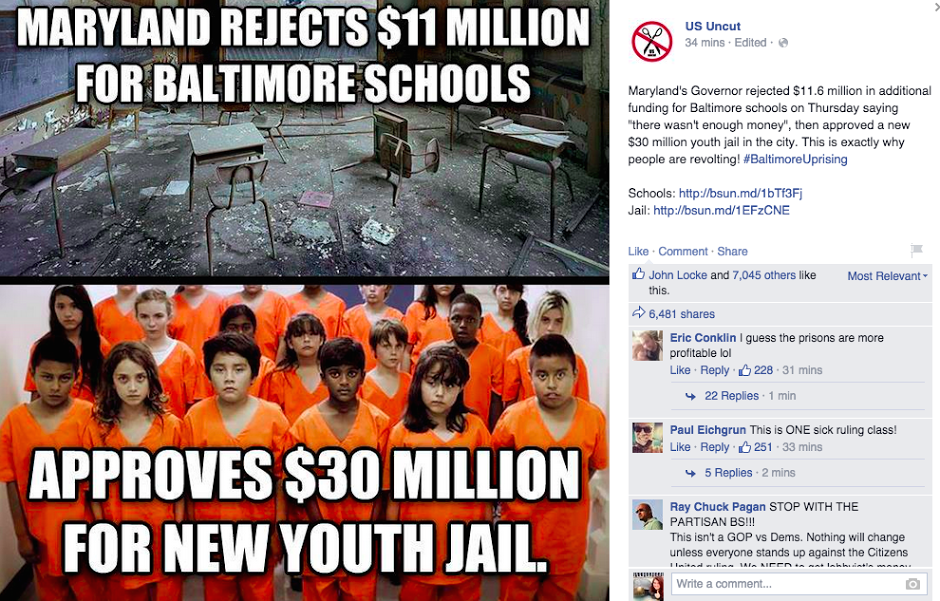
Democrats and their allies are now repeating the overreaction mistake. Perhaps the most ridiculous example being the attempt to paint Hogan as someone who would rather jail children than educate them based on the decision by the Board of Pubic works to approve the creation of a youth detention facility so that minors charged as adults will no longer be housed with adult criminals - an incredibly compassionate decision. In recent years, Maryland families have absorbed tax increases as well as stagnant wages. They've tightened budgets and forged ahead. I don't think that folks who voted for Larry Hogan are going to be very bothered by a decision that involves less than 1% of K-12 education and that only benefitted certain counties - especially when Hogan's budget increased overall K-12 spending. The hyperbolic rhetoric over, and overreaction to, his decision to not spend the money simply does not match the reality of the situation. And I think it will again do more to undermine Democrats than it will Hogan.

Friday, April 17, 2015

A Nonsensical End to the 2015 Legislative Session

Maryland's 2015 Legislative Session has come to an end, and what a silly end it was. Though the session got off to a rocky start - with a partisan State of the State address and a ridiculous overreaction to it by Democratic members of the Assembly - it quickly settled into a rather calm and productive session. Governor Hogan submitted his budget in late January and, as promised, he eliminated the state's structural deficit in a single year. The editorial boards of the Baltimore Sun and the Washington Post both saw much to laud in his budget. Many assembly Democrats were relieved that the budget was not a scorched earth effort to redefine state priorities. But Democrats did object to a few provisions. Hogan did not provide funds for a 2% cost of living raise (COLA) that had been given to state employees (essentially cutting their pay), he provided only half of the funding needed to meet the state's Geographic Cost of Education Index formula or GCEI (which provides additional funds to parts of the state where the cost of providing an education is higher), and he reduced Medicaid spending by taking away funds that would provide doctors with higher reimbursement and by eliminating Medicaid coverage for pregnant women earning between 186% and 250% of the poverty line.

Democrats pledged to find the roughly $200 million needed to fund those initiatives. The General Assembly cannot increase spending in the Governor's budget. They can cut spending, they can identify and recommend additional spending, and they can prevent a governor from spending money that they cut and recommended for other uses. The House budget committee found enough savings from cutting other programs to restore funding for the COLAs, the GCEI, and Medicaid. But in a controversial move, they found $75 million of that money by cutting in half a $150 million supplemental payment to the state pension fund proposed by Hogan. After years of underfunding the state pension fund, former Governor O'Malley and the legislature passed a plan to restore the pension balance via supplemental funds. But in his final budget, O'Malley reneged on the promise. Hogan attempted to meet the state's obligations, but the Assembly Democrats needed to find money to spend elsewhere. 

The revised budget was unanimously passed out of committee and then passed by the House with all but 10 members voting in favor. Democrats were criticized by the Washington Post for diverting the pension funds and the Senate attempted to compensate for the cut by passing a so-called sweeper amendment that would have dedicated up to $50 million of any year end surplus to the pension fund.

Initial indications were that Governor Hogan was satisfied with the budget deal. Though he believed that the budget was only part of a package that would include much of his legislative agenda. Though the Senate acted on much of his agenda items, the House was slow to follow suit. As the end of the session neared there was tremendous doubt regarding the outcome of the Governor's agenda.

As the final weekend approached, Hogan insisted that the General Assembly restore the $75 million in pension funds. The Assembly leadership was unmoved. The two sides attempted to reconcile their differences. On the final Friday of session, the House/Senate conference committee ultimately adopted much of the Senate's version of the budget. They offered the sweeper amendment, but not restoration of the $75 million. Hogan wasn't interested. On Saturday Hogan offered his plan - with roughly 60 hours remaining in the session. He was willing to fully fund the COLAs for state employees, he offered to increase funding for the GCEI from his initial 50% up to 75%, and he offered Democrats roughly half of the additional Medicaid money that they had sought. But in exchange, he wanted his legislative agenda enacted. Senate President Mike Miller and House Speaker Michael Busch said "no."

And this is where the nonsense reaches a fever pitch. Hogan, Miller, and Busch were arguing about $200 million in a $40 billion budget - roughly 0.5% of the budget. They all wanted to spend it, they just wanted to spend it differently. In the end, they were really only disagreeing about $75 million - Hogan wanted it dedicated to pensions and Miller and Busch wanted it to go to GCEI and Medicaid.

Neither side would budge. On the final day of session, the House and Senate passed their version of the budget. Neither the COLA, GCEI, Medicaid, nor pension money was going to be spent. Rather the budget recommended that Hogan fund the COLAs, GCEI, and Medicaid and he was prohibited from using the money on anything else. Hogan announced that he was unlikely to do so. Then, in the final hours of session, the House passed much of Hogan's agenda.

So session is over. There are no COLAs for state employees, the GCEI is only partially funded, pregnant women between 186% and 250% of poverty have no Medicaid, and the supplemental pension payment was $75 million short.

If Miller and Busch had simply agreed to Hogan's agenda (a rather modest one) on Saturday then they would've gotten the full COLA, 75% of the GCEI, and 50% of the Medicaid funds. Instead they said "No" and got nothing. Then they passed much of Hogan's agenda anyway.

As for Hogan, he was willing to give Miller and Busch nearly everything they wanted - save for the money he held back for pensions. But the Senate sweeper amendment offered a reasonable compromise. So Hogan walked away over a $75 million disagreement in a $40 billion budget - because he wanted all of his agenda.

What we witnessed in those final days of session was not governing. It was ego mixed with stubbornness. There was no reason for Hogan to reject the Miller and Busch plan and there was no reason for Miller and Busch to reject Hogan's plan.

Now the session is over. Hogan saw a significant amount of his legislative agenda passed by the Assembly. Much of it was modified and amended, but that's the nature of divided government and separation of powers. And the state has a budget. In that budget, roughly $200 million has been set aside by the legislature to fully fund state employee COLAs, GCEI, and Medicaid. It also has a provision to dedicate any surplus funds to the pension fund. All told, it's about $75 million away from Hogan's final offer to Miller and Busch. But none of it can be spent with Hogan's approval. With much of his agenda passed and the structural deficit greatly reduced, Governor Hogan should declare victory and agree to accept the Assembly's recommendations and spend the money they set aside. There's simply no good reason to keep saying "no."

Wednesday, February 11, 2015

Instead of Railing Against Hogan's Budget, Assembly Democrats Should Focus Efforts on Reforming the Process

It's abundantly clear that most Democratic members of the Maryland General Assembly are not pleased with major elements of Governor Hogan's proposed budget. The most contentious issues include a significant reduction in the rate of increase for spending on K-12 education and the elimination of a promised 2% cost of living increase for state employees. House Speaker Michael Busch and Senate Budget Committee Vice Chair Richard Madaleno have been among the most vocal opponents of the budget. Numerous Democrats have pledged to fight Hogan's budget.

But their pledges and their passions amount to next to nothing. There is precious little that any Democrat (or Republican) in the Assembly can do to substantively change Hogan's budget. Maryland adopted an executive centered budget process via a constitutional amendment it 1916 and ever since the General Assembly has been without the power of the purse. According to the constitution of Maryland, the Assembly cannot increase spending in the governor's budget and it cannot move funds around in an effort to increase funding in one area by reducing it elsewhere. All the Assembly can really do is reduce the amount of spending proposed by the governor.  The Assembly can introduce legislation to provide funding for programs - but only if the legislation identifies a funding source (e.g. raising taxes). Certainly, members of the Assembly can work with Hogan and try to convince him to introduce a supplemental budget that provides more funding for programs they value, but failing that, Hogan's budget will stand.

If Democrats in the Assembly really want to make a difference they will work to support SB 660, sponsored by Senators Madaleno, Guzzone, and Manno.  The bill would undo a constitutional amendment that has long outlived it's usefulness. The key section in the state constitution can be found in Article 2, Sec. 52 (6):
(6) The General Assembly shall not amend the Budget Bill so as to affect either the obligations of the State under Section 34 of Article III of the Constitution, or the provisions made by the laws of the State for the establishment and maintenance of a system of public schools or the payment of any salaries required to be paid by the State of Maryland by the Constitution thereof; and the General Assembly may amend the bill by increasing or diminishing the items therein relating to the General Assembly, and by increasing or diminishing the items therein relating to the judiciary, but except as hereinbefore specified, may not alter the said bill except to strike out or reduce items therein, provided, however, that the salary or compensation of any public officer shall not be decreased during his term of office; and such bill, when and as passed by both Houses, shall be a law immediately without further action by the Governor (amended by Chapter 373, Acts of 1972, ratified Nov. 7, 1972).
So in Maryland, the General Assembly is allowed to amend the budget to increase or decrease appropriations for the operation of the General Assembly or the judiciary, but it all other cases it may only reduce or eliminate spending. This is simply ridiculous! It's hard to imagine anything more counter to the concept of representational democracy than a legislature without the power of the purse. In no other state are legislators so irrelevant to the budget process. In roughly half of the states, governors are tasked with developing a budget (much like the president), but that budget is then subject to revision by the legislature. In the other half, the governor and the legislature share the responsibility of making the budget.

How did we wind up with such an executive-centric process? We overreacted to a budget crisis. Maryland was faced with a huge deficit in 1916 and the blame fell squarely on the shoulders of the General Assembly. Our solution? Strip the Assembly of its budget power and hand it all over to the governor. We see how well that worked out. Our ongoing struggles with structural deficits make clear that executives are not any better at budgeting than are legislators.

It's time for Maryland to undo the overreaction of 1916. Instead of offering what are largely hollow pledges to "fight spending cuts," legislators should instead focus on an amendment to the state constitution that would restore the legislature's proper role in the budget process. SB 660 would restore the legislature's role while still respecting the power of the governor. The legislation is far from perfect, especially with regard to the line item veto restrictions that it would place on the governor, but it's a good start.

And no, I'm not proposing this because there's a Republican governor or because I agree with those who would have you believe that Hogan's budget is a draconian overreach. I'm proposing this reform for the same reason I support redistricting reform, because both proposals would boost accountability and representation - two essential ingredients for democracy (unfortunately, none of the redistricting reform legislation introduced thus far is worth discussing).

** I'd like to add that I think Republicans in the Assembly should line up in support of this reform as well. There have been 2 Republican governors in the last 4 decades in Maryland. In most circumstances the GOP is totally shut out of the budget process. If the Assembly actually played a meaningful role then the GOP could gain opportunities to have a role as well. And keep in mind, the GOP made historic gains in the 2014 election. In the Senate, they GOP is 5 seats away from being able to filibuster legislation, thereby earning an automatic seat at the bargaining table. There are 4 Democratic Senators who won with less that 52% of the vote and another 4 or 5 who won in districts carried by Larry Hogan. At present, the MD GOP is one or two election cycles away from being a full-fledged minority partner in governing in the General Assembly. Wouldn't it be better to be a minority partner with the ability to influence the budget as opposed to a minority partner forced to wait for the next Republican governor? 

Monday, February 9, 2015

Maryland Senate Democrats Offer A Clear Reminder of Why Hogan Won

In response to Larry Hogan's "partisan" and "campaign-like" state of the state speech last week, Senate Democrats in the MD General Assembly have decided to take a page from the Mitch McConnell School of Partisanship by slowing down approval of Hogan's appointments and by subjecting the appointees to retaliatory treatment... In other words, Senate Democrats are responding to a speech by jeopardizing the proper functioning of state government. It's always great to see my state Senators behaving like my 4 year old... 

I wrote last week that I believed Hogan committed a strategic error with his first state of the state address as it was a time for more cooperative language. But Hogan did win. And he won comfortably against the Maryland Democratic Establishment's hand-picked and coddled candidate. And Hogan won on a message and an agenda identical to what he proposed in his speech before the Assembly. So what did Assembly Democrats expect to hear? Did they think Hogan would stand before them, hat in hand, and pledge to make a better Maryland for more Marylanders? If they did, they were either naive or arrogant.

And let's keep something very important in mind. Martin O'Malley's state of the state speeches were partisan as well. And in recent years they amounted to little more than test runs for potential campaign themes in a future presidential run. And as Assembly Republicans sat on their hands, Democrats dutifully rose and applauded. But no one in the Assembly or the press cared that O'Malley was being partisan. No one cared that his speeches may have offended Assembly Republicans. With Hogan's speech, Democrats got a taste of their own medicine and decided they didn't like it. Too bad.

Yes, I think Hogan made a strategic error with the speech, but Senate Democrats are behaving like children. I half expect them to announce plans to hold their collective breath until they turn blue if holding up his nominees doesn't force Hogan to come before them seeking forgiveness. 

Senate Democrats may be pleasing the party faithful, the partisan activists, and the other members of the state Democratic establishment that failed to deliver victory in November, but I suspect that their behavior is reminding a lot of voters why they decided to stay home and a lot of other voters why they decided to vote for Hogan.

Thursday, February 5, 2015

Hogan May Have Stumbled, But State Democrats Fell Flat

Newly elected governor Larry Hogan delivered his first State of the State address this week and though he started off on the wrong foot he planted a firm landing. Hogan opened his speech be repeating much of his campaign rhetoric concerning the weak state of Maryland's economy. I believe he got some bad advice. He should've opened by saying the election was over, the time for assigning blame passed, and time to work together at hand. Instead, he told an Assembly full of Democrats that they had horribly mismanaged the state and he was there to fix their mess. That's an odd strategy considering that Hogan can't accomplish any of his broader agenda without the support of some Assembly Democrats. But once Hogan transitioned to his 11 point plan he recovered quickly and closed strong.

Even though I think Larry Hogan erred a bit in his speech, the Democrats' reaction has been downright ridiculous and really shows how coddled the establishment has been in this state. In reality, Hogan offered a pretty modest and moderate agenda - no automatic gas tax increases, a small personal property tax exemption for small businesses, a repeal of the so-called Rain Tax (keep in mind that the Total Maximum Daily Load mandate from the EPA applied to Maryland, New York, Pennsylvania, West Virginia, and the District of Columbia. But only Maryland implemented a tax to comply. So other approaches do exist), restrained growth in the rate of funding increases, renewed support for public financing of gubernatorial elections, and a fair redistricting process. There is nothing radical, ridiculous, our unreasonable in this agenda.

But state Democrats reacted as if Hogan had offered right wing, fire and brimstone red meat. Democratic Senator James Rosapepe suggested the speech represented a mix of Republican and Tea Party appeals. I'm sorry, but if Hogan wanted to appeal to the Tea Party, he would've delivered a far different speech. In reality, Hogan's speech was a reasonable response to the 2014 election results that saw the election of only the 2nd Republican governor in 4 decades and included record gains for Republicans elsewhere in the state (and if MD had a non-partisan redistricting process the GOP gains would've been even greater). It's a sad commentary that to some state Democrats moderation and pragmatism is equated with Tea Party extremism.

Unfortunately, too many Assembly Democrats had become accustomed to having a fellow partisan come before them, heap praise upon all they were doing, and tell them to keep up the good work. Voters sent a different message last November (only a fool would blame Anthony Brown for the outcome). The days of praise are over (for at least the next 4 years). Hogan's speech offered a rude awakening to many in the Democratic establishment and their reactions suggest that many had still not come to grips with the outcome of the election. Meanwhile, Majority Leader Anne Kaiser's Democratic response was a tone deaf bit of fluff that should have been backed by a choir of Democratic Assembly members singing "Everything is Awesome" from The Lego Movie. If voters agreed with Kaiser's take on the state of the state then Anthony Brown would've delivered the State of the State address and not Larry Hogan.

In the end, Hogan's speech, the official Democratic response, and the reaction of establishment Democrats tell us that Hogan understands the results of the 2014 election, but that many Democrats still don't. I mean who could sit stone faced and silent in response to a call for fair redistricting reform? Turns out the answer is nearly every Democratic member of the General Assembly. Hogan may have stumbled a bit out of the gate, but it was establishment Democrats who fell flat in the end. Yes, Hogan needs the support of Assembly Democrats to accomplish many elements of his agenda, but in a state where the governor essentially dictates the budget and wields a veto pen, Assembly Democrats may need him more.