Showing posts with label Maryland. Show all posts

Saturday, November 3, 2018

Enough with the 2010 Obsession

Jealous keeps saying that if 1 million Democrats vote - he wins, because that's what happened in 2010 with O'Malley. There’s no reasonable scenario where fewer than 1 million Democrats turnout to vote in MD’s gubernatorial election. I don’t get the constant references to 2010 & needing 1 million Democrats. There are literally 500,000 more registered voters in 2018. It’s about crossover votes!

The most likely turnout scenario that I see predicts 1.2 to 1.3 million Maryland Democrats voting in this election. I’ve not even bothered w/ models that assume less. 2014’s loss wasn’t a result of low turnout. It was the result of Democratic crossover voters.

Jealous needs to hold Hogan to a lower share of Democrats than the 24% that he won in 2014 - under almost any realistic turnout scenario.

From day one, bringing wayward Democrats home should’ve been strategy number 1.

In the attached models, I assume that Democrats are 58% of all voters (that's better than in 2016) and I then assign Democratic votes to Hogan and Jealous based on various levels of support. Republicans and Other voters are assigned based on an average of the polls conducted in this race.


Jealous tops 1 million votes in each scenario, but loses any time Hogan tops 24% among Democrats.

I don’t offer these as a prediction. I’m only pointing at that everything, everything, comes down to crossover voters. Jealous needs to run against Trump for the next 4 days in an effort to bring Democrats home.


Friday, November 2, 2018

Familiar Patterns Seen in Maryland Early Voting

After 2 days of early voting I estimated that Maryland was on track for 16% turnout. It ended up at 16.72%. Compared to the 8.33% in 2014, that’s a 100% increase in turnout. That's pretty much the same as the increase in 2016 over 2012. Based on past trends, I believe that we’re on track for overall turnout of 52% or 53%. That would be better than the abnormally low turnout level in 2014, but below 2006 and 2010.

Some folks have been comparing the increase in total early voters between 2014 and 2018. But such a comparison doesn’t actually measure turnout increases. Since 2014, the total number of registered voters in Maryland has increased by 250,000. So to calculate any change in turnout, one needs to compare the percent of registered voters who turned out in 2014 (8.33%) to the percent of early voters who turned out in 2018 (16.72%).

The fact that early vote turnout in 2018 increased by essentially the same rate as 2016 over 2012 offers a reminder that even though early voting doubled in 2016, overall turnout only increased by 5.6%. Early voting turnout is yet to be predictive of overall turnout in Maryland.

The partisan breakdown of early voting is in line with expectations based on prior elections. Democrats were 64% of early voters. This is common in early voting in Maryland. Democrats were 65% of early voters in 2016 and 62% of early voters in 2014. But once Election Day voters were included in the counts, Democrats were 56% & 57% of overall voters, respectively. In other words, Democrats vote early at a higher rate than do other voters.

Looking at the early vote totals by gender also reveals similar patterns. Women cast 57% of the early vote in 2018 as compared to 56% in 2014. Their high watermark was in 2016 when they accounted for 59% of early voters.

Competitive County Executive races appear to have driven turnout above the statewide total in Anne Arundel County, Baltimore County, Howard County, and Montgomery County. The contest between Jesse Colvin and Andy Harris may have helped boost turnout in the counties of the 1st Congressional District - but it's worth noting that Eastern Shore counties have traditionally outpaced the rest of the state in early voting.

Early voting turnout in Western Maryland was low - and it usually is. Baltimore City lagged behind the statewide total - and it usually does. Prince Georges County started out with lackluster turnout, but finished strong and above the statewide total. This is a promising sign for Ben Jealous because Prince Georges County is likely to offer his greatest source of voters.

Same Day voter registration was not a big hit during early voting. Out of the 661,000 early voters only 3,700 registered on-site. That's about one half of 1%. It's likely that folks were not aware of the same day registration option. I'd expect to see more people take advantage of it in the future as they become more aware - much as better awareness of early voting has led to increased turnout in successive elections.

What does all of this mean for the outcome of the governor's race between Larry Hogan and Ben Jealous? Who knows! The early voting patterns are so in line with past early voting patterns that it would be folly to read too much into them. From the very beginning of this election the polls have clearly indicated that the outcome will be determined by Democratic voters and their willingness to crossover and vote for Hogan. Polls since August have consistently shown Hogan receiving support from 30-38% of Democrats. When Hogan won in 2014 it's estimated that nearly 25% of Democrats voted for him. So Ben Jealous needs to have Democratic voters "come back home" and vote for their party. In the end, Jealous needs to hold Hogan to no more than 25% of Democrats. That's a tall order, but the last two weeks of controversy surrounding President Trump may well encourage many Democrats to cast a vote against Trump and his party.

We'll know all of the answers on Tuesday night!

Tuesday, October 30, 2018

The Hogan/Jealous Election will be Decided by Crossover Voters

In several prior posts I have offered models for the Hogan/Jealous election based on Absentee ballot requests, prior election trends, and allocation of voters based on polling data. In this post, I want to look at all of the early votes and all of the Absentee requests collectively to see if they suggests a Blue Wave is building in Maryland. The Good folks over at Seventh State have already poked some holes in the Blue Wave argument. It's true that early voting is on track to be double what it was in 2014, but that's hardly surprising. Early voting doubled between 2012 and 2016 as well. But that dramatic increase between 2012 and 2016 did not result in a boost in overall turnout. Likewise, 2014 is on track to see turnout at or just below the 2010 level.

The key for this election isn't turnout, it's Democratic crossover voters. Polls taken since August have consistently shown Hogan dominating among Republican voters, winning the vast majority of unaffiliated voters, and receiving the support of between 30 and 37% of Democratic voters. It's easy to apply those partisan breakdowns to the total number of ballots cast or requested as of 10/29/2018. The results are presented in the table below.


If Hogan receives the high end level of support among Democrats then he would theoretically lead among the early votes and absentees by a margin of 53.9% to 43.2%. If Hogan's support among Democrats is at the low end, then the margin would fall to 49.4% to 47.6%.

Under either scenario the news is bad for Jealous because Democrats tend to dominate the early vote. In 2014 and 2016 Democrats accounted for 63% of the early vote, but only 55% of the total vote once Election Day was included. In 2014, Anthony Brown won the early vote by 9 points, but ultimately lost by 5 points. So the early numbers are likely to have the best results for Jealous. In fact, if I allocate the early vote to Jealous, based on Brown's 2014 support and to Hogan based on his 2014 support, then Jealous moves in a 5 point lead - as compared to the 9 point lead that Brown had. 

If the polls are right, and many Democrats intend to vote for Hogan, then all of the focus on turnout has just been background noise.

The 2018 election is unlikely to be determined by turnout. It's going to be determined by how many Democrats crossover and vote for Hogan. If the crossover vote is anywhere near 30% then Hogan wins regardless of turnout. It's not enough for Jealous that Democrats turnout, those Democrats need to come home to their party when they fill in their ballot.  

Wednesday, February 11, 2015

Instead of Railing Against Hogan's Budget, Assembly Democrats Should Focus Efforts on Reforming the Process

It's abundantly clear that most Democratic members of the Maryland General Assembly are not pleased with major elements of Governor Hogan's proposed budget. The most contentious issues include a significant reduction in the rate of increase for spending on K-12 education and the elimination of a promised 2% cost of living increase for state employees. House Speaker Michael Busch and Senate Budget Committee Vice Chair Richard Madaleno have been among the most vocal opponents of the budget. Numerous Democrats have pledged to fight Hogan's budget.

But their pledges and their passions amount to next to nothing. There is precious little that any Democrat (or Republican) in the Assembly can do to substantively change Hogan's budget. Maryland adopted an executive centered budget process via a constitutional amendment it 1916 and ever since the General Assembly has been without the power of the purse. According to the constitution of Maryland, the Assembly cannot increase spending in the governor's budget and it cannot move funds around in an effort to increase funding in one area by reducing it elsewhere. All the Assembly can really do is reduce the amount of spending proposed by the governor.  The Assembly can introduce legislation to provide funding for programs - but only if the legislation identifies a funding source (e.g. raising taxes). Certainly, members of the Assembly can work with Hogan and try to convince him to introduce a supplemental budget that provides more funding for programs they value, but failing that, Hogan's budget will stand.

If Democrats in the Assembly really want to make a difference they will work to support SB 660, sponsored by Senators Madaleno, Guzzone, and Manno.  The bill would undo a constitutional amendment that has long outlived it's usefulness. The key section in the state constitution can be found in Article 2, Sec. 52 (6):
(6) The General Assembly shall not amend the Budget Bill so as to affect either the obligations of the State under Section 34 of Article III of the Constitution, or the provisions made by the laws of the State for the establishment and maintenance of a system of public schools or the payment of any salaries required to be paid by the State of Maryland by the Constitution thereof; and the General Assembly may amend the bill by increasing or diminishing the items therein relating to the General Assembly, and by increasing or diminishing the items therein relating to the judiciary, but except as hereinbefore specified, may not alter the said bill except to strike out or reduce items therein, provided, however, that the salary or compensation of any public officer shall not be decreased during his term of office; and such bill, when and as passed by both Houses, shall be a law immediately without further action by the Governor (amended by Chapter 373, Acts of 1972, ratified Nov. 7, 1972).
So in Maryland, the General Assembly is allowed to amend the budget to increase or decrease appropriations for the operation of the General Assembly or the judiciary, but it all other cases it may only reduce or eliminate spending. This is simply ridiculous! It's hard to imagine anything more counter to the concept of representational democracy than a legislature without the power of the purse. In no other state are legislators so irrelevant to the budget process. In roughly half of the states, governors are tasked with developing a budget (much like the president), but that budget is then subject to revision by the legislature. In the other half, the governor and the legislature share the responsibility of making the budget.

How did we wind up with such an executive-centric process? We overreacted to a budget crisis. Maryland was faced with a huge deficit in 1916 and the blame fell squarely on the shoulders of the General Assembly. Our solution? Strip the Assembly of its budget power and hand it all over to the governor. We see how well that worked out. Our ongoing struggles with structural deficits make clear that executives are not any better at budgeting than are legislators.

It's time for Maryland to undo the overreaction of 1916. Instead of offering what are largely hollow pledges to "fight spending cuts," legislators should instead focus on an amendment to the state constitution that would restore the legislature's proper role in the budget process. SB 660 would restore the legislature's role while still respecting the power of the governor. The legislation is far from perfect, especially with regard to the line item veto restrictions that it would place on the governor, but it's a good start.

And no, I'm not proposing this because there's a Republican governor or because I agree with those who would have you believe that Hogan's budget is a draconian overreach. I'm proposing this reform for the same reason I support redistricting reform, because both proposals would boost accountability and representation - two essential ingredients for democracy (unfortunately, none of the redistricting reform legislation introduced thus far is worth discussing).

** I'd like to add that I think Republicans in the Assembly should line up in support of this reform as well. There have been 2 Republican governors in the last 4 decades in Maryland. In most circumstances the GOP is totally shut out of the budget process. If the Assembly actually played a meaningful role then the GOP could gain opportunities to have a role as well. And keep in mind, the GOP made historic gains in the 2014 election. In the Senate, they GOP is 5 seats away from being able to filibuster legislation, thereby earning an automatic seat at the bargaining table. There are 4 Democratic Senators who won with less that 52% of the vote and another 4 or 5 who won in districts carried by Larry Hogan. At present, the MD GOP is one or two election cycles away from being a full-fledged minority partner in governing in the General Assembly. Wouldn't it be better to be a minority partner with the ability to influence the budget as opposed to a minority partner forced to wait for the next Republican governor? 

Monday, February 9, 2015

Maryland Senate Democrats Offer A Clear Reminder of Why Hogan Won

In response to Larry Hogan's "partisan" and "campaign-like" state of the state speech last week, Senate Democrats in the MD General Assembly have decided to take a page from the Mitch McConnell School of Partisanship by slowing down approval of Hogan's appointments and by subjecting the appointees to retaliatory treatment... In other words, Senate Democrats are responding to a speech by jeopardizing the proper functioning of state government. It's always great to see my state Senators behaving like my 4 year old... 

I wrote last week that I believed Hogan committed a strategic error with his first state of the state address as it was a time for more cooperative language. But Hogan did win. And he won comfortably against the Maryland Democratic Establishment's hand-picked and coddled candidate. And Hogan won on a message and an agenda identical to what he proposed in his speech before the Assembly. So what did Assembly Democrats expect to hear? Did they think Hogan would stand before them, hat in hand, and pledge to make a better Maryland for more Marylanders? If they did, they were either naive or arrogant.

And let's keep something very important in mind. Martin O'Malley's state of the state speeches were partisan as well. And in recent years they amounted to little more than test runs for potential campaign themes in a future presidential run. And as Assembly Republicans sat on their hands, Democrats dutifully rose and applauded. But no one in the Assembly or the press cared that O'Malley was being partisan. No one cared that his speeches may have offended Assembly Republicans. With Hogan's speech, Democrats got a taste of their own medicine and decided they didn't like it. Too bad.

Yes, I think Hogan made a strategic error with the speech, but Senate Democrats are behaving like children. I half expect them to announce plans to hold their collective breath until they turn blue if holding up his nominees doesn't force Hogan to come before them seeking forgiveness. 

Senate Democrats may be pleasing the party faithful, the partisan activists, and the other members of the state Democratic establishment that failed to deliver victory in November, but I suspect that their behavior is reminding a lot of voters why they decided to stay home and a lot of other voters why they decided to vote for Hogan.

Thursday, February 5, 2015

Hogan May Have Stumbled, But State Democrats Fell Flat

Newly elected governor Larry Hogan delivered his first State of the State address this week and though he started off on the wrong foot he planted a firm landing. Hogan opened his speech be repeating much of his campaign rhetoric concerning the weak state of Maryland's economy. I believe he got some bad advice. He should've opened by saying the election was over, the time for assigning blame passed, and time to work together at hand. Instead, he told an Assembly full of Democrats that they had horribly mismanaged the state and he was there to fix their mess. That's an odd strategy considering that Hogan can't accomplish any of his broader agenda without the support of some Assembly Democrats. But once Hogan transitioned to his 11 point plan he recovered quickly and closed strong.

Even though I think Larry Hogan erred a bit in his speech, the Democrats' reaction has been downright ridiculous and really shows how coddled the establishment has been in this state. In reality, Hogan offered a pretty modest and moderate agenda - no automatic gas tax increases, a small personal property tax exemption for small businesses, a repeal of the so-called Rain Tax (keep in mind that the Total Maximum Daily Load mandate from the EPA applied to Maryland, New York, Pennsylvania, West Virginia, and the District of Columbia. But only Maryland implemented a tax to comply. So other approaches do exist), restrained growth in the rate of funding increases, renewed support for public financing of gubernatorial elections, and a fair redistricting process. There is nothing radical, ridiculous, our unreasonable in this agenda.

But state Democrats reacted as if Hogan had offered right wing, fire and brimstone red meat. Democratic Senator James Rosapepe suggested the speech represented a mix of Republican and Tea Party appeals. I'm sorry, but if Hogan wanted to appeal to the Tea Party, he would've delivered a far different speech. In reality, Hogan's speech was a reasonable response to the 2014 election results that saw the election of only the 2nd Republican governor in 4 decades and included record gains for Republicans elsewhere in the state (and if MD had a non-partisan redistricting process the GOP gains would've been even greater). It's a sad commentary that to some state Democrats moderation and pragmatism is equated with Tea Party extremism.

Unfortunately, too many Assembly Democrats had become accustomed to having a fellow partisan come before them, heap praise upon all they were doing, and tell them to keep up the good work. Voters sent a different message last November (only a fool would blame Anthony Brown for the outcome). The days of praise are over (for at least the next 4 years). Hogan's speech offered a rude awakening to many in the Democratic establishment and their reactions suggest that many had still not come to grips with the outcome of the election. Meanwhile, Majority Leader Anne Kaiser's Democratic response was a tone deaf bit of fluff that should have been backed by a choir of Democratic Assembly members singing "Everything is Awesome" from The Lego Movie. If voters agreed with Kaiser's take on the state of the state then Anthony Brown would've delivered the State of the State address and not Larry Hogan.

In the end, Hogan's speech, the official Democratic response, and the reaction of establishment Democrats tell us that Hogan understands the results of the 2014 election, but that many Democrats still don't. I mean who could sit stone faced and silent in response to a call for fair redistricting reform? Turns out the answer is nearly every Democratic member of the General Assembly. Hogan may have stumbled a bit out of the gate, but it was establishment Democrats who fell flat in the end. Yes, Hogan needs the support of Assembly Democrats to accomplish many elements of his agenda, but in a state where the governor essentially dictates the budget and wields a veto pen, Assembly Democrats may need him more.

Sunday, November 2, 2014

About the Hogan Poll Showing Him Ahead by 5 Points....

I have no idea how the MD gubernatorial race between Republican Larry Hogan and Anthony Brown will end, but the race appears to be very close. The Cook Political Report recently classified the contest as a tossup.  The Hogan camp caused a stir this past week by releasing an internal campaign poll that showed Hogan beating Brown 44-39%. Right away I was suspicious - a dead dog with a D after its name on the ballot would draw more than 39% in Maryland -right? So I contacted the Hogan campaign and convinced them to share all of the internals of the poll including questions asked and demographics of the sample and voting coalitions. Try as I might I could not find a flaw in the methodology or the questions. The sample size is a bit small so the error margin is a bit larger than usual. But if you consider the succession of polls from the Washington Post, to the Baltimore Sun, to Gonzales Research Marketing, and now to the Hogan poll there has been movement toward Hogan. Also, the three debates were good for Hogan. The first two were a tie, but Hogan won big in the third debate. Contrary to the dangerous candidate Brown accused Hogan of being, voters saw a candidate who was about as extreme as a vanilla milkshake.

The poll appeared to have a proper sample. It assumed an electorate that was 55% Democrats, 26% Republicans, and 19% Independents. Some have argued this is a bad sample as Democrats were 62% of the early voters and Independents were only 10% - wrong. Early voting attracts partisans eager to vote, but early voting is not a predictor of overall turnout.  In 2010, Democrats were 57% of the electorate and they have lost registration ground since then.

The Brown campaign has tried to downplay the poll, pointing to the 2 to 1 early vote Democratic turnout advantage last week. Problem is, that advantage was 3 to 1 in 2010. So Democrats are doing worse this election cycle than in 2012.  Of course in 2010 O'Malley crushed Ehrlich by a 14 point margin - so Democrats can lose some ground and still deliver for Brown. Then again, Ehrlich ran a horrible campaign in 2010 and surrendered votes a better GOP candidate would've won. This time around it's Brown who is running a bad campaign. As noted by Heather Mizeur, Brown's campaign has been relentlessly negative and, as described by the Baltimore Sun, "strikingly dishonest." Who knows how all of that will shake out.

The sample also assumed an electorate that would be 29% African American - essentially what it was in 2012. Based on weak primary turnout in PG County and Baltimore City, the final share may be lower than 29%. The poll found Hogan beating Brown 3 to 1 among white voters, but Hogan was only attracting 13% of the African American vote. Hogan was winning Independents by 2 to 1 and was receiving a 25% of the Democratic vote. The numbers all made sense. There were many undecideds and the poll pointed to a lot of unease with Brown.

And the most interesting aspect of the poll, to me, were the questions asking "How much have you seen, read, or heard recently about Anthony Brown/Larry Hogan and his campaign for Governor?" Then folks were asked "would you say you have a MUCH (more/less) favorable impression of him?" Now 2/3 of respondents said they learned some or a lot about Hogan during the campaign and by a 55-32% margin, what they learned made them feel more favorable toward him. But 3/4 indicated learning some or a lot about Brown and by 34-48% margin what the learned made them feel less favorable toward him.
It suggests Brown's negative campaign has backfired.

Is the poll a fluke? A bad sample? We'll find out Tuesday. But the findings certainly help to explain all of the high profile visitors like the Clintons and Obamas trying to rally support. The finding also help explain the recent mailing by the MD Democratic party that attempted to link the election to the incident in Ferguson, MO. The poll found Brown receiving 60% of the African-American vote. Hogan was at 13%. So 27% of African-Americans were undecided a week before an election where Brown could become the state's first African-American governor. You have wonder, if Brown can't count on the overwhelming support of the Democratic party's most loyal voters then how many other normally Democratic voters are equally ambivalent about him?

As a political scientist, I'm trained to predict the the future based observation of the past. As such, I have to believe that Brown is likely to win this race. Democrats have tremendous structural advantages in the state and come Tuesday we could see Hogan win by 3 or lose by 10. But it is becoming easier to see Hogan's path to victory. Though it's still hard to see how Hogan could be 5 points up in a state that has only elected two GOP governors in the last 45 years. It's hard as well to accept that Brown could be doing worse than Kathleen Kennedy Townsend. But this poll reveals real trouble for Brown. And he may well find himself the second MD heir apparent to have stumbled on his way to the coronation.

Tuesday will tell the tale.


Monday, October 13, 2014

Second Brown/Hogan Debate Ends in Another Tie

The second Maryland gubernatorial debate is in the can (or on the web...) and, for me anyway, the results mirrored the first debate. Both Anthony Browne and Larry Hogan performed well, neither made any serious mistakes, and neither scored any major blows. It was a tie. The debate itself, however, came across as a disorganized mess. But more on that later.

Anthony Brown
After 8 years as Lt. Gov. Brown is having serious trouble sealing the deal with voters in a state that favors his party by a 2-to-1 margin. There are many causes for his problems. 1) The national and the Maryland economy remain weak. Recent reports show that middle class Americans have seen all the income gains made between the mid-1990s and 2009 disappear in the last 5 years. In Maryland, wages have stagnated, unemployment is higher than the national average, and a record number of people have simply dropped out of the labor force. Good luck being the quasi-incumbent running in the midst of all of that. 2) Martin O'Malley is unpopular. No doubt part of O'Malley's collapse is linked to the poor economy, but I think it's linked as well to a sense that at a time of need within the state O'Malley is touring Iowa and New Hampshire in hopes of being president. I think folks see in Brown another rising star of the Democratic party and wonder if he'll follow O'Malley's example and put national ambitions ahead of his state. And 3) even after 8 years, most folks don't know Anthony Brown. Brown jumped into the governors race before anyone else, but even as he was securing a running mate and endorsements he was not introducing himself to voters. His campaign was structured around the assumption that Brown would be the presumptive frontrunner in the primary and that the general election would be a mere formality. As such, his campaign has shielded him from the press and the public. He does not attend unscripted events and prefers to meet with friendly audiences. As to the press, he rarely does interviews and his campaign manager has had more to say about Brown's agenda than has Brown.

It has been clear for weeks that the general election will not be a cake walk. And yet, the Brown campaign refuses to change strategy. They need to get Brown out in public. They need him in front of cameras and talking with reporters. The Baltimore Sun poll found that Brown is supported by only 71% of Democrats and he's losing independent voters by double digits. Worse, fully 25% of Brown's supporters are open to changing their mind. Based on current polling, if only half that many do change their minds then Brown loses. Brown has been so committed to telling voters why they shouldn't vote for Hogan that he forget to tell them why they should vote for him. A better Maryland for more Marylanders is not a reason, it's barely even a bumper sticker. In the debate today, he repeatedly reminded voters that the election is about the future - but he offered little regarding what that future would involve.

Brown's best moment was his discussion of the MD gun control bill. His passion was clear and when he indicated that Hogan said one thing in public and another in private he was clearly trying to raise doubts in voters minds about Hogan's promises to not try to undo "settled law" regarding guns, abortion, or same sex marriage. His closing statement in which he linked his military service to his public service was strong as well.

Brown's worst moment was attempt to belittle Hogan's understanding of the complexities involved in managing a state by saying to Hogan that he was a "small" business owner. In prior debates, Brown has said small businesses are the backbone of the economy and that he supports small businesses, but I guess he just doesn't think small business owners are smart enough to govern? It was a mistake.

Brown's non-answer to the question about funding pre-k was a bad moment as well. He essentially said that if the gambling revenue isn't there then Maryland will do what it has always done to deal with shortfalls. He then paused and quickly added, "by not raising taxes..." Well Maryland did raise taxes to deal with prior shortfalls. We raised taxes, froze spending, raided trust funds, shift costs to counties, and skipped out on pension obligations. Hogan should've asked Brown which of those options he'd consider should the gambling money not materialize.

Larry Hogan
Hogan continues to stay focused on the economy. Some are suggesting that he needs to branch out, but that's only partially true. Hogan is a Republican running in a state where independent and unaffiliated voters will soon outnumber registered Republicans. His window of opportunity is narrow. A recent poll found that by a 48-44% margin, Marylanders believe the state is going in the wrong direction - a 4 point margin. In 2002, Bob Ehrlich defeated a woefully incompetent candidate, Kathleen Kennedy Townsend, by about 3 points. That margin is the best that Hogan or any other Republican can expect. Hogan needs to win the 48% who think Maryland is going the wrong way. Given that Democrats control every aspect of statewide governance, it's hard to imagine that many of the 48% blame Republicans for the state's problems. But Hogan is tainted as well by the national GOP and by the lingering remnants of the Tea Party. For many in Maryland, national Republicans are responsible for the government shutdowns and there is no doubt that the national GOP continues to oppose abortion rights and is the major roadblock to national gun control legislation. Though Hogan may not support the national party on any of those issues, the R after his name means that for many voters those issues hang around his neck. Hogan needs to do better than simply say, it's settled law. Shift the focus more to the people. Say that if elected he will serve the people and their agenda. They've spoken on same sex marriage, abortion, and in state tuition for undocumented kids. Sometimes the job of those we elect is to stop and listen to the people. Then he needs to turn that around and say that too often those in Annapolis have forgotten to listen -  they refused to hear the people on the sales tax, the gas tax, the rain tax. They failed to hear the people when they raided trust funds dedicated to the bay. That's what he needs to do.

Hogan's best moment was in his rebuttal to a question about the errors in his campaign's plan to save $1.7 billion in fraud, waste, and abuse. The report is full of errors and Hogan couldn't really defend it, but rather than focus on that, Brown pointed to his own plan that has identified $1.5 billion in savings. Hogan responded with the perfect question - if you know the state is wasting $1.5 billion per year why haven't you fixed it?

But next time, Hogan needs to go after Brown's plan. The $1.5 billion will never materialize. Consider two items from the plan. Brown's plan says that MD is spending $105 million each year on improper Medicaid payments. If true, the federal Center for Medicare and Medicaid Services (which covers half on MD's Medicaid costs) would likely demand an audit of those payments and demand that the state reimburse the federal government - so that's money lost. Brown's plan also calls for $30 million in savings by reducing chronic diseases among state employees. Folks, chronic diseases are the leading cost drivers in the health care system. If we could manage chronic diseases then our nation's long term spending problems (all linked to Medicare and Medicaid) would be solved. So the notion that MD will solve a problem among state employees what no nation has managed to control seems unlikely. It wouldn't hurt for Hogan to point to specific problems like those.

Hogan's worst moment? He was too thin skinned when Brown was linking him to the Ehrlich administration. I'm not sure why he was so defensive. His retort that it wasn't Ehrlich/Hogan but it is O'Malley/Brown was weakened by his defensive tone. Next time Brown says Marylanders don't want to return to the "dark days" Hogan should just say that during those dark days unemployment was lower and wages were actually growing.

Hogan's other bad moment was his weak answer on gun control. Suggesting that he opposed a bill because it didn't do enough is a bad answer and it undercuts his message that he's a pragmatist. You know who reject bills because they don't go far enough? Ideologues. They want all or nothing and usually get nothing. Hogan needs a better answer and Brown needs to keep hitting on that issue.

The Debate Itself
I got the feeling that the moderators decided that they would try to cover every topic that people felt had been ignored in the first debate - bad idea. Sometimes topics are ignored for a reason. Doug Gansler tried again and again to get traction on the failed health exchange website - it never connected with voters - move on. Perhaps the better and more relevant question would be how will the tens of thousands of folks newly enrolled in Medicaid (mostly adults) find a doctor in a program that mainly serves children? By the state's own admission there were too few doctors in about 40% of the state to meet the needs of Medicaid enrollees BEFORE the expansion (pages 9-10 of the linked report). After the expansion many Marylanders will find that their new insurance card will simply be a license to hunt for a doctor who will take it.

It was also unclear just what the rules were. Was it response, rebuttal, rebuttal response? That seemed to be the case, but at times it was clearly response, rebuttal, rebuttal response, rebuttal response response, and once there was a rebuttal response response response... Moderators need to enforce the rules and keep the debate moving. And what was with the climate change question - the moderator directed the candidates to give a one word answer if possible. Really?  I thought the reference to questions coming in via twitter and social media was distracting and time consuming. Who cares where the question came from? If it's a good question, just ask it quickly and let the candidates reply. And I thought it was odd how a moderator would sometimes prompt another moderator - "did you have a follow up that you wanted to ask regarding my question?" If a moderator has a follow up, he or she will ask it. The debate was as long as the prior debate, but it felt shorter and less substantive, and not because of the candidates. Moderators should keep the train running on time, ask questions, and otherwise blend into the background. I like and respect each of the moderators, but I think a three person panel, especially three people crammed around a little table, was just a bad idea.

So I end this review much as I did the first review - it was a tie. This is still Brown's race to lose (this is Maryland after all), but Hogan is a serious threat. I think turn-out will be awful and right now, Hogan is ahead among the voters who most reliably turn-out.

Saturday, February 15, 2014

Though the Minimum Wage Needs a Boost, it is not a Living Wage

In prior posts, I've argued against proposals in Maryland to raise the minimum wage to $10.10 per hour on the grounds that it will do significant damage to the employment prospects of young and unskilled workers - and not provide much actual help to the working poor.

What I've not made clear is that I do not oppose raising the minimum wage. In fact, I think a review of the history of the wage suggests that it should be raised to approximately $8.40 an hour and then indexed to inflation thereafter. But the proposal to make the MD minimum $10.10 by 2016 simply goes too far and would likely have significant negative effects on youth and unskilled employment levels. Those advocating the $10.10 an hour wage like to claim that had the minimum wage in the late 1960s simply kept pace with inflation the wage today would be well be roughly$10.50 per hour. Unfortunately, those folks are being intentionally misleading.

In fact, a new Congressional Budget Office report puts the lie to most of the claims made in support of the $10.10 minimum wage. According to the report, such a wage hike would result in the loss of 500,000 jobs. Though the wage hike would theoretically inject $31 billion dollars into the economy, only 19% of that would benefit families living in poverty while 29% would benefit families earning three times the poverty level or more - this is because most of those earning the minimum wage are not in poor working families. But the $31 billion figure is actually meaningless. The CBO estimates that 93% of the $31 billion would be negated by lost income to businesses, lost income from the resultant job loss, and lost income due to higher prices caused by the wage hike. In Maryland, Martin O’Malley has argued that a $10.10 minimum wage would pump $456 million into the Maryland economy, but if the CBO estimates are accurate, that $456 million would actually be less than $30 million owing to job loss, higher prices and lost business income. As an alternative, the CBO considered a $9 minimum wage as well and noted far fewer negative effects.

Are Minimum Wage Earners Young and Childless or Working Parents?
The other justification for the $10.10 per hour proposal is that it would raise the income of a family of four, with a single parent working full time, to the poverty level.  But this a dubious goal. The average family size in American is 2.6, not 4. At a recent town hall meeting in southern Maryland Senator Ben Cardin offered some less than helpful statistics regarding those earning minimum wage. He said that roughly 2/3 are women and the average age of an earner is 35. His intent was clearly to create the impression that most minimum wage earners are single Moms. This is not the case. Roughly 1/3 of low income families are in house holds with a single adult.

As to the average age, the statistics shows why social scientists have three measures of central tendency, 1) the mean or simple average, 2) the median or value at which half the observations are above and half are below, and 3) the mode or the most frequently observed value.  Though most people are familiar with concept of an average, the measure can present a skewed picture. Imagine 10 people, 9 of them have $10 and one of them has $1,000. Calculating the average cash on hand is easy - $1,090/10=$109. Clearly that is not an accurate accounting of the group. The median and modal values would be $10 - more accurate.  So, back to minimum wage earners - consider the average age of 35 and a working life of 16-65 years of age. There are 19 measurable years between 16 and 35, but there are 30 measurable years between 35 and 65. Because our working life excludes our first 15 years of life, the simple average age of a minimum wage worker would skew "old." Consider how difficult it is to reconcile the average age with this fact: one-third of those earning the federal minimum wage are teens, and just over half of minimum wage earners are under the age of 25. If just over half are 25 of younger it suggests the median age is approximately 24 years old. And one final point, the vast majority of minimum wage earners are not the sole source of income for a family. So suddenly the image of minimum wage earners as single Moms disappears. It is true that about 1/4 of minimum wage earners fall into the category of parents with children - but it's inefficient and poor targeting to implement a 40% wage hike for the 75% of wage earners who are no parents supporting a family just to provide an income boost to 25% - and a recent piece in the Baltimore Sun demonstrated that as a result of the wage hike, many of those in that 25% would lose eligibility for social supports and wind up with less net income.

Would the Inflation Adjusted Wage Really Be over $10 per hour?
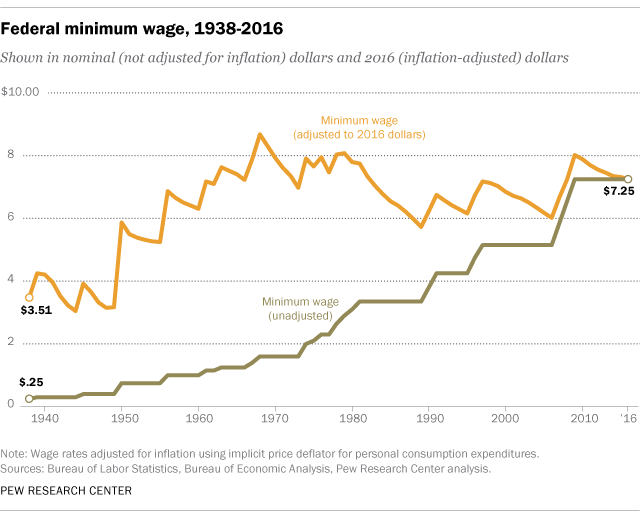
The following graph, courtesy of the unbiased folks at Pew, shows that the period from the late 1960s through at least 1981 were an unusually "generous" period for the minimum wage. But the period was far from the norm. If one were to select the late 1940s or the late 1950s as the basis for today's wage in would be far below $10.50, below $10.10, and below the current level of $7.25  - so claims of an inflation adjusted $10 minimum wage are simply disingenuous.  In the end, none of the main arguments for a $10 wage hold up to serious scrutiny.


Should the Wage Be Higher?
There is a case to be made that the inflation-adjusted average wage for the "generous" period should serve as a baseline for the wage moving forward. Without question, a concerted effort was made to increase the purchasing power of the minimum wage throughout the 1960s and 70s before a long slide began in the 1980s through until 2009. Boosting the wage to the 1960s and 70s level would yield a minimum wage for 2015 of approximately $8.40 per hour. If it were then indexed to inflation and automatically adjusted every year thereafter it would no longer go through long periods of decline followed by sudden increases. As result, it would provided some degree of predictability in the value of the wage to workers and the cost of labor to employers.

In a prior post I cited a New York study that estimated a 20% jump in job loss among the young and the unskilled as a result of a 30% hike in the state's minimum wage. Applying those findings to Baltimore City, where unemployment among those aged 16-24 is a devastating 31%, could lead to an unimaginable 37.5% unemployment rate. Beyond Baltimore City youth, the overall unemployment rates in Baltimore City, Washington county in western Maryland, and the counties of the lower Eastern Shore show that significant portions of the state simply could not absorb the job shock likely to be caused by a 40% wage hike.

The Governor and the folks at Raise the Wage estimate that over 500,000 workers would get a raise if the minimum were set at $10.10. With just under 3 million employed workers in the state that amounts to nearly 17%! That represents a significant new cost imposed upon businesses. How can anyone seriously think that employers will not respond by trimming hours, cutting positions, and refusing to hire the young and the less skilled?  How can anyone believe that the state's high unemployment counties will be made better off?

Senate President Mike Miller has been less than receptive to the idea of a $10.10 statewide minimum. He has raised the possibility of allowing counties to set their own wages. Though that is certainly preferable to a statewide minimum of $10.10 per hour, I think a wage of $8.40 per hour, adjusted for inflation thereafter, is the best option for the state (and the country). 

Wednesday, February 5, 2014

The Minimum Wage is a Poor Way to Support Working Families in Maryland

In a prior post, I argued against minimum and living wage schemes on the basis that they harm unskilled laborers and are far less effective than tax schemes like the Earned Income Tax Credit when it comes to targeting the working poor.  As Maryland lawmakers continue to consider a substantial hike in MD's minimum wage, I have been encouraged by the number of folks speaking against the perceived wisdom of such an increase.  Let me be clear, I do not oppose raising the minimum wage. In fact, I think a review of the history of the wage suggests that it should be raised to approximately $8.40 an hour and then indexed to inflation thereafter. But the proposal to make the MD minimum $10.10 by 2016 simply goes too far and would likely have significant negative effects on youth and unskilled employment levels.

In recent commentary, Barry Rascovar discussed the problems with a one-size-fits-all wage approach in a state with very different cost of living standards. Much like myself, Rascovar pointed to the better policy approach f increasing the Earned Income Tax Credit (a negative income tax that supplements the earnings of the working poor - especially those with children). Today, Howard Leathers, an associate professor in the Department of Agricultural and Resource Economics at the University of Maryland, published a piece in the Baltimore Sun in which he outlines the seemingly paradoxical reality that a substantial increase in the minimum wage would reduce net income for a working parent. In the example provided by Leathers, a 59% increase in the minimum wage would actually result in a 3% decline in net income for a working parent. How can that be? The answer is simple, with the higher wages, the low income working parent would pay higher taxes and lose eligibility for crucial social supports such as Food Stamps, subsidies for child care, and housing assistance.

Many may consider it a good thing for people to be more self reliant. In fact, decreased eligibility for social programs would result in less government spending for those programs - in theory. But consider the costs. The decreased government spending would be offset by higher spending by employers as a result of the higher hourly wage. Many of the businesses that pay minimum wage are small businesses with precious little profit margin. Faced with higher wage costs, those businesses would likely increase prices (if the market will allow) and customers would pay more for goods and services. Those businesses are likely as well to reduce their labor costs by reducing their workforce - meaning more unemployed individuals suddenly eligible for social support services. So we'd be left with some workers receiving a higher wage, but many being worse off due to lost benefits. And we'd have more people unemployed and drawing on the social services that the higher wages were supposedly replacing. It's a perverse form of income transfer as the low income workers who lose their jobs transfer their lost income to those who keep their jobs. Then, those who keep their jobs transfer their social service benefits to the newly unemployed.

And make no mistake, a minimum wage hike like that being proposed in Maryland will have a  negative impact on employment. Consider just two recent studies - in the first, professors from Texas A&M University determined "that the minimum wage reduces net job growth, primarily through its effect on job creation by expanding establishments. These effects are most pronounced for younger workers and in industries with a higher proportion of low-wage workers." In other words, businesses respond to higher wages by either not expanding or by hiring fewer employees when then do expand. The second study is the most compelling. Most studies of the employment effects of the minimum wage consider the impact of marginal increases in the wage - increases in the range of 10% or so. Maryland is considering a 40% increase in its minimum wage. Such dramatic increases are rare, and even more rarely studied. New York state implemented a 30% wage increase about 10 years ago and a recently published paper examined the impact of that increase. According to the authors - all college professors with expertise in the matter -  "the NYS minimum wage increase is associated with a 20.2% to 21.8% reduction in the employment of less-skilled, less-educated workers, with the largest effects on those aged 16 to 24."  Their results provide substantial evidence that state minimum wage increases can have significant adverse labor demand effects for low-skilled individuals.

To put the New York study into perspective, consider this - the unemployment rate in Baltimore City for those aged 16-24 is a devastating 31%. That is more than twice the statewide youth rate of 13.4% and nearly double the national rate of 16.1%. Imagine a 21% increase in youth unemployment in Baltimore City. Instead of a devastating 31% we'd see a catastrophic 37.5% rate. That is simply unacceptable - but the empirical data, and Governor O'Malley always claims to be driven by data and not ideology, suggests that a $10 minimum wage would only exacerbate an already out of control unemployment problem in Baltimore. Good luck finding anyone who would argue that a 40% increase in the minimum wage would improve the employment situation in Baltimore City.  The Governor and the folks at Raise the Wage estimate that over 500,000 workers would get a raise if the minimum were set at $10.10. With just under 3 million employed workers in the state that amounts to nearly 20%! That represents a significant cost imposed upon businesses - how can anyone seriously think that employers will not respond by trimming hours, cutting positions, and refusing to hire the young and the less skilled?

I'd like to address as well the issue of income inequality and effective means of targeting the needs of the working poor. Minimum wage laws are indiscriminate and incredibly inefficient policy tools. Is it really a problem if an 17 year old middle class kid living at home earns $7.25 an hour while working at a fast food restaurant? The obvious answer is "no." That kid is not supporting a family and is not trying to "live" on minimum wage. At present, one-third of those earning the federal minimum wage are teens, and just over half of minimum wage earners are under the age of 25. The vast majority of minimum wage earners are not the sole source of income for a family. But employers are not permitted to offer different wages to different employees doing the same job simply based on need (keep in mind, it was once common for employers to pay men more than women for doing the same job based on the notion that men had families to support - today we call such practices discriminatory). Using the minimum wage to target the needs of working families would require employers to pay substantially higher wages to all workers. So in order to provide a $10.10 wage to a working parent with two kids an employer would need to provide that same wage to an upper middle class kid working part time to earn pizza money. That is not sound policy.

I may not care if that middle class kid earns $7.25 an hour, but do I care if a mother or father working one full time or several part time jobs is unable to meet the basic needs of their family. As a policy person, and as someone who believes in "to each according to their need," the question must be - how can we best support that family? The answer is not some misguided one size fits all minimum wage that treats the 17 year old and the single parent as if they are the same. The answer is not a minimum wage hike that effectively lowers the net income of working parents while simultaneously increasing unemployment.

Social support programs such as Food Stamps, child care subsidies, and the earned income tax credit allow society to effectively target need without creating the negative effects of artificially inflated wages. And perhaps of even greater import, these social programs are more effective at addressing inequality. A higher minimum wage simply transfers income between low income workers - those that keep their jobs and those that lose their jobs. But social programs like those listed here effectively transfer income from the well-off who pay income taxes to the less well off who earn too little to pay income taxes.

Those advocating the $10.10 an hour wage like to claim that had the minimum wage in the late 1960ssimply kept pace with inflation the wage today would be well be roughly$10.50 per hour. Unfortunately, those folks are being intentionally misleading.

The following graph, courtesy of the unbiased folks at PEW, shows that the period from the late 1960s through at least 1981 were an unusually "generous" period for the minimum wage. But the period was far from the norm. If one were to select the late 1940s or the late 1950s as the basis for today's wage in would be far below $10.50, below $10.10, and below the current level of $7.25  - so claims of an inflation adjusted $10 minimum wage are simply disingenuous.  That said, there is a case to be made that the inflation-adjusted average wage for the "generous" period should serve as a baseline for the wage moving forward. Without question, a concerted effort was made to increase the purchasing power of the minimum wage throughout the 1960s and 70s before a long slide began in the 1980s through until 2009. Boosting the wage to the 1960s and 70s level would yield a minimum wage for 2015 of approximately $8.40 per hour. If it were then indexed to inflation and automatically adjusted every year it would no longer go throw long periods of decline followed by sudden increases - it would provided some degree of predictability in the value of the wage to workers and the cost to consumers.


The real choice facing lawmakers in Annapolis is not whether or not they should support working families, rather it is how best they can support those working families. I think a wage of $8.40 per hour, adjusted for inflation, is the best option for the state and the country. 

Wednesday, September 11, 2013

Intra-State Secessionist Movements a Symptom of a More Serious Disease

A small group of Western Marylanders are pursuing a quixotic secessionist movement that would see the state's 4 western counties break away and form a new state. Led by Scott Strzelczyk, the secessionists argue Maryland is controlled by a single party and by folks elected from 3 jurisdictions - Baltimore, Montgomery County, and Prince Georges County. Everyone else, they say, is being ignored.

Given that western Maryland is overwhelmingly white and rural, some have been quick to dismiss the secessionist movement as a race-based action motivated by white voters fearful of growing diversity in the state. Though such arguments may hold a kernel of truth, they obscure the more fundamental cause for these movements in Maryland and elsewhere. These intra-state movements are driven by a complex mix of issues that go to the very heart of a representative Democracy.

It's important to understand that what's happening in Western MD is not unique to the region or to MD.  For decades there has been a secessionist movement on the Eastern Shore. The movement's strength ebbs and flows much like the tides that surround the region. Proposals for a new state date back to the 1830s. In 1998, legislation was introduced that would have put the question of Eastern Shore secession on the ballot. Eastern Shore secessionists argue the region is not well represented in Annapolis, that tax dollars generated by tourists are not appropriately reinvested in the area, and that transportation monies are consistently directed elsewhere.

In Colorado multiple rural counties have pursued secession in an effort to create one or more new states. Movement organizers, including elected officials from the secessionist counties, argue their interests are not being represented in a state legislature dominated by officials from more suburban and urban counties. Recent gun control legislation as well as new renewable energy standards placed on electric cooperatives (common in rural areas) have bolstered the movement.

Lest you think the secession movements are all the result of disgruntled conservative, understand that disgruntled liberals are looking to secession as well. As recently as 2008 and again in 2012 Democratic officials in southern Florida sought to separate from the Republican rest of the state. And liberals in southern Arizona, frustrated by Republican dominance in the state capital, have pursued secession as well.

And these are just a selection of the intra-state secession movements active in the U.S. today. It's important to understand that intra-state secession movements are quite different from the secession movements seeking to separate from the United States altogether. Intra-state secessionist are not disillusioned with the United States, rather they are frustrated by a political system that they believe to be ignoring them - and the reality is, they probably are being ignored.

Given the deep divide between elected Democrats and Republicans, being a political minority in a state or legislative district likely means being marginalized. In truly competitive states and legislative districts, elected officials cannot afford to alienate voters not in their party. In such states and districts, fellow partisans lack sufficient numbers to ensure victory. As the parties have polarized and Democrats have become more consistently liberal and Republicans more consistently conservative some states that were once competitive no longer are. Maryland is a good example. Though Maryland has been dominated by Democrats since Reconstruction, Republicans were once more successful in the state. Ronald Reagan and George H.W. Bush carried MD in 1984 and 1988. Mac Mathias represented the state in the U.S. Senate for 18 years until 1987. But the parties were not as polarized then. There were plenty of moderate Democrats and Republicans and substantial bipartisan cooperation. In such an environment, conservative leaning voters are more comfortable voting for Democrats and liberal leaning voters are more comfortable voting for Republicans. In such an environment, competitive states and districts are more likely.

In the present era, however, voting Republican only makes sense if you have a preference for conservatism over liberalism - even if it's a slight preference. Voting Democrat only makes sense if you have a preference for liberalism over conservatism - even if it's slight. As a result, once competitive states have become less competitive. The number of landslide states has grown (states where one party typically wins the presidential vote by at least 10 points). It's important to understand this can happen even if the voters themselves have not become more liberal or conservatives - more polarized. It's not that voters polarized, it's that the parties and therefor candidates polarized. In an election between two polarized candidates, a non-polarized electorate can make polarized choices.

In Congressional and state legislative districts a similar dynamic has been playing out, but it has been assisted by power hungry partisans and frustrated people voting with their feet. As recently as 1992, there were about 103 truly competitive swing districts in Congress and about 123 landslide districts. Today, there are roughly 35 swing districts and 242 landslide districts. Some of this reflects the reality of voters choosing between two polarized candidates, but it also reflects substantial advances in the gerrymandering of congressional districts - drawing districts to either advantage or disadvantage a particular political party. The same thing has been going on with state legislative districts. In states dominated by Republicans, districts have been drawn to marginalize Democratic representation and Democrats have returned the favor in the states they dominate.

We see this in Maryland. Though Democrats do enjoy a 2-to-1 voter registration advantage in the state (57% to 27%) actual election results reveal a different balance. Republicans routinely receive 40% of the vote in the state and win in the counties and areas outside of the Baltimore/Washington corridor. That 40% largely precludes Republicans from winning statewide, but should ensure reasonable representation in the state legislature and some presence in the states Congressional delegate- especially given the significant swaths of Maryland where Republicans routinely outpoll Democrats . Yet the GOP claims only 1 of the state's 8 U.S. House seats (12.5%), only 12 of the 47 state senators (25%), and only 43 of the 141 delegates (30%). This under-representation is driven largely by the gerrymandering of MD's congressional and state legislative districts. Republicans are either packed into the 1st congressional district on the Eastern shore and northern MD or they are cracked and divided among the remaining 7 districts.


In the legislature, state senate districts defy county and city boundaries and divide neighborhoods and school districts all in the name of maximizing the number of Democratic seats. In the MD House most districts elect three delegates at large with the top three candidates winning a seat. As originally intended some districts were to be divided into subdistricts - either into three one-delegate subdistricts or into one two-delegate subdistrict and one one-delegate subdistrict. Democrats have used the subdistrict allowance to carve out Democratic subdistricts in otherwise Republican areas (see map below).

 
Almost without fail, the presence of subdistricts in MD redound to the benefit of Democrats.
 
Which brings me back to the secessionists... if you are a Republican in Maryland, or even an independent who leans a bit more to the right than to the left, then forget being represented in Annapolis. The deck has been stacked against you. And because the districts have been so meticulously drawn the majority party has no reason to care what minority Republicans or unaffiliated voters want. Simply stated, being a Republican in Maryland is like being a Democrat in Texas - you're invisible. It's this feeling of invisibility and irrelevance that's motivating folks in Florida, Colorado, Arizona, Maryland and elsewhere.
 
A recent study by Professor Philip Jones at the University of Delaware determined that political competition boosts accountability of elected officials, increases participation, and motivates voters to be more informed. We increasingly live in a system that has less and less competition, which means less accountability and less participation.
 
Intra-state secessionists are frustrated by a polarized and heavily manipulated political system that seeks to marginalize minority party voters in states. Nationally, the two parties may be well balanced, but it's a balance brought about by the representative imbalance in individual states.
 
Our system of government was not designed to ensure representation of two extreme and polarized factions. It was designed to force extremes to compromise, cooperate, and moderate. In the absence of such compromise and cooperation, the folks who are marginalized will seek alternatives ways to be heard. Alternatives that may or may not succeed, but that nevertheless point to significant problems at the heart of our representative form of government. We would do well to listen to what these marginalized voters are saying and ask whether the system is simply failing them or failing us all.
 
Though I understand the motivations for these secessionist movements, they are a cure worse than the disease. Were we to allow regions of states to breakaway and create politically homogenous new states we would make worse our existing problems. We already see some evidence of frustrated voters deciding to vote with their feet and move to states or districts that better represent their preferences. Such actions only make matters worse. By removing themselves from one area they contribute to the majority party's strength there and by relocating to an area where they are part of the majority they help further marginalize the minority in their new area. The solution is not ever more homogenous states and districts, the solution is to remove the impediments to true competition and representation.

Friday, September 6, 2013

Does the MD GOP have a Deep Bench?

In a recent interview I was quoted as saying:
“It speaks to the sorry state of the Republican party in Maryland... You’re not going to have Doug Gansler … you’ve got an open race, the potential for a divisive Democratic primary. If they want anyone to ever take them seriously, they’ve got to win some statewide offices every now and then, which means trying to build a bench instead of running these throwaway challenges.”
 
Apparently this annoyed Red Maryland's Greg Kline. After taking the obligatory GOP talking point swipe against college professors (for the record, no one who knows me would ever think I read the Huffington Post) he suggested that the MD GOP has a significant and impressive bench of potential candidates.
The good assistant professor (actually I'm an Associate Professor) is right that a lack of a candidate even being discussed does reflect poorly on the MDGOP but he his so wrong about the state party not having a bench or plenty of qualified, potential candidates.... Any potential AG candidate knows that they would be on their own running statewide.  The state party is too much focused on creating a list of people to call and too little focused on what they are going to tell the person on the other end of the phone.
Kline then goes on to explain why the MD GOP cannot get potential candidates to agree to run for office in the state. "Candidate recruitment, like recruiting for a college football team, is about selling the experience and making someone want to be a part of something. This is exactly what the party isn't doing."

Kline then rattles off a list of what the MD GOP must do if it wants to recruit candidates. And Kline is spot on. Where Kline and I actually disagree is on just what constitutes "a bench of candidates." To me, a strong bench consists of candidates preferably with some degree of name recognition and a clear willingness to run if asked. Even better are candidates already holding office. The party would be best served if they were able to tap candidates from among the swelling ranks of elected GOP officials at the county level. Kline argues that the party has a deep bench simply because there are a lot qualified potential candidates in the state (there are 5.9 million people in the state, of course there are a lot of qualified potential candidates) - but those folks aren't willing to run. To me, that's not a bench. At best it's a two-legged stool. To build on Kline's football team analogy, the bench consists of those folks on the team and ready to play. It doesn't refer to the excellent potential players that are watching from the bleachers.

In 2010 the state GOP let Doug Gansler run unopposed for AG. Nationwide, 2010 was a fantastic year for the GOP - Maryland was a glaring exception that didn't need to be. In the U.S. Senate race Queen Anne's County Commissioner sEric Wargotz scored the highest level of support against Mikulski in two decades. With very little money and no debates Wargotz neared 40% of the vote.

As I have argued in prior posts, Maryland is not a 2-to-1 Democratic state. If you look at actual election results it's closer to a 60/40 state. Credible GOP candidates are able to hit that 40% mark, stronger candidates are able to exceed that share. But such strong candidates are rare in MD. Michael Steele and Bob Ehrlich were each able to top that 40% mark. William Campell and Anne McCarthy were quality Comptroller candidates in 2010 and 2006. In 2014 the state GOP has the potential to have strong candidates for governor and Campbell is likely to run again for Comptroller. Though I consider Harford County Executive David Craig to be the strongest gubernatorial candidate, Delegate Ron George is a solid candidate as well and either could give the Democratic nominee a real fight. Assuming Craig or George actually campaign for the job (as opposed to Ehrlich's lazy mess of a campaign in 2010) they should have no problem topping Ehrlich's 42% from 2010 and could even achieve victory.

It's important that the state GOP have quality candidates running for all statewide offices, yes they'd all face an uphill battle to win but a strong top of the ticket can boost turnout and help candidates down ballot cross the finish line in races for the state Senate, House of Delegates, County Commissioners, or other local offices. These down ballot winners then become the MD GOP's real bench. Because of redistricting and Martin O'Malley's political gerrymandering of state legislative districts the MD GOP is going to have a tough time holding onto it's meager 12 seats in the 47 seat state Senate. Falling below 12 seats would be a devastating blow to the morale of any already suffering party. The GOP needs to reach 19 seats in the Senate to truly have an impact as that's the number needed to filibuster. Gerrymandering makes that a tall order, improbable but not impossible - especially if the top of the ticket is strong. But at present, the state Republican party is just a mess. And so long as it is a mess the bench of candidates will be thin. Folks like Red Maryland's Greg Kline, Mark Newgent, and Brian Griffith have been offering the state GOP a lot a free and good advice, but I'm not sure the state party is organized enough to listen.

Though Kline may think that I'm some left-wing Huffington Post reading academic, the reality is that I'm an unaffiliated voter who would very much like to see Maryland's one party monopoly broken. I may disagree with the GOP on a host of issues, but the same can be said of the Democrats. I have no preference for one party over the other. What I do want is a vibrant and open debate of the issues, I want deliberation and not one party hegemony. I want the 40% of Marylanders who consistently vote against the Democrats to have a voice equal to their numbers, instead of the gerrymandered mess that has effectively held the GOP to less than 30% of the seats in the General Assembly and only 1 seat among the states congressional delegation. Republicans have figured out how to win and be relevant in states like New Jersey and Massachusetts. There simply no excuse for the party's continued problems in Maryland.

Wednesday, August 28, 2013

To Reclaim the Governor's Mansion, MD GOP Should Look to McKeldin

In 1950, incumbent Democratic governor William Preston Lane was seeking reelection. Lane had won the office 4 years earlier by a wide margin. But by 1950, Lane was in trouble. He had committed his administration to taking on the numerous infrastructure improvements that had been delayed by WWII - including the Bay Bridge. Lane financed these improvements with an increased sales tax. Few could dispute the need for the improvements, yet the tax proved to be quite unpopular. In 1950, Lane was challenged for the Democratic nomination by George Mahoney. Mahoney was a conservative Democrat who appeared often on ballots during that era. Lane survived the primary challenge but emerged from the contest weakened.

In the general election he faced off against the former Republican Mayor of Baltimore City, Theodore Roosevelt McKeldin. McKeldin trounced Lane 57% to 42% in the election. At the time, it was the widest victory margin for any gubernatorial candidate in the state and it remains the high watermark for GOP candidates for governor. McKeldin was an effective and successful chief executive. He was what many today would call a New England Republican or a Rockefeller Republican. He did not dismiss government as evil or even a necessary evil - rather it served an important purpose. For McKeldin, that purpose was largely infrastructure and Marylanders benefit from his legacy any time they travel I-695, I-495, or US Route 50. McKeldin was re-elected in 1954 and after leaving public life in 1959, was reelected Mayor of Baltimore City from 1963-1967. He was the last two term Republican governor in MD and the last Republican Mayor of Baltimore City.

So what does any of this have to do with 2014 and the MD Republican gubernatorial nominating contest? I argue there are several things to be learned from McKeldin and the 1950 election. One important lesson being unpopular policies can harm a candidate even if voters support the need for the policies. Lane was seriously harmed by the increased sales tax - even as voters recognized the good that was coming from the revenue. Over the past 7 years, Marylanders have been subject to numerous tax increases - sales, income, gas, fees - voters in this Blue state may support the programs being funded, but that doesn't mean they're not smarting from the lost income. The increased sales and gas taxes may be the most onerous. Voter anger weakened Lane and created an opening for McKeldin.

The 1950 contest tells us as well that divisive primaries can provide opportunities for Republicans. The battle between Mahoney and Lane left the party divided and Lane weakened. This kind of party division also helped Republican Spiro "Ted" Agnew win the governorship in 1966. There is tremendous potential for a very divisive Democratic primary contest in 2014. At present, Lt. Gov. Anthony Brown and Attorney General Doug Gansler have nowhere to go other than the governor's mansion. Each man will fight like hell to win the party's nomination. Such a pitched battle could leave the Democratic electorate divided - providing an opening for the GOP. Such divisions occurred in 1950, 1966, and even in 2002 - when many in the party were less than thrilled by the coronation of the lackluster Lt. Gov. Kathleen Kennedy Townsend. Townsend furthered party divisions by tapping a white Republican to be her running mate. Republicans won the governor's mansion in each of those years.

Finally, McKeldin was the right kind of Republican for Maryland. Make no mistake, McKeldin was a partisan. He was a proud Republican. But McKeldin was also a realist. In 1950, Democrats outnumbered Republicans by about 2.6-1. McKeldin could not win without winning over Democrats. Ever the pragmatist, McKeldin worked hard to win over elements of the Democratic electorate left divided after their party's primary. McKeldin took elements of Mahoney's and Lane's agendas and made them part of his own. He downplayed partisanship, instead focusing on accountability. He argued Lane had presided over wasteful spending and unnecessarily high taxes. He argued that Lane was inaccessible and simply a part of the Democratic party machine. As governor, he focused on governmental reform and increased transparency in the state. He stood up to unions and other entrenched interests - rarely invoking party.

Republicans do have an opportunity in 2014 to repeat 1950 (though repeating McKeldin's 15 point victory margin is beyond impossible- but winning by 1.5% or 0.15% is still winning). If Anthony Brown is nominated, he will carry with him the weight of Martin O'Malley's tenure in office. For all of the good - spending in check, funding for education, same sex marriage, etc... - he will also bear the burden of the bad - a declining tax base, mediocre job growth, higher gas, sales, and income taxes, and a government sorely lacking in transparency and electoral accountability. The GOP must look to the McKeldin model, it must run on an agenda that is economic and not social. It should make government a central issue, but not by portraying it as a force of evil. Rather, it must be presented as an essential partner. But a partner in need of reform and oversight. Brown must be portrayed as being part of the party machine, a candidate incapable of and unwilling to commit to needed reforms (his laundry list of endorsements by the establishment should make that an easy argument). The GOP needs to run a campaign based on reform and accountability. A campaign about anything else will just elect the democratic nominee.

In an upcoming post I'll look at the candidates for the GOP nomination, but at present, only one declared candidate appears ready to carry forward the McKeldin mantle and reclaim the governor's mansion in Maryland. And that's Harford County Executive David Craig.

Wednesday, August 14, 2013

"Ganslergate" and the Manufacturing of News

As everyone who pays attention to Maryland politics knows, the Free State is in the midst of a scandal! Ganslergate, as one reporter laughingly described it to me. The Washington Post obtained a secretly recorded meeting between Attorney General Doug Gansler and a group of supporters. As reported by the Post, Gansler was rather dismissive of Lt. Governor Anthony Brown's campaign for the Democratic nomination for governor.
“I mean, right now his campaign slogan is, ‘Vote for me, I want to be the first African American governor of Maryland. That’s a laudable goal, but you need a second sentence: ‘Because here’s what I’ve done, and here’s why I’ve done it.’”
The meaning of Gansler's comments seem clear - Anthony Brown doesn't have a record or a message to take to voters; rather his election would mark an historic first for Maryland.

I must admit, when I first read the story and the quotes I didn't get what the controversy was. Doug Gansler noted something that everyone knows - race still matters in American politics. It especially matters in Maryland where African Americans account for 30-35% of the  Democratic primary electorate and about a quarter of the general election voters. Despite the importance of African Americans as a voting bloc in Maryland, only two African Americans have ever been elected to statewide office - Michael Steele and Anthony Brown. And both were elected as Lt. Governors in a state where votes are cast for a Governor/LT. Governor ticket. So no African American has ever been elected to statewide office at the top of the ticket.

Everyone who covers, analyses, strategizes, and works on Maryland politics recognizes that race matters in our state elections. In 2002, it was widely regarded as a critical error when Democratic Lt. Governor Kathleen Kennedy Townsend picked a white Republican to be her running mate. That the choice risked alienating African American voters was openly discussed. When Republican nominee Bob Ehrlich picked Michael Steele to be his running mate, race was again openly discussed. In a particularly pointed editorial, the editors at the Baltimore Sun said of Steele he "brought nothing to the ticket but the color of his skin." Essentially, the editors were saying that lacking any record or accomplishments Ehrlich and Steele were relying on race to win votes.  There was no outcry over the Sun's comments - other than from Ehrlich and Steele.

In 2006, Steele decided to run for the U.S. Senate. The Democratic nominee was to be either Representative Ben Cardin or former Representative and NAACP president Kweisi Mfume. The impact of race on that contest was openly discussed. Under the headline "Maryland Senate Race May Hinge On Ethnicity," Washington Post reporters wrote:
"As they stand, the racial divisions are stark: In the primary, Mfume, who is black, gets 72 percent of his support from black voters, the poll shows. Cardin, who is white, gets 82 percent of his backing from white voters."
It's hard to imagine a more clearly divided electorate. The Post's reporters noted that Cardin was the stronger candidate in a general election match-up with Steele, even though Steele's support among African American voters jumped significantly in a hypothetical match-up against Cardin.

After Cardin won the nomination he received the Washington Post's nomination. In an editorial written just prior to the election, the Post dismissed Steele as a man with little experience, few accomplishments, and nothing really to offer voters. In the final paragraph, the writers note:
"A victory for Mr. Steele, an African American, would add diversity to the Senate. That is a worthy goal, and it is one reason given by a number of high-profile black Democrats for breaking party ranks to endorse him. But it is worth noting that even those backers have not made the argument that Mr. Steele would be an especially effective lawmaker or a leader on any particular issue in the Senate. Maryland deserves all that, and only Mr. Cardin, with his deep experience, can deliver it."

In other words, the Post editors believed that the only reason Steele was receiving support from black Democrats was because he was African American. In 2006, it was commonly accepted that Steele was counting on the fact that he would be the state's first African American Senator to deliver significant support from African American voters. I have a hard time seeing how Gansler's comments cross a line when they don't even come close to being as blunt as an editorial in the very paper that broke the "Ganslergate" story.

Since initially publishing the original story on Gansler's comments, the Post has doubled down with stories on the "fallout" and "flak" that Gansler is receiving. Yet in these stories, the reader is treated to folks who already support Brown feigning outrage over Gansler's comments. I have to ask, can it really be called "fallout" when folks who never intended to vote for Gansler reiterate that they still aren't voting for Gansler?

I spoke with several reporters yesterday regarding this story, most agreed (off the record) that there was nothing particularly damning or offensive in what Gansler said. But these reporters were writing stories about the "scandal" because it was in the Washington Post...

This is a ridiculous story full of false indignation. Gansler is perhaps guilty of one thing, Brown himself has never made this contest about race - in fact he never speaks of the issue (though Gansler's comments appeared to be directed at the Brown campaign). That's the double standard of contemporary politics. We all know that race has an impact on elections, we know there are racial divisions in voting choices, we know that race has influenced election after election in Maryland. And the Cardin/Mfume contest in 2006 suggests there will be a significant racial divide among Democratic voters come election day. In a three person contest, the severity of that divide will likely determine the outcome. But the minute a candidate references race he/she is accused of exploiting the issue.

But the issue of race and the potential for an African American candidate for governor do play a role in this contest. Gansler was trying to make the point that Brown has offered few, if any, proposals for the future. Gansler was trying to say that Brown has "no achievement, no record." Whether or not that's true is debatable, but the claim is pretty tame and standard stuff in Maryland and certainly consistent with opinions offered by the very paper now pushing this story when writing about other candidates.

I realize that this is a particularly boring time in Maryland politics, but that doesn't mean we need to create scandals just to have something exciting to write about.

I'll reiterate what I've said before - I am not affiliated with the Gansler campaign and have no dog in the Gansler/Brown hunt. I had hoped that Comptroller Franchot would run, when he dropped out my attention shifted to Ken Ulman, the he opted to run for Lt. Governor. At present, I have no idea who I'll support in the general election and as an unaffiliated voter I can't even vote in the primary. So I'm not defending my candidate... I'm just annoyed by what is really a pointless story.