Tuesday, March 15, 2011

Maryland Ain't Wisconsin and O'Malley has not Betrayed State Workers

Imagine the scene: thousands of public employees taking to the streets, crowding the state capitol, denouncing changes to their benefits. Speakers took to stage and denounced the governor, "enough is enough" they said, "leave our pensions alone" and one employee for the Department of Social Services declared "I am in an abusive relationship, with the state..."

Is this a day in the life in Wisconsin? No, the scene I just described was of Annapolis, Maryland on March 14th. Thousands of state and county employees took to the streets to protest proposed changes to the state pension and retiree health plans, and many more came to denounce Governor Martin O'Malley's proposal to fund K-12 education at last year's level.

Maryland faces a $1.4 billion dollar budget shortfall this year and after calling a special session in 2007 and signing a significant tax increase into law, O'Malley vowed to balance the fiscal year 2012 budget without raising taxes again. During his tenure as governor, O'Malley has cumulatively cut nearly $7 billion from General Fund spending. Those cuts, coupled with tax increases, and federal aid allowed the state to balance its budget every year. But the federal aid is gone and a slow economy continues to hit tax revenue.

That said, O'Malley increased K-12 education funding by over $1 billion between FY 2007 and FY 2012 - increasing funding every year except for this year. For FY 2012 O'Malley has proposed holding funding at the FY 2011 level of $5.7 billion.

With regard to pensions and retiree health, O'Malley has publicly stated that he is committed to protecting the state's defined benefit retirement system. To that end, he proposed a series of reforms that would stabilize the pension and retiree health system - systems that currently have a combined unfunded liability of roughly $34 billion.

Under the O'Malley proposal:

Current retirees will see no change in their benefits.

For current employees and teacher, a one-time choice is offered for all service beginning in FY 2012:

  1. Continue to pay 5% of salary towards retirement, benefits earned prior to FY 2012 will be unchanged, but there will be a reduction to benefits earned for FY 2012 and beyond; or,
  2. Increase their contribution to retirement from 5% to 7% of pay and continue to earn benefits at the current level.
All employees hired in FY 2012 will be automatically required to to take the 7% contribution requirement. It will also take 10 years, instead of the current 5, to be vested and early retirement will increase from the current 55 to 60. Finally, retirement benefits will be calculated based on the employees highest five years of salary rather than the highest three years.

As for reforms to employee health benefits, the most significant change would be a gradual shift of employees from a state prescription drug benefit to the Medicare Part D drug benefit.

So to recap - O'Malley's proposal would achieve 80% funding of the state pension system by 2023 (the actuarially recommended level) and have no impact on current retirees and no impact on benefits already earned by active or former employees/teachers. Facing a $1.4 billion shortfall, O'Malley has maintained funding for K-12 education and introduced modest reforms to the pension system meant to protect it's long term health. And though state employees (myself included) have faced multiple furlough days, there have been no layoffs.

In Wisconsin, by means of comparison, the state faces a $136 million budget shortfall for FY 2011. The Legislative Fiscal Bureau estimates that "more than half" of the shortfall stems from a series of three tax cut measures signed into law by Governor Scott Walker after being passed in a special session of the legislature that he called. Governor Walker's budget includes a $900 million cut to K-12 education over two years, Walker has also proposed that state workers begin paying 5.8% of their salary into their pansions (up from zero) and that their contribution to their insurance premiums double from 6.2% to 12.6%. He recently signed legislation that strips from state workers their collective bargaining rights for health benefits, and limits their annual salary increases. He had threatened to layoff 1,500 state employees. To be sure, even after the increases in pension and premium contributions, Wisconsin public employees will contribute much less toward their benefits than most private sector employees and whereas Wisconsin public employees would still retain some collective bargaining rights Maryland public employees have very limited collective bargaining rights. Though some Maryland employees are represented by unions and have the right to bargain, there is no binding arbitration in the state and no right to strike.

But when comparing the real impact on workers, their wages, and their current rights the changes that have been proposed in Maryland pale in comparison to what is happening in Wisconsin. Governor O'Malley has proposed modest changes in an effort to protect the state pension system, protesting those changes seems misguided and counterproductive.

In-State Tuition for Undocumented Students? Of Course

The Maryland Senate has approved, by a 27-20 vote, legislation that would grant in-state tuition to undocumented students at public universities and community colleges. The bill would place significant restrictions on undocumented students before qualifying for in-state tuition, they must:
  • graduate from a Maryland high school and then attend a community college within the high school’s jurisdiction,
  • prove that taxes were paid by the student, parent or legal guardian for three years before entering college
  • complete an associate’s degree, or 60 credits, from a community college before they can qualify for in-state tuition at a four-year Maryland university
  • show proof of paid state income taxes while attending community college, and
  • sign an affidavit stating they will apply for legal residency when they are eligible

If they meet all of those requirements, then they can qualify for in-state tuition at a savings of about $10,000 per year.

Among those voting against the legislation were Senate Republican Leader Nancy Jacobs and Democratic Sen. Robert Zirkin - both had voted for a far more liberal version of the bill in 2003. That bill passed, but was vetoed by then governor Robert Ehrlich. Zirkin explained that his thinking on immigration had "evolved" since 2003 - by evolved he likely means that he has been influenced by anti-immigrant hysteria.

Critics contend that the bill punishes legal residents, rewards illegal activity and violates federal immigration law which prohibits “undocumented immigrants from obtaining a postsecondary education benefit that U.S. citizens cannot obtain." Ten other states offer similar in-state savings and have based eligibility on where the student went to high school, not on immigration status. Similarly, the Maryland legislation applies to all students regardless of residency status.

As for rewarding illegal activity, the kids affected by this bill did not break the law - their parents did - but what parent wouldn't risk anything and everything to provide a better life for their children? There are approximately 2 million undocumented children living in the United States today - these children were born outside the United States, but brought here illegally by their parents at a young age. These kids were raised in America, educated in our schools, they are Americans. Many of theses kids would consider America to be their home country and their actual home country to be a foreign land. About 65,000 of these kids graduate from our high schools every year - and face a future of virtually no options. Punishing these kids for choices made by their parents imposes upon them an unwarranted penalty and burden.

I recently met one of these students - she was brought to America from Guatemala at age 8 by her parents. She is a junior at a Maryland high school and has a 3.9 GPA, by all measures she is an exceptional student. A Supreme Court ruling from 1982 grants her the right to be educated in a public school, but upon graduation she has no real options. She cannot return to the country of her birth, not only did she leave there when she was a child, she now has three siblings - all born in the United States and all legal citizens. The idea that she would be separated from her family and return to a country that she does not know makes no sense. She has lived in America longer than her young siblings, yet because they were born in the U.S. they can get in-state tuition, a driver’s license, and a job no questions asked. Would we not be better served by rewarding her ambition and academic acheivement, by investing in her, by providing her a real opportunity to become a legal resident? What good is accomplished by marginalizing her or forcing her to live in the shadows?

No one is served by making it harder for students such as this to attend college. In-state tuition is appropriate for these students as they truly are residents of the state, they are students in the public school system, and their parents - though here illegally - do pay state taxes (in fact, they pay more in taxes than the recieve in benefits). The list of requirements placed on undocumented students seeking in-state tuition are arduous and anyone willing to meet those requirements is certainly worth the investment. One can only hope that the Maryland House of Delegates has more backbone when it comes to this issue than they had on the question of marriage equality.

Friday, March 11, 2011

Marriage Discrimination Comes Full Circle in Maryland

A bill to legalize same-sex marriage in Maryland died today in the House of Delegates. According to the Washington Post, the bill died as the result of opposition by Democrats in Southern Maryland (my home territory) and African-American Democrats from Prince Georges County who cited religious opposition to the bill among their constituents.

It is impossible to not see the sad irony of African-American lawmakers using religion as their justification for casting a vote against marriage equality. The arguments against interracial marriages were often steeped in religious rhetoric.

In June of 1958, Mildred Jeter, a black woman, and Richard Loving, a white man, left their home state of Virginia and traveled to Washington, DC to get married. Interracial marriages were illegal in Virginia.  Upon return to the state, the newlyweds were charged with violating state law. In January of 1959, the Lovings pled guilty, but their sentence was suspended after they agreed to leave the state.

The judge that presided over the case had this to say with regard to Virginia's ban on interracial marriage "Almighty God created the races white, black, yellow, malay and red, and he placed them on separate continents. And but for the interference with his arrangement there would be no cause for such marriages. The fact that he separated the races shows that he did not intend for the races to mix."

To be fair, many religious organizations eventually became the most vocal opponents of bans on interracial marriage, but the use of religious justifications by opponents of interracial marriage continued. Maryland banned interracial marriages until 1967.

In 1967, in Loving v. Virginia, the Supreme Court overturned bans on interracial marriage. The court determined that marriage is one of the "basic civil rights of man...To deny this fundamental freedom on so unsupportable a basis as the racial classifications embodied in these statutes, classifications so directly subversive of the principle of equality at the heart of the Fourteenth Amendment, is surely to deprive all the State's citizens of liberty without due process of law. The Fourteenth Amendment requires that the freedom of choice to marry not be restricted by invidious racial discrimination. Under our Constitution, the freedom to marry, or not marry, a person of another race resides with the individual and cannot be infringed by the State."

Here we are 44 years later and we have simply decided to replace race with gender preference - otherwise, the justification, the discrimination and the denial of basic equality remains the same. What is different about the story today, however, is that the discrimination has come full circle and the once discriminated against have now joined the ranks of the discriminators. This is a sad day for Maryland.

In Maryland, a Time to Lead

Maryland's House of Delegates will likely vote today on whether or not to legalize same-sex marriage in the state. By most counts, the legislation lacks the 71 votes need to pass. I have already written extensively about this issue and stand by prior comments and criticisms of the many delegates who appear to be unprepared for the awesome responsibility of legislating.

Today, I simply want to ask every member of the House of Delegates to look forward, beyond this vote, beyond 2012 or 2014.  Look 20 years into the future, a future where same-sex marriage is legal everywhere - a likely scenario given the dramatic changes in public opinion on the issue. Future generations will look to this era in American history with the same confusion and embarrassment that our generation looks to the era of segregation and anti-miscegenation laws. That future generation will wonder how intolerance, hate, and bigotry could have so defined our public policy with regard to gender preference, much the same as we wonder how we ever believed that the color of one's skin should determine one's rights.

Many members of the General Assembly will have children, grandchildren, or great grandchildren among that future generation. I ask those members, what will you say when your child or grandchild ask what role you played in the fight for equality?  Will you be able to say that you stood at the vanguard of the battle, that you cast a vote for equality that rippled across other states and set a new standard for tolerance? Or, will you lower your voice and your head and explain that when the time came to stand and be counted -- to lead -- you simply weren't up to the task?

Twenty years from now, will you be proud of the vote you'll cast today?

Sunday, March 6, 2011

A Civics Lesson for Maryland's Leaders

As a professor of political science I admit that I tend to view political issues through a slightly different lens than many voters and certainly many elected leaders. Few things frustrate me more than when people fundamentally fail to understand the difference between a direct democracy and a representative republic. America is of course the latter, yet is all too often treated by voters and even representatives as if it is the former.

I've thought of this important distinction quite a lot lately as Maryland's legislature has been considering a bill that would legalize same sex marriage. Similar bills had been introduced in the past, but they never survived Maryland's Senate - considered by many to be the more conservative half of the Maryland Assembly. When the legislation was introduced this year, political observers in the state again viewed the Senate as the challenge and the House of Delegates as more friendly territory. Then the conventional wisdom was upended. The state Senate passed the marriage equality legislation by a vote of 25-21 after little more than 2 weeks of wrangling. Shortly after passing in the Senate, it became clear that the House of Delegates was not nearly so friendly.

What was most surprising was that the bill was being derailed in the House not by vocal opponents of the measure, but rather by delegates who had openly supported, even co-sponsored the measure. Dels. Tiffany Alston and Jill Carter prevented a vote on the bill in the Judiciary committee because they were having second thoughts about a bill each co-sponsored. In the end, the bill was approved by the committee - Carter voted for it, but Alston voted against it complaining "This has not been the deliberative process that we normally engage in in this committee." Perhaps the committee could have deliberated more had she not staged a walk-out when the bill was up for consideration.

Another bill sponsor, Del. Sam Arora, suddenly announced that he was opposed to the bill he sponsored and would vote against it on the floor. Two days later he announced that he once again supported the bill that he had co-sponsored.

All of this intrigue is likely the result of a simple gamble taken by many delegates. They assumed that same sex marriage would die in the Senate, as always, and they would never be called upon to cast a vote. Then the unimaginable happened, the moment so many representatives dread - they had to cast a contentious vote. They sponsored the bill believing that it would win them favor among some constituent groups while never really worrying about a backlash from opponents for a vote that would never come.

When it became clear that a vote would come, all of those opponents started reaching out to their delegates and voicing their concern. Many supporters and even co-sponsors simply were not ready for the pressure and they wavered, buckled, flip-flopped and altogether embarrassed themselves.

Especially frustrating has been the comments and justifications offered by many of these delegates. Del. Arora, after changing his mind about changing his mind stated that he would support the bill in committee and "On the floor, I will vote to send the bill to the governor so that Marylanders can ultimately decide this issue at the polls... I think that is appropriate." Arora was speaking to the expected petition for a referendum - Maryland, voters may challenge recently enacted legislation via a ballot initiative.

Maryland Governor Martin O'Malley, who once supported having the legislature resolve this issue and indicated that he would sign whatever compromise legislation the legislature delivered to his desk, has been largely silent on this issue. O'Malley, as chairman of the Democratic Governors Association, has been happy to engage in high profile battles with Republican governors like Chris Christie or Scott Walker over issues of union rights, public pensions, and health reform but has chosen to stand on the sidelines as his own state debates the preeminent civil rights issue of the day. When O'Malley did enter the fray his contribution was that he wished the House of Delegates would come together and compromise on a bill, that he would sign legislation legalizing gay marriage, but "We should let the people decide." Again referring to the expected ballot initiative.

After voting against the bill that she co-sponsored, Del. Alston said "I think people make the best decisions they can with the options that are available to them... I don't think anyone should hold any of our decisions against us, because this is a very difficult decision." 

Arora, O'Malley, and Alston need to better understand that important distinction between direct democracy and representative republic. In Federalist 10 James Madison spoke of direct democracies as "spectacles of turbulence and contention." In a representative republic "the delegation of the government... to a small number of citizens elected by the rest..." These representatives, will "refine and enlarge the public views, by passing them through the medium of a chosen body of citizens, whose wisdom may best discern the true interest of their country, and whose patriotism and love of justice will be least likely to sacrifice it to temporary or partial considerations."

Madison is telling us that in a representative republic we entrust our elected leaders to use their judgment when making decisions. It is not for them to place their fingers in the wind and vacillate with the ebb and flow of public opinion. It is for them to act based on their conception of what is best for community and country (or state).

None of this should be misconstrued as indicating that the voters have no say, of course they do. Madison wrote of this in Federalist 57, "Before the sentiments impressed on their minds by the mode of their elevation can be effaced by the exercise of power, they will be compelled to anticipate the moment when their power is to cease, when their exercise of it is to be reviewed, and when they must descend to the level from which they were raised; there forever to remain unless a faithful discharge of their trust shall have established their title to a renewal of it."

Here, Madison is telling us that those elected to lead are to exercise their judgment, to do what they think best, but to know that they will ultimately be held to account for their decisions via elections - that is when the people speak. Madison may have been writing about the US Congress specifically, but he was also writing of the concept of representation generally.

When O'Malley and Arora speak of letting the people decide, one wonders, what did the people of Maryland do on November 2, 2010 if not decide? The voters elected every member of the state Senate, every member of the House of Delegates, and Governor O'Malley. The obligation now falls on the elected to make the tough decisions and to exercise good judgment - not to rely on phone calls, public pressure, opinion polls or any other manner of non-binding expression of public sentiment.  On November 4, 2014, Dels. Alston, Arora, Carter and every other member of the Assembly will face the voters' binding judgment - but before that day they have an obligation to act, to decide, to lead.

In Maryland, the right to referendum exists and the voters of the state are entitled to render their judgment on any particular piece of legislation, but before that can happen it falls upon our elected leaders to make a decision - no matter how hard and no matter the potential impact on their political career.

Too many of the problems in our states and in our nation can be linked to elected leaders making decisions based on the best interests of their reelection campaigns instead of the best interests of the community. We're certainly seeing that in Maryland as our state considers legalizing same sex marriage.

Friday, March 4, 2011

Civil Unions for All?

In a report at MyFoxDC, Del. Alston's position has been clarified considerably. Alston wishes to do away with marriage altogether, and have Maryland recognize only civil unions.
"I believe, as a government, we should issue something that is the same for everybody... And I think, if we wanted to issue a license to everybody and call it a civil union license. And then everybody in the state - whether heterosexual or homosexual - would get the same exact license."
This position clarification makes clear that she recognizes that it would be discriminatory to have marriage for one group and civil unions for another - there would be no separate but equal issue as I wrote about yesterday. But, have we really come to this? Is Alston really saying that she would rather see "marriage" cease to exist in Maryland than extend the right to marry to same sex couples? Following the 1954 Brown v. Board of Education decision ending racial segregation in public schools many state and local governments resisted integration. The Virginia Assembly passed laws allowing the governor to close integrated schools. In Prince Edward County Virginia every public school in the county was closed to avoid integration.

This is just not the path we should be following.

And let me be clear, I am not equating the conditions of racial segregation to the marriage/civil union issue, rather I am equating the basic concept of providing separate institutions or provisions based on a decision that a designated class of people are not deserving of the same rights and protections afforded to most. Civil unions, whether for same sex couples or for everyone, only make sense in a world where same sex couples are considered to be unworthy of the institution of marriage.

A new poll from Pew finds that public support has been rising every year and at present 45% support it and 46% oppose. But when considering polls that provide respondents with a choice between Opposing same sex marriage, Supporting same sex marriage, or Supporting civil unions, an average of poll responses compiled by Charles Franklin shows a clear plurality now supports same sex marriage. In the span of only 4 years support for same sex marriage has moved from a third place finish among those three options to the preferred option.

The American people are clearly moving in the direction of outright support for marriage equality - Maryland has the chance to be on the leading edge of that trend. Ending marriage and replacing it with civil unions would not be a step forward, it would be a step behind.

Thursday, March 3, 2011

Separate but Equal in Maryland, Roger Taney Would be so Proud

Update: Del. Alston's position has been clarified - she would end marriage in Maryland and replace it with civili unions for all - please see my updated post. This certainly negates the separate but equal issue, but does not really resolve much of anything.

As a follow up to her decision to reconsider supporting a marriage equality bill that she co-sponsored, Del. Tiffany Alston says that she has found the solution - an amendment that would offer civil unions instead. "I have what I believe to be a solution..." Alston reportedly said.

Civil Unions is not an altogether new solution, 100 years ago we referred to such solutions as "separate but equal." Under the guise of separate but equal, African-Americans were entitled to receive the very same public services and accommodations as whites - public schools, bathrooms, water fountains - but states were free to provide different facilities for each. The U.S. Supreme Court endorsed the policy in 1896 in Plessy v. Ferguson and six decades of legal segregation followed - until a later court, in Brown v. Board of Education of Topeka, acknowledged what everyone knew: separate but equal was anything but equal.

If Maryland decides as a matter of law that heterosexual couples can marry, but homosexual couples must enter civil unions then it will take the coward's way out and declare that separate but equal is an acceptable public policy - at least the state would be living up to the legacy of native son Roger Taney - former member of the House of Delegates, former state senator, and, as Chief Justice of the Supreme Court, author of the infamous Dred Scott decision - but is that the legacy Del. Alston, or any other member of the assembly, wants to leave?

Wednesday, March 2, 2011

Same-Sex Marriage Intrigue in Maryland

Update 2: Separate but Equal in Maryland, Roger Taney Would be so Proud


Update: A vote is now expected tomorrow. Del. Carter has indicated that she will vote in favor of the bill. Del. Alston has not stated how she intends to vote.

Legislation legalizing same-sex civil marriage in Maryland passed by a relatively comfortable 25-21 margin in the state Senate last week. Most analysts considered the Senate to be the tougher challenge and assumed that passage would be rather easy to secure in the Maryland House of Delegates... apparently not. As the House Judiciary Committee was preparing to vote to send the bill to the floor 2 members of the committee staged a walk-out and ended consideration of the bill. Dels. Jill Carter of Baltimore and Tiffany Alston of Prince Georges County decided that they weren't prepared to vote for the legislation - an incredibly interesting and mindboggling decision given that both are co-sponsor of the bill.

Del. Carter later indicated that she was withholding support because she feels that the Assembly should be focused on more important issue such as education or child custody... one may reasonably ask then, why she chose to sponsor a bill that she deemed to be of lesser importance. Alston told press outlets that she was reconsidering her position, but later issued a statement in which she wrote "As a law maker it is my duty and privilege to serve the people and try to find balance and equity where inequity exits. This duty is compounded when your personal religious beliefs are contrary to what you believe to be fundamentally right for society.... Accordingly, I have resolved that if and when the chairman calls the vote I will be ready to vote based on what I believe is right..”

Many interpret Alston's statement to be an indication that she will support the bill. In another development, Del. Melvin Stukes of Baltimore withdrew his sponsorship of the bill explaining that he thought the bill only provided for civil unions and not for civil marriage. In the spirit of full disclosure, I know Del. Stukes and have the utmost respect for him, but the text of the bill has always been clear with regard to legalizing civil marriage.

So what's happening in the Maryland House? Why are co-sponsors of the bill flaking out? The most likely explanation is that they sponsored the legislation based on the assumption that it would never pass in the Senate and they would never be called upon to cast a vote in favor of it. Now, there is a very real possibility that the bill will become law and these lawmakers were not prepared for the pressure of actually casting a vote.

It is likely more than a coincidence that the three delegates referenced are African American and represent predominantly African-American constituencies. As reported by the Washington Post, African-American churches and religious leaders have emerged as a strong voice of opposition to the legalization of same-sex marriage (as have Catholic churches and leaders). No doubt Dels. Stukes, Carter, and Alston have been hearing much of that opposition.

If they happen to be reading this blog post I would ask that they consider the words of Rep. John Lewis, one of America's greatest heroes of the Civil Rights movement.

Writing in 2003 Lewis declared in no uncertain terms “I have fought too hard and for too long against discrimination based on race and color not to stand up against discrimination based on sexual orientation. I’ve heard the reasons for opposing civil marriage for same-sex couples. Cut through the distractions, and they stink of the same fear, hatred and intolerance I have known in racism and in bigotry.”

Fifty years ago, many states declared that African-Americans were not free to marry the person of their choosing. For a reason as arbitrary as the color of one's skin, a basic civil right was denied. Today, even more states deny the right to marry based on sexual orientation - is that truly less arbitrary?

One need not equate the struggle against generations of pain, suffering, and discrimination suffered by African Americans with the contemporary civil rights struggles of gay and lesbian Americans - but one should certainly equate the basic concept of fairness and equality under the law. In Loving v Virginia, the 1967 Supreme Court decision that outlawed bans on interracial marriage in the U.S., the court declared marriage to be a fundamental civil right. I would ask Dels. Stukes, Carter, Alston, and every other delegate - will you support this fundamental civil right or not?

Tuesday, February 22, 2011

The Problem is Collective Cowardice, not Collective Bargaining

In a report issued last year, the Pew center determined that there was a $1 trillion gap "at the end of fiscal year 2008 between the $2.35 trillion states had set aside to pay for employees’ retirement benefits and the $3.35 trillion price tag of those promises." Since then that gap has only grown and is estimated to now be closer to $2 trillion.

The report continued "In 2000, just over half the states had fully funded pension systems. By 2006, that number had shrunk to six states. By 2008, only four—Florida, New York, Washington and Wisconsin—could make that claim. In eight states—Connecticut, Illinois, Kansas, Kentucky, Massachusetts, Oklahoma, Rhode Island and West Virginia—more than one-third of the total pension liability was unfunded. Two states—Illinois and Kansas—had less than 60 percent of the necessary assets on hand."

In Connecticut, the state government has $9.35 billion in assets in its pension fund, but $21.1 billion in obligations. In Maryland, the state pension and retiree health health benefit system is underfunded to the tune of $35 billion. In New Jersey, the state's pensions are underfunded to the tune of $54 billion.

The impact of these pension obligations have come to head recently in Wisconsin where Governor Scott Walker has introduced legislation to increase state employee contributions to their health care and pension programs. In Maryland, Governor O'Malley has proposed changes to the state's pension system as well - essentially telling state employees that they can either pay more to receive current benefit levels, or pay current amounts and receive less. New employees would simply face greater costs to fund their beneifits, and receive less than under the current system.

Indiana, New Jersey, New York and myriad other states are attempting to deal with these unfunded obligations - but in Wisconsin, Governor Walker has gone a step farther. In addition proposing that public employees contribute more toward their benefits, he is proposing to eliminate the right of public employees to engage in collective bargaining for non-wage benefits. He argues that this must be done to allow the state and local governments restore fiscal order.

The idea that the budget troubles in states like WI, NJ, NY and CA (or, well, everywhere) are the result of public sector unions and collective bargaining is ridiculous. Certainly states face tremendous deficits owing to the legacy costs of retiree pensions and health - but the fault does not lie with the unions, it rest solely with the governments that made the deals then chose to not fund them (or that chose to invest them, ignoring the risks of a down market).

States agreed to the retiree benefits, wages, and health benefits, states agreed to wage increases, states made promises to their workers and then chose to not fund those promises. Doing so during tight times would have meant tax increases, program cuts, or both. Instead state goverments, governors and legislators, promised the moon and stars to everyone - great benefits for state employees, low taxes and public services for the taxpayers.

Now, the bills are coming due. States are facing the harsh reality of their unfunded obligations and realizing they have run out of options. And the magnitude of the problem has grown to the point where there are no easy solutions. Increasing taxes to close the gaps would require significant tax increases, cutting programs or benefits would require dramatic cuts - the only real option is a combination of tax increases and spending cuts. Promised benefits will need to be curtailed, Americans who have enjoyed the services provided by government will now have to start paying off the debt incurred by habitually underfunding them.

But even if pensions and benefits are cut, even if taxes need to be raised - curtailing or eliminating collective bargaining rights accomplishes little. We have not come to this point because unions demanded too much, we're here because policymakers made promises they never paid for.

At the federal level we see the same issue with the looming funding crises for Social Security and Medicare, the problems stem from promises made that we chose to not fund. The Social Security unfunded liability, in other words, what government has promised compared to what we have committed to fund, is projected to be $17.5 trillion. For Medicare, the unfunded obligation is greater than $80 trillion. Social Security will begin to pay out in benefits more than it takes in this year. Medicare faces a solvency crisis in about 6 years.
 
The unfunded liabilities of Social Security and Medicare are no more the fault of workers and retirees than are the unfunded state pensions - they simply reflect promises made that have not been funded. It's a situation not unlike the decision to authorize wars in Iraq and Afghanistan at an annual cost of $200 billion while simultaneously reducing government revenue via tax reductions.
 
States face $2 trillion in unfunded obligations, the federal government tens of trillions, our current federal deficit is $1.6 trillion in a $3.7 trillion budget, our accumulated national debt stands at $14 trillion, and our interest payments on that debt are set to soar.
 
We cannot tax our way out of debt, we cannot cut our way out of debt, we cannot grow our way out of debt - the magnitude of the problem demands a combination of painful cuts and tax increases in the near term, coupled with reforms and ultimately reductions in entitlement programs (or, at the state level, retiree benefits) long term. Had we been more proactive and begun to deal with these problems sooner, it would have been less painful. Had we promised less, or actually funded the promises we made we would not be where we are... but we didn't, and we are.

How likely are we to make the tough decisions that are now required? At the federal level a very reasonable proposal from the National Commission on Fiscal Responsibility has already been rejected by Congress and the President that created the commission. Instead, Congress and the President agreed to extend the Bush era tax rates at a cost of $550 billion.

In the states, Republican governors like Chris Christie in New Jersey or Scott Walker in Wisconsin speak of fiscal discipline and budget cuts, all while cutting taxes and decreasing revenue. In Illinois, a Democratic legislature and governor raised income taxes by 66% to close a budget gap, but on the spending side merely restricted spending growth to 2% - a rate greater than the inflation rate. My award for political courage and common sense goes to Connecticut governor Daniel Malloy who has proposed solving his state's budget crisis with $1.8 billion in spending cuts and $1.5 billion in tax increases - neither Democrats nor Republicans are happy with his plan, which means it must be a pretty responsible and balanced plan. In Maryland, Governor O'Malley signed tax increases into law in 2007 and since then has submitted budget cuts totaling $6.6 billion, and has begun pension reform - other states need to follow the lead of Malloy and O'Malley.
 
In the end, the problem is not collective bargaining, the problem is a collective cowardice on the part of those who made easy promises and avoided tough decisions - and ultimately the collective willingness of the American public to believe that no bill would ever come due for all that we've enjoyed.

Sunday, February 13, 2011

For Maryland, a Chance to Lead on Same Sex Marriage

Update 2: The Baltimore Sun is reporting "Sen. Katherine Klausmeier said today that she has decided to vote in favor of same-sex marriage..." Sen. Joan Carter Conway, Baltimore Democrat has  emerged as the crucial 24th vote.


Update: Democrat Sen. Edward Kasemeyer (Baltimore and Howard counties) is now a yes. According to the Washington Post "With Kasemeyer's support, 22 senators have now pledged to vote for the same-sex marriage bill, which needs 24 votes for passage. A 23rd senator, Joan Carter Conway (D-Baltimore), has said she will vote for the bill if she believes it will pass."

Same-sex marriage proponents appeared poised to score a significant victory in Maryland as the state Senate inches closer to approving a bill, SB 116, that would redefine marriage as being between two individuals as opposed to being between one man and one woman. The bill needs 24 votes in the state Senate and presently enjoys 22 committed supporters and 5 Senators who are considering supporting the measure.  

In the landmark Loving v Virginia case, which overturned interracial marriage bans, the Supreme Court ruled "Marriage is one of the "basic civil rights of man," fundamental to our very existence and survival.... To deny this fundamental freedom on so unsupportable a basis as the racial classifications embodied in these statutes, classifications so directly subversive of the principle of equality at the heart of the Fourteenth Amendment, is surely to deprive all the State's citizens of liberty without due process of law"

The federal government and most states are well behind the curve on this issue - Maryland has a chance to lead on protecting this "basic civil right.".

Here is the list of Supporters and Opponents and Undecideds:   

No public position/Undecided   
Sen. John Astle, Anne Arundel County Democrat
Sen. Joan Carter Conway, Baltimore Democrat
Sen. Ulysses Currie, Prince George's County Democrat
Sen. Katherine Klausmeier, Baltimore County Democrat
Sen. James Rosapepe, Prince George's County Democrat

For
Sen. James Brochin, Baltimore County Democrat
Sen. Bill Ferguson, Baltimore Democrat (sponsor)
Sen. Jennie Forehand, Montgomery County Democrat (sponsor)
Sen. Brian Frosh, Montgomery County Democrat (sponsor)
Sen. Rob Garagiola, Montgomery County Democrat (sponsor)
Sen. Lisa Gladden, Baltimore Democrat (sponsor)
Sen. Verna Jones, Baltimore Democrat (sponsor)
Sen. Edward Kasemeyer, Baltimore and Howard counties Democrat
Sen. Delores Kelley, Baltimore County Democrat (sponsor)
Sen. Nancy King, Montgomery County Democrat (sponsor)
Sen. Allan H. Kittleman, Howard County Republican
Sen. Katherine Klausmeier, Baltimore County Democrat
Sen. Richard Madaleno, Montgomery County Democrat (sponsor)
Sen. Roger Manno, Montgomery County Democrat (sponsor)
Sen. Nathaniel McFadden, Baltimore Democrat (sponsor)
Sen. Karen Montgomery, Montgomery County Democrat (sponsor)
Sen. Paul Pinsky, Prince George's County Democrat (sponsor)
Sen. Catherine E. Pugh, Baltimore Democrat (sponsor)
Sen. Victor Ramirez, Prince George's County Democrat (sponsor)
Sen. Jamie Raskin, Montgomery County Democrat (sponsor)
Sen. James Robey, Howard County Democrat
Sen. Ronald Young, Frederick County Democrat (sponsor)
Sen. Bobby Zirkin, Baltimore County Democrat (sponsor)

Against
Sen. Joanne Benson, Prince George's County Democrat
Sen. David Brinkley, Carroll and Frederick counties Republican
Sen. Richard Colburn, Eastern Shore Republican
Sen. James DeGrange, Anne Arundel County Democrat
Sen. Roy Dyson, Southern Maryland Democrat
Sen. George Edwards, Western Maryland Republican
Sen. Joseph Getty, Baltimore and Carroll counties Republican
Sen. Barry Glassman, Harford County Republican
Sen. Nancy Jacobs, Harford and Cecil counties Republican
Sen. J.B. Jennings, Baltimore and Harford counties Republican
Sen. James Mathias, Eastern Shore Democrat
Sen. Thomas Middleton, Charles County Democrat
Sen. Thomas V. Mike Miller, Prince George's and Calvert counties Democrat
Sen. C. Anthony Muse, Prince George's County Democrat
Sen. Douglas J.J. Peters, Prince George's County Democrat
Sen. E.J. Pipkin, Eastern Shore Republican
Sen. Edward Reilly, Anne Arundel County Republican
Sen. Christopher Shank, Washington County Republican
Sen. Bryan Simonaire, Anne Arundel County Republican
Sen. Norman Stone, Baltimore County Democrat
  

At present, only five states and the District of Columbia allow same-sex marriages to be performed within their states. Three other states, Maryland included, recognize same-sex marriages legally performed in other jurisdiction. Vermont, New Hampshire, Connecticutt, and DC are the only jurisdictions to have legalized
same sex marriage via legislation. In Iowa and Massachusetts state courts ordered the legalization of same sex marriage. 

In 31 states, legalization has been put to the voters via referendum and in each state, the voters have rejected it. 

It's an historical coincidence that by 1940, 31 out of 48 states had banned interracial marriage in some form. Gradually, as attitudes began to change 15 of the states overturned their laws - including Maryland, but Maryland waited until 1967, the same year that the Supreme Court would eventually declare bans on  interracial marriage.
Maryland has a chance to make a statement, Maryland has a chance to lead - voters have a chance to tell their representatives that equality knows no caveats. 

Friday, February 11, 2011

New Census Data Should be a Wake-up Call to Maryland GOP

Want to better understand Martin O'Malley's 14 point victory margin over Republican and former Governor Bob Ehrlich in Maryland? Look no farther than the just release Census data for Maryland - all of Maryland's population growth over the past decade has been among racial and ethnic minorities. In 2000, non-Hispanic whites were 65% of the state's population. In 2010, that has fallen to below 55%. All told, that state has welcomed 477,000 new residents, a 9% increase in the past decade. But the population of non-Hispanic whites has declined by 3.9% while the Hispanic population more than doubled, the Asian population increased by 51% and the African American population by 14%.
These numbers should serve as wake-up call for the Maryland Republican Party. Table One shows what the new numbers are likely to mean for the composition of Maryland voters based on national voter registration and turnout rates.
In November 2010, Bob Ehrlich, a former governor elected by a 3 point margin in 2002, defeated by 6 points in 2006, was trounced by a 14 point margin. Ehrlich's 14 point margin of loss was first forecast in a Washington Post poll released days before the election. In that poll, the Post found that O'Malley was leading among African American voters by a margin of 88% to 6%, Ehrlich led among whites 50% to 44% (When Ehrlich won the governorship in 2002 he received 64% of the white vote). I could not find any Maryland polls from 2006 of 2010 that reported support among Hispanic or Asian voters, but this is not surprising as each population composed less than 5% of the state's population. A review of national exit polls from 2010 shows that Democrats won Hispanic voters by a 60% to 38% margin and Asian voters by a similar 58% to 40%. Democratic and Republican support among African Americans was 89% and 9% respectively - essentially the same as in Maryland. Nationwide, Republicans fared better among white voters, 60% to 37%, than did Ehrlich in Maryland.

If I take the nationwide numbers and apply them to voter numbers in Table One the result is a 56% to 44% Republican loss (Table Two) - not far from the 55.8% to 42.3% actual results (note that my population tallies do exclude a a few thousand state residents of mixed, or Native American heritage - exit polls often categorize these populations collectively as "other" and show that Democrats win them by a margin similar to that of Hispanic and Asian voters).


The new Census data is an alarm bell for Maryland Republicans and it's warning them that unless they can broaden their appeal beyond the state's shrinking share of white voters they will not be winning statewide office. But let's assume that Republicans in Maryland can regularly receive 60% - or even Ehrlich's 2002 level of 64% support among white voters - I show that in Table Three - the Republican still loses by 10 points.

Republicans cannot base a statewide electoral strategy on winning the white vote and losing all other racial and ethnic groups by wide margins. Table Four offers just one simulation of how Republicans would  have to perform among the non-white population just to receive 50% of the vote in Maryland.


Notice that it is a substantial change - a dramatic improvement among African Americans and considerable improvement among Hispanics. Critics of my quick analysis may well point out that turn-out among African American voters in Maryland is often lower than nationwide turn-out so I may be overstating Democratic performance a bit, but I would counter by pointing out that a strategy based on the hope that key voting groups stay home is no strategy - it's a gamble. I would add as well that Hispanic and Asian voters still have very low turn-out rates, but these rates have been rising and if turn-out among Hispanics eventually rises to that of African-American and white voters then Republicans will have no hope of winning statewide without becoming more competitive among non-whites.

The demographic changes taking place in Maryland are but a leading indicator of changes taking place throughout the United States. If Maryland Republicans can find a way to broaden their appeal and again become competitive in the Free State, they may well serve as an example for national Republicans to emulate. Republicans reclaimed the House of Representatives in November in victory fueled by support among white voters and lower turn-out by minority voters. In 2008, Barack Obama won election even though he lost white voters by a 12 point margin - his victory was driven by wide victories among racial and ethnic minorities - winning Hispanic and Asian voters by a nearly 2 to 1 margin. Just 4 years early, George W. Bush was much more competitive among these voters - but between 2004 and 2008 the GOP adopted a hard line on immigration reform and minority voters turned away from the party.

In Maryland, the GOP could begin by supporting measures such as the Maryland DREAM Act which would extend in-state college tuition benefits to undocumented immigrants who have attended state high schools. One may wonder what impact that would have on the votes of legal immigrants but consider just one example recently profiled in the Washington Post - Anngie Gutierrez is a High School senior at Bladensburg High, she is an undocumented resident and ineligible for in-state tuition (nor can she register to vote). When asked about the bill, Republican House Minority Leader Anthony O'Donnell said "Why would we offer in-state tuition to people who violated our laws to get here?"


Anngie, like most undocumented youths, was brought to the US illegally when she was a child. Her parents may have violated the law, but she did not. More significant with regard to political fallout, however, Anngie has three siblings who were born in the US. They are citizens and they will be able to vote when they're 18. Can anyone reasonably assume that they would consider voting for a party that sought to block their sister's access to an affordable education? Doubtful.

When asked about the doubling of the state's Hispanic population Republican Delegate Patrick McDonough reportedly replied  "This should be a warning bell to the state of Maryland that we have a serious illegal immigration problem." The fact that McDonough see Hispanic as synonymous with illegal immigrant is not a good sign that Republicans have a strategy to deal with the electoral significance of the state's changing demographics.

For Maryland Republicans, the phone is ringing - will they take the call?

Friday, January 21, 2011

In Maryland, Budget Proposal Shows Why O'Malley Won Re-election

I openly admit that I was shocked by Maryland Governor Martin O'Malley's margin of victory in his re-election bid against former Governor Bob Ehrlich. I argued on this blog and in the pages of the Baltimore Sun and the Maryland Gazette that the race would be close. In the closing days of the campaign, the Washington Post and the Baltimore Sun released polls showing O'Malley ahead by 11 to 16 points - I dismissed both polls. I had no doubt that O'Malley was ahead, but double digits?  In one interview, in an unguarded moment, I pledged to eat my Blackberry if O'Malley won by 14 points... he won by 14.45 (at least I now have an excuse to get the new Verizon iPhone).

In the waning days of the race, as Ehrlich was losing momentum, I explained that Ehrlich had a very tough case to make. Martin O'Malley, a progressive Democrat by admission, had very much governed as a fiscal conservative. O'Malley's single flourish of progressive budgeting was evident in the 2007 special session of the Maryland General Assembly when taxes on businesses and individuals were raised resulting in $800 million in new revenue in FY 2009 - but even those tax increases were coupled with $500 million in spending reductions that same year - rather than a "tax and spend" liberal O'Malley was a "tax and cut spending" moderate.

Then came the Great Recession and a collapse in state revenue - since December of 2007 the state has realized $8 billion less in revenue than forecast. As revenue declined the state's budget deficits ballooned and O'Malley became a "cut spending" conservative. Since assuming office in 2007, O'Malley had presided over $5.6 billion in cuts to the state's General Fund budget - with the FY 2012 budget released today the record of spending cuts will jump to $6.6 billion. Those cuts, coupled with the 2007 tax increases, and roughly $1.3 billion in federal bailout dollars allowed the state to balance its budget every year (coupled with a multitude of additional cuts imposed by the Board of Public Works).

But current forecasts show Maryland $1.4 billion shy of a balanced budget in FY 2012, and with a newly elected Republican House of Representatives in Washington there will be no more federal bailout dollars. In the budget submitted today, Governor O'Malley doubles down on his record of spending cuts as he closes the deficit relying almost entirely on them. Fully $1 billion in savings comes from reduced spending, another $300 million comes from fund transfers, and only $150 million from projected increases in revenue. The budget also begins the process of dealing with the state's unfunded pension obligations and introduces a new, optional pension system for new employees.  It will now take longer for employees to be vested in the pension, early retirement age increased from 55 to 60, and benefit calculated on highest 5 years of salary rather than highest 3 years. Substantial savings will also be achieved by shift future retirees to the Medicare Prescription Drug Benefit - eventually I believe the state will have to abandon its defined benefit pension system, but O'Malley found a way to protect it at least for a few more years.

The 2010 midterm election was an election driven by concerns over the economy and concerns over seemingly irresponsible government spending. Martin O'Malley not only weathered the GOP tide that swept across statehouses in November, he generated a tide of his own. He was able to accomplish this not simply because Maryland is an overwhelmingly Democratic state, but because he has made some very difficult choices as governor. And, despite his progressive leanings, has presided over an era of very conservative budgeting.

With that record of fiscal management, what did Bob Ehrlich have to run against? What reason would Maryland voters have to defeat O'Malley? If you were a progressive voter seeking an expansion of government you may not have been happy with O'Malley - but Ehrlich was not an alternative. If you were a moderate seeking responsible budgeting, O'Malley was delivering. And if you were a conservative, you may have preferred even less spending and lower taxes - but here you would have been challenged by the fact that general fund spending increased dramatically under Ehrlich. Under O'Malley, the state has eliminated 4,200 positions and the ratio of state employees to state residents is at its lowest level in 40 years.

I will temper my praise for O'Malley's 2012 budget by making clear that I think more needs to be done to reform the state's pension system - namely it should be eliminated and replaced by a defined contribution system with no future state obligations. I also think that the Governor has already cut too much from Medicaid reimbursements and hospitals in the state - but on balance, I have a hard time imagining a more responsible and reasonable budget.

So yes, I was shocked that O'Malley won by 14 points... but on reflection, I shouldn't have been.

Friday, January 14, 2011

The Arizona Tragedy and the False Narrative of a Polarized America

There is a great write-up in the New Republic on just how bad the press covered the tragedy in Arizona and how it ignored a real problem (treating mental illness, seeing warning signs) while focusing on an imagined one (heated rhetoric).

The false narrative with regard to the shooting created by the press and opportunistic political leaders served to reinforce perhaps the greatest false narrative of our day, that the American public is polarized. There is little to no evidence that the general public is polarized - at least any more polarized now than at any point in the last 30 years. Rather we live in a two party system and the parties have become ever more polarized and controlled by partisan fringes. Polarized parties create the illusion of a polarized public.

As if on cue, Paul Krugman furthers the myth of a divided America today writing "One side saw health reform, with its subsidized extension of coverage to the uninsured, as fulfilling a moral imperative: wealthy nations, it believed, have an obligation to provide all their citizens with essential care. The other side saw the same reform as a moral outrage, an assault on the right of Americans to spend their money as they choose." Says Krugman, "There’s no middle ground between these views."

There of course is a middle ground between those views and it's the ground upon which a plurality, perhaps a majority, of Americans reside. What Mr. Krugman means to write is that for the political class, such as himself and Glenn Beck and Sarah Palin, there is no middle ground. But the political class is quite polarized and in that respect a poor representation of America.

Scholars like Alan Abramowitz have made a cottage industry of trying to prove that the electorate is indeed becoming more polarized. They cite as evidence the stark differences between self identified Republicans and self identified  Democrats on issues such as abortion, health insurance, aid to minorities, presidential approval and voting, and self identification as Liberal or Conservative.

When defined in that way, there is in fact evidence that Democrats and Republicans have drifted farther apart over the last 20 years - but as odd as it sounds, it does not demonstrate polarization. To paraphrase an old country song, folks are looking for polarization in all the wrong places. Morris Fiorina has explored polarization from the perspective of changes in popular opinion, separate from party labels and has found no increase in polarization.

When Americans are asked to express support or opposition for the supposedly polarizing policy areas cited by Abramowitz and Paul Krugman - health insurance, aid to minorities, government spending and services, defense spending, and abortion - Fiorina finds that there has been no increase in polarization on these issues in the past 20 years. In fact, Fiorina finds that the public has shifted slightly to the left on the issues government support for health coverage and the provision of services and slightly to the right on the issues of national defense and aid to minorities. There has been no change with regard to abortion. In other words, we're shifting together on some issues, not at all on others.

So what's going on, what are folks like Abramowitz really measuring? Simple, it's called party sorting. As the agendas of the political parties became ever more divergent Americans began to "sort" more neatly into one party or the other - and more Americans began to identify as either pure Independents or only loosely associated with a party.

As the agenda of the Democratic Party became more liberal and the Republican Party more conservative, liberal Republicans left the party and became Democrats or Independents and conservative Democrats became Republicans or Independents.

Krugman writes "Commentators who pine for the days of civility and bipartisanship are, whether they realize it or not, pining for the days when the Republican Party accepted the legitimacy of the welfare state, and was even willing to contemplate expanding it."  What Krugman has conveniently ignored is the fact that the Democratic Party once included many folks who rejected the legitimacy of the welfare state as well.

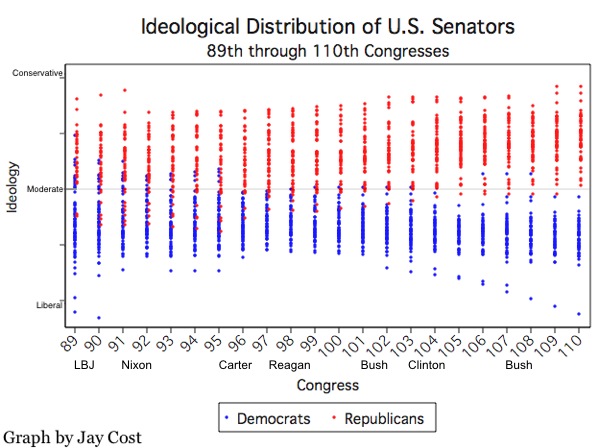
The following graph charts Congressional polarization from the 89th Congress through the 110 Congress, notice the considerable overlap in the middle that existed in the 1960s and through the 1970s.  There was a time when Conservative Democrats and Liberal Republicans were not anomalies. This helps to explain why legislation that today would divide the parties, the Civil Rights Act, the Creation of Medicare and Medicaid, even passage of President Reagan's first budget in 1981 were, in fact, bi-partisan affairs.


Today, however, there is no home in the Democratic Party for conservatives and no real home in the Republican Party for moderates - this is why Jim Jeffords bolted the GOP in 2001 and Joe Lieberman felt so ill at ease with Democrats back in 2006.

The parties polarized, the public did not. As Fiorina notes, there has been precious little change in the last 30 years with regard to the share of Americans who identify as Conservative, Moderate, or Liberal. Rather conservatives no longer feel comfortable in the Democratic Party and Liberals are no longer comfortable in the Republican Party - Moderates appear to be less comfortable with both parties.  The electorate is no more polarized now than in 1970, 1980, or 1990 - but the parties are. So of course 90% of Republicans vote Republican and 90% of Democrats vote Democrat. Of course Presidential approval correlates to party affiliation, it's the natural byproduct of party sorting, but party sorting is not the same as polarization.

The reasons for party polarization are many - the breakdown of mass-based political parties that operated as bottom-up entities driven often by local issues has played a role. Parties are now top-down entities controlled by a relative and ideologically similar few.

The increase in political competition has played a role as well. The Democrats lost their hold on the South, the Republicans lost their hold on the North East. According to data from State Politics and Policy Quarterly only 7 states had divided government in 1954, in 2007 that number stood at 23 states. With few exceptions, either party has fair shot at winning statewide elections in most states (remember, we vote for offices other than President). A recent study by political scientist Daniel Coffey determined that there is a direct and positive correlation between party competition and party ideology. As a state becomes more competitive between Republicans and Democrats the respective parties become ever more conservative and liberal.

V.O. Key hinted at this in 1956 when he argued that competition would force parties to offer more distinct policies to voters in an effort to influence their choice. Additionally, as competition increases the parties come to rely more heavily, not on the mean, median, or moderate voter, but rather on the more committed and active voter. For Democrats this means liberal activists and for Republicans conservative activists. This has the effect of pushing the parties ever farther to the extreme. This is, of course, what has happened.

Where is there evidence of polarization? Among the most engaged and active third of the electorate - what we call base voters, as they form the foundation of support for each party. Sadly this third has a tremendous impact on the direction and agenda of the two major parties. This third votes regularly and is more likely to contribute to and be active in politics. Parties and politicians seek to motivate these voters by painting every election as a choice between political life and death. Recall the closing days of the 2000 election when Al Gore suggested that "strict constructionists" like George W. Bush are little different from those who once deemed a black man to be but three-fifths of a person. Or the waning days of the 2008 campaign when Sarah Palin accused Barack Obama of "palling around with terrorists."


The goal for the left and the right is the same, scare the hell out your base to motivate them. So the left reduces the right to a caricature of bigoted, racist, violent, homophobic fascists and the right reduces the left to a caricature of immoral, anti-American, authoritarian socialists. The hope is that the scare tactics will motivate the base and win over wavering voters in the middle - remember, Democrats won Independent voters by 19 points in 2006 only to see Republicans win them by 19 points in 2010.

So America is not a deeply polarized nation on the brink of civil war. Rather, the American electorate is being poorly represented by a very polarized political class. A political class that sees the world in measures of black and white where there is "no middle ground." It is a pernicious myth that is doing great harm to America - and as we just witnessed in Arizona it all too often causes the political class to focus on imagined problems at the expense of real problems.

Sunday, January 9, 2011

American Politics: Electoral Realignment or a Model of Stability?

As part of a larger research project, I've been working on updates to Gerald Pomper's 1968 study of electoral coalitions by studying the linear correlation of state by state election results in paired presidential elections. According to Pomper an electoral conversion or realignment would be evident via a “change in the parties’ bases of support… the geographic distribution of each party’s vote would be different from the past: traditional strongholds would fall, while new areas of strength would become evident.” Such changes or shifts in support would be evident in statistical analyses of the correlation between sequential elections. High levels of correlation would indicate stability, and low levels change.

Though some have openly wondered whether the 2008 election of Barack Obama represented a political realignment, I contend that the political realignment of the late 1960s has been maintained, and is in fact incredibly stable.


Using election data for all states and DC since 1928 I have calculated linear correlations for all successive elections in the last 8 decades.  As shown in the first graph below, the correlations reveal the very stable New Deal realignment as well as it's collapse in the 1960s and the emergence of a new and stable electoral pattern - a realignment. The only disruption of that new stability occurred in 1976 with the election of Jimmy Carter, likely a reflection of fallout from Richard Nixon and Carter's strength in the south, in the midst of the southern realignment toward the Republicans.


What is unmistakable is that 2008 fit comfortably into the electoral pattern that emerged at the end of the 1960s - 2008 was very much a normal election, its correlation with 2004 and the average of 1992-2004 were both quite high. This suggests that no realignment, defined by James Campbell as "a durable and substantial shift in the parties’ national electoral balance of power,” took place in 2008.


I wanted to be certain that I was not missing more subtle evidence of realignment by focusing too much on national trends, so I next divided the states into three groups - Reliably Democratic states, Reliably Republican, and Swing states. Reliably Republican or Democratic states were defined as having voted with their respective party's candidate in at least four of the last five elections, through 2004. The designations were based on an analysis by the Population Reference Bureau conducted prior to the 2008 election.


This resulted in 39 states (including DC) that were not considered to be competitive. The remaining 12 states were coded as swings.


As shown in the following graph, I found a high degree on stability in the Democratic states (light green line)through 2008, lesser but still high stability in the Republican states (red line) and in the swing states (blue line) I found high levels of correlation from one election to the next only when a president was re-elected, or succeeded in office by a member of the same party. Conversely, elections that witnessed the defeat of an incumbent or a shift in party control of the White House was marked by lower correlations - until 2008. Swings state results were highly correlated with 2004.


The swing state finding for 2008 was intriguing given that George W. Bush won 11 of the 12 swing states in 2004 and Barack Obama only 5 in 2008.  I suspect the high degree of correlation reflects the closeness of the results across those swing states in both elections - even though the partisan outcome shifted in nearly half.


It is also possible that the high degree of correlation indicates some changes taking place in swing states. Six swing states (AR, KY, LA, MO, TN and WV) have not gone Democratic since 1996, suggesting that they may no longer be swing states.


I recoded those states as reliably Republican and it reduced the correlation coefficient for 2008 among swing states from the high .845 to a much lower .416 (no graph). The Republican correlation coefficient in 2008 declined slightly from .917 to .795.


The results appear to suggest that the Southern realignment that began in the late 1960s is complete as 4 of the 6 swing states recoded as Republican are southern states. In all, it suggests that the battlefield of swing states may be decreasing.


It's too soon to tell whether Indiana, North Carolina, or Virginia need to be removed from the reliably Republican column and added to the swing state group.


A recent blog post by Professor Andrew Gelman noted that there has been a decline in state by state vote swings, noting "the red-blue map is much more stable from election to election than it used to be." My analysis suggests that much of this stability results from the culmination of the southern realignment, the Democratic electoral coalition has been very stable since 1968 and the hiccups in the Republican coalition have involved southern states in elections with southern Democratic candidates. In recent elections, southern states once considered swing states (because they still voted for southern Democratic presidential candidates) seemed to have completed their journey to the Republican column - witness the failure of southern Democrat Al Gore to carry a single southern state in 2000.


The overall results from my analyses thus far do support my contention that a relatively stable electoral pattern emerged in the late 1960s and there is little evidence of any break in that stability. America remains in the post New Deal electoral system. A highly competitive system in which Republicans and Democrats are near parity and neither party dominates the political scene. Though Republicans have won 7 of the 11 Presidential contests between 1968 and 2008, Democrats have have enjoyed majority control in the House of Representatives in 15 of 22 Congresses between 1968 and 2010. And unified party control of the House and the White House has only existed for 5 of 22 Congresses.


Everett Carll Ladd labeled the post New Deal era the "No Majority Realignment." It's a fitting and effective description of an era that emerged in the late 1960s, and it appears, remained intact through 2010.

Friday, December 17, 2010

Compromise in the Era of the True Believers

The recent handwringing on the Left and on the Right over the tax deal struck between President Barack Obama and Senate Republicans has provided a nice opportunity for Americans to see that there is in fact little difference between the far Left and the far Right in America - to be sure, they differ with regard to their stance on issues - but when it comes to the their arrogant, self-righteous, intransigence they are cut from the same cloth.

Political scientist E. E. Schattschneider once wrote,
Democracy is based on a profound insight into human nature, the realization that all men are sinful, all are imperfect, all are prejudiced, and none knows that whole truth…. Even when we disagree with other people we like to think that they speak from good motives and while we realize that all men are limited, we do not let ourselves imagine that any man is bad. Democracy is a political system for people who are not sure that they are right.
In other words, the very foundation of the democratic social contract is the understanding that no one philosophy or ideology is to be privileged above others. In contemporary American politics this is simply no longer the case. As political elites, be they Liberal or Conservative, have grown ever more polarized they have lost sight of the reality that "none knows that whole truth" and that at its heart "Democracy is a political system for people who are not sure that they are right."

Instead we live in an age when the Left and the Right have drifted so far apart that neither is able to see any good in the opposition. Last year, William Galston presciently warned,
"polarized partisanship creates a climate in which each party is likely to deny any truth or virtue to the other. But because no party has a monopoly on truth or virtue, this mindset all but rules out legislation that draws from the best ideas of both... partisan polarization tends to create a self-fulfilling prophecy. If Democrats feel sure that Republicans will only obstruct their legislative agenda, why allow them to participate in drafting it?"
In the midst of an ever more partisan and bitter era in American politics, and following a devastating electoral defeat for Democrats, President Obama and Republican Senate Leader Mitch McConnell achieved the impossible - compromise. As the clock ticked down on tax rates enacted under George W. Bush and a Republican Congress many Democrats, still stinging from the midterm elections, demanded that only the tax rates for those earning less than $250,000 per year be extended. Republicans sought to maintain all tax rates at current levels. During his presidential campaign, Obama had promised to allow the upper income tax rates to expire. During the same time that Congress and the White House was discussing the issue of the tax rates, Congress was also considering an extension of federal unemployment benefits - but Republicans in the Senate were blocking the effort.

The deal struck between McConnell and the White House allowed for a temporary two-year extension of the Bush era tax rates, a temporary 2 percentage point reduction in the payroll tax, and a 13 month extension of unemployment benefits. The legislation passed the Senate by an impressive 81-19 margin and after considerable moaning by Democrats it passed the House with a bipartisan majority of 277-148.

Yet this tremendous victory has caused many on the Left to view President Obama as a traitor who betrayed his base. Some have even called for a primary challenge to Obama in 2012. It's enough to give a casual political observer whiplash. During the height of the health care debate the American Left defended Obama against attacks from the Right. Obama critics were derided as racists, radicals, birthers - all seeking to bring down the President. Now Obama has to deal with flak from his Left - his great treasonous crime? Compromise.

In his book "The True Believer" Eric Hoffer wrote
"It is the true believer's ability to "shut his eyes and stop his ears" to facts that do not deserve to be either seen or heard which is the source of his unequalled fortitude and constancy. The fanatic cannot, can not be weaned away from his cause by an appeal to his reason or moral sense. He fears compromise and cannot be persuaded to qualify the certitude and righteousness of his holy cause.  Though they seem to be at opposite poles, fanatics of all kinds are actually crowded together at one end. It is the fanatic and the moderate who are poles apart and never meet. The fanatics of various hues eye each other with suspicion and are ready to fly at each other's throat. But they are neighbors and almost of one family. They hate each other with the hatred of brothers."
Those "true believers" on the Left who now decry President Obama as a traitor to the faith are little more than the dizygotic siblings of those on the Right who angrily dismiss the President as a socialist out to destroy America or who believe McConnell sold out. Left or Right, they are fanatics. Democrats lost 63 seats in the House of Representatives in the November midterm, they lost 6 Senate seats, and over 700 state legislative seats in the worst electoral rout in 70 years. Somehow, many Democrats have convinced themselves that the correct response is to entrench, to defend ever more vigorously progressive policies - seemingly oblivious to the fact that the 2010 losses were driven by the massive defection of Independent voters who felt that Democrats were already pursuing an agenda that was too far left. Meanwhile, conservatives and Tea Party folks in Congress have mistaken the voters repudiation if Obama and the Democrats. The greatest threat to the GOP in 2012 isn't Obama it's the possibility of Tea Party intransigence.

President Obama got the message of the 2010 midterms, the tax deal is evidence of that and probably the first significant mile marker in his road to reelection. Mitch McConnell got the message as well and provided a significant boost to Congressional Republicans. Congressional Democrats seem clueless.

What has been too often lost in the discussion of the tax compromise are the effects that it is having on other legislation. Now that the tax deal is out of the way it is very likely that the Senate will join the House and vote to repeal of Don't Ask, Don't Tell, and the Senate is likely to ratify the START treaty - it's event possible that the Dream Act will pass the Senate - none of this would have been possible without the compromise on taxes.

The far Left thinks that President Obama sacrificed too much, the far Right suspects the same of Senate Republicans. All I can say is, if the fanatics are angry, it must have been a damn good compromise. It's not the bill I would have preferred, but I welcome the precedent that it may set for future relations between the White House and Congressional Republicans.

Wednesday, November 17, 2010

It Wasn't a Messaging Problem

I spoke to a group of St. Mary's College alums tonight about the 2010 midterms. I said the same things that I've been saying for two weeks - I called it the Myths of 2010 talk: 

Myth One - Democrats didn't turn-out. This is not true. Compared to the last midterm election in 2006 Democratic turnout was essentially the same, as was Republican turnout. Democrats lost because Independents shifted their support to Republicans by nearly 36 points compared to 2006. Too many folks are comparing 2010 turnout to that of the 2008 Presidential election - but this is a poor comparison. Turnout in midterm elections never rivals Presidential turnout. The 2006 to 2010 comparison is more appropriate.


Myth Two - Democrats were overwhelmed by outside spending. The Citizen's United ruling allows corporations to engage in political spending and this certainly provided cash to Republicans, but the simple truth is all that outside spending merely brought Republicans to spending parity with Democrats. Certainly Republicans had more money than in past midterms, but Democrats were not "overwhelmed."


Myth Three - It was the return of the "Angry White Male." Republicans made gains among most demographic groups, but their victory was actually fueled by an historic victory among women.  For the first time since exit polling of midterms began in the early 1980s Republicans won a majority of women's votes, they also improved their standing among Hispanics, older voters, and gay and lesbian voters.
Myth Four - The losses were normal for a midterm. Most models for midterm elections projected Democratic losses of 30 to 50 seats with the typical range in the high 30s. As Nate Silver at 538.com recently noted, the loss of 60+ seats exceeded the normal and it appears that support for health reform, cap and trade, and the stimulus bill hurt Democrats.

Myth Five - Democrats were too timid (This is the one that got me in trouble). The myth is that Democrats lost because they failed to be bold, they compromised too much, they did not defend or explain what they accomplished.  This is just wrong, Democrats were bold, but the voters rejected what they accomplished. It was not about messaging, voters simply did not like what Democrats did.

On myth five I was asked, "how can it be that it was not a messaging problem when exit polls show that people supported health care reform?" To which I replied, no poll showed that. The response? "Yes, exit polls showed that people liked parts of the bill." And there you have it... there is a crucial difference between liking parts of a bill and supporting the entire bill.  A recent Kaiser poll demonstrates this: 
"...almost half of Americans want Washington lawmakers to repeal all or parts of the health care reform law. However, when asked about specifics, most want to keep key provisions. Over 70 percent want to keep the parts that provide tax credits to small businesses and financial help to Americans who don't get insurance through their jobs. A majority also want to keep provisions that close the Medicare doughnut hole and prohibit denying coverage due to pre-existing conditions. The requirement for all Americans to have health insurance or risk paying a fine is the lightning rod of health care reform. Sixty-eight percent of Americans want this provision repealed."
So people like some of it, but dislike other parts - it's possible to support repeal of a bill that contains elements that you like. I offer an illustration, Democrats support extension of the Bush tax cuts for people earning less than $250,000 a year, but oppose extending them for those earning more - if a Republican House passes an extension for everyone, Democrats will still support the part of the bill that benefits those earning $250,000 or less, but likely oppose the bill.
I understand the desire to blame the 2010 results on messaging - after all, who wants to accept that their policy preferences were just rejected by a majority of Americans? Also, a messaging problem means tweaking a communications strategy - the alternative explanation, that voters got the message but rejected the policy, means either altering your policy agenda or suffering more defeats at the hands of voters.It may be tough to accept, but Democrats did not lose because of their messaging, they lost because of their policies.