Saturday, October 29, 2016

Dear St. Mary's Voters: Please Vote "YES" on Code Home Rule ballot question!

To all folks in St. Mary's county - I urge you to please vote YES on the ballot question regarding the adoption of Code Home Rule as the governing structure for the county. In Maryland, there are three options for counties - Commissioner, Charter, or Code Home Rule. We are currently Commissioner style.

Under this approach, Commissioner authority is limited. The General Assembly has full power to legislate for the County. Commissioners may enact ordinances where authorized by Express Powers enabling legislation, or specific public local laws. So instead of having a local government that can respond to voter concerns or the needs of the county we have a style of government in which our Commissioner are treated like children who must go to their parents to get permission. It's an inefficient form of government and it is outdated. St. Mary's population has been growing at a pace that places it among the fastest growing counties in the state - and yet we still have a system of government that was put in place when the county was a small farming rural county.

Under Code Home Rule, Commissioners can enact, amend, or repeal local laws on a wide array of matters. Most powers granted to Charter counties are also granted to Code counties (they have  broad legislative power). The General Assembly may still enact public local laws covering an entire class of Code counties, but not for one single Code county.

St. Mary's is one of only six counties which still have this very limited form of government. Another six counties have adopted Code Home Rule. The remaining 11 counties and Baltimore City have Charter government. So please, help bring St. Mary's into the 21st Century and vote YES on Code Home Rule!

Thursday, September 29, 2016

With History as a Guide, Clinton is the Clear Favorite in November

If you're interested in any historical comparisons: As of today, Clinton's average lead over Trump is 47.4 to 44.4. On this day in 2012, Obama's lead over Romney was 48.7 to 44.6. On this day in 2004, Bush led Kerry 48.6 to 43.4. In the end, Obama won by 3.9% and Bush by 2.5%. On this day in 2008, Obama led McCain 49.9 to 43.9.
Thus far, this race most closely resembles 2012 and 2004 - with Clinton in the Obama position in 2012 and the Bush position in 2004. The question for Trump is, does he under perform like Romney (Obama got a huge hurricane Sandy bump) or close strong like Kerry (Bush took a hit as faith in the Iraq War faltered). But in 1984, 1988, 1992, 1996, 2004, 2008, and 2012 the candidate in the lead (regardless of the margin) at this point ultimately won the election.

Using history as a guide - and barring some "October Surprise" - Clinton continues to be the clear favorite going into November. That being said, I'm just offering an historical comparison. I am not making a prediction. There is a very angry electorate out there. Trust in government is the lowest ever recorded, and no small number of people are openly angry at government. Trump is the perfect vessel for their anger and frustration. And, given that Clinton is doing better than usual in some red states it is very possible that she could win the popular vote but lose the Electoral College.

Tuesday, September 27, 2016

Unprepared Trump gave little to move undecided his way

The most watched debate in 2008 wasn’t between John McCain and Barack Obama. It was the vice presidential showdown between Joe Biden and Sarah Palin that attracted all of the attention.
By the time of that debate, Palin’s qualification and preparedness for office had been pilloried by the press and late night comics and people tuned into the debate expecting to see a disaster of epic proportions. Instead, Palin surprised her critics and even her proponents by delivering a competent performance against the more experienced Biden.
How did Palin pull it off? Simple — weeks of intense preparation and mock debates.
The folks who tuned into the debate between Donald Trump and Hillary Clinton finally got to see the Palin v. Biden debate they had been expecting in 2008.
Unprepared
From the very first question, it was clear that Trump had done little to no preparation for this debate. And yet, it was the first 20 minutes or so where Trump did best.
In a clear pitch to working class voters, Trump hammered away at trade agreements and the exodus of American manufacturing to other countries. He hung the North American Free Trade Agreement (NAFTA) and the Trans-Pacific Partnership (TPP) around Clinton’s next.
But even in the midst of his strongest performance he was weak. He couldn’t explain how he would keep jobs from leaving the U.S. He couldn’t explain just how he would punish companies that left. And, he had no answer to Clinton’s correct observation that what Trump was proposing was nothing short of a trade war — which threatens the global economy.
After those initial exchanges, Trump’s lack of preparedness became ever more clear. In response to Clinton’s criticism that Trump’s tax plan would add $5.3 trillion to the debt, Trump’s response was “Your regulations are a disaster, and you’re going to increase regulations all over the place.” Perhaps an example would’ve helped?
Easily goaded by Clinton
On exchange after exchange, Trump could muster little more than broad generalities in response to Clinton. Perhaps worse for Trump is how easily he was goaded by Clinton. Merely a mention of his tax returns and the possibility that he wasn’t as wealthy as he claimed sent Trump on an unnecessary and unhelpful tangent about the combined values of his buildings and total value of his outstanding loans.
Whereas Clinton was able to goad Trump with her responses, Trump was typically unable to muster much more than “it’s a disaster” when he responded to Clinton’s comments.
Perhaps the most damaging segment of the debate was when Clinton made reference to the many small businesses who claim that Trump refused to pay them for services or that Trump used his power to force them to accept greatly reduced payments. The best defense Trump could muster was “Maybe he didn’t do a good job and I was unsatisfied with his work…”
Trump’s biggest supporters are white, working class voters — many of whom live paycheck to paycheck — and I think he needed a better response. It apparently did not occur to say that in his business he has created thousands of jobs. It didn’t occur to him, because he never prepared for the debate.
By the final 30 minutes, Trump was clearly tired and frustrated and mostly unfocused. Clinton’s performance was far from perfect, but her mistakes were overshadowed by Trump’s.
Qualifications
Late in the 2008 election cycle, a question was raised regarding Barack Obama’s experience and qualifications to be president. One of Obama’s proponents responded that Obama’s successful campaign for the nomination was evidence of his qualifications.
Monday night, on a debate stage with Hillary Clinton, Donald Trump proved that a successful campaign for a party’s nomination is not sufficient proof of experience or qualifications. Many Republicans office holders have justified their support for Trump by arguing that he would be a better president than Clinton. Last night’s debate revealed that to be a hollow argument.
Impact?
How will the debate impact the race? It’s hard to say. They entered the race in a virtual tie and it will take about a week to truly see any debate impact.
It is unlikely that the debate will have any effect on the folks who already support Trump, but unlike more recent elections there are many more undecided voters this year. By the time the debates came around in 2012, only 5-7% of the electorate were still up for grabs. Today, roughly 15% of voters are undecided. Trump gave them little reason to choose him.

Friday, September 2, 2016

In Response to Hogan, Senator Ferguson Gets it Right

In response to Governor Hogan's executive order mandating a post Labor Day start for the school year, state Senator Bill Ferguson penned a must read response for MarylandReporter. 

Ferguson writes "if we are to have a conversation about adjusting our calendar, let it not be about starting the school year later, let it be about making the year longer, richer, and more purposeful... In an era of global competitiveness we need to be talking about a longer school year, not a shorter one." 

He is absolutely correct. In fact, the legislative task force that in 2014 endorsed a post Labor Day start noted that many of those who attended the various task force meetings expressed support for year round schooling - and for good reason. But unlike other calls for a year round school year that simply takes the same 180 day count and just spreads it more evenly across 365 days, Ferguson calls for more days of schooling. And for good reason. Research has shown that a simple year-round approach, that relies on the same number of days, doesn't improve the education outcomes for anyone. What's need are more days of instruction. At present, the American education calendar imposes a tremendous burden on low income and working class families and especially on minority communities. Imagine the benefits of a 240 day school year - children with access to nutritious meals, no retention gap from the long summer, more time for personalized instruction, less stress on families as parents commit less of their limited disposable income on childcare. These are but a few of the benefits of a longer school year. 

I've longed believed that such a policy would go nowhere in Maryland - perhaps I was wrong (perhaps not). It would be wonderful if Governor Hogan's executive order spurs a real conversation about meaningful education reform, instead of just hand wringing and attempts at recrimination.


Thursday, September 1, 2016

Labor Day Showdown in the Free State

This week, Governor Hogan issued an executive order mandating that the Maryland school year begin after Labor Day and end no later than June 15th. The motivation for the post Labor Day start being the desire to generate a little additional revenue from family vacations to Ocean City prior to the start of the school year. Estimates are that the revised start date could generate up to $74 million in economic activity. This is not a new issue in Maryland and multitude of other states have grappled with the Labor Day question as well. The MD General Assembly created a task force back in 2013 to study the issue and that task force recommended adopting the post Labor Day start date, but their recommendation had no authority. 

The task force report noted:
"All 24 local school system superintendents, the State Superintendent, union representatives, the Maryland Association of Boards of Education, and the Public School Superintendents’ Association of Maryland are opposed to a post-Labor Day start date."
The task force was not moved by that universal opposition, noting instead that "there was no compelling evidence that showed there was any impact on education starting post-Labor Day..." and "there was no quantifiable evidence that a post-Labor Day start is harmful to local schools systems."  

The post Labor Day start has been a favorite of Democratic Comptroller Peter Franchot and was endorsed by former Democratic Governor Martin O'Malley. But given opposition by local school systems and the Maryland State Education Association, the Maryland General Assembly was not willing to impose the mandated start date.

Tuesday, July 19, 2016

Death of the Grand Old Party

Obituary: That Grand Old Party died today in an apparent suicide. All vestiges of the party's small and limited government beliefs were washed away in a ritualistic roll call that culminated with the now deceased party jumping off of a cliff (Reminiscent of the national Democratic party's suicide in 1972). In its place, a new party arose. A party committed to an authoritarian presidency devoid of reason or direction. In a rather confusing development, the new party will also use the name Republican even though it has little connection to that party. Though the new party will be called Republican, it dare not attempt to use GOP as a synonym as there is nothing Grand about this new endeavor. So good bye GOP and hello to the New Coke edition of the Republican Party. May it die a quick and painful death (likely from self-inflicted wounds).

Saturday, April 2, 2016

Kasich Offers GOP's Best Chance of Beating Clinton

If only one poll showed Trump losing to Clinton, perhaps you could dismiss as a bad poll. But when 50 out of 56 polls show Trump losing, often in spectacular fashion, you can't dismiss the results as inaccurate. Trump would be a disaster for the GOP - perhaps costing them the House and definitely the Senate. The reason Trump is behind and the reason he will lose is simple - only 35% of voters have a favorable opinion of him. Fully 63% do not like him - that's a deficit of 28 percentage points. Clinton is unpopular as well, but her unfavorable number is 55% and her favorable is 41% - so her deficit is 14 percentage points, exactly half the size of Trump's.
Folks need to remember that primary voters and general election voters are very different. So far, Trump has carried about 40% in the primaries, primaries in which about 17% of Republicans have voted. That translates to 7% of all Republicans. Only about 30% of registered voters are in the GOP. They key to winning is winning over non-GOP voters. And Clinton's unavailability is driven large by exceptionally high unfavorable ratings from registered Republicans - voters she was never going to win. Trump, however, has high unfavorable numbers from Democrats as well as Independent AND Republican voters. 
Republicans seem to think that a majority of voters dislike Clinton as much as they do. They think there is no way voters would choose Clinton. This belief is driven by the echo chamber effect - the anti-Clinton folks talk with other anti-Clinton folks so they only hear about disapproval. They also think everyone hates Obama, but Obama's approval rating has rebounded and is back over 50% - it's actually 53%. One clear indicator of whether the party in power will win an election is the approval rating of the president - if it's above 50% the party in the White House usually wins.
If Trump is the nominee, I think a lot of Republicans are going to be completely dumbfounded on election night as they watch Clinton win, Democrats retake the Senate, and possibly the House. At this point, the GOP's best hope for defeating Clinton is a contested convention that picks a nominee other the Trump (or Cruz who loses to Clinton in 44 out of 56 polls and has an unavailability deficit of 20 percentage points.)
So who beats Clinton? John Kasich. He leads in 11 out of 16 polls and in 10 of 10 of the most recent polls. What's Kasich's favorability deficit? He doesn't have one. He actually has a favorability surplus of 7 percentage points - interestingly, his average lead over Clinton is just about 7%. Kasich may not winning among the 7% of Republicans who have voted in primaries, but he's clearly the preferred choice among those folks who will vote on Election Day.

Friday, April 1, 2016

Of Course People Are Offended By the Confederate Flag: It Was Literally the Symbol of Segregation

Recent events at St. Mary's College have garnered some unfortunate news coverage. Last week, as part of an Easter tradition, students hid decorated beer cans all around campus. Unfortunately, some of the beer cans were adorned with Confederate flags and with racist, sexist, and homophobic statements. There can be no defense of the statements that were written on the cans, but many folks have a hard time understanding the offense that people take with the Confederate flag. This is understandable - because most people don't know the actual history of the flag or how it came to be part of American culture. Once that history is made clear, people tend to understand why displaying the flag is not something that anyone should ever do proudly. 

Many will tell you that the "confederate flag" is simply a symbol of Southern Pride, or that it represents the ideals of limited governments and "state's rights." But such claims are not supported by the flag's actual history. In reality, the confederate battle flag pretty much disappeared from view and memory after the war. The flag truly became a symbol of the south during the late 1940s and the 1950s - and racial prejudice played the key role in its reemergence. In 1948, Southern Democrats split from the Democratic party over the issue of civil rights. Strom Thurmond ran under the banner of the States Rights Democratic Party, or the Dixiecrats. They adopted the battle flag as their symbol and their party platform declared "We stand for the segregation of the races..." "States rights" and segregation were understood to be synonymous. Thurmond won in South Carolina, Alabama, Mississippi, and Louisiana. In fact, he topped 70% in AL, MS, and SC.

In 1956, Georgia incorporated the confederate flag into its state flag. Why did GA make the change? To protest the 1954 Brown v. Board of Education ruling which outlawed school segregation. Then, in 1962, George Wallace, governor of Alabama and proud segregationist, raised the battle flag over the State house. Why? To link the south's battle against integration to the "glorious Civil War." Wallace ran for president as a third party candidate in 1968 and segregation was a central theme of his campaign. He carried 5 southern states and came in a close 2nd in 4 more. So the reemergence of the confederate battle flag was driven by opposition to integration and civil rights. The flag was then and is now a symbol of segregation and oppression.

Why do so few people know the real history of the flag? Because of what they learned in school.  Text books up through the 1960s and into the 1970s provided a very distorted picture of the Civil War and the Jim Crow south. Text book companies knew they could not sell books in Southern markets if they told the whole truth. And they were not going to produce Northern versions and Southern versions of their books. So generations grew up thinking that the Civil War was over "states right" and that slavery was a marginal issue. They also learned that Southern politicians opposed integration simply because they believed in a limited federal government. That the Dixiecrats were simply defending states' rights. Now, all of those folks are hearing things that don't fit with what they learned and many are claiming that people are just trying to rewrite history. In reality, people are actually trying to right history.

Now, I don't think that every person who displays the flag is a racist who endorses the flag's history. Rather I think they are unaware of its true history and have accepted the popular myth that the flag simply symbolizes southern culture or heritage. It may be that many of the folks who display the Confederate flag today do so with no racial motivation. They may believe that it represents limited government or state's rights. But their intentions and motivations cannot undo the flag's true history and purpose. Nothing can separate the symbol from its past. Those who proclaim that the flag is about "heritage and not hate" should know that the history of the flag makes clear that it represents heritage AND hate.

Wednesday, March 30, 2016

GOP Convention Delegates Should Look to Governors for Nominee

Dear GOP Delegates,

When you get to Cleveland this summer and no one wins the nomination on the first ballot you will have a very important decision to make. Donald Trump and Ted Cruz will be the clear leaders in the delegate race, but neither man can be nominated. Cruz has become the face of the anti-Trump movement and Trump heads the anti-establishment movement. So Cruz and Trump represent the deep divide within the GOP. To nominate either would be to perpetuate the divide and make it nearly impossible for the party to unify. So you must pick someone entirely different. I have some suggestions.

It would be great to see a successful governor like John Kasich nominated, but I don't think the party can look to any of the declared candidates from this cycle (a move that would require a change to current party rules - a change that is being considered). Speaker Paul Ryan would make an excellent choice. He is the intellectual leader of the GOP. But in the end, I think you need to look to a governor. Hillary Clinton is beatable and a Republican with a good reputation and executive experience is an obvious choice to challenge her.

There are three obvious candidates to consider: Susana Martinez of New Mexico, Charlie Baker of Massachusetts, and Larry Hogan of Maryland.

Martinez is a successful and popular governor of a swing state. As a former Democrat she'd appeal to moderate and independent voters. As a woman, she would cancel out Clinton's cynical attempt to make gender a qualifying factor in the election. As a Latina, her nomination would do much to undo the tremendous damage done to the party image by Trump. But she also rescinded sanctuary status for illegal immigrants who commit crimes in her state which would appeal to Cruz and Trump supporters. Her Achilles heal is the weak job growth during her tenure. That would likely relegate her to the VP spot with Baker or Hogan.

Baker and Hogan offer similar appeal. Both were successful businessmen (which should appeal to Trump supporters) and both won election in very blue states. Perhaps most surprising, given the political make up of their respective states, they are the two most popular governors in the country. Baker and Hogan are fiscal conservatives. Baker is a social liberal, which may anger evangelicals - but I think they'd accept anyone over Clinton. Hogan has deftly avoided discussing social policies, but he could find success employing the same strategy he used to win in Maryland. On issues like same sex marriage Hogan simply acknowledged that it was settled law and he wasn't interested in relitigating the past. The Supreme Court has determined that same sex marriage is a constitutional right - it is settled.

Hogan ran on a promise to bring better management skills and a more responsible budget to a state with chronic structural deficits. Hogan tackled the structural deficit and is now battling state Democrats over mandatory spending formulas that threaten the return of deficits. Hogan is leading a discussion in Maryland that must be held at the national level as well. He's provided record funding for education (which should win over moderates and independents), has avoided any hint of scandal, and the Maryland economy is doing quite well.

Baker and Hogan are both in their first terms and Hogan has not held elective office before - but the success of Trump and Cruz makes clear that experience in elective office is no virtue this cycle. Neither men is part of the Washington establishment - which is a virtue this cycle.

So there you have it - three solid options to consider in Cleveland. A ticket the included Martinez and either Hogan or Baker would make for a strong challenge to Clinton. Much stronger than any ticket that included Trump or Cruz.

Monday, March 28, 2016

Trump, the Frankenstein's Monster of Conservative Talk Radio

Donald Trump spent part of his day today talking with a conservative talk radio host in Wisconsin. It was a contentious conversation because the host was a #neverTrump person. Amusingly, Trump had no idea until the host finally told him so 15 minutes into the conversation. It turns out that much of conservative talk radio is in the #neverTrump camp. I find it to be rather ironic that conservative radio hosts don't like Trump because they made him inevitable. These hosts have spent the Obama years railing against the establishment, convincing listeners that establishment Republicans were sell outs, that they refused to fight Obama (nevermind that Obama's domestic agenda effectively ended in January 2011 when the HOP tookover the House). They've spent years railing against illegal immigrants, hyping every rare instance of an illegal immigrant committing a heinous crime. Telling listeners that illegal immigrants are simultaneously taking our jobs and mooching on our supposedly generous welfare benefits. They've spent years selling anti-Islamic nonsense, convincing listeners that sharia is coming to America, that Muslim refugees are really just terrorists exploiting the system and that we're all unsafe (nevermind that more people die in the US from mass shootings at schools and movie theaters than from Islamc terror attacks).

So of course when Trump came along embracing every bit of this nonsense a group of voters that had been primed for the message embraced him. And of course, all of the credible candidates, who recognized that talk radio hosts were really just selling a load of bull to generate ratings (hate and fear are good for generating ratings and votes), were deemed to be "establishment" candidates and therefor unacceptable. And one by one, all of the candidates capable of winning in November were passed over and driven out of the race.

And so, Trump won over 40% the 17% of Republicans who voted in the primaries and now that 7%  of the party has made him the front runner. In so doing, they have done tremendous damage to the Republican Party image. They have made it nearly impossible for the party to gain any traction with the growing number of minority voters. They have attracted the overt support of white nationalists. They have turned the incredibly flawed Hillary Clinton into a solid front runner. They have put the GOP House majority at risk. They have created an opening for the GOP to lose all the ground it has gained in the last 40 years and again become a minority party.

And through it all, these folks have managed to convince themselves that Trump is a strong candidate and that a majority of Americans agree with them (nevermind that polling clearly shows Trump losing to Clinton and that Clinton's lead is growing). They excuse all of the nonsense that comes out of Trump's mouth and they even accept him attacking the spouses of his opponents. They accept his constant whining about unfair rules and his frequent threats of lawsuits. And they do this, at least in part, because folks like Rush Limbaugh, Mark Levin, and other broadcast blowhards have primed them for Trump's message. Now those broadcasters hate Trump. Probably because Trump has now become the leader of their movement - he's taken it away from them and with it their influence over their listeners. So I am amused by their embrace of #neverTrump - he is after all very much their creation.

Thursday, October 8, 2015

Conditional Party Government and the GOP Speaker Turmoil

If you are at all confused by the turmoil in Washington and the sudden one-two punch of John Boehner's sudden retirement and presumptive successor Kevin McCarthy's equally sudden decision to withdraw from the Speaker race, fear not! Political science has the explanation. It all comes down to a very elegant theory of power in Congress known as Conditional Party Government. 

It its simplest form, Conditional Party Government holds that whether or not power in Congress will be highly centralized among party leadership is conditioned upon two things - 1) the degree of unity (homogeneity) within each party and 2) the degree of difference (heterogeneity) between the parties. If each party is internally united around a common set of policy goals then there is little to fear from centralized power among the leadership. Leadership will put forward legislation favored  by the party and block legislation that is opposed. Likewise, if the two parties are deeply divided then there is significant motivation to ensure that the minority party have as little influence over the legislative process as possible. This is more easily achieved if power, and therefore access to the process, is controlled by party leadership. 

But, if a party is divided there is little to gain from centralized control. After all, leadership may push an agenda that many in the party oppose. Likewise, if the two parties are not far apart on the issues then there is little reason to want to exclude them from the process.

There can be no question that House Republicans and House Democrats are deeply divided and, as such, there is every reason for the House GOP to want to exclude Democrats from the legislative process. But that's only one of the two conditions.

The House GOP is internally divided, especially on matters relating to the budget and the debt ceiling. It's divided between two camps 1) a pragmatic wing of the party that believes they have an obligation to govern, to deliver a budget, and to avoid a government shutdown - even if that means compromising with Democrats and President Obama - and 2) an insurgent minority, the Freedom Caucus, that prefers confrontation, showdowns, and shutdowns to compromise. And both factions have to deal with the pressure coming for the Republican party base, the activists who vote in primaries, which is more aligned with the Freedom Caucus. The Freedom Caucus is no longer willing to accept centralized power in the leadership and base voters are encouraging them to push back.

For the better part of 30 years, the trend in the House has been toward ever more centralized power. So being Speaker meant controlling the agenda. Controlling committee assignments. Controlling the rules of debate. The GOP divisions are making that approach to leadership impossible. The Freedom Caucus wants consultation, access, influence. They want a more subservient Speaker. So any new Speaker will have to consult, get permission, and make concessions (something that was once normal back when the two parties were more ideologically diverse). So far, nobody wants to be Speaker under those restrictions. Boehner wasn't willing to accept such a diminished role and neither was Kevin McCarthy. It appears that Paul Ryan will also take a pass.

Now, you may think that this simply represents arrogance on the part of those unwilling to accept diminished authority. It's more complicated than that. The Freedom Caucus is home to a lot of recently elected members with little institutional memory. Boehner, McCarthy, Ryan and many in the GOP's pragmatic wing understand a simply reality - anything done to weaken the Speaker will strengthen the Democratic minority. Members of the Freedom Caucus say that they want a more open process. There are few ways to open the process only to them. So if they prevail and elect a chastened and restrained Speaker they are likely to realize that the price of their expanded access was just too high. If the Freedom Caucus weakens the Speaker they will strengthen Democrats. In the end, I suspect the Freedom Caucus will realize that the price of a weakened Speaker is simply too high. I'm just not sure how quickly they'll realize it. But at some point, I think they'll have to see that what divides them from House Democrats is far greater than what divides them from the other members of their own party. 

*As a quick aside... I'd love to see centralized power in Congress subside. I would much prefer the days when free and open debate took place and when the minority party was treated with some degree of respect. I'm not advocating centralized power and I'm not cheer-leading for any faction within the House GOP. I'm just trying to make sense of what's going on.

Sunday, September 27, 2015

Compromise Is Not A Sign Of Weakness, But Refusing To Compromise Is

There's a great quote in a New York Times article exploring the fallout from John Boehner's sudden and dramatic decision to resign as Speaker and from Congress.

"At its core, there’s a group of members in the House Republican caucus who affirmatively don’t want to govern if that means compromise. And governing always means compromise.”

This of course is the core problem. Folks on the right often claim to believe in the strict text of the constitution, yet their governing philosophy completely dismisses the constitutional order. From the moment the GOP won the House in 2010 a group of hard core Republicans decided that only they should determine the nation's agenda. Never mind that Democrats had the presidency and the Senate. Now the GOP has the House and Senate and the hard core are doubling down. Again ignoring the presidency and the Dem's ability to filibuster.

And when leaders like Boehner and McConnell try to govern by negotiating the compromises that our constitution demands they are treated as weak leaders and sell outs. Former Majority Leader captured it well in a recent Op-Ed:

"...somewhere along the road, a number of voices on the right began demanding that the Republican Congress not only block Mr. Obama’s agenda but enact a reversal of his policies. They took to the airwaves and the Internet and pronounced that congressional Republicans could undo the president’s agenda — with him still in office, mind you — and enact into law a conservative vision for government, without compromise.
Strangely, according to these voices, the only reason that was not occurring had nothing to do with the fact that the president was unlikely to repeal his own laws, or that under the Constitution, absent the assent of the president or two-thirds of both houses of Congress, you cannot make law. The problem was a lack of will on the part of congressional Republican leaders."
In truth, Republican leadership has been anything but weak. Instead they've tried hard to fashion compromises in the face of a partial party revolt. Ronald Reagan cut deals and compromised with Democrats often. The folks who now claim to revere Reagan actually revere a myth of an uncompromising conservative who never existed and never would've been a success if he had. When Reagan proclaimed that government was not the solution to our problems and that government was the problem he was referring to a convoluted tax code and excessive regulations. Reagan did succeed in lowering taxes and easing some regulations, but he never preferred a shut down over cutting a deal. And Reagan also agreed to tax increases, new regulations, and several sizeable expansions of Medicaid. For all of the railing against "Obamacare" the Medicaid expansions under Reagan transformed Medicaid from a relatively small program into the largest single source of health coverage in the nation. But Reagan used his leverage as President and the GOP Senate majority to reach compromises he could live with. He never got everything he wanted, but neither did Democrats. That's how are system is supposed to work.

But the current crop of hard core GOP in the House and folks like Ted Cruz in the Senate believe that they should get 100% of what they want. They're not willing to accept anything less. Though that strategy may please the small number of folks who vote in primaries it's unlikely the majority of general election voters will continue to back a majority party that refuses to govern.

Wednesday, August 19, 2015

Questioning Maryland Democrats and Their New Found Religion on Redistricting Reform

In response to Governor Hogan's call for redistricting reform, Democratic members of Maryland's congressional delegation have argued instead for national reform. Representatives Hoyer and Van Hollen have each argued that Democrats in Maryland should not surrender the redistricting power so long as Republicans hold onto the power in other states. So only bilateral disarmament is acceptable. 
I have advocated national redistricting reform for years. Nothing would please me more or be better for our democracy than national reform. But forgive me for not placing much stock in Md Democrats' new found redistricting faith. Rather I think they are calling for national reform in an effort to provide cover for state Democrats who don't want to give up the power pick and choose their voters. Why am I so dismissive? Let's just say our Democratic delegation sang a different tune when their party controlled Congress AND the White House a few years ago and had the power to enact reform.
In 2008 and 2009, a bipartisan group of Representatives sponsored legislation to enact nation-wide, non-partisan redistricting reform and called on then Speaker Nancy Pelosi to hold hearings - but it went nowhere. Democrat Zoe Lofgren sponsored the Redistricting Reform Act, but it died as well - and no one in the MD delegation co-sponsored it.
2008 offered a perfect storm for reform - under divided government and 2 years prior to a new Census neither party knew who would be in control of drawing new district lines. That uncertainty would have made reform achievable.
If you think that President Bush would have vetoed the measure, the legislation was reintroduced in 2009. At that time Democrats controlled the whole process - the House, the White House, and held a filibuster-proof majority in the Senate. President Obama was on record as opposing gerrymandering having once commented "too often, our representatives are selecting their voters, as opposed to the voters selecting the representatives. That is a situation that I think the American people should not accept."
But these efforts at bilateral disarmament went nowhere. In fact, as sponsors of the bill were advocating nationwide, bilateral disarmament, Nancy Pelosi joined an effort opposing non-partisan redistricting reform in her home state of California.
None of the members of the MD delegation co-sponsored or expressed any support for Lofgren's measure. None.* And all of MD's current Democratic incumbents, except for John Delaney, were in Congress at the time. In fact, Steny Hoyer was Majority Leader at the time. Van Hollen was chairman of the Democratic Congressional Campaign Committee, the fifth-ranking position among House Democrats. Support from either man would've guaranteed passage of the bill - but both were silent. Both knew all too well that it was the gerrymandering efforts of Parris Glendening in 2001 that transformed Maryland's 4 to 4 congressional delegation into a 6 to 2 delegation. Gerrymandering was specifically responsible for Van Hollen's defeat of liberal Republican Connie Morella in 2002. 
Why else did Democrats refuse to reform? Because 2006 and 2008 were great years for Democrats. The party regained control of the House and Senate in 2006 and won the White House in 2008. In both elections, the party made gains in state legislatures and governorships.  In 2009 talk was of a Democratic realignment and a new coalition of voters that would continue to deliver for Democrats. In short, the party gambled on winning big in 2010 and being in control of redistricting in states across the nation. They saw an opportunity to undo Republican gains made after the 2000 Census and secure a Democratic House majority for a decade.
Of course, they lost big on that gamble. In 2010, Republicans made the largest gains in state legislatures by a single party in a century. They used that new power to do what Democrats had planned to do - they gerrymandering the hell out the states they controlled (with especially egregious examples in PA, NC, and TX.  Democrats did the same in the few states they controlled (with their own equally egregious examples in IL and MD).
So when you hear a Democratic member of Congress calling for national reform or condemning Republican gerrymandering, do a quick search to see if he or she supported reform in 2009 when their party faced no obstacles to reform. If they were in Congress at the time, and the answer is "No", then feel free to cast a cynical eye upon them. They had the chance to reform the process, but their commitment to reform lost out to their avarice.
Now let me get to the Republicans (of course there's only one Republican in MD's delegation, but his party controls Congress). There is redistricting reform legislation in Congress right now (and 3 of MD's 6 congressional Democrats are co-sponsors). Republicans control the House and Senate and there remains every reason to believe that President Obama would sign a reform bill. The ball is their court now. If they refuse to reform, they easily could find themselves on the losing end of redistricting after the 2020 Census.
It's a perfect time for reform as neither party can predict who will be in charge after 2020. So call on Speaker Boehner, on Steny Hoyer, on Elijah Cummings, on Dutch Ruppersberger, on John Delaney and on Andy Harris to lend their support to the Redistricting Reform Act of 2015. Let's end this nonsense once and for all.

* Though this article references sponsorship of Zoe Lofgren's Redistricting Reform Act, which has been reintroduced in every Congress for the last decade, John Sarbanes was a co-sponsor of John Tanner's Fairness and Independence in Redistricting Act of 2007. But did not co-sponsor the bill when it was reintroduced in subsequent Congresses. Chris Van Hollen signed on as a co-sponsor of the Fairness and Independence in Redistricting Act of 2009, signing on a year after it was introduced, but did not co-sponsor the bill when it was reintroduced in the following Congress.

Monday, August 10, 2015

Maryland Needs Redistricting Reform Now

During his State of the State address, MD Governor Larry Hogan called for redistricting reform in Maryland. As he condemned the process of partisan Gerrymandering (used by both parties to create artificial party strength by disenfranchising members of the minority party) most Democrats in the General Assembly sat on their hands and refused to embrace his call. Their reluctance is easy to understand once one looks at Maryland's state legislative and congressional district maps (see below).

Democrats outnumber Republicans in Maryland by roughly 2 to 1, but that voter registration advantage overstates the actual electoral strength of Democrats. As I have detailed in prior posts, the effective partisan breakdown in Maryland is closer to 1.5 to 1. It's an advantage sufficient to explain Democrats' dominance in statewide elections, but insufficient to explain their 3 to 1 domination in the General Assembly and their 7 to 1 advantage in the state's Congressional delegation. In order to maintain those tremendous advantages, Democrats have rigged the game. They have manipulated the states legislative and Congressional districts so as to effectively disenfranchise non-Democratic voters.

Maryland's state legislative districts look as though they were created by an over-caffeinated 4 year old with a paint gun. But the haphazard appearance obscures what is actually a carefully crafted map. Jagged and sprawling districts have been created solely to serve a single purpose - maximize the number of Democratic seats. Each of Maryland's legislative districts elect 3 members to the House of Delegates. The districts can either elect all of the members at large or a district can be subdivided into 3 single member or into a 1 single member and 2 two member districts. As originally intended, single member districts were to be reserved for geographically large rural districts. Democrats have used the district structures to carve out Democratic districts in otherwise Republican regions - this is clearly evident in Districts 2, 3, 30 and 37. Democrats have leveraged their effective map making into a nearly 3 to 1 majority in the General Assembly.


But Maryland's legislative districts cannot hold a candle to the state's Congressional districts when it comes to political manipulation. During much of the 1990s, Maryland had a 4-to-4 congressional delegation. But during the 2001/2002 redistricting process then Governor Parris Glendening and state Democrats dedicated themselves to correcting that "flaw." The new map resulted in a 6-to-2 Congressional delegation and elevated Maryland to the proud status as one of the most gerrymandered states in the nation. Casper Taylor (D-Allegany), then Speaker of the Maryland House, said the plan was the best way to elect more Democrats, arguing "We Democrats deserve six [Democrats] and two [Republicans]." 

In 2011, Governor O'Malley had a chance to correct the abuse of process committed in the name of petty partisanship in 2002, but instead he doubled-down and gerrymandered Maryland so drastically that the state now stands side-by-side with the Rorschach test that is the gerrymandered mess created by the GOP in Texas. The O'Malley map created a 7-to-1 Congressional delegation in Maryland. According to data from the 2010 Census, only 174,000 Marylanders actually needed to be placed into new districts in order to create districts with equal populations. The O'Malley plan placed over 1.5 million Marylanders - nearly a third of the state's residents - into new districts.


So brazen were the efforts to gerrymander the map that few bothered to disguise their motives. Maryland's 3rd District is considered to be one of the most gerrymandered districts in the nation. Why does it look like "broken-winged pterodactyl, lying prostrate” across Central Maryland? According to Senate President and map co-author Mike Miller Jr. (D-Calvert) the answer is simple, the map was gerrymandered to meet the needs to the 3rd District's Democratic representative. "Congressman Sarbanes lived in Baltimore County, but wanted to continue to represent the capital city Annapolis." Why do so many districts claim a part of the Baltimore region? Again, according to Miller, because so many of the state's incumbent Democrats live in the Baltimore region. But such accommodations were not afforded to the state's Republican incumbents. Republican Roscoe Bartlett saw his once conservative sixth district fundamentally altered in a successful effort to create a new Democratic district.


Miller attempted to defend the map with a rather peculiar argument. He stated, "Maryland is a small state ... and it doesn’t have many rural, conservative areas that would vote for Republicans that could comprise a district of 700,000 people." This is of course wrong. The reason the map is so gerrymandered is because Maryland is full of regions that would and do vote Republican and these regions surround four counties and Baltimore City that represent the bulk of the Democratic vote. If Democrats were to produce a map containing compact districts that respected existing county lines then there would be 4 or 5 Democratic districts packed along the I-95 corridor and Republicans would carry the rest of the state.

Miller's response to Larry Hogan's call for redistricting reform - "It's not going to happen... this is an issue that needs to be settled nationally." Miller cited Republican gerrymandering in other states and a reason to not reform the process in Maryland. Maryland Democratic Party executive director Pat Murray criticized Hogan's proposal as "dabbling in national politics instead of focusing on issues that impact middle-class families."  Both are just sorry statements. There is perhaps no issue of greater import to state and local politics than the issue of gerrymandering. And there is perhaps no issue more important to middle and working class families than that of fair representation. At it's heart gerrymandering represents the concerted effort by partisans to undermine the fundamental right democratic representation. Gerrymandering creates a system in which those in office choose their voters instead of a system where voters choose those in office. Miller understands this all to well as he took advantage of his position on the redistricting committee to redraw his own district in an effort to boost his electoral fortunes. 

Of course it would be preferable to have national redistricting reform, but those who represent the people of Maryland have first and foremost an obligation to the people of Maryland. As such, any effort to avoid reform of Maryland's redistricting process by calling for national reform is simply an excuse to put the interests of the people of Maryland secondary to the interests of the national party. Maryland needs redistricting reform now.


Sunday, July 12, 2015

Civil War Was About Slavery, Claiming Otherwise is Revisionist Nonsense

I've heard some familiar comments of late, such as "the Civil War wasn't about slavery" or the Confederate Flag isn't a symbol of racism.  So I want to address both claims in this post - sorry for the length.

As to the Civil War, slavery was the central cause of secession, which of course led to war. Look at the secession declarations of SC, GA, TX, MS, and VA. Why were they seceding? Because of northern states interfering with the institution of slavery. The redefinition of the cause(s) of the war came many years later. In the disputed election of 1876, the GOP agreed to abandon Reconstruction in exchange for a Hayes victory. With Republican reconstructionists gone, white southern Democrats began the systematic purging of blacks from public office and voter rolls. That's also when the efforts to romanticize the war really began - it was about tariffs... it was about state's rights...

That slavery was the cause of secession was openly admitted by southern politicians at the time.  Lawrence Keitt, a congressman from South Carolina, in a speech to the House on January 25, 1860 said "African slavery is the corner-stone of the industrial, social, and political fabric of the South; and whatever wars against it, wars against her very existence. Strike down the institution of African slavery and you reduce the South to depopulation and barbarism... The anti-slavery party contend that slavery is wrong in itself, and the Government is a consolidated national democracy. We of the South contend that slavery is right, and that this is a confederate Republic of sovereign States." Later, as a delegate to the South Carolina secession convention, during the debates on the state's declaration of causes: "Our people have come to this (secession) on the question of slavery. I am willing, in that address to rest it upon that question. I think it is the great central point from which we are now proceeding, and I am not willing to divert the public attention from it." Charleston, South Carolina, Courier, Dec. 22, 1860.

Henry Rector, Governor of Arkansas,  on March 2, 1861, said at the Arkansas Secession Convention, "The area of slavery must be extended correlative with its antagonism, or it will be put speedily in the 'course of ultimate extinction.'....The extension of slavery is the vital point of the whole controversy between the North and the South...They believe slavery a sin, we do not, and there lies the trouble."

Thomas Goode a delegate to Virginia Secession Convention, in March 1861 said, "Sir, the great question which is now uprooting this Government to its foundation---the great question which underlies all our deliberations here, is the question of African slavery..."

G. T. Yelverton, delegate to the Alabama Secession Convention in January 1861 declared, "The question of Slavery is the rock upon which the Old Government split: it is the cause of secession."

John Baldwin, as a delegate to the Virginia Secession Convention, In March 1861said "There is but one single subject of complaint which Virginia has to make against the government under which we live; a complaint made by the whole South, and that is on the subject of African slavery.... the great cause of complaint now is the slavery question, and the questions growing out of it. If there is any other cause of complaint which has been influential in any quarter, to bring about the crisis which is now upon us; if any State or any people have made the troubles growing out of this question, a pretext for agitation instead of a cause of honest complaint, Virginia can have no sympathy whatever, in any such feeling, in any such policy, in any such attempt. It is the slavery question. Is it not so?..."

It was openly, proudly, and repeatedly proclaimed by those pursuing secession that slavery was the central issue. Shouldn't we give serious weight to the opinions of the men who actually led the secession fight? They clearly thought it was about slavery.

So how can it be that so many folks are convinced that slavery was a side issue? Most likely because they were taught that it was. Consider a recent story in the Washington Post, "A lot of white southerners have grown up believing that the Confederacy’s struggle was somehow a noble cause rather than a war in the defense of a horrific institution that enslaved millions of human beings.” Sadly, plenty of northerners have fallen prey to the same myth. Many southern states adopt textbooks at the State level and they will not accept books that tell the true history of the south. As such, textbooks gloss over and often omit meaningful discussions of slavery, Jim Crow, segregation, white primaries, etc... and students north, south, east, and west grow up with precious little understanding of our history. Indeed there is plenty to be proud of, but we must acknowledge as well that of which we should be ashamed.

We should be ashamed of slavery and we should be ashamed of any effort to present those who fought for the preservation of slavery as men with noble intentions. The South seceded to protect slavery, victory would've meant the continuation of slavery. So whether or not slavery existed in some northern states, whether or not most Southerners didn't own slaves, and whether or not individual Confederate soldiers supported slavery are all irrelevant arguments. The soldiers fought on behalf a treasonous government dedicated to perpetuating slavery. As such, they are as guilty of that sin as are Nazi soldiers and guards at concentration camps who claimed after the war that they were only following orders. Under no circumstances should any government entity, from a local park service to the national park service, do anything to honor the Civil War South, those who fought for it, or symbols created solely to represent the struggle (The state song of Maryland is a prime example. It was written during the secessionist furvor and is a plea to the State to secede).

Which brings us to the current flap over the "confederate flag"  (actually it was a battle flag). Many will tell you that the flag is simply a symbol of Southern Pride, or that it represents the ideals of limited governments and "state's rights." But such claims are derived from the same revisionist nonsense that sought to rewrite the true cause of the Civil War. In reality, the confederate battle flag pretty much disappearing from view and memory after the war. The KKK liked to use it, but that was about it.  The flag truly became a symbol of the south during the late 1940s and the 1950s - and racial prejudice played the key role in its reemergence. In 1948 Southern Democrats split from the Democratic party over the issue of civil rights.  Strom Thurmond ran under the banner of the States Rights Democratic Party, or the Dixiecrats. They adopted the battle flag as their symbol and their party platform declared "We stand for the segregation of the races..." Thurmond won in South Carolina, Alabama, Mississippi, and Louisiana. In fact, he topped 70% in AL, MS, and SC.

In 1956, Georgia incorporated the battle flag into its state flag. Why did GA make the change? To protest the 1954 Brown v. Board of Education ruling which outlawed school segregation. Then, in 1962, George Wallace, governor of Alabama, and proud segregationist, raised the battle flag over the State house. Why? To link the south's battle against integration to the glorious Civil War. Wallace ran for president as a third party candidate in 1968, and segregation was a central theme of his campaign. He carried 5 southern states and came in a close 2nd in 4 more. So the reemergence of the confederate battle flag was driven by opposition to integration and civil rights and those who adopted as their symbol linked that opposition to the cause of the Civil War.

So the war was over slavery and the flag was a symbol of segregation and oppression.  Now, I don't think that every person who displays the flag is a racist who endorses the flag's history. Rather I think they are unaware of its true history and have accepted the popular myth that the flag simply symbolizes southern culture or heritage. It may be that many of the folks who display the Confederate flag today do so with no racial motivation. They may believe that it represents limited government or state's rights.  But their intentions and motivations cannot undo the flag's true history and purpose. The Swastika long predates Nazi Germany. The word and the symbol mean "good fortune." The symbol was widely used across Europe in the early 20th Century. I doubt anyone would be OK with any person, organization, or country displaying the Swastika today and saying it only represents their wish for "good fortune." Nothing can separate the symbol from its horrific past. It has been forever tainted. This applies to the Confederate flag as well. So people are absolutely justified in being offend by its display and no state or governmental entity should be honoring or displaying it as a contemporary symbol.

Does that mean that Civil War gift shops shouldn't sell replicas or that TV Land should pull the Dukes of Hazzard from it's lineup? I don't think so, the flag has a history and was a symbol of the South. It's appropriate to display it in that context. Purging it from Civil War sites would undermine the telling of our history. As to the Dukes of Hazzard, folks offended by the car can change the channel. Concerned advertisers can direct their money elsewhere. These are quite distinct from a government displaying and honoring the flag. Should people be able to display their Confederate flags? Of course, free speech protects the right to be offensive and ignorant of history.  But freedom of speech does not mean freedom from judgement. And those who proclaim that the flag is about "heritage and not hate" should know that those of us who actually know the history of the flag also know that the flag represents heritage AND hate.


Monday, July 6, 2015

"Endaxi" and the Greek "No" Vote


(I'm writing this from the Greek island of Chios, home to my wife's family, and my adopted second home for nearly 15 years. I offer this observation not as an expert on Greek politics or culture, but as a political scientist who has enjoyed many a day in the generosity and warmth of that culture).

While walking with my father-in-law along the main harbor today he was telling me about WWII when Chios was occupied by the Germans (he was a young boy at the time and remembers it vividly). The harbor was bombed by the allied forces, the people were starving, Red Cross food drops were bombed out of fear the Germans would use them. Mainland Greece and the islands were divided among Axis powers. It occurred to me during that talk that I better understand the reaction of the Greek people to all that is going on as well as the overwhelming "No" vote. Look at Greece in the 20th Century, war with Turkey, the Greek genocide, the war with Italy, the German invasion and occupation, the communist v anti-communist civil war after WWII, the (re)return and then (re)rejection of the monarchy.

The history of Greece in the 20th Century is one of upheaval, struggle, and crisis - but especially of survival. Through it all, Greece persevered. There was always a tomorrow and it was better than the dark days that preceded it.  There is a word in Greek that pops up in nearly every conversation - "endaxi." Roughly translated means "ok" or "alright," but is better understood as equivalent to "everything is alright" or "it will be ok." I can't tell you how often you hear "endaxi" in conversations. The word is more than an expression, it's an attitude that permeates the culture. "It's alright, it will be ok." So as Greece teeters on the brink of a Eurozone exit, as banks remain closed and people stand in lines for their $60 Euro withdrawal limit, and as they vote "oxi!" overwhelmingly rejecting the Eurozone's proposal for a path forward, there is among all of the concern and confusion the sense of "endaxi." It will be ok.

I hope it's true. The unfortunate downside to the "endaxi" attitude is a feeling that nothing need be done. That it will be ok, with or without my help. This why it's easy for a demagogic leader like Tsipras to convince people that they could vote "No" with no consequences. That Greece is the victim of Europe's selfishness. "It will be ok, you don't need to do anything - endaxi."

We'll know soon enough if "endaxi" is a blessing or a curse.

Friday, June 26, 2015

In Marriage Equality Ruling, It was the Constitution that Won

I've seen a few posts from folks today arguing that the Supreme Court was wrong to legalize same-sex marriage. Many of these folks argue that we do not have a right to marry (or a right to privacy for that matter). These folks are making a common, but dangerous, mistake. They are assuming that our rights are enumerated in the Constitution. They are not. The 9th amendment makes clear, "The enumeration in the Constitution, of certain rights, shall not be construed to deny or disparage others retained by the people." In other words, we have other rights. Rights in addition to those that are enumerated. The burden is not on we, the people, to prove which additional rights we have, the burden is on government to show which rights it can deny, limit, or abridge. The 14th Amendment's equal protection clause ensures that rights, and even privileges, which do exist must be afforded equally. In ruling in favor of the rights of same sex couples to marry, the court simply (and quite conservatively) concluded that no state or party could show a compelling reason to deny a right. Much as there was no compelling reason to deny marriage between people of different races/ethnicities. With all due respect to Justice Roberts, the Constitution (and the 9th Amendment) won today.

Sunday, May 17, 2015

Governor Hogan Wants To Do What?

Last week Governor Hogan caused a big stir in MD politics when he announced that he was moving ahead with a plan to reopen the Annapolis State Police Barracks and add 100 officers - even though the General assembly never considered, let alone approved, his supplemental budget request to do both.

Hogan announced that he would pay for the initiative by line item vetoing a $2 million earmark in the Capital Budget that was supposed to finance improvements at the Maryland Hall for the Creative Arts in Annapolis. A Hogan spokesperson said of the plan "This demonstrates Governor Hogan’s overall commitment to general savings for Maryland taxpayers..."

The decision represents quite a few things, but a commitment to cost savings clearly ain't one of them. This audacious proposal has so many problems that one really needs to question just who has been advising the Governor.

Consider - during the legislative session, the Governor sent the Assembly a supplemental budget for the State's Operating Budget (which funds day-day operations of the state) requesting $8 million to reopen the Annapolis Barracks and hire 100 new troopers. House Speaker Michael Busch did not brings the supplemental to the floor for consideration.  Hogan is now proposing to delete $2 million in spending approved in the Capital Budget (which funds construction and infrastructure) so that he can use those funds to move forward with the barracks reopening and the new hires.

In only three sentences, the prior paragraph has laid out multiple problems in Hogan's plan. Consider first the question of math. Hogan estimated the cost of reopening the barracks and hiring the troopers to be roughly $8.2 million. He now plans to pay for the $8.2 million plan via the cancellation of a $2 million project. I'm not quite clear how a cost deficit of $6.2 million demonstrates an "overall commitment to general savings."  But the issue of cost is actually not the biggest problem with the proposal. As Governor, Hogan has the authority to strike an item from the Capital Budget. But he cannot then take that money and spend it something not already in the Capital Budget. Nor can he - as is the crucial point here - take money allocated in the Capital Budget and transfer it to the Operating Budget. Which is exactly what he would need to do in order to fulfill his plan. Oh, and he can't spend money in the Operating Budget that wasn't authorized by the Operating Budget - so he can't add money to the authorized budget for the state police.

So Governor Hogan wants to transfer $2 million out of the Capital Budget and into the Operating Budget (which he can't do) in order to fund an $8 million program (which $2 million can't do). So unless the Governor's advisors have discovered a previously unknown section of the Maryland constitution this plan is going nowhere and may prove to be the most significant unforced error yet committed by this young administration.

So if the $2 million can't really be used to pay for the barracks and the officers what else could be the motivation for the plan? The likely answer is very disturbing and very unfortunate. The Maryland Hall for the Creative Arts is in Speaker Michael Busch's district and the Speaker has been a tremendous benefactor over the years. Hogan has made clear that he is unhappy with Busch. Hogan blames Busch for the agenda failures he endured during the legislative session and called Busch "petulant" for refusing to allow consideration of Hogan's supplemental budget proposals. By claiming $2 million in savings from an earmark that is insufficient to fund the barracks and unavailable to the Operating Budget, Hogan did little more than take a figurative swing at Speaker Busch (a man without whom Hogan can never achieve his legislative goals). What a ridiculous motivation.

I admit to being generally supportive of Governor Hogan and I have (justifiably) defended his actions on many occasions. But this bizarre proposal is simply beyond my comprehension. If the Governor has some larger plan or some clear legal guidance that would better explain how the $2 million for the Capital Budget can have any impact on his plans via the Operating Budget then he owes it to everyone in the state to release that information as soon as possible. But if he is moving forward with this based solely on the idea that saving $2 million from the Capital Budget would produce general savings to the state in order to offset new spending that he is not authorized to spend, all in an effort to hurt Speaker Busch, then I'm left with the quote from the esurance commercials so aptly applied to this situation by Bryan Sears of the Daily Record - that's not how any of this works. And It's certainly not what voters were looking for when the rejected politics as usual last November.

Friday, May 15, 2015

Overreaction to Hogan's GCEI Decision Does Not Reflect the Reality of the Situation

In what has become a recurring theme, Democrats and their allies - like the Maryland State Education Association - are overreacting to Larry Hogan's decision to not fully fund the Geographic Cost of Education Index (GCEI) which allocates additional education funds to certain counties. The $68 million he is withholding represents less than 1% of the state's $7.5 billion education budget. In a recent Twitter post, a representative of the MSEA stated that per pupil spending in MD had increased every year of the past 10 years... until now. Problem is, it's not true. According to an annual report issued by the U.S. Census Bureau Maryland's per pupil spending in 2012 was below both the 2010 and 2011 levels. The reference to per pupil funding is clearly part of an effort to get the public to equate per pupil spending with student achievement. But numerous studies have confirmed there's no correlation between spending and achievement.

If I were advising Hogan I would've told him to spend the $68 million for the GCEI, but by no means do I think that his decision to withhold the money will undermine the quality of education in the state. One must consider as well that the withheld GCEI funds total only $68 million out of $7.5 billion in K-12 education spending in Hogan's budget. That's less than 1%. Governor O'Malley funded none of the GCEI in his first year in office and only one-third of it in his second year - and no one questioned his commitment to education. Additionally, Hogan's budget increased overall K-12 spending by 1% over FY 2015, that is the same spending increase contained in Governor O'Malley's budget last year. And again, there was no gnashing of the teeth then. The fact that Governor O'Malley got a free pass to make K-12 funding decisions similar to those made by Governor Hogan suggests that the criticism of Hogan is mostly driven by political opportunism and not true policy opposition.

And let's remember as well where that contested $68 million in GCEI funds came from - the woefully underfunded state employee pension fund. Though the money already in the pension system is untouchable, payments intended for the state pension system, specifically the OPEB (other post-employment benefits), were repeatedly cut by the Assembly in order to free up money for other priorities. Years of treating those intended payments like an ATM helped to create billions in unfunded future obligations. So a few years ago, Governor O'Malley and the Assembly pledged to make it sound via annual supplemental funding via the budget, as well as increased cost sharing and reduced benefits for employees. Then O'Malley and the Assembly failed to make the promised supplemental payments even as employees endured the new costs.

So what does this have to do with the $68 million in GCEI funds? In his budget, Governor Hogan proposed a $150 million supplemental payment to the pension fund and proposed funding half of the GCEI. He also proposed the elimination of some Medicaid coverage and the cancellation of a 2% raise that had been given to all state workers. The Assembly wanted to fully fund the GCEI and the other two measures as well, but because of strict restrictions on their ability to add spending to the Governor's budget they needed to first find the money and then recommend that the Governor spend it. Among other found savings, they decided to take half of the pension supplemental payment, but in doing so they claimed as well that future supplemental payments could be reduced as well. This was crucial as it freed up $2.5 over the next 10 years billion for spending elsewhere. But the decision to reduce the supplemental payments is expected to impose new costs of about $4.5 billion in the next 10 years as the state must make more payments to make the system sound. That equals $2.5 billion that won't be available for other priorities - such as education. Diverting that money, knowing the future costs, was the very definition of short sighted. Hogan has pledge to return the $68 million to the pension fund

Consider as well the context of Governor Hogan's surprise victory in 2014. Maryland had a serious structural deficit problem - ranging from $750 million to $1 billion. Over the past many years the Governor and the Assembly tried to close the gap via increases in sales, income, gas, cigarette, and alcohol taxes. But the deficit persisted. So to meet the balanced budget requirement the folks in Annapolis raided the pension system, the highway trust fund, and the Chesapeake Bay fund - all to achieve single year fixes to the deficit. Governor Hogan campaigned on a promise to truly eliminate the deficit, no more single year fixes by raiding other funds. Taxes in Maryland had been increased already w/o closing the gap, suggesting that the time had come to place the same focus on spending that had been placed on revenue.

Medicaid and education are the state's largest spending obligations - it's hard to imagine how one could address spending w/o education and Medicaid being affected in some way. In the face of all that, a decrease in spending on the non-mandatory GCEI by an amount equal to less than 1% of the state's K-12 budget isn't very severe and certainly isn't unreasonable or an education Armageddon. And it doesn't demonstrate a lack of investment in our children. Governor Hogan did accept the Assembly's request to reinstate the Medicaid spending and the 2% state employee raise - but he said "No" to the GCEI request. In a prior post, I urged Governor Hogan to approve spending the $68 million on the GCEI - mostly as a political calculation intended to foster some goodwill in the Assembly. My colleague David Lublin wrote a piece for his Seventh State blog in which he referred to Hogan's decision as an "unforced error."

David and I agree that this was an unnecessary strategic error, but we clearly disagree with regard to the likely ramifications. As with so many things related to Hogan, Maryland Democrats cannot seem to avoid hyperbolic overreactions that cause no harm to Hogan while undermining their agenda. During the general election the Brown campaign and the state Democratic establishment decided to embrace the strategy of painting Hogan as a radical. They wanted voters to believe that Hogan was a Tea Party Neanderthal who wanted assault rifles on playgrounds and had no respect for women. The portrayal was so ridiculous that in undermined faith in Brown's campaign and boosted Hogan. Then, after Hogan delivered a less than conciliatory State of the State speech (another unforced error) Democrats again overreacted - most notably by holding up confirmation of Hogan's appointees. In the end, the overreaction caused far more harm to democrats than the speech did to Hogan.

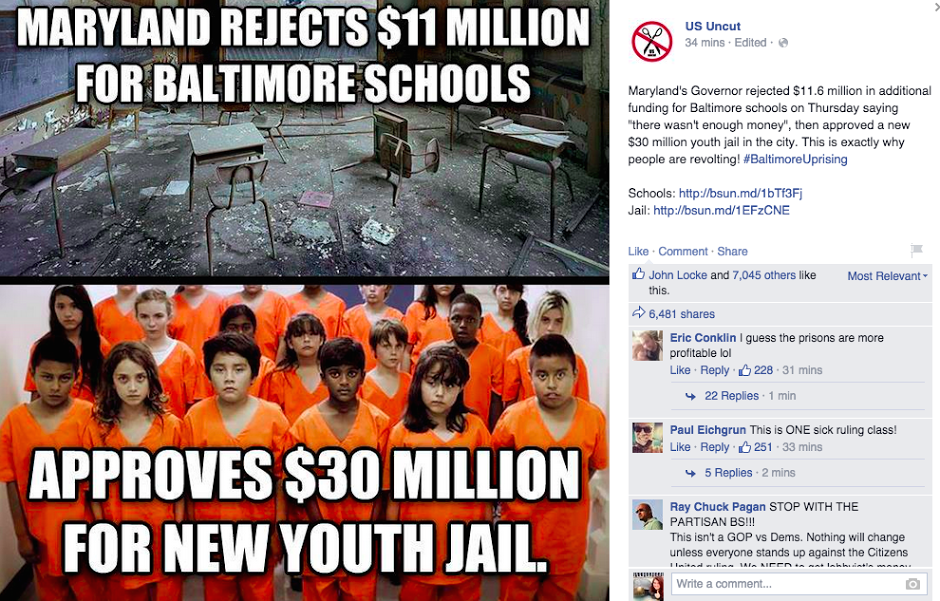
Democrats and their allies are now repeating the overreaction mistake. Perhaps the most ridiculous example being the attempt to paint Hogan as someone who would rather jail children than educate them based on the decision by the Board of Pubic works to approve the creation of a youth detention facility so that minors charged as adults will no longer be housed with adult criminals - an incredibly compassionate decision. In recent years, Maryland families have absorbed tax increases as well as stagnant wages. They've tightened budgets and forged ahead. I don't think that folks who voted for Larry Hogan are going to be very bothered by a decision that involves less than 1% of K-12 education and that only benefitted certain counties - especially when Hogan's budget increased overall K-12 spending. The hyperbolic rhetoric over, and overreaction to, his decision to not spend the money simply does not match the reality of the situation. And I think it will again do more to undermine Democrats than it will Hogan.