(St. Mary’s City, MD) August 26, 2010—A public forum for candidates seeking party nominations in Maryland’s 5th Congressional District will be held 6:30-8:30 p.m. Tuesday, September 7, at Auerbach Auditorium in St. Mary’s Hall at St. Mary’s College of Maryland. The 5th Congressional District seat is currently represented by Democrat Steny Hoyer, the House Majority Leader. Three Democrats, including Hoyer, Sylvanus Bent, and Andrew Gall, and four Republicans, Collins Bailey, Chris Chaffee, Charles Lollar, and Chris Robins, will appear on the September 14th primary ballot; all have been invited to attend.
Voters may submit questions to candidates either during the evening's program or in advance by e-mailing questions to arlyons@smcm.edu with Candidate Question in the subject line. Though the forum will be limited to 5th Congressional District candidates, which covers Calvert, Charles and St. Mary’s as well as portions of Prince George’s and Anne Arundel counties, all local candidates are invited to "meet and greet" the public and to offer campaign literature on the grounds of St. Mary’s Hall prior to the forum.
The forum is sponsored by the college’s Center for the Study of Democracy and the St. Mary’s County branch of the NAACP.
The Center for the Study of Democracy was founded as a joint initiative of St. Mary's College of Maryland and its partner institution, Historic St. Mary's City, the site of Maryland's first capital. The Center provides a forum for presentations by government officials, journalists, and scholars, and encourages and supports public participation in political processes. You can learn more about the Center by visiting www.smcm.edu/democracy/ or by following the Center on Facebook www.facebook.com/SMCMDemocracy.
The mission of the National Association for the Advancement of Colored People is to ensure the political, educational, social, and economic equality of rights of all persons and to eliminate racial hatred and racial discrimination. The St. Mary's County Branch was chartered in January of 1946. You can learn more about the St. Mary’s County branch by visiting http://www.stmarysnaacp.org/.
For forum information, contact arlyons@smcm.edu or 240-895-6432.

Wednesday, September 1, 2010
Monday, August 30, 2010
For Democrats, A Year of Warning Signs Ignored
I have been arguing for many months that the 2010 midterms would be a devastating election for Democrats - not the typical midterm rout for the president's party but rather a political earthquake. The first real rumbles of the earthquake began in the Summer of 2009 when town hall protests over health reform became front page news. At the time, many in the traditional press and within the Democratic party leadership dismissed the protests and the protesters as the rantings of a vocal, uninformed, angry minority with little national significance.
Then came the gubernatorial elections in New Jersey and Virginia.
New Jersey is a reliably Democratic state that voted overwhelmingly for President Obama, the President and Vice President nearly took up residence in the state to help incumbent John Corzine, but he lost to Chris Christie. No matter, the press and party officials declared - it was a local race and Corzine was a bad candidate - no national significance.
Virginia was once a reliably Republican state and hadn't voted for a Democrat for President since Johnson in 1964. Barack Obama won it by a comfortable margin in 2008 and suddenly Virginia was declared a swing state. In 2009 Creigh Deeds won the Democratic nomination for governor against Republican Bob McDonnell. Deeds was an experienced state senator and he ran a tough campaign for the nomination, defeating Terryy McAuliffe, former chair of the Democratic National Committee and Virginia congressman Brian Moran. Deeds won nearly 50% of the vote in that three way race - an impressive feat. In the general election, Deeds ran as a moderate and sought to portray McDonnell as an extremist, 1950s throwback, based entirely on a graduate thesis that McDonnell had written in college. McDonnell won 59% to 41%. No matter, the press and party officials declared - it was a local race and Deeds was a bad candidate - no national significance.
The health care debate continued into the fall and on Christmas Eve the US Senate passed a health reform bill in a strict party line vote. At the time, Pollster.com showed that the public opposed the bill by a 50% to 40% margin. No problem, thought Democratic party leadership, people will eventually support the bill.
Then came Massachusetts... seemingly out of nowhere a little known Republican state senator by the name of Scott Brown defeated the Democratic state Attorney General Martha Coakely to fill the U.S. Senate vacated by the late Ted Kennedy. Coakley was an experience Massachusetts politician. She was the District Attorney of Middlesex County and in her 2006 campaign to become Attorney General she carried 73% of the vote. In the 2009 primary for the Democratic Senatorial nomination she topped a four person race receiving 47% of the vote. As the general election race tightened, President Obama came to the state to campaign for Coakley, but she lost to Brown 52% to 47%. No matter, the press and party officials declared - it was a local race and Coakley was a bad candidate, prone to gaffes - no national significance.
In late March, the Senate passed the House version of health reform - using the reconciliation process to circumvent an expected Republican filibuster. At the time, the public opposed the bill by a margin of 50% to 42%. No problem, thought Democratic party leadership, people will eventually support the bill.
During all of this time - from Summer 2009 to late Spring 2010 - there were increasing indications that things were getting bad for Democrats. Charlie Cook's Political Report and Stuart Rothenberg's Rothenberg Report were regularly updating House and Senate race rankings and an ominous trend was evident. With each new update, more Democratic House seats were in play and Republican seats seemed safer and safer. Then Democratic Senate seats were moving to the danger column. At the same time, and in no way unrelated, President Obama's approval rating was falling. In the Summer of 2009 the President's approval rating was hovering around 52% and his disapproval was about 40-42%. By the late Spring of 2010 he was even-up at 47%.
In April 2010, I wrote about a new Pew Poll that suggested a major shake-up was coming in November. I wrote then "2010 has the potential to be a wave election that will surpass 2006 and 2008 and rival 1958, 1974, and 1994." The Rothenberg Report listed 79 House seats in play and 68 were held by Democrats. It was in April that I first suggested that a GOP Senate was a real possibility. In May, I warned that low Democratic turn-out in primary elections was an ominous sign of things to come. In late June, after Republicans gained a rare, but now common, lead on the so-called generic ballot I wrote that an "Electoral Bloodbath" was coming. I noted that "Senate races that should be safe bets for Democrats in Washington, California, Oregon, and Illinois are all competitive or tied." Just this month I predicted that a GOP wave was coming and argued that a gain of 70 House seats and a Senate majority are both distinct possibilities. At that time, the Rothenberg Report listed 88 competitive Seats and 76 were held by Democrats. Rothenberg was also predicting GOP Senate gains of 5-8 seats.
Today, Al Hunt has declared the Democrat's Senate majority "In Danger." Charlie Cook has officially put the number of possible GOP House gains in a range that would mean reclaiming the House and recently offered this tidbit "there are a whopping 32 Democratic incumbents who have trailed GOP challengers in at least one public or private poll. At this point in 2006, there were only 11 Republican incumbents who trailed in at least one public or private poll, yet 22 went on to lose." And Mark Halperin, the Senior Political Analyst for Time magazine, Time.com, and MSNBC, recently predicted "Republicans are in a position to pick up as many as 60 seats." Meanwhile, the President's approval rating is in negative territory, the GOP continues to lead the generic ballot, and Pollster.com shows that opposition to health reform is at roughly the same level it was in December 2009 and March 2010.
For nearly a year, Democrats ignored the significant signs of a restless and unhappy electorate. Warnings in VA, NJ, and MA were dismissed. Legislation that was overwhelmingly opposed was passed under less than admirable circumstances. The party now stands less than 70 days from the 2010 midterms and they are poised to pay a political price most closely aligned with the dramatic elections of 1974, 1994, and 2006. Don't be surprised if in January 2011 Republicans find themselves in control of the House, the Senate, a majority of the Governorships, and the State Legislatures - a complete reversal from today and from what many were predicting the day after the election in 2008.
Democrats, and many analysts, made a significant error after the 2006 and 2008 election cycles. They became convinced that Americans were gravitating to the Democratic party and they assumed that the new allegiances were secure and not fleeting. It was an assumption based on an outdated understanding of mass based party attachment. A growing number of Americans no longer align themselves with party long term. They are perfectly comfortable voting Democrat in 2008 and Republican in 2010. (Republicans made a similar error after 2002 and 2004 - and may well again after 2010).
Even now, there is little indication that Democrats fully appreciate what is happening. Much as they thought to make excuses for the losses in NJ, VA, and MA they have sought to explain opposition to health reform, the President, and the party's overall agenda by looking outward rather than inward. As such, many defenders of the faith have taken to declaring that opposition to the party's agenda is driven by fear, hatred, and racism. The flaw in this argument being that Democrats are in dire straits because they have lost folks who previously voted for them - so for Democrats to be correct then these voters must have overcome their intolerant and racist tendencies in 2006 and 2008 but now Republicans or Tea Partiers have managed to fan the smoldering flames. It's hard to imagine how the Democrats hope to win over voters after spending months defaming them. Worse, if Democrats create a caricature of their opposition they will never take seriously the lessons of any electoral defeat and learn no lessons from the loss. Gallup reports today that Republicans have taken an historic 10 point lead on the generic ballot - bigotry and nativism are simply insufficient explanations of such significant developments.
Democrats thought that they had a foundation of popular support on which to build their policy priorities - they were wrong. They are now convinced that opposition to their agenda is based on economic anxiety and intolerance. Those who are desperately trying to paint this election as being driven by the economy are simply looking for convenient excuses and failing to recognize the substantial changes in the American political system and the growing disconnect between the electorate and the elected in recent decades. These are crucial miscalculations. And at this late date, there is really nothing they can do to correct their errors or stop the coming wave.
Then came the gubernatorial elections in New Jersey and Virginia.
New Jersey is a reliably Democratic state that voted overwhelmingly for President Obama, the President and Vice President nearly took up residence in the state to help incumbent John Corzine, but he lost to Chris Christie. No matter, the press and party officials declared - it was a local race and Corzine was a bad candidate - no national significance.
Virginia was once a reliably Republican state and hadn't voted for a Democrat for President since Johnson in 1964. Barack Obama won it by a comfortable margin in 2008 and suddenly Virginia was declared a swing state. In 2009 Creigh Deeds won the Democratic nomination for governor against Republican Bob McDonnell. Deeds was an experienced state senator and he ran a tough campaign for the nomination, defeating Terryy McAuliffe, former chair of the Democratic National Committee and Virginia congressman Brian Moran. Deeds won nearly 50% of the vote in that three way race - an impressive feat. In the general election, Deeds ran as a moderate and sought to portray McDonnell as an extremist, 1950s throwback, based entirely on a graduate thesis that McDonnell had written in college. McDonnell won 59% to 41%. No matter, the press and party officials declared - it was a local race and Deeds was a bad candidate - no national significance.
The health care debate continued into the fall and on Christmas Eve the US Senate passed a health reform bill in a strict party line vote. At the time, Pollster.com showed that the public opposed the bill by a 50% to 40% margin. No problem, thought Democratic party leadership, people will eventually support the bill.
Then came Massachusetts... seemingly out of nowhere a little known Republican state senator by the name of Scott Brown defeated the Democratic state Attorney General Martha Coakely to fill the U.S. Senate vacated by the late Ted Kennedy. Coakley was an experience Massachusetts politician. She was the District Attorney of Middlesex County and in her 2006 campaign to become Attorney General she carried 73% of the vote. In the 2009 primary for the Democratic Senatorial nomination she topped a four person race receiving 47% of the vote. As the general election race tightened, President Obama came to the state to campaign for Coakley, but she lost to Brown 52% to 47%. No matter, the press and party officials declared - it was a local race and Coakley was a bad candidate, prone to gaffes - no national significance.
In late March, the Senate passed the House version of health reform - using the reconciliation process to circumvent an expected Republican filibuster. At the time, the public opposed the bill by a margin of 50% to 42%. No problem, thought Democratic party leadership, people will eventually support the bill.
During all of this time - from Summer 2009 to late Spring 2010 - there were increasing indications that things were getting bad for Democrats. Charlie Cook's Political Report and Stuart Rothenberg's Rothenberg Report were regularly updating House and Senate race rankings and an ominous trend was evident. With each new update, more Democratic House seats were in play and Republican seats seemed safer and safer. Then Democratic Senate seats were moving to the danger column. At the same time, and in no way unrelated, President Obama's approval rating was falling. In the Summer of 2009 the President's approval rating was hovering around 52% and his disapproval was about 40-42%. By the late Spring of 2010 he was even-up at 47%.
In April 2010, I wrote about a new Pew Poll that suggested a major shake-up was coming in November. I wrote then "2010 has the potential to be a wave election that will surpass 2006 and 2008 and rival 1958, 1974, and 1994." The Rothenberg Report listed 79 House seats in play and 68 were held by Democrats. It was in April that I first suggested that a GOP Senate was a real possibility. In May, I warned that low Democratic turn-out in primary elections was an ominous sign of things to come. In late June, after Republicans gained a rare, but now common, lead on the so-called generic ballot I wrote that an "Electoral Bloodbath" was coming. I noted that "Senate races that should be safe bets for Democrats in Washington, California, Oregon, and Illinois are all competitive or tied." Just this month I predicted that a GOP wave was coming and argued that a gain of 70 House seats and a Senate majority are both distinct possibilities. At that time, the Rothenberg Report listed 88 competitive Seats and 76 were held by Democrats. Rothenberg was also predicting GOP Senate gains of 5-8 seats.
Today, Al Hunt has declared the Democrat's Senate majority "In Danger." Charlie Cook has officially put the number of possible GOP House gains in a range that would mean reclaiming the House and recently offered this tidbit "there are a whopping 32 Democratic incumbents who have trailed GOP challengers in at least one public or private poll. At this point in 2006, there were only 11 Republican incumbents who trailed in at least one public or private poll, yet 22 went on to lose." And Mark Halperin, the Senior Political Analyst for Time magazine, Time.com, and MSNBC, recently predicted "Republicans are in a position to pick up as many as 60 seats." Meanwhile, the President's approval rating is in negative territory, the GOP continues to lead the generic ballot, and Pollster.com shows that opposition to health reform is at roughly the same level it was in December 2009 and March 2010.
For nearly a year, Democrats ignored the significant signs of a restless and unhappy electorate. Warnings in VA, NJ, and MA were dismissed. Legislation that was overwhelmingly opposed was passed under less than admirable circumstances. The party now stands less than 70 days from the 2010 midterms and they are poised to pay a political price most closely aligned with the dramatic elections of 1974, 1994, and 2006. Don't be surprised if in January 2011 Republicans find themselves in control of the House, the Senate, a majority of the Governorships, and the State Legislatures - a complete reversal from today and from what many were predicting the day after the election in 2008.
Democrats, and many analysts, made a significant error after the 2006 and 2008 election cycles. They became convinced that Americans were gravitating to the Democratic party and they assumed that the new allegiances were secure and not fleeting. It was an assumption based on an outdated understanding of mass based party attachment. A growing number of Americans no longer align themselves with party long term. They are perfectly comfortable voting Democrat in 2008 and Republican in 2010. (Republicans made a similar error after 2002 and 2004 - and may well again after 2010).
Even now, there is little indication that Democrats fully appreciate what is happening. Much as they thought to make excuses for the losses in NJ, VA, and MA they have sought to explain opposition to health reform, the President, and the party's overall agenda by looking outward rather than inward. As such, many defenders of the faith have taken to declaring that opposition to the party's agenda is driven by fear, hatred, and racism. The flaw in this argument being that Democrats are in dire straits because they have lost folks who previously voted for them - so for Democrats to be correct then these voters must have overcome their intolerant and racist tendencies in 2006 and 2008 but now Republicans or Tea Partiers have managed to fan the smoldering flames. It's hard to imagine how the Democrats hope to win over voters after spending months defaming them. Worse, if Democrats create a caricature of their opposition they will never take seriously the lessons of any electoral defeat and learn no lessons from the loss. Gallup reports today that Republicans have taken an historic 10 point lead on the generic ballot - bigotry and nativism are simply insufficient explanations of such significant developments.
Democrats thought that they had a foundation of popular support on which to build their policy priorities - they were wrong. They are now convinced that opposition to their agenda is based on economic anxiety and intolerance. Those who are desperately trying to paint this election as being driven by the economy are simply looking for convenient excuses and failing to recognize the substantial changes in the American political system and the growing disconnect between the electorate and the elected in recent decades. These are crucial miscalculations. And at this late date, there is really nothing they can do to correct their errors or stop the coming wave.


Saturday, August 28, 2010
Newsweek Poll Creates more Questions than it Answers
Please see my latest post, regarding the New Newsweek poll.
Update: According to Mark Blumenthal of Pollster.com Princeton Survey Research provided him with the data on the missing cases that were not included in the offical release. With that data in hand, Blumenthal was able to replicate the survey results and the 45% to 45% tie. My original post was intended to criticize Newsweek for releasing data that did not allow for replication of its reported results. I stand by the criticism. I would add as well that given the impact that the inclusion of the 5% of unaffiliated voters had on the final results they should have been included in the final release. That 5% overwhelmingly favored Democrats - a fact that should have been addressed - or given the small size of the sub sample discarded.
Original Post:
In a front page story on their website Newsweek proclaims "NEWSWEEK Poll: Democrats May Not Be Headed for Midterm Bloodbath." According to Newsweek, the poll's results suggest "the party is better off this year than Republicans were in 2006, when the GOP lost 30 House seats, and than the Democrats were in 1994, when they lost 52 House seats."
What did the poll find? That President Obama's approval rating is at 47% and Democrats and Republicans are tied at 45% on the generic ballot. Compared to other recent polls the Newsweek survey does show the Democrats to be in far better shape - problem is, the Newsweek poll actually confirms what other polls have found and should give Democrats great cause for concern.
Newsweek reports that Republicans and Democrats are tied at 45%. The folks at Newsweek were kind enough to break down that support by party - see Table One.

According to Table One, Democrats are winning 90% of the Democratic vote and Republicans are winning 94% of the Republican vote - Independents favor Republicans by a 45% to 33% margin - resulting a 45% to 45% tie...
Something seem fishy? It should. Consider the breakdown by party - 284 Republicans, 280 Democrats and 247 Independents - that's 33% Republican, 33% Democrat and 29% Independent (a few folks must have reported no party). It is mathematically impossible for Democrats and Republicans to be tied at 45% if each party is receiving similar shares of their own party vote, but Independents prefer Republicans by 12 points. If Democrats are winning a few less of their own votes as compared to the GOP, and they are losing Independents - they simply cannot be tied.
If you apply the actual sample size to the reported results then you end up with what is shown in Table Two.

Notice that no mention is made of party identification - but the only way to arrive at a 45% to 45% split is by significantly altering the party identification of the survey respondents. I do this in Table Three.
 *** See Update
In order to get to a 45% to 45% race, one must change the sample such that 37% are Democrats, 30% are Republicans and 33% are Independents. There are few other combinations that get you to 45% but all involve a significant increase in Democrats and considerable decrease in Republicans. Newsweek offers no explanation for such a dramatic change to its own sample, but there is no reasonable argument for such a party breakdown (According to data provided to Mark Blumenthal by Princeton Survey Research the 5% of unaffiliated respondents supported Democrats by a 40% to 29% margin - this data was not included in the official release).
In the 2008 election Democrats were 39% of the electorate, Republicans 32% and Independents 29% - no one believes that Democrats will hold a similar advantage in 2010. In 2004, the last good Republican year, Democrats and Republicans were 37% of the electorate and Independents were 26% - roughly equal to the actual Newsweek sample.
If you want to become truly confused, look to the last page of the survey where Princeton Survey Research (Newsweek's pollster of choice) reports the results of the following question "In politics TODAY, do you consider yourself a Republican, Democrat, or Independent?" They report that respondents were 32% Republican, 36% Democrat, and 27% Independent - so the last page provides a partisan breakdown that does not match the breakdown reported on the first page. Worse - if you plug the reported breakdown into Table Two or Table Three Republicans still lead by 47.4% to 42.6% - the poll is pure nonsense.
Now it's possible that after weighting for gender, age, education, race, region, and population density the partisan ID of the sample would change - but if one reasonably assumes that the party ID shown on the final page of the survey is the weighted breakdown then the poll's results still cannot be explained. Newsweek should release fully the effects of it's weighting so that a true assessment of its poll can be made.
So Newsweek may be reporting that all is well and that 2010 will not be a bloodbath, but they had to do some serious data weighting to arrive at that conclusion. Something that Newsweek has done before and that I wrote about in National Review Online in 2008. When I "corrected" Newsweek's data back in 2008 I showed that their poll reporting an 11 point lead for Barack Obama over John McCain was more like a 4 point lead - guess who was closer to the actual election result (hint: It wasn't Newsweek then and I do not think that it's Newsweek now).
Update: According to Mark Blumenthal of Pollster.com Princeton Survey Research provided him with the data on the missing cases that were not included in the offical release. With that data in hand, Blumenthal was able to replicate the survey results and the 45% to 45% tie. My original post was intended to criticize Newsweek for releasing data that did not allow for replication of its reported results. I stand by the criticism. I would add as well that given the impact that the inclusion of the 5% of unaffiliated voters had on the final results they should have been included in the final release. That 5% overwhelmingly favored Democrats - a fact that should have been addressed - or given the small size of the sub sample discarded.
Original Post:
In a front page story on their website Newsweek proclaims "NEWSWEEK Poll: Democrats May Not Be Headed for Midterm Bloodbath." According to Newsweek, the poll's results suggest "the party is better off this year than Republicans were in 2006, when the GOP lost 30 House seats, and than the Democrats were in 1994, when they lost 52 House seats."
What did the poll find? That President Obama's approval rating is at 47% and Democrats and Republicans are tied at 45% on the generic ballot. Compared to other recent polls the Newsweek survey does show the Democrats to be in far better shape - problem is, the Newsweek poll actually confirms what other polls have found and should give Democrats great cause for concern.
Newsweek reports that Republicans and Democrats are tied at 45%. The folks at Newsweek were kind enough to break down that support by party - see Table One.

According to Table One, Democrats are winning 90% of the Democratic vote and Republicans are winning 94% of the Republican vote - Independents favor Republicans by a 45% to 33% margin - resulting a 45% to 45% tie...
Something seem fishy? It should. Consider the breakdown by party - 284 Republicans, 280 Democrats and 247 Independents - that's 33% Republican, 33% Democrat and 29% Independent (a few folks must have reported no party). It is mathematically impossible for Democrats and Republicans to be tied at 45% if each party is receiving similar shares of their own party vote, but Independents prefer Republicans by 12 points. If Democrats are winning a few less of their own votes as compared to the GOP, and they are losing Independents - they simply cannot be tied.
If you apply the actual sample size to the reported results then you end up with what is shown in Table Two.

The two right columns show the actual share of the respondents who supported each party - if one looks at the actual sample then Republicans are leading the generic ballot by a margin of 46% to 40%. Contrary to the headline and tenor of the story, a 6 point lead for the GOP among registered voters would signal a coming bloodbath. It would also be consistent with most recent polls.
Newsweek includes a disclaimer that reads: Data are weighted so that sample demographics match Census Current Population Survey parameters for gender, age, education, race, region, and population density.
Notice that no mention is made of party identification - but the only way to arrive at a 45% to 45% split is by significantly altering the party identification of the survey respondents. I do this in Table Three.

In order to get to a 45% to 45% race, one must change the sample such that 37% are Democrats, 30% are Republicans and 33% are Independents. There are few other combinations that get you to 45% but all involve a significant increase in Democrats and considerable decrease in Republicans. Newsweek offers no explanation for such a dramatic change to its own sample, but there is no reasonable argument for such a party breakdown (According to data provided to Mark Blumenthal by Princeton Survey Research the 5% of unaffiliated respondents supported Democrats by a 40% to 29% margin - this data was not included in the official release).
In the 2008 election Democrats were 39% of the electorate, Republicans 32% and Independents 29% - no one believes that Democrats will hold a similar advantage in 2010. In 2004, the last good Republican year, Democrats and Republicans were 37% of the electorate and Independents were 26% - roughly equal to the actual Newsweek sample.
If you want to become truly confused, look to the last page of the survey where Princeton Survey Research (Newsweek's pollster of choice) reports the results of the following question "In politics TODAY, do you consider yourself a Republican, Democrat, or Independent?" They report that respondents were 32% Republican, 36% Democrat, and 27% Independent - so the last page provides a partisan breakdown that does not match the breakdown reported on the first page. Worse - if you plug the reported breakdown into Table Two or Table Three Republicans still lead by 47.4% to 42.6% - the poll is pure nonsense.
Now it's possible that after weighting for gender, age, education, race, region, and population density the partisan ID of the sample would change - but if one reasonably assumes that the party ID shown on the final page of the survey is the weighted breakdown then the poll's results still cannot be explained. Newsweek should release fully the effects of it's weighting so that a true assessment of its poll can be made.
So Newsweek may be reporting that all is well and that 2010 will not be a bloodbath, but they had to do some serious data weighting to arrive at that conclusion. Something that Newsweek has done before and that I wrote about in National Review Online in 2008. When I "corrected" Newsweek's data back in 2008 I showed that their poll reporting an 11 point lead for Barack Obama over John McCain was more like a 4 point lead - guess who was closer to the actual election result (hint: It wasn't Newsweek then and I do not think that it's Newsweek now).
Monday, August 23, 2010
In Maryland, Comparing Ehrlich/Murphy to Townsend/ Fustero is Ridiculous
A new poll conducted by Center Maryland/OpinionWorks found what most analysts had long expected - that former Republican Governor Robert Ehrlich is in no danger of losing the GOP nomination to newcomer Brian Murphy. The survey of 600 likely General Election voters (and a much smaller sample of 170 Rebublicans) found that Ehrlich leads Murphy 75% to 13% with only 11% undecided.
The poll is devastating news for the Murphy campaign. It shows that after two weeks of generally positive news, a high profile interview on a national cable news station, multiple interviews on statewide television, talk radio, and newspapers- all the result of a surprise endorsement by Sarah Palin - Murphy has barely topped 10%. One cannot help but wonder - how low was his support before the last two weeks?
Center Maryland is to be commended for conducting this poll, it fills a much needed void in the Maryland race, but the write-up on the poll contained a very poor analogy. It their write-up, Center Maryland states
Murphy, on the other had, is an organized and reasonably well funded candidate. He has respectable name recognition, has run a rather good insurgent campaign and he's received plenty of press coverage. He has also raised over $200,000 and spent $170,000 on his campaign. It may well be much less than the $1.3 million that Ehrlich has spent, but there is a sizable difference between $1,000 and $170,000.
The question should not be whether breaking the "Fustero Line" of 20% indicates weakness by Ehrlich, the real question should be how is Murphy not doing any better than 13%? Reaching 20% on primary day will not signal dissatisfaction with Ehrlich, rather it would mark a low bar of achievement for Murphy's campaign. Spinning it any other way is just nonsense.
The poll is devastating news for the Murphy campaign. It shows that after two weeks of generally positive news, a high profile interview on a national cable news station, multiple interviews on statewide television, talk radio, and newspapers- all the result of a surprise endorsement by Sarah Palin - Murphy has barely topped 10%. One cannot help but wonder - how low was his support before the last two weeks?
Center Maryland is to be commended for conducting this poll, it fills a much needed void in the Maryland race, but the write-up on the poll contained a very poor analogy. It their write-up, Center Maryland states
But with 11 percent of likely Republican primary voters still undecided, it’s possible that Murphy could break through Maryland’s “Fustero line” – the 20 percent threshold that political observers suggest might represent a weakness in Ehrlich’s hold over his party base.This is simply a ridiculous analogy and no serious observer of Maryland politics should ever compare the Ehrlich/Murphy race to the Townsend/Fustero primary. In 2002, the campaign of Lt. Governor Kathleen Kennedy Townsend was deeply embarrassed when David Fustero managed to win 20% of the primary vote. Fustero had no organized campaign of which to speak, virtually no money, and was all but ignored by the press. As the primary approached he was campaigning via letters to the editor. Fustero had spent less than $1,000 on his candidacy, compared to Townsend's $2.3 million. Fustero should not have received 5% of the vote, let alone 20%. It's safe to say that few who voted for Fustero had ever seen his name before reading it on the ballot - it was a pure protest vote against Townsend.
For many political observers, the performance of established gubernatorial candidates in primary elections against unknown or relatively unknown challengers marks an opportunity to assess how well those candidates will hold their base in general elections. Eight years ago, when then-Lt. Gov. Kathleen Kennedy Townsend lost 20 percent of the Democratic primary vote to an unknown retired grocery clerk named Robert Fustero, many analysts quickly suggested that she was having trouble energizing core Democratic constituencies. Townsend ultimately lost to Ehrlich two months later. Similar questions might be raised about Ehrlich if Murphy were to exceed 20 percent of the vote in the September Republican primary.
Murphy, on the other had, is an organized and reasonably well funded candidate. He has respectable name recognition, has run a rather good insurgent campaign and he's received plenty of press coverage. He has also raised over $200,000 and spent $170,000 on his campaign. It may well be much less than the $1.3 million that Ehrlich has spent, but there is a sizable difference between $1,000 and $170,000.
The question should not be whether breaking the "Fustero Line" of 20% indicates weakness by Ehrlich, the real question should be how is Murphy not doing any better than 13%? Reaching 20% on primary day will not signal dissatisfaction with Ehrlich, rather it would mark a low bar of achievement for Murphy's campaign. Spinning it any other way is just nonsense.
Thursday, August 19, 2010
Poll: Maryland Voters Seem Comfortable with O'Malley and Ehrlich
A new poll confirms that the race for governor in Maryland continues to be tight. The latest Rasmussen Reports survey finds Martin O'Malley and Bob Ehrlich tied at 47% to 47%. The race has been tied all summer and nothing much has changed. Recent campaign fundraising reports show that Martin O'Malley has a $4.7 million cash advantage over Ehrlich - and these numbers suggest that O'Malley will need that advantage to turn out the vote. Ehrlich needs to use these numbers to convince potential donors that he can in fact win this race - so long as he has the money to compete.
 There are several truly interesting findings in the latest poll and as always they offer areas of hope and concern for both campaigns. An equal share of voters consider each candidate to be "mainstream." This should worry team O'Malley - in a state that is 2 to 1 Democrat one would expect voters to see the Republican as less mainstream. Likewise, the candidates have equal favorability ratings. The O'Malley camp wants to convince voters that the Ehrlich years were not good for the state - but this finding suggests that voters have a rather positive recollection of Ehrlich's tenure.


Likewise, 77% of respondents describe Ehrlich as Somewhat or Very Conservative. For O'Malley, 25% describe him as Moderate and 55% describe him as Somewhat or Very Liberal. These numbers tell us something important about the Maryland electorate - commentators obsess over the Democrats' 2 to 1 voter registration advantage in the state portraying Democratic voters as a monolithic group. This is simply wrong. While the Democratic Party in much of the nation has slowly purged itself of the social conservatives who once called it home there is still a strong element of those old school Democrats in Maryland - call them "Boll Weevils" or "Blue Dogs" they are Democrats by tradition, even though the party is no longer aligned with many of their core beliefs. This is why Republicans win in counties where registered Democrats outnumber them. In only 7 of Maryland's 24 counties (Baltimore City is, in effect, a county) do Republicans hold an advantage - and it's often a slim one (Harford only recently switched from plurality Democrat to plurality Republican). Yet Ehrlich carried 21 counties in 2002 and 20 counties in 2006.
A look at Maryland's Senate makes that clear - the sea of red are legislative districts represented in the state Senate by Republicans - yet most of the counties included in these districts are majority Democrat.

O'Malley should should be a bit concerned that he is tied with a candidate that 3/4 of Marylanders consider to be Somewhat or Very Conservative - it may suggest that that many voters like that about Ehrlich - or that in 2010 many voters are looking for a conservative candidate.
O'Malley can take heart in the fact that his job approval rating has finally topped 50% - reaching 54% in this poll. President Obama has a 56% approval rating, so the president is unlikely to be a drag on the O'Malley ticket.
All things considered, I would give an edge to Bob Ehrlich based on the favorability and mainstream ratings, but mostly based on the last two questions in the survey:
9* Generally speaking, how would you rate the U.S. economy these days? Excellent, good, fair, or poor?
- 1% Excellent
- 7% Good
- 37% Fair
- 55% Poor
- 1% Not sure
10* Are economic conditions in the country getting better or worse?
- 31% Better
- 41% Worse
- 23% About the same
- 4% Not Sure
I would not want to be associated with the party in power heading into an election in which 55% of potential voters rate the economy as poor and 41% say it is getting worse. That's a strong tide for O'Malley to fight.
If Ehrlich can get his fundraising in order this may well become his race to lose.
* Image courtesy of RealClearPolitics.com
Democrats' "Extreme" Strategy May not Work
Facing awful polling numbers, an unpopular President, and a dreadful economy Democrats have sought to change the narrative of the 2010 midterms by portraying Republican candidates as being "outside the mainstream" and "extreme." This is hardly a new strategy and Republicans have often sought to define Democratic candidates as too liberal for the American mainstream.
There is mounting evidence, however, that the strategy will have little effect on the outcome of the 2010 election. With the President sinking to new lows in public approval, seemingly everyday, and the Democratic led Congress reaching all time lows of public approval it's increasing hard for the Democrats to define their opponents as extreme.
The Hotline is reporting today that "A prominent Democratic pollster is circulating a survey that shows George W. Bush is 6 points more popular than President Obama in "Frontline" districts -- seats held by Democrats that the Democratic Congressional Campaign Committee sees as most vulnerable to Republican takeover. That Bush is more popular than Obama in Democratic-held seats is cause for outright fear."
You read that correctly, President Bush - who left office with a 35% approval rating - is more popular than Barack Obama in key congressional districts currently held by Democrats - that is devastating.
It is also clear that the Republicans are going to push back hard against the extremist label. The National Republican Senatorial Committee has released a very hard hitting ad suggesting that Republicans are not the extremists in this election.
Adding his voice to the chorus of bad news, Charlie Cook has just released a revised estimate of the House 2010 outlook:
There is mounting evidence, however, that the strategy will have little effect on the outcome of the 2010 election. With the President sinking to new lows in public approval, seemingly everyday, and the Democratic led Congress reaching all time lows of public approval it's increasing hard for the Democrats to define their opponents as extreme.
The Hotline is reporting today that "A prominent Democratic pollster is circulating a survey that shows George W. Bush is 6 points more popular than President Obama in "Frontline" districts -- seats held by Democrats that the Democratic Congressional Campaign Committee sees as most vulnerable to Republican takeover. That Bush is more popular than Obama in Democratic-held seats is cause for outright fear."
You read that correctly, President Bush - who left office with a 35% approval rating - is more popular than Barack Obama in key congressional districts currently held by Democrats - that is devastating.
It is also clear that the Republicans are going to push back hard against the extremist label. The National Republican Senatorial Committee has released a very hard hitting ad suggesting that Republicans are not the extremists in this election.
Adding his voice to the chorus of bad news, Charlie Cook has just released a revised estimate of the House 2010 outlook:
With today’s ratings changes in 10 House districts, The Cook Political Report is now raising its House forecast from a Republican net gain of between 32 and 42 seats to a gain of between 35 and 45 seats, with the odds of an outcome larger than that range greater than the odds of a lesser outcome. A turnover of 39 seats would tip majority status into Republican hands. At this point, only 214 House seats are Solid, Likely or Lean Democratic, while 181 seats are Solid, Likely or Lean Republican, and 40 seats are in the Toss Up column. While this would imply an advantage for Democrats, given the continuous erosion we have seen in dozens of contests so far this cycle, races shifting from Solid and Likely Democrat to Lean Democratic and Toss Up, we would be surprised if there was not more movement over the 78 days from now until Election Day.There are barely 80 days to go and Democrats still have not found a narrative that works for them - and they are running out of time.
Monday, August 16, 2010
2010: An Historic GOP Wave?
There is general agreement that the GOP is likely to make significant gains in the coming midterm elections. All questions now focus on just how many seats the Republicans will gain in the House and Senate. In some respects that is a moot point. With only 41 seats in the U.S. Senate, Republicans have been able to block or force significant alterations to many Democratic initiatives. Health reform was only possible by way of the reconciliation process - after 60 Democrats voted for an initial bill prior to the loss of their supermajority. By most accounts Republicans will gain at least 4 and perhaps 7 seats in the Senate. With 45 or 48 seats Republicans will be able to block any and all legislation they so choose.
In the House, most analysts see Republican gains of 30-35 seats, just shy of the 39 needed to regain control. A recent release by Gallup reported that the average seat gain for the minority during a midterm when the president's approval is below 50% is 36 seats. Simply put, Republicans are within striking distance of reclaiming the House. Democrats will not be able to govern with a scant 4 seat majority in the House.
Translation: The midterm election is likely to mark the end of President Obama's current agenda - even if the Democrats retain control of Congress.
That said, I continue to think that the 2010 midterm is taking the shape of a growing GOP wave - one that will likely result in far more than 35 seats gained in the House and likely 8 or 9 seats gained in the Senate.
Why am I so convinced of this? Consider this chart from Pollster.com averaging the so-called generic ballot question. Republicans currently hold a 6.1 percentage point lead. Democrats lost their lead as the health care battle was starting last year and have never recovered. Recent efforts to undermine faith in the GOP, to link them to the Tea Party, and to tie them to George W. Bush have clearly failed.
History is the other reason that I see the likelihood of significant GOP gains. Consider the most recent Gallup tracking poll tally for the generic ballot:

It shows Republicans leading by a 50% to 43% margin over Democrats - the trend since March shows that the parties have been near parity, with a slight advantage for Republicans. More recently, the trend has clearly favored the GOP.
Now, consider the next chart - it shows the generic ballot question from 1950 through 2006. Notice anything interesting? Since 1950, Republicans have only led the generic ballot twice - in 1994 prior to the so-called Republican Revolution and in 2002 just before George W. Bush became the first president since FDR to see his party gain seats during the first midterm of his first term.

In neither case - 1994 nor 2002 - did the GOP top 50% in the generic ballot. Rather they were the choice of a plurality. In fact, until this week the GOP had never reached 50% in Gallup's generic ballot question. At only four points since 1950 had the GOP even achieved parity with Democrats - yet they have been on a level playing field since March and are now pulling away.
We are in uncharted territory. Since the 1950s the American electorate has always had a generic preference for Democrats. That era has ended. If the generic ballot is accurately capturing public sentiment - and there is no reason to doubt that it is - the GOP is poised to score a tremendous and impressive electoral comeback in November. One that seemed all but impossible just 18 months ago.
In the House, most analysts see Republican gains of 30-35 seats, just shy of the 39 needed to regain control. A recent release by Gallup reported that the average seat gain for the minority during a midterm when the president's approval is below 50% is 36 seats. Simply put, Republicans are within striking distance of reclaiming the House. Democrats will not be able to govern with a scant 4 seat majority in the House.
Translation: The midterm election is likely to mark the end of President Obama's current agenda - even if the Democrats retain control of Congress.
That said, I continue to think that the 2010 midterm is taking the shape of a growing GOP wave - one that will likely result in far more than 35 seats gained in the House and likely 8 or 9 seats gained in the Senate.
Why am I so convinced of this? Consider this chart from Pollster.com averaging the so-called generic ballot question. Republicans currently hold a 6.1 percentage point lead. Democrats lost their lead as the health care battle was starting last year and have never recovered. Recent efforts to undermine faith in the GOP, to link them to the Tea Party, and to tie them to George W. Bush have clearly failed.
History is the other reason that I see the likelihood of significant GOP gains. Consider the most recent Gallup tracking poll tally for the generic ballot:

It shows Republicans leading by a 50% to 43% margin over Democrats - the trend since March shows that the parties have been near parity, with a slight advantage for Republicans. More recently, the trend has clearly favored the GOP.
Now, consider the next chart - it shows the generic ballot question from 1950 through 2006. Notice anything interesting? Since 1950, Republicans have only led the generic ballot twice - in 1994 prior to the so-called Republican Revolution and in 2002 just before George W. Bush became the first president since FDR to see his party gain seats during the first midterm of his first term.

In neither case - 1994 nor 2002 - did the GOP top 50% in the generic ballot. Rather they were the choice of a plurality. In fact, until this week the GOP had never reached 50% in Gallup's generic ballot question. At only four points since 1950 had the GOP even achieved parity with Democrats - yet they have been on a level playing field since March and are now pulling away.
We are in uncharted territory. Since the 1950s the American electorate has always had a generic preference for Democrats. That era has ended. If the generic ballot is accurately capturing public sentiment - and there is no reason to doubt that it is - the GOP is poised to score a tremendous and impressive electoral comeback in November. One that seemed all but impossible just 18 months ago.
Thursday, August 12, 2010
Is Ehrlich Debate Challenge a Smoke Screen?
Update III: And now it makes sense - Ehrlich raised $3.2 million, but only has $2 million in the bank. So O'Malley has a tremendous cash advantage. No wonder Ehrlich wanted to change the story.
Update II: The Ehrlich camp is reporting that they raised $3.2 million - essentially on par with what the O'Malley camp raised during the same period. There is no doubt that O'Malley will have raise more cash - in total - but Ehrlich will have more than enough to run a competitive race. I'm not sure why they waited until Friday to release this data. I assume that they worried about comparisons between Ehrlich's cash on hand and O'Malley's.
Update: Julie Bykowicz is reporting at the Baltimore Sun that team Ehrlich is going to wait until tomorrow to release their numbers. To me, this is further evidence that the numbers will be weak and the debate challenge was a smoke screen. It is a tried and true tactic in politics to issue bad or otherwise unflattering news on a Friday so that it will be lost in a weekend full family activities and other real life distractions.
Seemingly out of the blue, and one month before the nominating primary, Republican gubernatorial candidate Bob Ehrlich has issued a pretty detailed debate challenge to his likely Democratic opponent, Governor Martin O'Malley.
The general election is 3 months away and the race is pretty much tied - why issue a debate challenge now? Call be suspicious but I have to wonder if Ehrlich is trying to change the storyline and there are three possible stories that he's trying to quash:
Update II: The Ehrlich camp is reporting that they raised $3.2 million - essentially on par with what the O'Malley camp raised during the same period. There is no doubt that O'Malley will have raise more cash - in total - but Ehrlich will have more than enough to run a competitive race. I'm not sure why they waited until Friday to release this data. I assume that they worried about comparisons between Ehrlich's cash on hand and O'Malley's.
Update: Julie Bykowicz is reporting at the Baltimore Sun that team Ehrlich is going to wait until tomorrow to release their numbers. To me, this is further evidence that the numbers will be weak and the debate challenge was a smoke screen. It is a tried and true tactic in politics to issue bad or otherwise unflattering news on a Friday so that it will be lost in a weekend full family activities and other real life distractions.
Seemingly out of the blue, and one month before the nominating primary, Republican gubernatorial candidate Bob Ehrlich has issued a pretty detailed debate challenge to his likely Democratic opponent, Governor Martin O'Malley.
The general election is 3 months away and the race is pretty much tied - why issue a debate challenge now? Call be suspicious but I have to wonder if Ehrlich is trying to change the storyline and there are three possible stories that he's trying to quash:
- He wants people to stop talking about Brian Murphy. His rival for the GOP nomination has been receiving a great deal of free press following his surprise endorsement from Sarah Palin. Murphy has been all over the pages of the Washington Post and the Baltimore Sun and has landed interviews on local TV and radio as well as the Fox Business channel.
- O'Malley just announced that he has a campaign war chest loaded with $6.7 million - a hefty sum heading into the campaign and a number that may dampen enthusiasm among Ehrlich supporters.
- Speaking of fundraising, Ehrlich still has not released his current fundraising totals. O'Malley released his yesterday (so that he could brag about the impressive haul) but the Ehrlich camp seems to be waiting. I find it odd that they would issue a debate challenge on the same day they intend to release their fundraising totals - unless those totals are less than impressive. Ehrlich wanted to raise $3 million, if he came in under that number the press spin would be very negative and it would make Ehrlich appear weak against the fundraising prowess of O'Malley.
Tuesday, August 10, 2010
With Palin Endorsement is Murphy a "Mama Grizzly"?

Though some are quick to dismiss the impact of Palin's endorsement, it is worth noting that Palin's track record so far this election cycle has been pretty good. And for Murphy, the endorsement provided two things that he desperately needed - free advertising and better name recognition. CNN,the New York Times, the Baltimore Sun, and the Washington Post have all committed new ink to the Murphy campaign. Murphy even landed an interview on the Fox Business channel and the endorsement was covered by all the local news stations. In the near term, this endorsement will help Murphy, but it is unlikely that Palin will come to the state and campaign for him and equally unlikely that there will be a long term effect.
As for the impact of her endorsement on Robert Ehrlich's campaign - I think that Tom Schaller got it mostly right in the Baltimore Sun: "Mr. Ehrlich said the snub didn't matter, but he knows better and ought to be giddy. Ms. Palin would have done far more harm to his candidacy by endorsing him, and if anything she gave Mr. Ehrlich the opportunity to polish his preferred image as a non-ideological pragmatist."
Come the general election, Governor Martin O'Malley will likely claim that Bob Ehrlich is a dangerous, right-wing conservative, out of step with Maryland voters. Ehrlich can respond by reminding voters (the majority of whom will be Democrats) that he was too moderate for Sarah Palin.
Liberal commentators like Schaller are too quick to dismiss Palin and her impact on politics - this is a mistake. Palin has had a tremendous effect on national politics since being plucked from obscurity in 2008. But her brand of conservatism is simply a poor fit with Maryland, a state that has sent only three Republican governors to Annapolis since 1950 and each - Theodore McKeldin, Spiro "Ted" Agnew, and Ehrlich - was a moderate Republican with significant bi-partisan appeal (yes, even Agnew). Democrats outnumber Republicans by a 2 to 1 margin in Maryland and although many Maryland Democrats are of the conservative "Blue Dog" variety they are not Republicans. Any statewide Republican candidate needs to win about 25% of the Democratic vote - an endorsement from Sarah Palin is not an effective strategy to achieve that mark.
Brian Murphy should enjoy the exposure that Palin's endorsement has afforded him, and his time in Maryland politics may yet come, but not this year and not in this race. In the end, Palin's endorsement of Murphy will have roughly the same impact on the campaign as the economic stimulus bill signed by President Obama last year had on the economy - the effect will near-term, limited, and mostly inconsequential - other than to boost the political fortunes of his opponents.
Thursday, August 5, 2010
Same Sex Marriage and "Judicial Activism"
On Wednesday, August 4 a federal judge voided California's ban on same sex marriage (proposition 8) declaring that it violated the due process and equal protection clauses of the U.S. Constitution. The issues tends to be a bit divisive and as one can imagine the reaction to the ruling has varied - but there is one narrative that I find especially troubling. On supported of Proposition 8 said this: "The whole nation is watching, and the whole nation should be quaking to think that a single judge sitting in California can reverse the will of 7 million voters."
This is a variation on a similar theme often raised after controversial judicial rulings - that judges should not act counter to the will of the voters or their elected representatives. I will defer to the judgement of Alexander Hamilton on such matters. In Federalist 78, Hamilton addressed this very subject:
So who should determine what the Constitution means? The people? Their representatives? Again, Hamilton provides the answer:
Soon, the Supreme Court will likely be asked to consider whether the individual mandate included as part of comprehensive health reform violates the Constitution. The decision by the court to void the mandate would be significant as the health reform law did not include a severability clause - meaning that a decision to invalidate the mandate would likely invalidate the entire bill.
I will not presuppose what the court will decide - but I remain confident that the judges will do just what the are supposed to do - interpret the Constitution and uphold its will above all else.
This is a variation on a similar theme often raised after controversial judicial rulings - that judges should not act counter to the will of the voters or their elected representatives. I will defer to the judgement of Alexander Hamilton on such matters. In Federalist 78, Hamilton addressed this very subject:
Some perplexity respecting the rights of the courts to pronounce legislative acts void, because contrary to the Constitution, has arisen from an imagination that the doctrine would imply a superiority of the judiciary to the legislative power. It is urged that the authority which can declare the acts of another void, must necessarily be superior to the one whose acts may be declared void. As this doctrine is of great importance in all the American constitutions, a brief discussion of the ground on which it rests cannot be unacceptable.Hamilton's point is clear - no act of law, whether approved by voters or representatives may violate the Constitution.
There is no position which depends on clearer principles, than that every act of a delegated authority, contrary to the tenor of the commission under which it is exercised, is void. No legislative act, therefore, contrary to the Constitution, can be valid. To deny this, would be to affirm, that the deputy is greater than his principal; that the servant is above his master; that the representatives of the people are superior to the people themselves; that men acting by virtue of powers, may do not only what their powers do not authorize, but what they forbid.
So who should determine what the Constitution means? The people? Their representatives? Again, Hamilton provides the answer:
The interpretation of the laws is the proper and peculiar province of the courts. A constitution is, in fact, and must be regarded by the judges, as a fundamental law. It therefore belongs to them to ascertain its meaning, as well as the meaning of any particular act proceeding from the legislative body.Interpretation of the law and of the Constitution is the sole responsibility of the judiciary and if a law is found to violate the Constitution it does not matter if it was approved by 7 or 7 million voters - it is void. The same applies to any legislation enacted by the House and Senate and signed by a president.
Soon, the Supreme Court will likely be asked to consider whether the individual mandate included as part of comprehensive health reform violates the Constitution. The decision by the court to void the mandate would be significant as the health reform law did not include a severability clause - meaning that a decision to invalidate the mandate would likely invalidate the entire bill.
I will not presuppose what the court will decide - but I remain confident that the judges will do just what the are supposed to do - interpret the Constitution and uphold its will above all else.
Tuesday, August 3, 2010
Midterm Update - The GOP Wave Has Not Crested
Last week, some pundits wondered aloud if Democrats were staging a mini rally against Republicans. The Gallup tracking poll reported a Democratic lead in the so-called generic ballot question for two consecutive weeks. Charlie Cook wrote "One interpretation of recent results is that the momentum in this critical midterm election has shifted and the Republican wave has subsided. Another interpretation is that it's too soon to tell whether much has changed at all."
The latest Gallup poll shows that Republicans have reclaimed a 5 point lead. A review of the generic ballot question from several polls available at Realclearpolitics.com shows that Republicans currently lead in every national poll.

The Republicans enjoy an average lead of 6% - and nearly every poll is limited to registered voters and not likely voters. This is significant as Republicans appear far more motivated to vote in the 2010 midterm, so the average "likely voter" is probably much more Republican than the typical "registered voter." A recent survey by Pew found that "Fully 56% of Republican voters say they are more enthusiastic about voting this year than in previous elections – the highest percentage of GOP voters expressing increased enthusiasm about voting in midterms dating back to 1994."Among Democrats, only 42% reported such enthusiasm. To add a bit oh historical perspective "The Republican Party now holds about the same advantage in enthusiasm among its party’s voters that the Democratic Party held in June 2006 and the GOP had late in the 1994 campaign." Pew is actually understating the historical significance as this is the first time that any party has recorded an enthusiasm rating above 50% in the last 16 years.
What impact will this enthusiasm have come election day? Cook notes in his column that a 5 point lead among registered voters for Democrats typically translates into a tie with Republicans among actual voters - because registered voter numbers historically underestimate actual Republican turn-out. In October 1994 Gallup reported that Democrats enjoyed a 46% to 44% lead over Republicans in the generic ballot - on Election Day Republicans won the national popular vote 52% to 45%. So a 2 point Democratic lead among registered voters translated into a 7 point Republican lead among actual voters and a gain of just over 50 House seats.
The current 6 point lead held by Republicans would likely translate into a pick-up of at least 40 - if not 50 - seats in the House. If the actual lead come election day is closer to 10 points it would not be unrealistic to see Republicans pick-up roughly 70 seats in the House - and likely come within a single vote of retaking the Senate.
Events can still change, Democrats can still reclaim an advantage - though one must wonder how. A look at the generic ballot trend going back to President Obama's inauguration shows that voters began to turn on the Democrats just as the health reform battle was heating up last summer and despite a slight tightening in lat spring 2010 the trend has been favoring the GOP for over a year. As Republicans learned in 2006, once started it's hard to alter that trend.

The latest House race assessment from the Rothenberg Report finds that 88 House seats are "in play." Of the 88, only 12 are held by Republicans, and the Rothenberg report excludes some Democratic seats that now seem to be in danger including Illinois’s 17th congressional and North Carolina's 11th. In the Senate, Rothenberg predicts GOP gains of 5 to 8 seats and even sees the once safe seats in CA, WA, and WI as moving toward the GOP. All of this, coupled with President Obama's newly reached low of 41% approval in the USA Today Gallup poll, point to significant GOP gains in November. The coming wave has not crested.
The latest Gallup poll shows that Republicans have reclaimed a 5 point lead. A review of the generic ballot question from several polls available at Realclearpolitics.com shows that Republicans currently lead in every national poll.

The Republicans enjoy an average lead of 6% - and nearly every poll is limited to registered voters and not likely voters. This is significant as Republicans appear far more motivated to vote in the 2010 midterm, so the average "likely voter" is probably much more Republican than the typical "registered voter." A recent survey by Pew found that "Fully 56% of Republican voters say they are more enthusiastic about voting this year than in previous elections – the highest percentage of GOP voters expressing increased enthusiasm about voting in midterms dating back to 1994."Among Democrats, only 42% reported such enthusiasm. To add a bit oh historical perspective "The Republican Party now holds about the same advantage in enthusiasm among its party’s voters that the Democratic Party held in June 2006 and the GOP had late in the 1994 campaign." Pew is actually understating the historical significance as this is the first time that any party has recorded an enthusiasm rating above 50% in the last 16 years.
What impact will this enthusiasm have come election day? Cook notes in his column that a 5 point lead among registered voters for Democrats typically translates into a tie with Republicans among actual voters - because registered voter numbers historically underestimate actual Republican turn-out. In October 1994 Gallup reported that Democrats enjoyed a 46% to 44% lead over Republicans in the generic ballot - on Election Day Republicans won the national popular vote 52% to 45%. So a 2 point Democratic lead among registered voters translated into a 7 point Republican lead among actual voters and a gain of just over 50 House seats.
The current 6 point lead held by Republicans would likely translate into a pick-up of at least 40 - if not 50 - seats in the House. If the actual lead come election day is closer to 10 points it would not be unrealistic to see Republicans pick-up roughly 70 seats in the House - and likely come within a single vote of retaking the Senate.
Events can still change, Democrats can still reclaim an advantage - though one must wonder how. A look at the generic ballot trend going back to President Obama's inauguration shows that voters began to turn on the Democrats just as the health reform battle was heating up last summer and despite a slight tightening in lat spring 2010 the trend has been favoring the GOP for over a year. As Republicans learned in 2006, once started it's hard to alter that trend.

The latest House race assessment from the Rothenberg Report finds that 88 House seats are "in play." Of the 88, only 12 are held by Republicans, and the Rothenberg report excludes some Democratic seats that now seem to be in danger including Illinois’s 17th congressional and North Carolina's 11th. In the Senate, Rothenberg predicts GOP gains of 5 to 8 seats and even sees the once safe seats in CA, WA, and WI as moving toward the GOP. All of this, coupled with President Obama's newly reached low of 41% approval in the USA Today Gallup poll, point to significant GOP gains in November. The coming wave has not crested.
Thursday, July 29, 2010
President Obama and Independent Voters - A Marriage of Convenience Heading for a Nasty Divorce?
The always great William Galston takes a look at just how much public opinion of the Democrats and Republicans has shifted among Independents. Galston considers the recent PEW poll
Why? Consider two more points from Galston:
Obama's message spoke directly to the concerns of Independent voters and they supported him on Election Day by a margin of 52% to 44%. In 2004 Bush and Kerry split Independents 48% to 49%. Independents also increased their share of the electorate between 2004 and 2008 from 26% to 29%. So Independents have become more crucial to a presidential candidate and they helped deliver the White House to Obama.
 In July of 2009 Gallup reported that Obama's support among Independents stood at a strong 56% - that was after the passage of the stimulus bill, but just before the summer of health care reform townhall meetings that would foreshadow the tough reform battle in Congress. Today, Obama's approval rating among Independents stands out 38% - an 18 point decline in one year.
Why the decline? Because Obama's legislative successes have turned Independents away. The economic stimulus bill added more than $800 billion to the national debt - on top of the $800 billion bank bailout passed in the waning days of the Bush administration. As a result, the nation's deficit for 2009 totaled $1.4 trillion and the deficit for 2010 is estimated to reached $1.5 trillion - simply staggering figures.
Just as concern over the debt was reaching a critical mass las summer the health reform debate began. Estimates placed the cost of reform at $1 trillion over ten years - triggering more debt concerns. Other elements of the reform proposals caused more concern - the individual mandate that Obama had opposed during the campaign was now part of the mix as was a proposal to tax employer health benefits. The individual mandate included a tax penalty for failure to comply - so the two proposals that candidate Obama had criticized were now on the table and the pledge to not raise taxes was pushed aside.
The manner in which health reform passed further antagonized Independent voters. The use of budget reconciliation to pass the bill in the Senate following the surprise election of Republican Scott Brown in Massachusetts and the brief flirtation with using the "deeming" process to pass the bill in the House so as to avoid politically painful votes struck many Independents as more of the "politics as usual" that Obama had promised to change. Worse, subsequent news accounts reported that the cost of reform may well be more than initially estimated - and in fact may well worsen our deficits and increase costs.
Promises of transparency have been undermined with recent news regarding financial regulation and word that it exempts the Securities and Exchange Commission for freedom of information act requests. Add to this the fact that Obama administration issued an executive order prohibiting the hiring of lobbyists and then went about issuing multiple exemptions to that order so that lobbyists could be hired.
 Adding more fuel to the debt fire a just released report from the Congressional Budget Office warns that unless serious actions are taken - significant spending cuts, dramatic tax increases, or both - "growing budget deficits will cause debt to rise to unsupportable levels... In only one other period in U.S. history—during and shortly after World War II" has our debt reached its current levels.
But the CBO warns that tax increases "would discourage work and saving, further reducing output and incomes."
In sum, President Obama and Congressional Democrats have scored considerable legislative successes - but many of those successes contained elements that directly broke pledges made by the President during the 2008 campaign - pledges that were central to his gaining the support of Independents. This means that Democrats cannot go into the midterms touting their accomplishments. Instead, indications are that they will base their campaign not on why they are worthy of support, but rather on why Republicans are unworthy- including portraying Republicans as racist Tea Party fanatics. It's a desperate and risky tactic, but it's the only option they have. They cannot win back the support of Independents in the near term, so instead they are trying to depress their support for and turnout on behalf of Republicans.
It's a sad state of affairs and speaks to how much the Democrats' fortunes have changed in the last two years. Between 2002 and 2006 unified Republican government drove Independents into the arms of the Democrats. Four years later Democrats appear to be driving them right back. It remains to be seen whether the result will divided government, and if so, how Independents will react to that.
"On the whole, 58 percent of voters see Democrats as liberal or very liberal, while 56 percent see Republicans as conservative or very conservative; no surprise there. But voters now place themselves much closer to the Republican Party than to the Democratic Party on this left-right continuum. Indeed, the ideological gap between the Democratic Party and the mean voter is about three times as large as the separation between that voter and the Republican Party. And, startlingly, the electorate places itself a bit closer to the Tea Party movement (which is well to the right of the Republican Party) than to the Democratic Party. All this represents a major shift from five years ago, when mean voters placed themselves exactly halfway between their ideological perceptions of the Democratic and Republican parties."Many political insiders have wondered why the Democrats and the Presidents are in such dire straits considering the success they have had enacting legislation - the stimulus, health reform, regulatory reform - by many measures this Congress and President have had one of the most productive sessions in years. Yet with each new bill approval of Congress seems to fall more and the President's approval rating is stuck in the mid 40s.
Why? Consider two more points from Galston:
- "In May 2009, after Obama had taken office and the broad political debate had shifted away from social issues and national security toward the economy and federal regulation, Pew found that Independents had begun to move toward the Republican Party."
- "Democrats are far more ideologically diverse than Republicans. Twenty-four percent of Democrats describe themselves as conservative or very conservative, while only 5 percent of Republicans call themselves liberal or very liberal."
Obama's message spoke directly to the concerns of Independent voters and they supported him on Election Day by a margin of 52% to 44%. In 2004 Bush and Kerry split Independents 48% to 49%. Independents also increased their share of the electorate between 2004 and 2008 from 26% to 29%. So Independents have become more crucial to a presidential candidate and they helped deliver the White House to Obama.
Why the decline? Because Obama's legislative successes have turned Independents away. The economic stimulus bill added more than $800 billion to the national debt - on top of the $800 billion bank bailout passed in the waning days of the Bush administration. As a result, the nation's deficit for 2009 totaled $1.4 trillion and the deficit for 2010 is estimated to reached $1.5 trillion - simply staggering figures.
Just as concern over the debt was reaching a critical mass las summer the health reform debate began. Estimates placed the cost of reform at $1 trillion over ten years - triggering more debt concerns. Other elements of the reform proposals caused more concern - the individual mandate that Obama had opposed during the campaign was now part of the mix as was a proposal to tax employer health benefits. The individual mandate included a tax penalty for failure to comply - so the two proposals that candidate Obama had criticized were now on the table and the pledge to not raise taxes was pushed aside.
The manner in which health reform passed further antagonized Independent voters. The use of budget reconciliation to pass the bill in the Senate following the surprise election of Republican Scott Brown in Massachusetts and the brief flirtation with using the "deeming" process to pass the bill in the House so as to avoid politically painful votes struck many Independents as more of the "politics as usual" that Obama had promised to change. Worse, subsequent news accounts reported that the cost of reform may well be more than initially estimated - and in fact may well worsen our deficits and increase costs.
Promises of transparency have been undermined with recent news regarding financial regulation and word that it exempts the Securities and Exchange Commission for freedom of information act requests. Add to this the fact that Obama administration issued an executive order prohibiting the hiring of lobbyists and then went about issuing multiple exemptions to that order so that lobbyists could be hired.
But the CBO warns that tax increases "would discourage work and saving, further reducing output and incomes."
In sum, President Obama and Congressional Democrats have scored considerable legislative successes - but many of those successes contained elements that directly broke pledges made by the President during the 2008 campaign - pledges that were central to his gaining the support of Independents. This means that Democrats cannot go into the midterms touting their accomplishments. Instead, indications are that they will base their campaign not on why they are worthy of support, but rather on why Republicans are unworthy- including portraying Republicans as racist Tea Party fanatics. It's a desperate and risky tactic, but it's the only option they have. They cannot win back the support of Independents in the near term, so instead they are trying to depress their support for and turnout on behalf of Republicans.
It's a sad state of affairs and speaks to how much the Democrats' fortunes have changed in the last two years. Between 2002 and 2006 unified Republican government drove Independents into the arms of the Democrats. Four years later Democrats appear to be driving them right back. It remains to be seen whether the result will divided government, and if so, how Independents will react to that.
Tuesday, July 27, 2010
New Poll Offers Cause for Concern for Ehrlich and O'Malley
Maryland political junkies have been treated to a slew of statewide polls lately - we've been treated to 4 new polls in as many weeks. In general, the polling data released during the first half of the last four weeks mostly suggested that Governor Martin O'Malley is in danger of losing his job and that former Governor Bob Ehrlich is gaining momentum in his quest to reclaim his old job. But the two most recent polls paint a far murkier picture - combined, the four polls confirm that the Maryland gubernatorial race is a pure toss-up (and that's usually considered to be worse news for the incumbent).
Polls by Rasmussen Reports and Magellan strategies, release in late June and the first week of July, each should Ehrlich with a narrow lead. The Rasmussen survey showed Ehrlich erasing what had been a O'Mally lead, and the Magellan poll showed Ehrlich running strong among Democracts - a necessity in a state where Democrats outnumber Republicans by a two-to-one margin.
A few days after the Magellan poll, Public Policy Strategies reported that O'Malley had a slight lead - but confirmed that Ehrlich was winning nearly a quarter of all Democrats and enjoyed a wide lead among Independent voters.
Today, the latest Gonzales Research poll was released and it shows O'Malley with a small lead as well - 45% to 42%.
The bad news for Ehrlich:
- The Gonzales poll shows O'Malley and Ehrlich tied among Independents and Ehrlich winning only 20% of Democrats - Ehrlich must win Independent voters by a clear margin and he needs to carry roughly 25% of Democrats.
- O'Malley's re-elect numbers have gone down 4 points since last year, he is stuck in the mid-40% range in this and every other poll.. What had been a 9 point lead in January is now a 3 point lead. O'Malley's approval rating is below 50%.
- This race could go either way. I think that it is likely to be decided by a matter of 20,000 votes - more or less.
- O'Malley is in a bad spot for an incumbent, but two of the last four polls have Ehrlich still in the low 40s.

Monday, July 12, 2010
In Maryland, Poll Finds More Bad News for O'Malley
In a recent radio interview with John Domen I was asked whether all the polling on the Maryland race was telling us anything. The reporter wondered whether it was a forgone conclusion that Democrat Martin O'Malley would win given the Democrat's registration advantage in Maryland (roughly 58% D to 27% R). I said that the race was anything but a safe bet for O'Malley - in fact I said O'Malley needed to be worried. O'Malley has not polled at 50% or above in any reelection poll and worse yet, every new poll shows former Republican governor Robert Ehrlich in a stronger position.
 A new poll from Rasmussen finds Ehrlich edging Gov. O'Malley 47% to 46%. This may not seem like much, but the trend has been clear. In February, O’Malley led 49% to 43%, After Ehrlich announced the race narrowed in April to 47% to 44%. The two were tied last month with 45% apiece. So since February O'Malley has fallen from +6 to -1. Since announcing, Ehrlich has gone from -3 to +1. Simply stated, O'Malley is losing ground and Ehrlich is gaining.
 In the Rasmussen survey, Ehrlich wins 87% of the state’s GOP vote and 22% of Maryland Democrats, while O’Malley earns just 71% support in his own party. These numbers essentially mirror the results in a recent poll by Magellan Strategies that I wrote about in a prior post. The Magellan poll showed the candidates tied among Independent voters, but Rasmussen reports that Ehrlich leads by 15 points.
If Ehrlich can win 87% of Republican, roughly a quarter of Democrats, and carry Independent voters by 15% he will be very happy on Election night 2010.
A new poll from Public Policy Polling is expected very soon and will either confirm or confound what other polls have shown. I've written much on the Maryland race and expect to write much more. Stay tuned!
If Ehrlich can win 87% of Republican, roughly a quarter of Democrats, and carry Independent voters by 15% he will be very happy on Election night 2010.
A new poll from Public Policy Polling is expected very soon and will either confirm or confound what other polls have shown. I've written much on the Maryland race and expect to write much more. Stay tuned!
Friday, July 2, 2010
In Blue Maryland, O'Malley Threatened by Growing GOP Wave

In a prior post I showed that the key for Republican candidates in Maryland is not reduced turnout among Democratic voters, but rather a poor performance among them by the Democratic candidate and increased turnout by Republican voters. In 1994, Republicans came within 6,000 votes of winning the gubernatorial race because the Democratic candidate's vote total was only 80.5% of all Democrats voting. In contrast, the Republican's vote total equaled 155.6% of all Republicans voting - the Democratic candidate lost a lot of Democrats and the Republican candidate claimed them. The scenario was nearly identical in 2002 when Ehrlich won the race.
The new poll shows O'Malley winning 64% of Democrats to Ehrlich's 25%. Among Republicans, Ehrlich wins 90% to O'Malley's 7%. The two essentially split the Independent vote with O'Malley at 38% and Ehrlich at 34%.

Of course, 100% turnout will not happen. The average turnout for registered Democrats in gubernatorial elections since 1994 has been 61.6%, turnout for Republicans has averaged 64.4%, and Independent voters have average 43%. Add those assumptions to my prior vote estimate and O'Malley's 27,000 vote victory margin becomes a 9,000 vote margin of loss.
But I'm not done... in the strong Republican years of 1994 and 2002, Democratic turnout was close to the 4 election average at 61.95%, but GOP turnout was higher - 66.15%. Independent turnout was unchanged. Apply those turnout assumptions to the Magellan poll and Ehrlich wins by 19,000 votes.
So O'Malley by 27,000 or Ehrlich by 19,000? It all depends on how many Democrats ultimately defect to Ehrlich and how many Republicans turnout. If the 2010 election in Maryland follows the pattern of 1994 or 2002 then Ehrlich will make a return trip to Annapolis. Unfortunately for Martin O'Malley, all indications are that 2010 will look very much like 1994 and 2002. As political guru Charlie Cook wrote today - "A GOP Wave is On the Way...."
This Keynesian Votes for Austerity
Battle lines are being drawn over whether America and indeed the world needs to increase government spending in order to stimulate economic growth or institute austerity measures to stem the tide of crippling government debt.
I am a Keynesian - I believe in government stimulus - but I cannot endorse Keynesian policies at this time because we have failed to adhere to Keynesian theory for so long. Put into the simplest of terms Keynesian economic theory tells us that government should engage in deficit spending during economic downturns in order to compensate for lax private sector activity and to spur economic growth. This can be accomplished via spending, tax cuts, or both. This aspect of Keynesian policy has been standard practice since the 1930s. Even the Reagan era policies - often derided as supply side or trickle down - were truly Keynesian. The tax cuts were financed via large federal deficits. These government financed tax cuts spurred tremendous economic growth during the 1980s.
But deficit spending only tells half the Keynesian tale. The rest of the theory holds that during times of economic growth, government must pay down the debt incurred to bring about that growth. So once an economy returns to healthy growth deficit spending must be reigned in, debt paid off. This is accomplished via spending cuts, tax increases, or a bit of both. This aspect of Keynesian economic policy has never been standard practice - rather our government (and in fact most western democracies) have instead maintained the "stimulus" policies of deficit spending even during strong economic times.
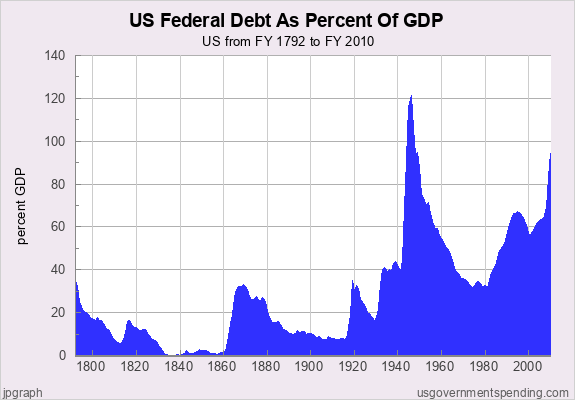 Look at the chart to the right - it tracks total US debt as a percentage of the overall economy, or GDP. During our nation's first century you'll notice a rise and fall of our debt to GDP ratio. Our debt was high after the Revolutionary War, but we slowly retired it. It grew again during the War of 1812, but we retired it, it spikes during the Civil War only to fall again.
 This spending did halt the dramatic economic declines on the early 1930s, but did not produce sustained growth. That would not occur until the build up for World War II when US debt ballooned to a rate more than twice that of GDP. Note in the next chart how economic growth peaked during the height of wartime spending. Though there was a decline in growth after the war, it was short lived and followed by a half century marked by economic expansion and brief episodes of contraction, or recession.
 The net effect of these two acts was a brief period of surpluses during the late 1990s/early 2000s (see the third graph). But this era was short lived. Congress gave into special interest pressure in 1999 and restored many of the Medicare cuts in the Medicare Balanced Budget Refinement Act of 1999. Returning to the second graph we can see a period of recession in early 2000-2002.

I am a Keynesian - I believe in government stimulus - but I cannot endorse Keynesian policies at this time because we have failed to adhere to Keynesian theory for so long. Put into the simplest of terms Keynesian economic theory tells us that government should engage in deficit spending during economic downturns in order to compensate for lax private sector activity and to spur economic growth. This can be accomplished via spending, tax cuts, or both. This aspect of Keynesian policy has been standard practice since the 1930s. Even the Reagan era policies - often derided as supply side or trickle down - were truly Keynesian. The tax cuts were financed via large federal deficits. These government financed tax cuts spurred tremendous economic growth during the 1980s.
But deficit spending only tells half the Keynesian tale. The rest of the theory holds that during times of economic growth, government must pay down the debt incurred to bring about that growth. So once an economy returns to healthy growth deficit spending must be reigned in, debt paid off. This is accomplished via spending cuts, tax increases, or a bit of both. This aspect of Keynesian economic policy has never been standard practice - rather our government (and in fact most western democracies) have instead maintained the "stimulus" policies of deficit spending even during strong economic times.
We see another spike following World War I and a steady decline just prior to the onset of the Great Depression -at which time Keynesian economic policy truly comes to America. Our prior periods of debt were caused by national crisis - War. The debt accrued during the Depression was related to an attempt to mitigate a financial crises. At the onset of the Great Depression our nations accrued debt was only 16.3% of GDP. Depression era deficit spending, or stimulus, doubled our debt ratio to post-World War I levels.
If you return to the first graph you'll see that initially we did begin to retire our debt. The US debt to GDP ratio fell dramatically during the post war economic boom. This halted during the latter part of the 1960s as economic crisis and the Vietnam War put pressure on our economy and the US budget. Our debt to GDP ratio fell to Depression-era levels, but has never since fallen below those level.
The economic expansion of the 1980s and 1990s should have been met with measures intended to retire our burgeoning debt - but those tough decisions were not made - with two exceptions. The Omnibus Budget Reconciliation Act of 1993 increased taxes. It created 36 percent and 39.6 income tax rates for individuals in the top 1.2% of the wage earners, it created a 35 percent income tax rate for corporations, the cap on Medicare taxes was repealed, and transportation fuels taxes were raised by 4.3 cents per gallon. The result was increased federal revenue and declining debt. Then in 1997, the Balanced Budget Act of 1997 trimmed hundreds of billions from the Medicare program - reducing government spending.
That recession was met with an aggressive tax reduction/stimulus plan - The Economic Growth and Tax Relief Reconciliation Act of 2001 (EGTRRA). EGTRRA reduced tax rates across the board and reduced the top rate from 39.6% to 35%. In addition, taxpayers were sent rebate checks ranging from $300 a person to $600 a couple to stimulate the economy. Economic growth returned until the current downturn.
Those 2001 tax cuts and the Medicare increases came at a high price as US deficits soared and our debt to GDP ratio began to rise again.
So we find ourselves in 2010 in the midst of a dramatic economic slowdown. Unemployment is at 9.5% and the US economy has lost 8 million jobs in the last two years. In late 2008, Congress passed the Troubled Asset Relief Program or TARP to allow the United States Department of the Treasury to purchase or insure up to $700 Billion of "troubled assets". In January of 2009 Congress passed the American Recovery and Reinvestment Act which appropriated $787 billion in tax cuts and spending. TARP and the Recovery Act were financed via deficit spending and added greatly to our debt and deficit.
Total US debt has reached 80% of GDP and is expected to surpass GDP by 2015. We are already at levels not seen since the height of World War II. The most recent economic outlook from the Congressional Budget Office looks at the share of debt held by the public, as opposed to what the government owes itself, finds that debt to GDP ratio is 62%, but "federal debt held by the public would rise... to 181 percent of GDP in 2035, and annual deficits would exceed 10 percent of GDP beginning in 2027."
Why does this matter?
If the ratio of debt to GDP continues to rise, lenders may become concerned about the financial solvency of the government and demand higher interest rates to compensate for the increasing riskiness of holding government debt. Eventually, if the debt-to-GDP ratio keeps increasing and the budget outlook does not improve, both foreign and domestic lenders may not provide enough funds for the government to meet its obligations. By then, whether the government resolves the fiscal crisis by printing money, raising taxes, cutting spending, or going into default, economic growth will be seriously disrupted.
So how does all of this come back to my current opposition to additional stimulus and more Keynesian demand side policies? Simple, we have defied Keynesian policy for over 40 years. Since the late 1960s we have continually spent beyond our means in good times and lean years. Rather than pay down the debt accrued during periods of recession, we have continued to accrue debt at an alarming rate. At the onset of the Great Depression our debt to GDP ratio was but 16% and our budget balanced. Today, we entered the Great Recession with a debt to GDP ratio of 80% and a budget habitually out of balance. Rather than stimulus, America must embrace austerity. Such austerity will cause pain, but it will be a temporary pain as we pay for the excesses of the past 4 decades. The other option is continued deficit spending and crushing debt that we will never be able to grow out from under. The choice is between short term pain with long term health (austerity) and short term relief with long term ruin (stimulus).
Subscribe to:
Posts (Atom)